A practical guide to using AI for differentiation in UK classrooms. Covers resource tiering, scaffold generation, adaptive questioning, SEND-specific adaptations, subject-by-subject approaches, and a step-by-step workflow for getting started.
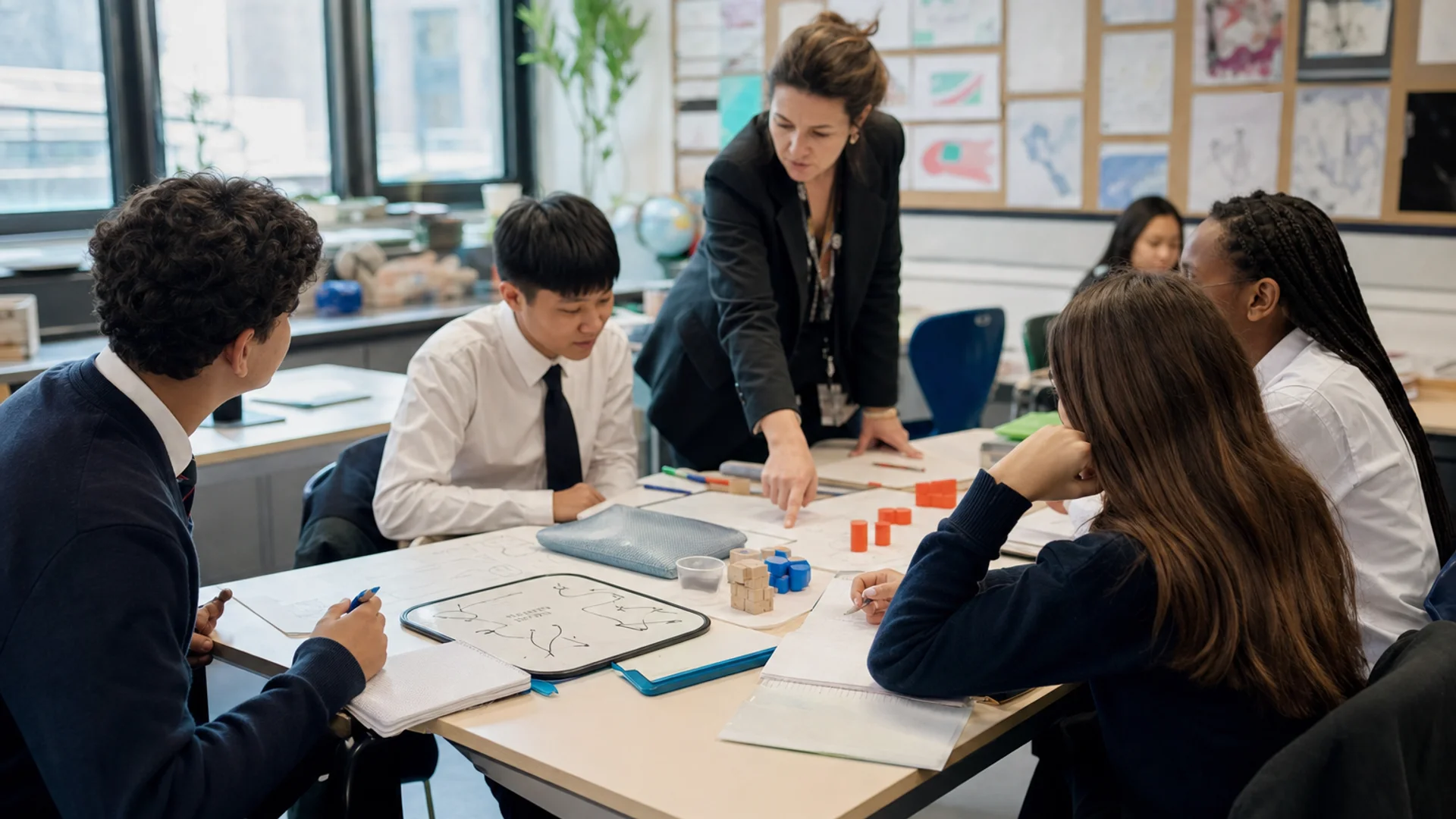
Every class is a mixed-ability class. Even when pupils are setted by prior attainment, the spread of reading ages, processing speeds, prior knowledge and motivation within a single classroom demands constant adaptation. AI tools now make some of that adaptation faster, but they do not remove the need for a teacher who understands why one pupil needs a sentence starter while another needs a constraint removed.
Key Takeaways
AI generates differentiated resources quickly: Producing three versions of a worksheet (support, core, extension) that previously took 45 minutes can now take under 5, provided you give the AI tool the right prompt.
The teacher's role shifts, not shrinks: AI handles resource production. You handle the decisions: who gets which resource, when to move a pupil between levels, and what the underlying misconception actually is.
Differentiation is not just worksheets: AI can also adapt questioning sequences, generate scaffolding prompts, and create targeted retrieval activities, all faster than manual preparation.
Start with one lesson, one class: Generate three versions of a single activity for your most familiar class. Evaluate the quality before scaling to other groups.
Research on differentiation consistently shows that adapting instruction to pupils' current understanding improves outcomes (Tomlinson, 2001). The problem has never been the principle but the workload. Creating three versions of a resource, modifying questioning for different groups, and tracking which pupils need which scaffold takes hours that most teachers do not have. AI tools address the production bottleneck without solving the pedagogical challenge underneath.
What AI Differentiation Looks Like
AI differentiation is not a separate pedagogical approach. It is the use of AI tools to accelerate the resource creation and adaptation that good differentiation already requires. The decisions remain with the teacher; the production shifts to the machine.
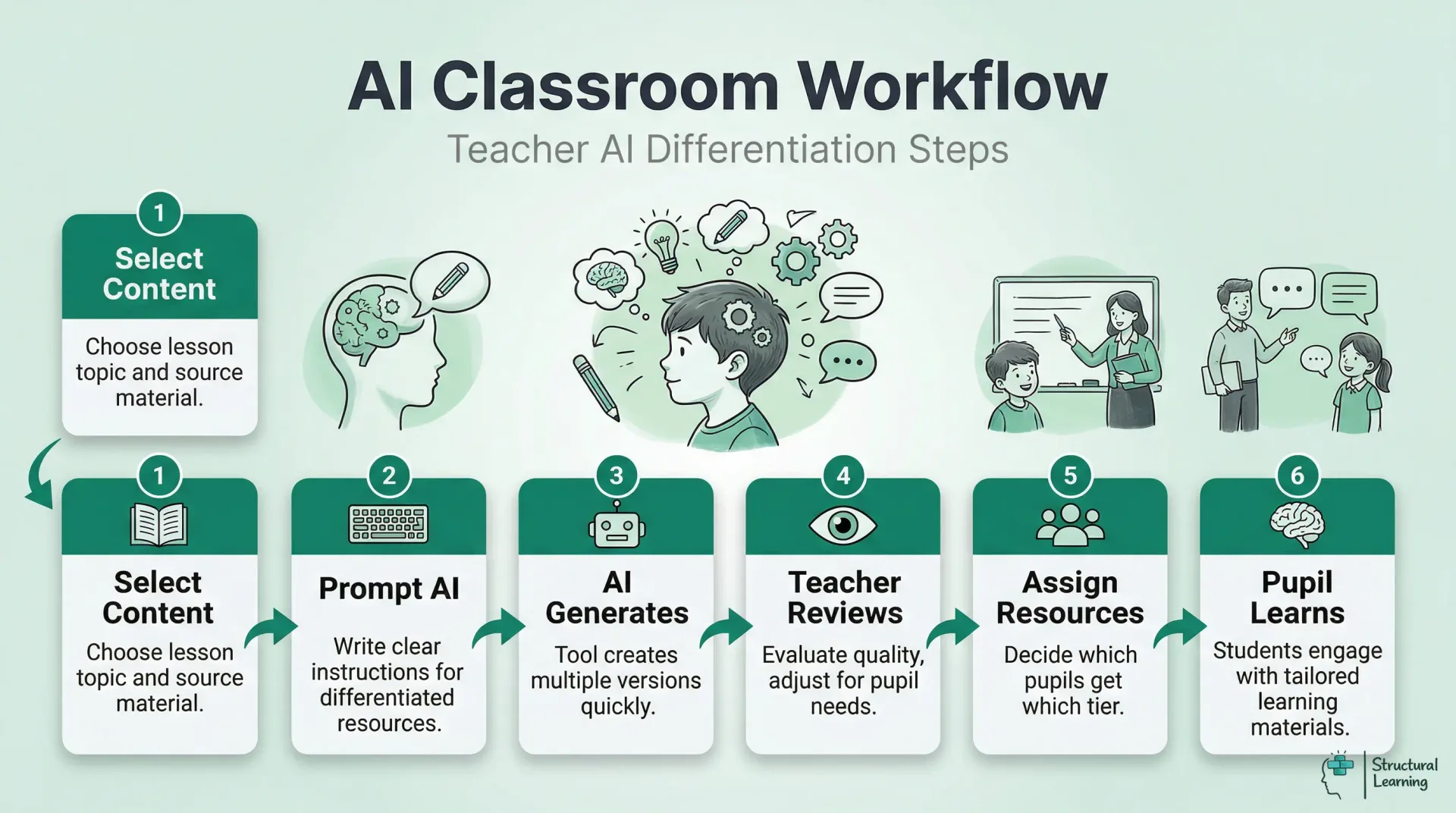
In practice, this means a Year 6 teacher preparing a reading comprehension lesson can paste the text into an AI tool and request three versions: one with simplified vocabulary and sentence starters for below-expected pupils, one at the expected standard with open questions, and one with inferential and evaluative questions for greater-depth pupils. The AI produces all three in under two minutes. The teacher then reviews each version, adjusts where needed, and decides which pupils receive which resource.
The critical distinction: the AI creates the resources. The teacher makes the assessment judgements about who needs what. These are different skills, and conflating them leads to poor differentiation regardless of the tool.
Three Models of AI Differentiation
There are three practical ways to use AI for differentiation in a typical classroom, each with different demands on teacher time and different levels of AI capability.
Model
How It Works
Teacher Time
Best For
Resource tiering
AI generates 3 versions of the same activity at different levels
5 min to prompt + 10 min to review
Worksheets, reading tasks, homework
Scaffold generation
AI creates graduated support: sentence starters, worked examples, prompt cards
Most teachers start with resource tiering because it maps directly onto existing practice. If you already create a "must, should, could" worksheet, AI simply does it faster. The scaffold and questioning models require more prompt-engineering skill but offer greater pedagogical return.
Prompting AI for Differentiation
The quality of AI-differentiated resources depends entirely on the quality of your prompt. A generic instruction like "make this easier" produces resources that are shorter but not genuinely adapted. Effective differentiation prompts include five specific elements.
Element
Why It Matters
Example
Year group and subject
Calibrates vocabulary and complexity
"Year 8 history"
Learning objective
Keeps all versions focused on the same outcome
"Explain the causes of the English Civil War"
Number of tiers
Defines how many versions you need
"Three versions: support, core, extension"
What changes between tiers
Prevents AI from just making text shorter
"Support: sentence starters and word bank. Core: open questions. Extension: source evaluation."
Format requirements
Ensures output is classroom-ready
"Fit on one A4 page per tier. Use a table for the word bank."
A Worked Example: KS3 Science
Here is a complete prompt for differentiating a Year 9 biology task:
"You are a KS3 science teacher in a UK state school. Create three versions of a worksheet on 'How the heart pumps blood around the body' for Year 9 pupils.
Support version: Use a diagram with labels for pupils to match. Include a word bank (atria, ventricles, valves, oxygenated, deoxygenated). Sentences use no more than 15 words. Four questions testing recall only.
Core version: Pupils describe the journey of blood through the heart in their own words. Include a blank diagram for labelling. Six questions mixing recall and explanation.
Extension version: Pupils explain what happens when a heart valve fails and predict the consequences. Include a data table of resting vs exercising heart rates for analysis. Four questions requiring evaluation."
This prompt produces three genuinely different resources in under two minutes. The key is specifying what changes between tiers, not just the difficulty label.
Differentiation by Subject
The application of AI differentiation varies across the curriculum because different subjects demand different types of adaptation. A Year 5 maths lesson and a Year 10 English lesson require fundamentally different approaches to scaffolding.
English
AI is particularly effective at generating graduated writing scaffolds. For a Year 7 creative writing task, you can prompt the AI to produce: a story map with sentence starters for lower-attaining pupils, a structure strip with paragraph prompts for middle-attaining pupils, and a constraints-based challenge (write the story in exactly 250 words, or from a secondary character's perspective) for higher-attaining pupils. The same narrative content, three different entry points.
For reading comprehension, AI can generate questions at different depths from the same text. Lower-attaining pupils get retrieval questions ("Find two words that describe the forest"). Middle-attaining pupils get inference questions ("Why does the character hesitate?"). Higher-attaining pupils get evaluative questions ("How does the writer create a sense of unease? Support your answer with evidence from the text").
Mathematics
Maths differentiation through AI works best at the task level. You can paste a set of core problems and ask the AI to generate a scaffolded version (with worked examples and part-completed solutions), a core version (the original problems), and an extension version (applying the same concept to unfamiliar contexts or multi-step problems). Tools like Diffit and TeacherMatic can do this automatically from a topic name.
The trap in maths differentiation is reducing the cognitive demand rather than providing access to it. A scaffolded version should still require pupils to think; it should remove unnecessary barriers (reading load, working memory demands) while preserving the mathematical reasoning. AI tools default to making problems easier. Prompt them to make problems more accessible instead.
Science
Science differentiation benefits from AI's ability to generate multiple representations of the same concept. For a Year 8 lesson on photosynthesis, AI can produce: a labelled diagram with fill-in-the-gaps for lower-attaining pupils, a written explanation task with key vocabulary highlighted for middle-attaining pupils, and an experimental design challenge ("How would you test whether light intensity affects the rate of photosynthesis?") for higher-attaining pupils. All three address the same concept but through different cognitive demands.
Humanities
In history, geography and RE, differentiation often centres on source material and question complexity. AI can rewrite a primary source at a lower reading age while preserving its key content, generate guided analysis questions for less confident pupils, and create evaluation frameworks for more able pupils. For a Year 9 geography lesson on climate change, the same data set can be accompanied by three different task sheets: one asking pupils to read the data (support), one asking them to identify trends (core), and one asking them to evaluate the reliability of the data source (extension).
Primary
In primary classrooms, AI differentiation often focuses on reading level adaptation. A Year 3 class reading about the Great Fire of London can receive the same historical content at three reading ages. The AI adjusts sentence length, vocabulary complexity and the number of ideas per paragraph without changing the core historical facts. This allows mixed-ability guided reading where every pupil engages with the same topic at an appropriate level.
For maths, primary teachers use AI to generate concrete-pictorial-abstract progressions. The AI produces visual representations (pictorial stage) alongside abstract number sentences, allowing pupils at different stages of mathematical development to work on the same learning objective.
AI Differentiation for SEND
Pupils with special educational needs and disabilities benefit significantly from AI-generated adapted resources, but the adaptation must be specific to the need. "Making it easier" is not differentiation for SEND; creating resources that account for specific processing requirements is.
SEND Need
AI Adaptation
Prompt Instruction
Dyslexia
Simplified sentence structure, larger text prompts, sans-serif font specification
"Rewrite using sentences under 12 words. Avoid dense paragraphs. Use bullet points where possible."
ADHD
Chunked tasks with clear checkpoints, visual progress markers
"Break this into 5 short tasks of 3-4 minutes each. Add a checkbox before each task."
"Add a visual cue beside each key term. Use colour coding: who (orange), what doing (yellow), what (green)."
Dyscalculia
Concrete examples before abstract, number line scaffolds, reduced number of problems
"Start each problem with a real-world context. Include a number line. Reduce to 5 problems instead of 10."
EAL
Bilingual glossaries, visual vocabulary, simplified instruction language
"Create a glossary of 10 key terms with simple English definitions and space for home language translation."
The 2024 DfE survey found that 57% of SEND teachers already use AI tools for creating adapted resources, making this the fastest-growing area of AI adoption in UK schools (DfE, 2024). The advantage is clear: a teaching assistant who previously spent 30 minutes adapting a single worksheet can now generate SEND-appropriate versions in minutes, freeing time for direct pupil support.
For a deeper look at AI tools matched to specific SEND needs, see our guide to AI in special education.
Adaptive Learning Platforms
Beyond teacher-prompted differentiation, several platforms offer real-time adaptive learning where the AI adjusts difficulty based on pupil responses. These work differently from manual differentiation because the AI makes the adaptation decisions, not the teacher.
Personalised homework paths based on class teaching
Teacher sets topic; AI adjusts question difficulty
Tassomai
Science (primarily)
Daily quiz with algorithm-driven focus areas
Limited; AI determines revision priorities
Diffit
Cross-curricular reading
Adapts text reading level; generates tiered activities
Teacher chooses text and target levels
These platforms are useful for homework and independent practice where real-time teacher adjustment is not possible. During lessons, teacher-led differentiation using AI-generated resources remains more responsive because you can read the room in ways an algorithm cannot. A pupil's body language, their willingness to ask questions, and their interaction with peers all inform differentiation decisions that no platform can make.
Avoiding Common AI Differentiation Mistakes
The speed of AI resource generation creates new risks that did not exist when differentiation was entirely manual.
1. Differentiating down, not across. The default AI behaviour when asked to "simplify" is to remove content. This produces a support version that covers less curriculum rather than providing a different route to the same learning. Always specify that all tiers must address the same learning objective. The support version should scaffold access to the learning, not reduce the learning itself.
2. Over-differentiating. Producing five tiers of a worksheet when two would suffice creates management overhead without pedagogical benefit. In most lessons, three versions (support, core, extension) are sufficient. More tiers means more decisions about who receives what, more resources to monitor, and more complexity to manage during the lesson.
3. Static grouping. Using AI to generate differentiated resources makes it tempting to assign pupils permanently to a tier. "Jamie always gets the support sheet." This contradicts what we know about the zone of proximal development (Vygotsky, 1978). Pupils should move between tiers based on their current understanding of the specific topic, not a fixed label. Use AI-generated resources flexibly, not as a tracking system.
4. Neglecting the extension group. AI tools are much better at simplifying than extending. When you prompt for an "extension" version, the AI often produces more of the same rather than something qualitatively different. For genuine extension, specify what higher-order thinking looks like: analysis, evaluation, creation, transfer to new contexts. Higher-order thinking requires deliberate prompt design.
5. Skipping the review. AI-generated differentiated resources are drafts, not finished products. A support version may use vocabulary that is still too complex. An extension version may include content beyond the curriculum. Five minutes of teacher review catches errors that would take 20 minutes to unpick during the lesson.
AI Differentiation and Rosenshine's Principles
AI-assisted differentiation maps directly onto several of Rosenshine's principles of instruction (Rosenshine, 2012). Understanding these connections helps you use AI tools more effectively rather than treating them as separate from your existing pedagogy.
Principle 1 (Daily review): AI generates differentiated retrieval practice questions at three levels. Lower-attaining pupils recall key facts. Middle-attaining pupils explain connections. Higher-attaining pupils apply knowledge to new scenarios. All three groups engage with the same prior learning, but the cognitive demand scales appropriately.
Principle 6 (Check for understanding): AI creates tiered exit tickets that assess the same learning objective at different depths. This gives you diagnostic data on every pupil, not just the pupils who put their hands up.
Principle 10 (Weekly and monthly review): AI generates personalised revision materials based on which topics each pupil found most difficult. Rather than a generic revision sheet, each pupil receives a set of questions targeting their specific gaps. Platforms like Seneca and Carousel Learning do this automatically.
The principle is simple: AI handles the production of differentiated materials. Rosenshine's framework tells you when and how to deploy them. The combination of research-informed timing and AI-powered resource creation is more effective than either approach alone.
A Practical Weekly Workflow
Here is a workflow that integrates AI differentiation into weekly planning without adding hours to your preparation time.
When
AI Task
Teacher Task
Sunday evening (15 min)
Generate tiered resources for 3 key lessons
Review outputs, adjust tier assignments based on last week's data
Before each lesson (5 min)
Generate differentiated starter questions
Decide which pupils need which tier today
During the lesson
N/A (resources already prepared)
Circulate, adjust scaffolding live, move pupils between tiers
After the lesson (5 min)
Auto-mark exit tickets
Note which pupils need tier adjustments for next lesson
Friday (10 min)
Generate personalised revision based on the week's data
Review revision materials, send home as weekend homework
Total additional AI time: approximately 40 minutes per week. Total time saved on manual resource creation: approximately 2-3 hours per week. The net gain is not just time but quality. Resources that would have been a single worksheet for the whole class become three purposeful versions that genuinely meet different needs.
Getting Started: Your First Lesson
Choose one lesson with a class you know well. Select a task you would normally give to everyone as the same worksheet. Open ChatGPT, Claude, or Diffit and use this template:
"I am teaching [subject] to [year group]. The learning objective is [objective]. Create three versions of a [task type]:
Support: [specific scaffold type, e.g., sentence starters, word bank, part-completed answers]
Core: [the standard task with open questions]
Extension: [higher-order challenge, e.g., evaluate, compare, apply to new context]
All three versions must address the same learning objective. Format each to fit on one A4 page."
Review the output. Print the three versions. Distribute based on your assessment of where each pupil is with this specific topic. After the lesson, note what worked and what needed adjusting. That single lesson gives you enough information to decide whether AI differentiation is worth scaling across your teaching.
For a broader guide to AI tools in the classroom, see our hub article on AI for teachers. For assessment-focused differentiation, see AI marking and feedback. And for specific approaches to managing mixed-ability groups, see our complete guide to differentiation strategies.
Further Reading
Further Reading: Key Research on Differentiation
The evidence base for differentiation is well established, and recent research is beginning to address AI-assisted approaches specifically.
How to Differentiate Instruction in Academically Diverse ClassroomsView study ↗ 8,200+ citations
Tomlinson (2001)
The foundational text on differentiated instruction. Tomlinson's framework of differentiating content, process and product provides the conceptual basis for understanding where AI tools fit into classroom practice. Her emphasis on readiness, interest and learning profile as the three drivers of differentiation remains the standard model.
Mind in Society: The Development of Higher Psychological ProcessesView study ↗ 74,000+ citations
Vygotsky (1978)
The original source for the zone of proximal development, which underpins all differentiation theory. Vygotsky's argument that learning leads development (not the reverse) provides the rationale for scaffolding and graduated support, the very things AI differentiation tools now produce at scale.
Principles of Instruction: Research-Based Strategies That All Teachers Should KnowView study ↗ 3,600+ citations
Rosenshine (2012)
The ten principles provide a research-validated structure for effective instruction, several of which directly involve differentiation (checking for understanding, providing scaffolds, independent practice). This article shows how AI tools can support each principle through automated resource generation.
ChatGPT for Good? On Opportunities and Challenges of Large Language Models for EducationView study ↗ 2,800+ citations
Kasneci et al. (2023)
Comprehensive analysis of large language models in education, including their potential for personalised learning and adaptive content generation. Particularly relevant for understanding the technical capabilities and limitations of AI-generated differentiated materials.
Generative Artificial Intelligence in EducationView study ↗ DfE Official Guidance
Department for Education (2025)
The UK government's position on AI use in schools, with specific sections on personalised learning and differentiation. Includes expectations for school AI policies, data protection when using AI with pupil data, and the balance between AI-generated and teacher-created resources.
Every class is a mixed-ability class. Even when pupils are setted by prior attainment, the spread of reading ages, processing speeds, prior knowledge and motivation within a single classroom demands constant adaptation. AI tools now make some of that adaptation faster, but they do not remove the need for a teacher who understands why one pupil needs a sentence starter while another needs a constraint removed.
Key Takeaways
AI generates differentiated resources quickly: Producing three versions of a worksheet (support, core, extension) that previously took 45 minutes can now take under 5, provided you give the AI tool the right prompt.
The teacher's role shifts, not shrinks: AI handles resource production. You handle the decisions: who gets which resource, when to move a pupil between levels, and what the underlying misconception actually is.
Differentiation is not just worksheets: AI can also adapt questioning sequences, generate scaffolding prompts, and create targeted retrieval activities, all faster than manual preparation.
Start with one lesson, one class: Generate three versions of a single activity for your most familiar class. Evaluate the quality before scaling to other groups.
Research on differentiation consistently shows that adapting instruction to pupils' current understanding improves outcomes (Tomlinson, 2001). The problem has never been the principle but the workload. Creating three versions of a resource, modifying questioning for different groups, and tracking which pupils need which scaffold takes hours that most teachers do not have. AI tools address the production bottleneck without solving the pedagogical challenge underneath.
What AI Differentiation Looks Like
AI differentiation is not a separate pedagogical approach. It is the use of AI tools to accelerate the resource creation and adaptation that good differentiation already requires. The decisions remain with the teacher; the production shifts to the machine.
In practice, this means a Year 6 teacher preparing a reading comprehension lesson can paste the text into an AI tool and request three versions: one with simplified vocabulary and sentence starters for below-expected pupils, one at the expected standard with open questions, and one with inferential and evaluative questions for greater-depth pupils. The AI produces all three in under two minutes. The teacher then reviews each version, adjusts where needed, and decides which pupils receive which resource.
The critical distinction: the AI creates the resources. The teacher makes the assessment judgements about who needs what. These are different skills, and conflating them leads to poor differentiation regardless of the tool.
Three Models of AI Differentiation
There are three practical ways to use AI for differentiation in a typical classroom, each with different demands on teacher time and different levels of AI capability.
Model
How It Works
Teacher Time
Best For
Resource tiering
AI generates 3 versions of the same activity at different levels
5 min to prompt + 10 min to review
Worksheets, reading tasks, homework
Scaffold generation
AI creates graduated support: sentence starters, worked examples, prompt cards
Most teachers start with resource tiering because it maps directly onto existing practice. If you already create a "must, should, could" worksheet, AI simply does it faster. The scaffold and questioning models require more prompt-engineering skill but offer greater pedagogical return.
Prompting AI for Differentiation
The quality of AI-differentiated resources depends entirely on the quality of your prompt. A generic instruction like "make this easier" produces resources that are shorter but not genuinely adapted. Effective differentiation prompts include five specific elements.
Element
Why It Matters
Example
Year group and subject
Calibrates vocabulary and complexity
"Year 8 history"
Learning objective
Keeps all versions focused on the same outcome
"Explain the causes of the English Civil War"
Number of tiers
Defines how many versions you need
"Three versions: support, core, extension"
What changes between tiers
Prevents AI from just making text shorter
"Support: sentence starters and word bank. Core: open questions. Extension: source evaluation."
Format requirements
Ensures output is classroom-ready
"Fit on one A4 page per tier. Use a table for the word bank."
A Worked Example: KS3 Science
Here is a complete prompt for differentiating a Year 9 biology task:
"You are a KS3 science teacher in a UK state school. Create three versions of a worksheet on 'How the heart pumps blood around the body' for Year 9 pupils.
Support version: Use a diagram with labels for pupils to match. Include a word bank (atria, ventricles, valves, oxygenated, deoxygenated). Sentences use no more than 15 words. Four questions testing recall only.
Core version: Pupils describe the journey of blood through the heart in their own words. Include a blank diagram for labelling. Six questions mixing recall and explanation.
Extension version: Pupils explain what happens when a heart valve fails and predict the consequences. Include a data table of resting vs exercising heart rates for analysis. Four questions requiring evaluation."
This prompt produces three genuinely different resources in under two minutes. The key is specifying what changes between tiers, not just the difficulty label.
Differentiation by Subject
The application of AI differentiation varies across the curriculum because different subjects demand different types of adaptation. A Year 5 maths lesson and a Year 10 English lesson require fundamentally different approaches to scaffolding.
English
AI is particularly effective at generating graduated writing scaffolds. For a Year 7 creative writing task, you can prompt the AI to produce: a story map with sentence starters for lower-attaining pupils, a structure strip with paragraph prompts for middle-attaining pupils, and a constraints-based challenge (write the story in exactly 250 words, or from a secondary character's perspective) for higher-attaining pupils. The same narrative content, three different entry points.
For reading comprehension, AI can generate questions at different depths from the same text. Lower-attaining pupils get retrieval questions ("Find two words that describe the forest"). Middle-attaining pupils get inference questions ("Why does the character hesitate?"). Higher-attaining pupils get evaluative questions ("How does the writer create a sense of unease? Support your answer with evidence from the text").
Mathematics
Maths differentiation through AI works best at the task level. You can paste a set of core problems and ask the AI to generate a scaffolded version (with worked examples and part-completed solutions), a core version (the original problems), and an extension version (applying the same concept to unfamiliar contexts or multi-step problems). Tools like Diffit and TeacherMatic can do this automatically from a topic name.
The trap in maths differentiation is reducing the cognitive demand rather than providing access to it. A scaffolded version should still require pupils to think; it should remove unnecessary barriers (reading load, working memory demands) while preserving the mathematical reasoning. AI tools default to making problems easier. Prompt them to make problems more accessible instead.
Science
Science differentiation benefits from AI's ability to generate multiple representations of the same concept. For a Year 8 lesson on photosynthesis, AI can produce: a labelled diagram with fill-in-the-gaps for lower-attaining pupils, a written explanation task with key vocabulary highlighted for middle-attaining pupils, and an experimental design challenge ("How would you test whether light intensity affects the rate of photosynthesis?") for higher-attaining pupils. All three address the same concept but through different cognitive demands.
Humanities
In history, geography and RE, differentiation often centres on source material and question complexity. AI can rewrite a primary source at a lower reading age while preserving its key content, generate guided analysis questions for less confident pupils, and create evaluation frameworks for more able pupils. For a Year 9 geography lesson on climate change, the same data set can be accompanied by three different task sheets: one asking pupils to read the data (support), one asking them to identify trends (core), and one asking them to evaluate the reliability of the data source (extension).
Primary
In primary classrooms, AI differentiation often focuses on reading level adaptation. A Year 3 class reading about the Great Fire of London can receive the same historical content at three reading ages. The AI adjusts sentence length, vocabulary complexity and the number of ideas per paragraph without changing the core historical facts. This allows mixed-ability guided reading where every pupil engages with the same topic at an appropriate level.
For maths, primary teachers use AI to generate concrete-pictorial-abstract progressions. The AI produces visual representations (pictorial stage) alongside abstract number sentences, allowing pupils at different stages of mathematical development to work on the same learning objective.
AI Differentiation for SEND
Pupils with special educational needs and disabilities benefit significantly from AI-generated adapted resources, but the adaptation must be specific to the need. "Making it easier" is not differentiation for SEND; creating resources that account for specific processing requirements is.
SEND Need
AI Adaptation
Prompt Instruction
Dyslexia
Simplified sentence structure, larger text prompts, sans-serif font specification
"Rewrite using sentences under 12 words. Avoid dense paragraphs. Use bullet points where possible."
ADHD
Chunked tasks with clear checkpoints, visual progress markers
"Break this into 5 short tasks of 3-4 minutes each. Add a checkbox before each task."
"Add a visual cue beside each key term. Use colour coding: who (orange), what doing (yellow), what (green)."
Dyscalculia
Concrete examples before abstract, number line scaffolds, reduced number of problems
"Start each problem with a real-world context. Include a number line. Reduce to 5 problems instead of 10."
EAL
Bilingual glossaries, visual vocabulary, simplified instruction language
"Create a glossary of 10 key terms with simple English definitions and space for home language translation."
The 2024 DfE survey found that 57% of SEND teachers already use AI tools for creating adapted resources, making this the fastest-growing area of AI adoption in UK schools (DfE, 2024). The advantage is clear: a teaching assistant who previously spent 30 minutes adapting a single worksheet can now generate SEND-appropriate versions in minutes, freeing time for direct pupil support.
For a deeper look at AI tools matched to specific SEND needs, see our guide to AI in special education.
Adaptive Learning Platforms
Beyond teacher-prompted differentiation, several platforms offer real-time adaptive learning where the AI adjusts difficulty based on pupil responses. These work differently from manual differentiation because the AI makes the adaptation decisions, not the teacher.
Personalised homework paths based on class teaching
Teacher sets topic; AI adjusts question difficulty
Tassomai
Science (primarily)
Daily quiz with algorithm-driven focus areas
Limited; AI determines revision priorities
Diffit
Cross-curricular reading
Adapts text reading level; generates tiered activities
Teacher chooses text and target levels
These platforms are useful for homework and independent practice where real-time teacher adjustment is not possible. During lessons, teacher-led differentiation using AI-generated resources remains more responsive because you can read the room in ways an algorithm cannot. A pupil's body language, their willingness to ask questions, and their interaction with peers all inform differentiation decisions that no platform can make.
Avoiding Common AI Differentiation Mistakes
The speed of AI resource generation creates new risks that did not exist when differentiation was entirely manual.
1. Differentiating down, not across. The default AI behaviour when asked to "simplify" is to remove content. This produces a support version that covers less curriculum rather than providing a different route to the same learning. Always specify that all tiers must address the same learning objective. The support version should scaffold access to the learning, not reduce the learning itself.
2. Over-differentiating. Producing five tiers of a worksheet when two would suffice creates management overhead without pedagogical benefit. In most lessons, three versions (support, core, extension) are sufficient. More tiers means more decisions about who receives what, more resources to monitor, and more complexity to manage during the lesson.
3. Static grouping. Using AI to generate differentiated resources makes it tempting to assign pupils permanently to a tier. "Jamie always gets the support sheet." This contradicts what we know about the zone of proximal development (Vygotsky, 1978). Pupils should move between tiers based on their current understanding of the specific topic, not a fixed label. Use AI-generated resources flexibly, not as a tracking system.
4. Neglecting the extension group. AI tools are much better at simplifying than extending. When you prompt for an "extension" version, the AI often produces more of the same rather than something qualitatively different. For genuine extension, specify what higher-order thinking looks like: analysis, evaluation, creation, transfer to new contexts. Higher-order thinking requires deliberate prompt design.
5. Skipping the review. AI-generated differentiated resources are drafts, not finished products. A support version may use vocabulary that is still too complex. An extension version may include content beyond the curriculum. Five minutes of teacher review catches errors that would take 20 minutes to unpick during the lesson.
AI Differentiation and Rosenshine's Principles
AI-assisted differentiation maps directly onto several of Rosenshine's principles of instruction (Rosenshine, 2012). Understanding these connections helps you use AI tools more effectively rather than treating them as separate from your existing pedagogy.
Principle 1 (Daily review): AI generates differentiated retrieval practice questions at three levels. Lower-attaining pupils recall key facts. Middle-attaining pupils explain connections. Higher-attaining pupils apply knowledge to new scenarios. All three groups engage with the same prior learning, but the cognitive demand scales appropriately.
Principle 6 (Check for understanding): AI creates tiered exit tickets that assess the same learning objective at different depths. This gives you diagnostic data on every pupil, not just the pupils who put their hands up.
Principle 10 (Weekly and monthly review): AI generates personalised revision materials based on which topics each pupil found most difficult. Rather than a generic revision sheet, each pupil receives a set of questions targeting their specific gaps. Platforms like Seneca and Carousel Learning do this automatically.
The principle is simple: AI handles the production of differentiated materials. Rosenshine's framework tells you when and how to deploy them. The combination of research-informed timing and AI-powered resource creation is more effective than either approach alone.
A Practical Weekly Workflow
Here is a workflow that integrates AI differentiation into weekly planning without adding hours to your preparation time.
When
AI Task
Teacher Task
Sunday evening (15 min)
Generate tiered resources for 3 key lessons
Review outputs, adjust tier assignments based on last week's data
Before each lesson (5 min)
Generate differentiated starter questions
Decide which pupils need which tier today
During the lesson
N/A (resources already prepared)
Circulate, adjust scaffolding live, move pupils between tiers
After the lesson (5 min)
Auto-mark exit tickets
Note which pupils need tier adjustments for next lesson
Friday (10 min)
Generate personalised revision based on the week's data
Review revision materials, send home as weekend homework
Total additional AI time: approximately 40 minutes per week. Total time saved on manual resource creation: approximately 2-3 hours per week. The net gain is not just time but quality. Resources that would have been a single worksheet for the whole class become three purposeful versions that genuinely meet different needs.
Getting Started: Your First Lesson
Choose one lesson with a class you know well. Select a task you would normally give to everyone as the same worksheet. Open ChatGPT, Claude, or Diffit and use this template:
"I am teaching [subject] to [year group]. The learning objective is [objective]. Create three versions of a [task type]:
Support: [specific scaffold type, e.g., sentence starters, word bank, part-completed answers]
Core: [the standard task with open questions]
Extension: [higher-order challenge, e.g., evaluate, compare, apply to new context]
All three versions must address the same learning objective. Format each to fit on one A4 page."
Review the output. Print the three versions. Distribute based on your assessment of where each pupil is with this specific topic. After the lesson, note what worked and what needed adjusting. That single lesson gives you enough information to decide whether AI differentiation is worth scaling across your teaching.
For a broader guide to AI tools in the classroom, see our hub article on AI for teachers. For assessment-focused differentiation, see AI marking and feedback. And for specific approaches to managing mixed-ability groups, see our complete guide to differentiation strategies.
Further Reading
Further Reading: Key Research on Differentiation
The evidence base for differentiation is well established, and recent research is beginning to address AI-assisted approaches specifically.
How to Differentiate Instruction in Academically Diverse ClassroomsView study ↗ 8,200+ citations
Tomlinson (2001)
The foundational text on differentiated instruction. Tomlinson's framework of differentiating content, process and product provides the conceptual basis for understanding where AI tools fit into classroom practice. Her emphasis on readiness, interest and learning profile as the three drivers of differentiation remains the standard model.
Mind in Society: The Development of Higher Psychological ProcessesView study ↗ 74,000+ citations
Vygotsky (1978)
The original source for the zone of proximal development, which underpins all differentiation theory. Vygotsky's argument that learning leads development (not the reverse) provides the rationale for scaffolding and graduated support, the very things AI differentiation tools now produce at scale.
Principles of Instruction: Research-Based Strategies That All Teachers Should KnowView study ↗ 3,600+ citations
Rosenshine (2012)
The ten principles provide a research-validated structure for effective instruction, several of which directly involve differentiation (checking for understanding, providing scaffolds, independent practice). This article shows how AI tools can support each principle through automated resource generation.
ChatGPT for Good? On Opportunities and Challenges of Large Language Models for EducationView study ↗ 2,800+ citations
Kasneci et al. (2023)
Comprehensive analysis of large language models in education, including their potential for personalised learning and adaptive content generation. Particularly relevant for understanding the technical capabilities and limitations of AI-generated differentiated materials.
Generative Artificial Intelligence in EducationView study ↗ DfE Official Guidance
Department for Education (2025)
The UK government's position on AI use in schools, with specific sections on personalised learning and differentiation. Includes expectations for school AI policies, data protection when using AI with pupil data, and the balance between AI-generated and teacher-created resources.
{"@context":"https://schema.org","@graph":[{"@type":"Article","headline":"AI Differentiation in the Classroom: A Teacher's Guide","description":"A practical guide to using AI for differentiation in UK classrooms. Covers resource tiering, scaffold generation, adaptive questioning, SEND-specific adaptations, and a step-by-step workflow.","datePublished":"2026-02-19T16:17:43.718Z","dateModified":"2026-02-19T16:17:43.719Z","author":{"@type":"Person","name":"Paul Main","jobTitle":"Founder & Educational Consultant"},"publisher":{"@type":"Organization","name":"Structural Learning","logo":{"@type":"ImageObject","url":"https://assets-global.website-files.com/63316a087abe0105c6171382/63316a087abe01f540171755_Structural-Learning-Logo.png"}},"wordCount":3080},{"@type":"BreadcrumbList","itemListElement":[{"@type":"ListItem","position":1,"name":"Home","item":"https://www.structural-learning.com/"},{"@type":"ListItem","position":2,"name":"Blog","item":"https://www.structural-learning.com/blog"},{"@type":"ListItem","position":3,"name":"AI Differentiation in the Classroom","item":"https://www.structural-learning.com/post/ai-differentiation-in-the-classroom"}]}]}