Updated on
September 18, 2026
Working Wall Examples: Maths, English, EYFS and KS2
Working wall examples with photographs for maths, English and EYFS, what teachers do with the wall week by week, a planner mini app and a printable A4 plan.

Updated on
September 18, 2026
Working wall examples with photographs for maths, English and EYFS, what teachers do with the wall week by week, a planner mini app and a printable A4 plan.
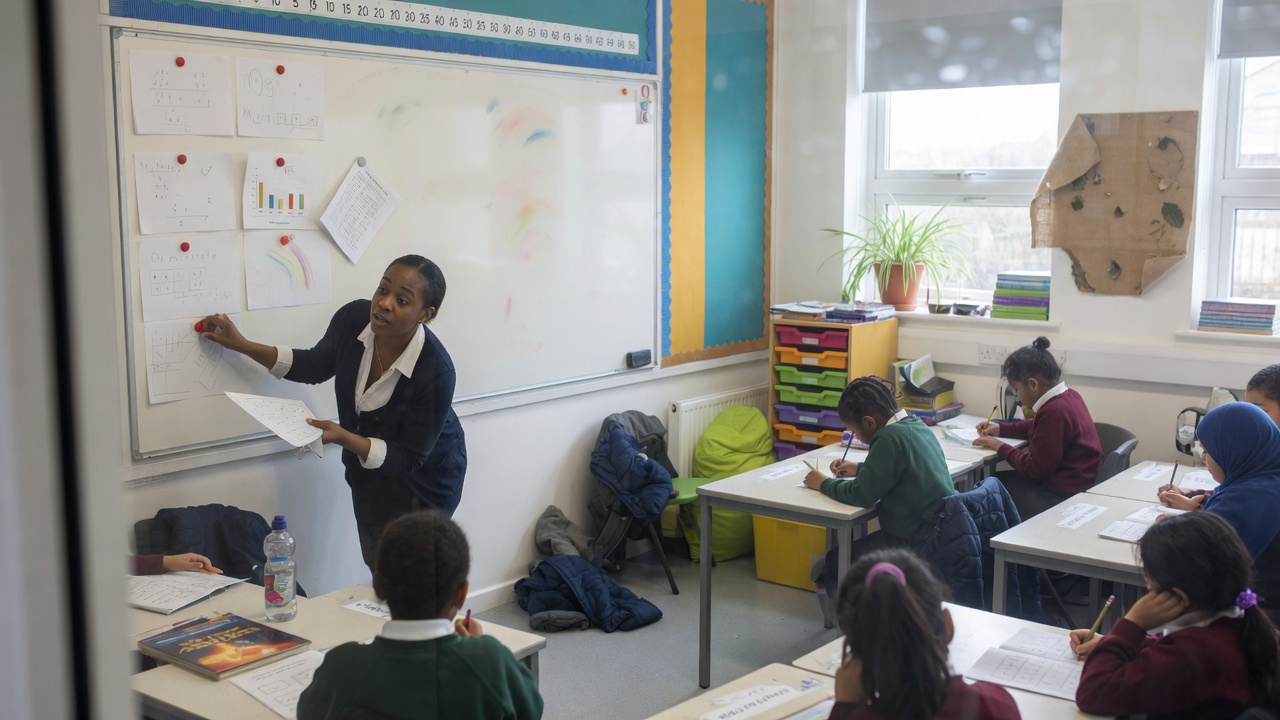
A working wall is a classroom display that is built during a unit of work rather than after it: the current model, the vocabulary, the steps and the class's own jottings go up as they are taught, and the wall comes down when the unit ends. It differs from a display of finished work because it is unfinished on purpose, and because the teacher and the learners use it in the lesson rather than look at it from across the room.
TThis page gives you examples of working walls by subject and phase, from Reception to Year 6 with a note on secondary. It also gives you the moves that make a wall work, the objections in teachers' own words, what the research on classroom displays does and does not say, and the one sentence Ofsted has ever written about displays. It sits beside our evidence-led guide to classroom display, which covers the research on clutter and cognitive load in more depth; this page is the examples.
AA working wall is a display that changes as a unit progresses, and its content is produced in lessons: the flipchart from the shared write, the photocopied whiteboard, the sticky notes with the class's adjectives on them, the worked calculation from Tuesday, the vocabulary the class met on Thursday. It is usually one board, sometimes a whiteboard, belonging to one subject at a time, nearly empty at the start of a unit and a full record of it by the end.
It is not a display of finished work, which stays up for a term; not a poster pack, which is printed before the learning and says the same thing whatever the class did; and not a knowledge organiser pinned up, which is a reference sheet rather than a record of the work.
TThe distinction matters because the words get used loosely. The most-read post in our September 2026 listen to UK teachers on X was an assistant head drawing the line hard: a working wall changes daily, it's scraps of paper, it's post it notes, it's photocopied whiteboards, it's sheets of flip chart paper
(@Ria1984, 18 October 2025). A teacher of the deaf pushed back: her laminated key-word cards with the BSL signs get used constantly in lessons
(@RuncieN, 19 October 2025), which by the purist's test makes them a display.
Each example is a composite of walls UK teachers photographed and described on X between September 2024 and September 2026, redrawn in words rather than reproduced. The three columns are the ones other guides leave out: what is on the wall, what the teacher does with it, what the learners do with it.
Six routines teachers described on social media. Each row is a named classroom: the whiteboard as the wall, the blank Monday board, the card a child takes, the lab coat, the Word Jail, and the low-sensory wall. The evidence column is a fetched page, not the post.
| Routine, as teachers describe it | What you would notice | What the evidence says |
|---|---|---|
| Whiteboard as the wall reported practice Use the class whiteboard as the working wall so the small step, the representation and a jotting go up during the lesson, not after it. |
A dated board, half full. Marker on the ledge. Learning added in the moment in a Year 3 room. | EEF Improving Mathematics in Key Stages 2 and 3, 2022 update, Recommendation 2 (page fetched): choose a manipulative or representation for the specific mathematics, and treat it as a temporary scaffold that comes off once independence is there. This post is one Year 3 whiteboard, not a trial of that recommendation. |
| Blank board, new writing week reported practice Start the writing week with a nearly empty lined board. Fill it the next day with vocabulary and sentence starters the class actually met. |
A blank working wall on Monday in Year 6. Discussion writing named. The wall has room left. | HFL Education, English working wall: steps to success (page fetched 17 Sep 2026): working walls should be interactive, and resources are most effective when created and added in the English lesson with the class. A board that arrives full has nothing left to add. Not a trial of this Year 6 room. |
| Take the vocabulary card reported practice Put vocabulary at child height so a Reception learner can take a card, copy the word, and put it back. |
A card missing from a Velcro strip. A child at the wall during writing, then back at the table. | Godwin and Fisher (2026), Mind, Brain, and Education, DOI 10.1111/mbe.70040 (abstract fetched): US kindergarten children encoded wall displays more accurately the more time they spent off-task, and then scored worse on the lesson. Sending a learner to fetch a named card is a different move from hoping they look. This Reception post is not that experiment. |
| Word Jail for misspellings reported practice Leave an empty hessian pocket. Pin common misspellings and overused words as they appear. Take a word out when the class has stopped using it.
|
A pocket that fills and empties. The wall is ready in September because it is empty. | Barrett, Davies, Zhang and Barrett (2015), Building and Environment, DOI 10.1016/j.buildenv.2015.02.013, via Barrett’s Teacher Magazine interview (page fetched): keep displays turning over so the walls do not clutter, and give every learner a chance to have work up. A pocket that empties is that turnover. Not a trial of Word Jail. |
| Shared lab coat for science words reported practice The whole school adds scientific terms to one coat on the working wall, instead of a printed word bank that never moves.
|
A coat that fills term by term. New words in different hands. | Barrett in Teacher Magazine (fetched): a class project that joins individual work into one display the class owns together can deepen impact. A lab coat is that shape. It is not a study of science vocabulary, and it is not a working wall trial. |
| Low-sensory walls, shop-front corridors reported practice Split the building: classroom walls stay as low-sensory working walls; corridors take the showcase displays.
|
Calm rooms. About thirty corridor showcases. The working wall is not the school’s shop front. | Barrett in Teacher Magazine (fetched) describes schools placing displays outside the classroom door so belonging starts at the entrance, and prioritising daylight over covering windows. A corridor showcase is that split. It is not evidence that Ofsted requires either wall. The 2025 toolkit page does not name them. |
| Not found in the posts we read. No UK secondary, KS3, Year 7 to 9 or GCSE teacher describing a working wall. No post pairing the letters WAGOLL with a working wall. No UK teacher using the phrase nobody looks. No Ofsted post that named a working wall as a requirement. US classroom teachers did not call the practice a working wall; they said anchor chart, sound wall or focus wall. | ||
TThe secondary row is thin on purpose: the nearest example was an English teacher abroad annotating a Year 10 paragraph for the wall (@engteacherabro2, 6 September 2026, Vietnam). Secondary teachers rarely own their room, and a wall built during a unit needs a room that is yours. That is a timetable problem, not a pedagogy one.
TThe maths working walls teachers praise on X share one feature: they are written during the lesson, not printed before it. A Year 3 maths lead's board was a whiteboard, dated, headed with the unit, with the concrete, pictorial and abstract stages side by side and a handwritten vocabulary list (@parkroad_maths, 14 October 2025). A south London school said the same at whole-school level: By seeing learning built live, children gain confidence, independence, and a toolkit for problem-solving
(@RockliffeManor, 5 September 2025).
What goes on a maths working wall, and why:
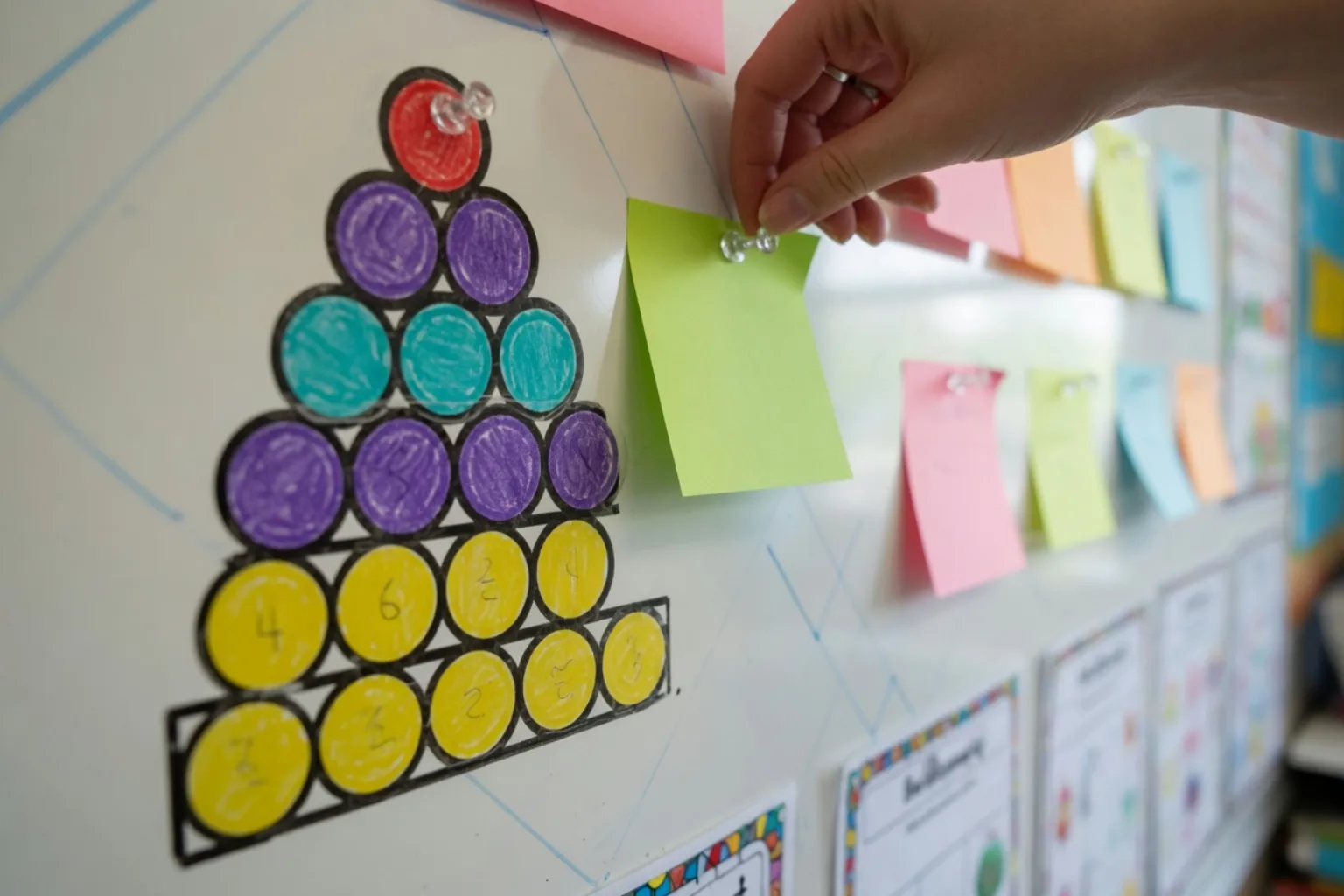
By year group the wall changes size more than shape: three headings at child height in Reception, a number line and one example in Year 1, two weeks of a unit with four operations and the mistakes box in Year 6, on squared paper because the class works on squared paper.
The maths trap is the poster pack: printed column-method posters, printed place-value grids, printed vocabulary on hessian, all up in September and still up in July. The teachers in our listen called that a display. It may be a good display, but it is not a working wall, because nothing on it was worked.
The English working walls in UK primary schools are more standardised than the maths ones, because most schools follow a writing sequence and the wall carries it. The kit seen repeatedly in photographed walls from Early Years to Year 6 is:
AA Year 6 class in Rotherham showed the cycle in a single post: a blank working wall at the start of a new writing week, filled the next day with discussion-writing vocabulary and sentence starters as the class met them (@ColeridgeSchool, 14 September 2026). The blank board is the point, because a wall that arrives full has nothing left to teach.
What the teacher does with an English wall is the part most guidance skips. Three moves:
Flip chart paper with things we've created in the lesson. Shared writes, synonyms, adverbials etc(@smurph1905, 19 October 2025).
The English trap is the printed display pack: printed headings, printed "powerful adjectives", a printed WAGOLL from a scheme. It looks complete and it teaches nothing the class did not already have, because none of it came out of the class's work.
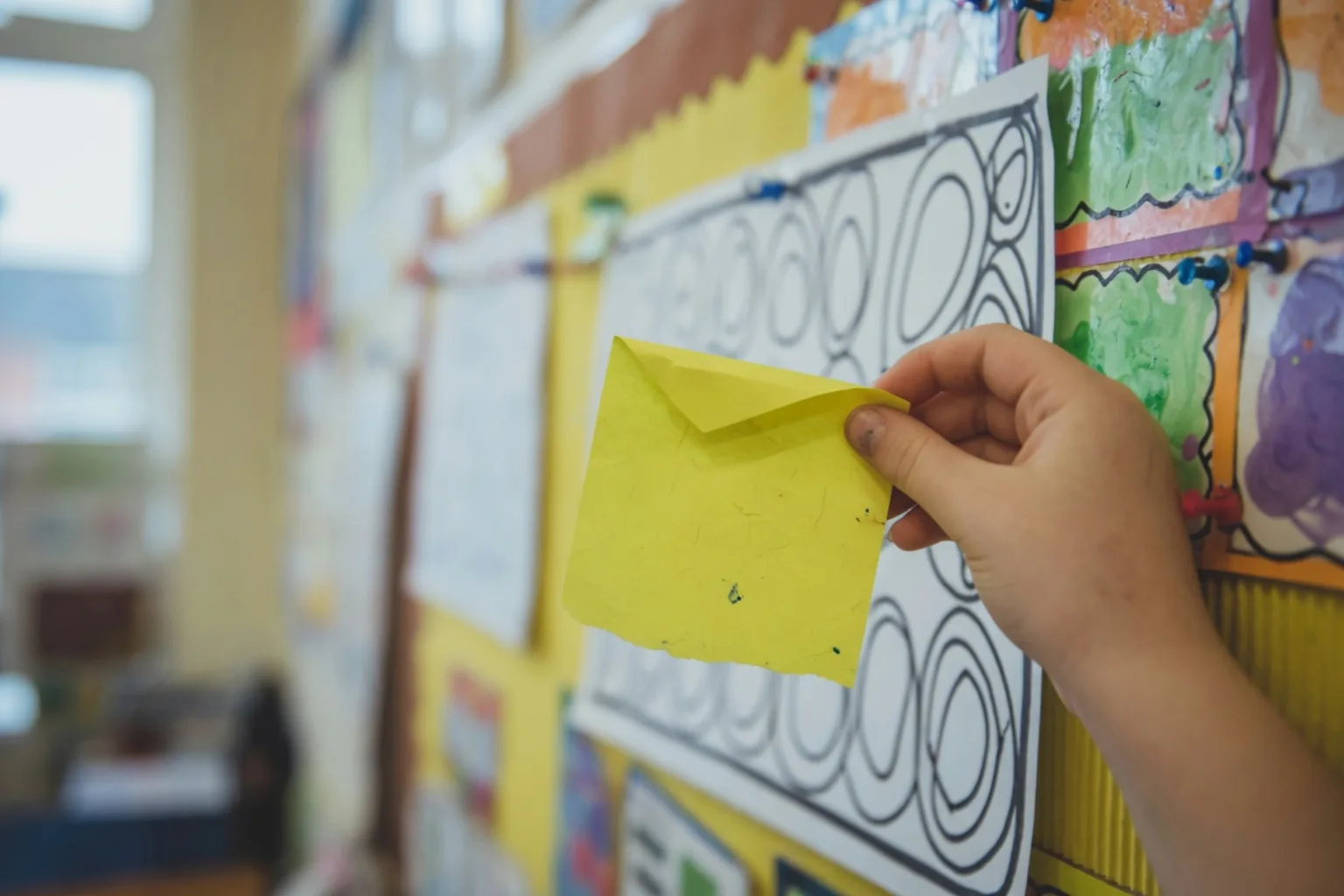
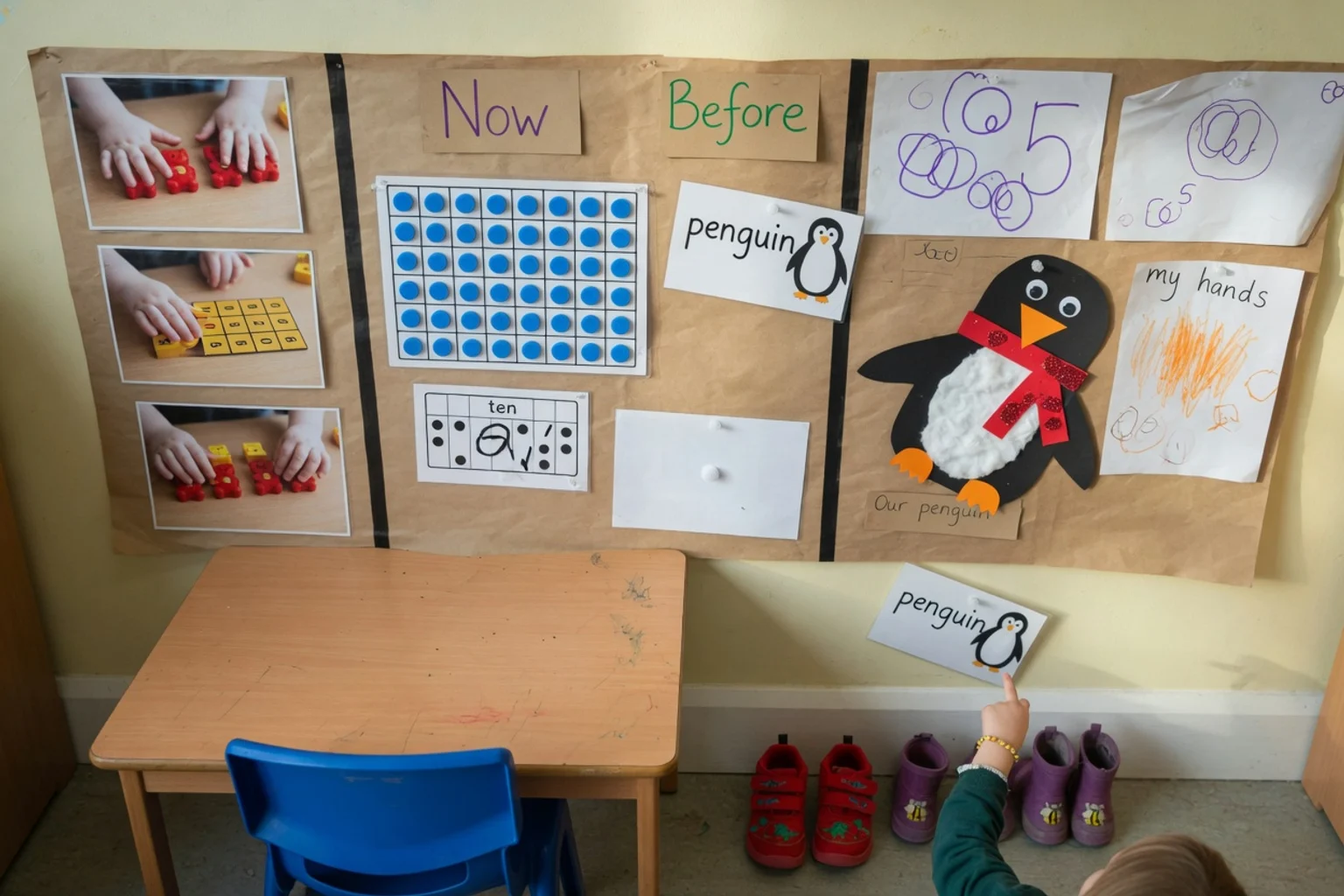
Reception working walls are a different object, and a Key Stage 2 writing wall dropped into a Reception classroom is the wrong tool. The Reception walls teachers photograph are a term's scrapbook: photographs of the children doing the thing, drawings, the class's own marks, a cork board that fills up week by week. One EYFS lead had even run out of room on my working wall
by the end of an eight-week autumn term (@MrsGriffiths7, 19 December 2024).
WWhat makes an EYFS wall a working wall rather than a scrapbook is one move: the children take things from it, as one Reception teacher's vocabulary-for-spelling post showed (@MrsBarn74775129, 15 March 2025). The vocabulary cards are at child height and physical, so a child writing about a caterpillar walks to the wall, takes "cocoon", copies it and puts it back.
TThe research on environmental print points the same way. Print on the walls of a young child's world only teaches when an adult refers to it: an intervention in which parents drew three and four year olds' attention to the print around them improved letter knowledge and print motivation, where print that was merely present did not (Neumann, Hood and Ford, 2013).
An EYFS maths wall (the Reception row in the table) is three headings at child height with the resources on it, and items move from Current Learning to Prior Learning when the class has them: progress shown without a printed chart.
Three posts carried a board a teacher could pin. The useful words are lifted into a strip you can print.
Year 3 love having a white board as a working wall as learning is added in the moment.
@parkroad_maths
The useful bit is the whiteboard used as the working wall, with learning added in the moment.
Year 3
A blank working wall means one thing in Y6… new writing week! We have been exploring discussion writing today and we can’t wait to fill our working wall with vocabulary and sentence starters tomorrow
@ColeridgeSchool
The useful bit is the blank board at the start of a writing week, filled next with vocabulary and sentence starters.
Y6 · new writing week
In reception we have been using the working wall to support our writing. The children have been taking the vocabulary to support their spelling.
@MrsBarn74775129
The useful bit is the vocabulary children take from the wall to support spelling.
Reception
TThe examples above share five moves: practitioner consensus, seen across the search results and the listen, and the ones to check a wall against.
It depends if the teacher takes the time to make reference to them and include them in their lessons(@mandyjwilding, 28 August 2026).
working walls down ready for next half term(@mrslsorby, 24 October 2025).
Two design judgements of ours, stated as such because no study tests them: one working wall per subject in a room, two at most; and put it where the teacher can reach it from the board. A learner who has to hold the board in mind while looking across the room at the wall is integrating two sources at a cost (the split-attention effect; Sweller, van Merriënboer and Paas, 1998), but the room-layout claim is ours.
A labelled wall plan. The board starts nearer blank. Each zone is added in lessons. The sixth strip is the cycle, not a sixth zone.
Handwritten heading and date. Changes when the small step changes.
This week only. Number line, bar, tens frame, rail. A scaffold that can come off.
Written live. Crossing-out left on. Not a printed pack.
Four or five words, or cards to take. Added as taught.
Sticky notes, photocopied boards, mistakes box, Word Jail. Their marks, this week.
Start blank, add in the lesson, fetch it, do not copy it, take something down.
The fastest way to see the difference is to take the display you already have and change it item by item, so the left column is the maths display most classrooms start September with; the right column is the same board a week into the unit, run as a working wall.
| On the display in September | On the working wall a week into the unit |
|---|---|
| A printed "Maths" banner and printed column-method posters, laminated in August and unchanged since | A handwritten heading with this week's small step and the date, and one column-method example written in the lesson with its correction still on it |
| A printed word bank of thirty maths words, most of them for units the class has not reached | Four words the class needs this week, handwritten as they came up, with a meaning beside each |
| A printed place-value chart covering every year group in the school | The place-value chart for this unit, drawn on flipchart during modelling, with the base-ten photo pinned beside it |
| A printed "growth mindset" poster in the corner that nobody has read since October | A mistakes box with two anonymised errors from the class's books and the corrections |
| Nothing that moves, because everything was finished before the first lesson | A flag on the small-step heading that moves when the step does, and a gap where next week's example will go |
| Up from the first day of September until the last day of July | A photograph of the finished board in the class book at the end of the unit, then a blank board |
Nothing in the right column took longer than the lesson it came from, which is the point of the exercise, because a working wall is cheaper than a display when the lesson makes it.
An honest page says this before the how-to, so the objections below are from UK teachers on X between September 2024 and September 2026, quoted with handle and date, and every one of them is fair.
<They become wallpaper. A wall that was finished before the unit started, or has not changed since, is a display, and learners treat it as one: If you use them as wallpaper and don't change them they'll treat them as wallpaper, hence the term WORKING walls
(@mandyjwilding, 28 August 2026).
<In Key Stage 1 they are often a mess. A retired primary head: My pet hate is working walls particularly in KS1…..they're usually a mess which many children ignore
(@ballater6, 18 October 2025). The fix is fewer items, larger, with the teacher reading the wall aloud rather than expecting a five year old to read it from a desk.
<Some teachers would rather have whiteboards. A head of school who still teaches Year 6 asked whether any other teacher felt they could just do with about ten whiteboards at the front of their room at once
(@MrBoothY6, 3 November 2024); a Year 5 English lead replied that she would drop every display/working wall (apart from English!) and otherwise have whiteboards covering every inch
(@teachingwrens, 3 November 2024); a retired deputy and SENCO preferred a whiteboard rather than a display board
as the working wall rather than the trend for working walls
(@DebbieBowers18, 6 November 2025). A whiteboard used as the working wall is a working wall (the Year 3 example above is one), but it gets wiped, and the record of the unit goes with it.
<Leaders want consistency and teachers want a room they can write on. The same trust wall in every classroom photographs well on a leadership account; the teacher's version of consistency is a wall that matches the lesson they just taught. Both pull against each other, so a school's expectation is better written as a cycle ("the current unit, built in lessons, taken down at the end") than as a layout.
The evidence for them is indirect. No controlled study has tested a working wall against no wall. The research section below says what the evidence does cover.
These are the questions teachers ask when the idea meets a classroom, quoted as posted, not the article’s verdict on the idea. Each two-sentence answer is grounded in the replies on that thread and in fetched pages. Where the replies disagree, the disagreement is the finding.
Question
“My pet hate is working walls particularly in KS1…..they’re usually a mess which many children ignore”
What the replies and the evidence say. The same thread has @Ria1984 calling scraps and post-its the definition of a working wall, so the mess is, for her, the point. Barrett (Teacher Magazine interview, fetched) says a fully covered lively wall distracts and a bare wall under-stimulates; KS1 sticky notes nobody can read from a desk sit on the lively side. The replies do not agree that the wall should go. They disagree about whether unfinished paper is use or clutter.
Question
“My working wall has laminated key words with the associated BSL sign. These get used constantly in lessons”
What the replies and the evidence say. This is a reply to @Ria1984, who had said laminated visuals mean it is not a working wall. The disagreement is the finding: use versus material. A teacher of the deaf and maths lead needs the BSL cards to stay. HFL Education (page fetched) still says add in the lesson with the class; it does not ban laminate that is fetched.
Question
“She took it down, painted walls, backed boards, started some new working walls… HT was FURIOUS! Told her to get it all back up!”
What the replies and the evidence say. The parent account is describing a new teacher who stripped shabby printed displays. @quiethead24 likes hessian because it lasts and cuts workload; @PieCorbett called dull hessian nonsense. The live fight is SLT consistency versus a wall the teacher can write on, not whether Ofsted asked for the Twinkl. The 2025 toolkit page (fetched) does not name working walls.
Question
“I'd be quite happy to drop every display/working wall (apart from English!) and otherwise have whiteboards covering every inch of my classroom”
What the replies and the evidence say. @DebbieBowers18 wants a whiteboard as the working wall rather than the trend for working walls. @parkroad_maths already does that in Year 3. The disagreement is not “wall or no wall”. It is whether the record of the unit should survive the wipe. A photograph of Friday’s board recovers most of the record; nobody in the thread had measured that.
American teachers almost never say "working wall". The same practice in a US classroom is the anchor chart, built on chart paper with the class and hung where it can be pointed at, and the argument is the same one in different words. A dual-language consultant's back-to-school reminder was that an anchor chart must be co-created with students
(@JoseMedinaJr89, 7 August 2025), and a teacher who sat at the back of her own empty room was shocked at the "visual noise"
and cut the walls to a few items (@ChassieQ, 18 January 2025). Co-created against printed, and sparse against cluttered: the UK working wall and the US anchor chart are one practice with two names, and this page uses the UK one.
Photograph the wall on Friday and check the photograph against these six questions, because a photograph shows what a learner sees from a desk and a teacher standing next to the board does not. It is the audit a subject leader can run across a school in a lunchtime.
Two or three "no" answers means the wall is a display and the fix is the five moves above rather than a tidier display, while six "yes" answers is a wall that is working, whatever it is made of.
The research most often quoted about classroom walls is about clutter, not working walls, and it needs reading carefully before it is used either for or against one.
Decorations unrelated to the lesson cost attention and learning in young children. Kindergarten children taught six science lessons in a laboratory classroom were more distracted, spent more time off task and learned less when the walls were heavily decorated than when the decorations were removed (Fisher, Godwin and Seltman, 2014). The effect was replicated with older primary children, autistic and not, watching a video of a teacher in a decorated room (Hanley et al., 2017), and in Portugal with 8 to 12 year olds on attention and memory tasks (Rodrigues and Pandeirada, 2018). In every study the decorations had nothing to do with the lesson, the samples were small and the setting was a laboratory or a video. The honest reading is that irrelevant visual material costs, which argues for a sparse wall that carries the lesson and for stripping the rest. It has not tested a display that is the lesson.
Bare is not best either. The largest UK study of classroom design, 153 primary classrooms in 27 schools, found the physical classroom explained about 16 per cent of the variation in a year's progress, with visual stimulation best in the middle: plain rooms and busy rooms both did worse than balanced ones, and a room the learners felt was theirs, with their own work in it, was one of the strongest factors (Barrett et al., 2015). That is the whole environment, correlational, and it is the study that stops the clutter research being read as an argument for empty walls.
The mechanisms a working wall relies on are supported. Off-task looking in primary classrooms rises after about ten minutes of an activity and the environment is a main source of it (Godwin et al., 2016), which is the reason to put the wall in the teacher's sightline and send learners to it deliberately. Print teaches when an adult points at it (Neumann, Hood and Ford, 2013). Worked examples help novices (Sweller, van Merriënboer and Paas, 1998). Providing models and scaffolds is on Rosenshine's list of what effective teachers do (Rosenshine, 2012), and a working wall is the physical form of both.
So: evidence that clutter costs, evidence that a balanced room owned by its learners helps, evidence for the mechanisms, and no study of working walls themselves. A school that adopts them on this basis is making a reasonable bet rather than following the research.
The examples are UK primary. They come from schools that photograph their walls and from teachers who argue about them on X, a sample of the enthusiastic and the annoyed, not of classrooms. Secondary was silent in our listen and the secondary row in the table is inference.
No study tests a working wall. The mechanisms are supported; the practice is not measured. A school that wants to know whether its walls are used should ask the learners, which none of the accounts in our listen had done.
The lamination argument is a proxy. Teachers argue about laminated versus handwritten because it is visible, but the thing it stands for, whether the wall was built in lessons and is used in them, is what matters, and a laminated card that learners fetch every day beats a handwritten one nobody looks at.
Consistency has a cost. A trust-wide layout photographs well and can stop a teacher from doing the one thing the wall is for, which is matching the lesson they just taught, so the expectation worth writing down is the cycle rather than the layout.
The whiteboard critics have a point. A whiteboard used as the working wall loses the record but gains the immediacy, and for some teachers that trade is right, especially since a photograph of the wall at the end of the unit, stuck in the class book, recovers most of the record.
Nothing beyond one sentence, and it is this: the current school inspection handbook says that inspectors may ask to take photographic evidence, for example of pupils' work and displays
, and that they will not photograph learners themselves (Ofsted, 2023). That is the handbook's only mention of displays, and it does not say what a display should contain, how often it should change, or that a working wall should exist. Ofsted's 2018 clarification document for schools, written to dispel inspection myths, does not mention displays at all. Our listen found no UK teacher in two years describing a working wall as an inspection requirement; the only mention was a Reception teacher who ran out of wall space in a term that happened to include an inspection.
If a school's working-wall expectation is justified by Ofsted, the justification is a myth, whereas if it is justified by the cycle above it stands on its own.
What is a working wall in a classroom? A display built during a unit of work, in lessons, from the class's own models, vocabulary and examples, and taken down when the unit ends. The teacher and the learners use it during lessons rather than look at it afterwards.
What should be on a maths working wall? The current small step as a heading, the representation the class is using this week, one worked example with the steps visible, four or five vocabulary words with meanings, and a box of the class's own common mistakes with the corrections, with Reception to Year 6 versions in the maths section above.
What should be on an English working wall? The writing sequence with the current stage marked, the toolkit features for this text type added as they are taught (a scaffold that comes down with the wall), the vocabulary with definitions, a modelled piece written in front of the class with the features marked, and this week's grammar or spelling focus.
How is a working wall different from a display? A display shows finished work and stays up, whereas a working wall shows work in progress and changes as the unit does; the teacher writes on it in the lesson and sends learners to fetch from it, which no printed display pack, however good, can offer.
Does Ofsted require working walls? No: the school inspection handbook's only reference to displays is that inspectors may photograph them as evidence, and it says nothing about what they should contain or whether they should exist.
What does an EYFS working wall look like? Photographs, drawings and the class's own marks, at child height, filling up over the term, with physical vocabulary cards and maths resources the children can take off the wall and use: a scrapbook of the term that children fetch from, not a Key Stage 2 writing wall in miniature.
Barrett, P., Davies, F., Zhang, Y. and Barrett, L. (2015) The impact of classroom design on pupils' learning: final results of a holistic, multi-level analysis. Building and Environment, 89, 118 to 133. https://doi.org/10.1016/j.buildenv.2015.02.013
Education Endowment Foundation (2020) Improving Mathematics in Key Stages 2 and 3. Guidance report. London: EEF. https://educationendowmentfoundation.org.uk/education-evidence/guidance-reports/maths-ks-2-3
Fisher, A. V., Godwin, K. E. and Seltman, H. (2014) Visual environment, attention allocation, and learning in young children: when too much of a good thing may be bad. Psychological Science, 25(7), 1362 to 1370. https://doi.org/10.1177/0956797614533801
Godwin, K. E., Almeda, M. V., Seltman, H., Kai, S., Skerbetz, M. D., Baker, R. S. and Fisher, A. V. (2016) Off-task behaviour in elementary school children. Learning and Instruction, 44, 128 to 143. https://doi.org/10.1016/j.learninstruc.2016.04.003
Hanley, M., Khairat, M., Taylor, K., Wilson, R., Cole-Fletcher, R. and Riby, D. M. (2017) Classroom displays: attraction or distraction? Evidence of impact on attention and learning from children with and without autism. Developmental Psychology, 53(7), 1265 to 1275. https://doi.org/10.1037/dev0000271
HFL Education (2025) English working wall: steps to success. Blog. https://www.hfleducation.org/blog/english-working-wall-steps-success
Neumann, M. M., Hood, M. and Ford, R. (2013) Using environmental print to enhance emergent literacy and print motivation. Reading and Writing, 26(5), 771 to 793. https://doi.org/10.1007/s11145-012-9390-7
Ofsted (2023) School inspection handbook. London: Ofsted. https://www.gov.uk/government/publications/school-inspection-handbook-eif
Rodrigues, P. F. S. and Pandeirada, J. N. S. (2018) When visual stimulation of the surrounding environment affects children's cognitive performance. Journal of Experimental Child Psychology, 176, 140 to 149. https://doi.org/10.1016/j.jecp.2018.07.014
Rosenshine, B. (2012) Principles of instruction: research-based strategies that all teachers should know. American Educator, 36(1), 12 to 39. https://www.aft.org/sites/default/files/Rosenshine.pdf
Sweller, J., van Merriënboer, J. J. G. and Paas, F. G. W. C. (1998) Cognitive architecture and instructional design. Educational Psychology Review, 10(3), 251 to 296. https://doi.org/10.1023/A:1022193728205