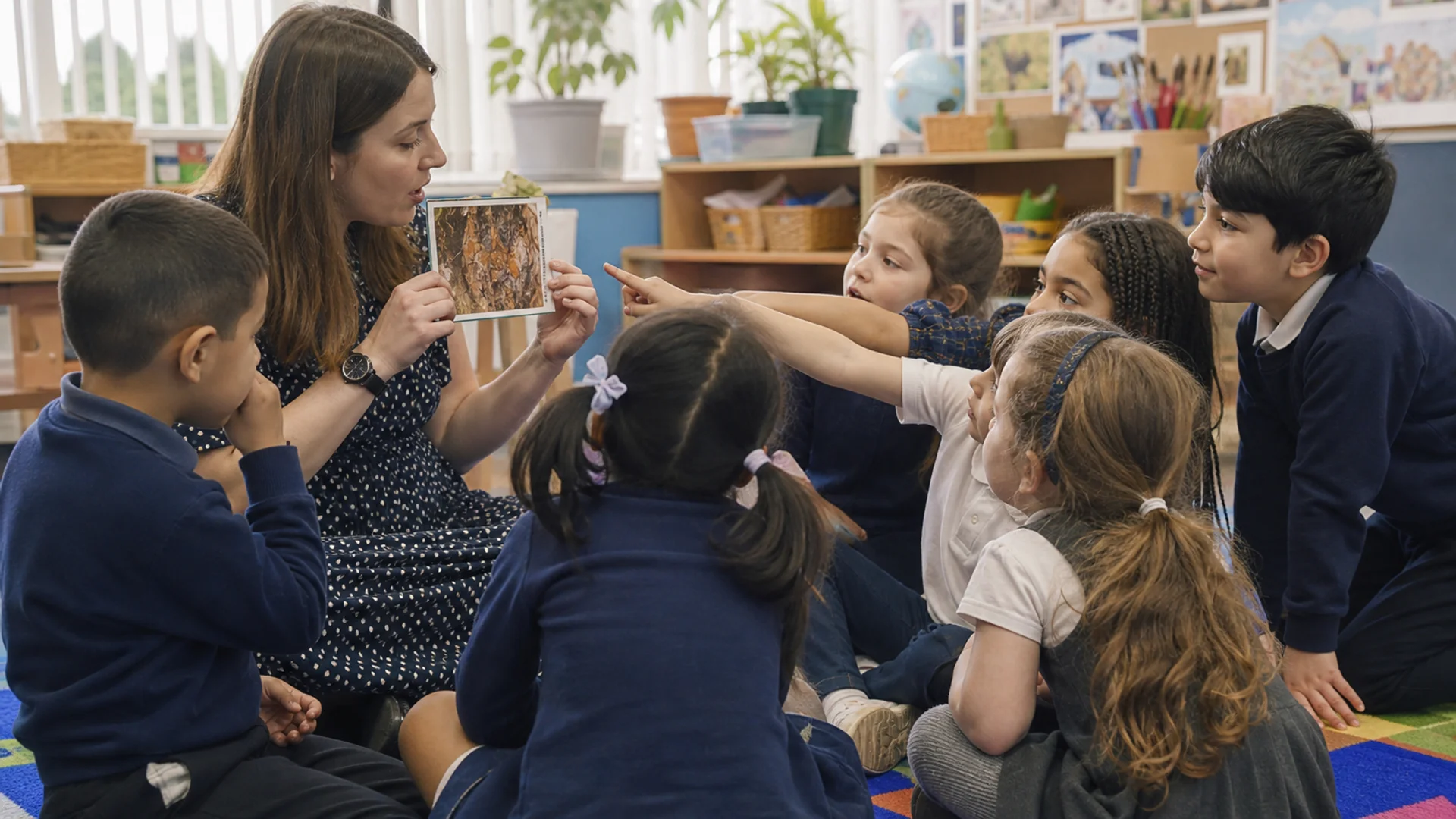
Seeking happiness by finding purposeSecondary students in navy blazers and striped ties discussing purpose in life during an inspiring classroom activity.

Updated on  

February 23, 2026

Seeking happiness by finding purpose

How can we find meaning and purpose when our lives are so busy in school? Frances Robertson provides us with some insights.


Course Enquiry
Copy citation

Robertson, F (2023, May 09). Seeking happiness by finding purpose. Retrieved from https://www.structural-learning.com/post/seeking-happiness-by-finding-purpose

Finding Purpose

When working in schools it is so easy to think about ensuring the staff are happy, the children are happy and that the parents are happy. It may even be that some leaders are also trying to ensure the Governing body is happy. Many parents will say "providing they are happy" when talking to teachers at parent evenings and meetings. You may find yourself thinking, " I just want to be happy".

Key Takeaways

  1. Beyond 'Happy': The Purpose Revolution: Why schools replacing 'happiness goals' with purpose-driven cultures see stronger wellbeing and resilience in pupils and staff
  2. The Vocabulary Shift: Move past 'happy/sad' labels, discover how expanding emotional vocabulary transforms behaviour managementand pupil self-awareness
  3. Values That Stick: How involving pupils in creating school values shifts focus from perfectionism to growth, reducing anxiety across your community
  4. The Parent Partnership Problem: Why your student wellbeing initiatives fail without parent buy-in, and the workshops that align home-school language around effort, not outcomes

So, what I am going to say next may be surprising. I have for a long time been urging schools to move the language away from the word "Happy" or "Happiness". It may seem a sensible word to use however when linked to well-being, as it often is, it can become a loaded word. By that I mean what happens when you are not happy?

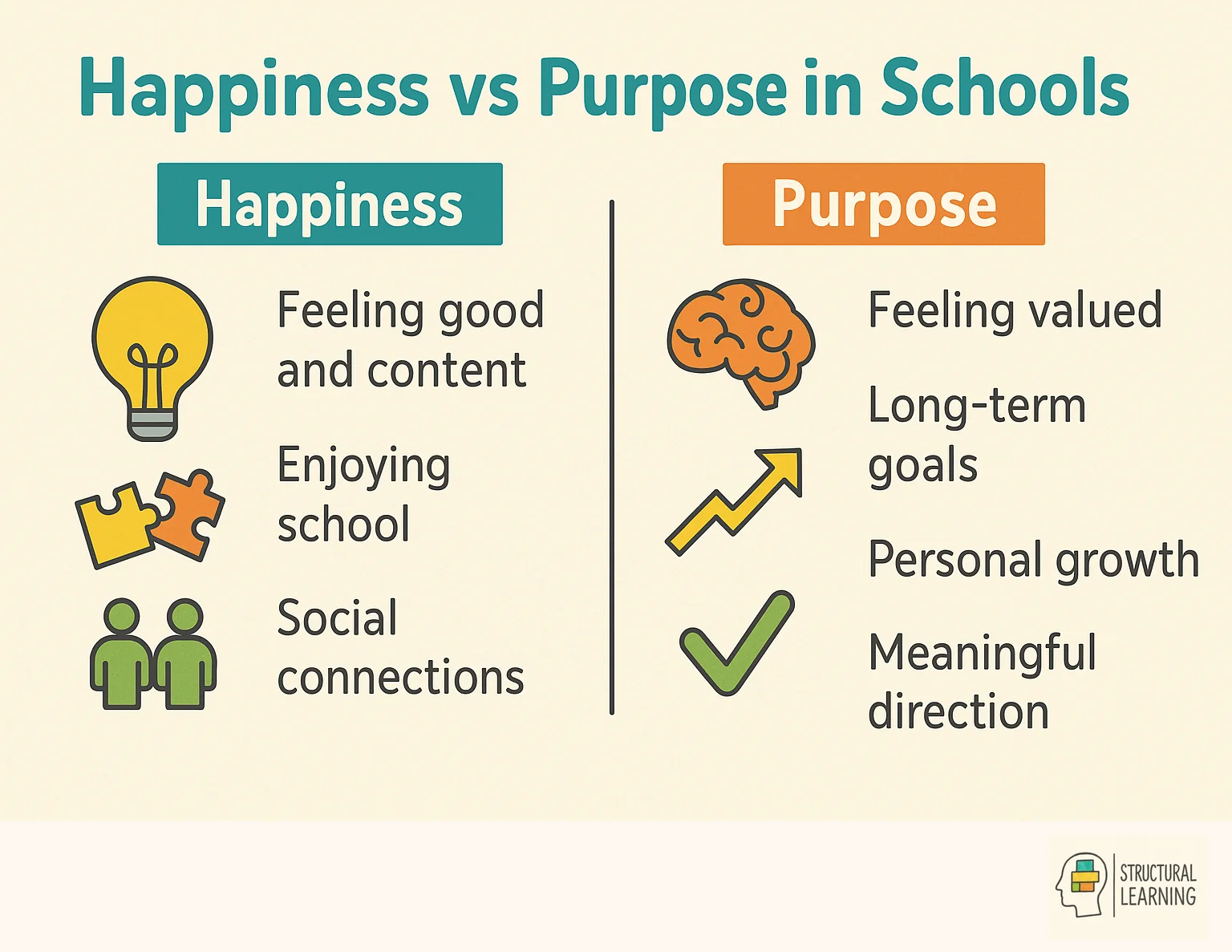
Comparison infographic showing happiness vs purpose approaches in schools for better wellbeing outcomes
Happiness vs Purpose in Schools

If happiness is set up as the ideal emotional state, we potentially can leave our children, staff and so on in a crestfallen state when they are not happy. Realistically for how long can you remain in a state of happiness?

Before reading on, pause and consider when were you last really happy?

What caused it?

How did that feel?

How long did it last?

Are you still feeling that emotion right now?

If in your schools you are trying to improve the mental health and wellbeing of your school community by having the state of "happy" or "happiness" as your goal, ironically this is likely to become a stumbling block. This state is not and cannot be a permanent basis. You become habituated to what makes you happy and then would need more and more of it to remain in that state. Therefore trying to seek this out becomes burdensome. I am, though, not suggesting that positivity cannot be longer lasting. There is much research out there about the power of positivity.

This view is very much backed up and supported by the group of psychologists working in the field of positive psychology.

If we look at Maslow's hierarchy of needs we can see that we have two needs. The first set are the basic ones that enable us to simply survive. The other set of needs are ones of psychological and personal growth which allows for intellectual and creative growth. The need for growth includes the need to be connected, feelings of self worth, accomplishment and realisation of your own potential.

There is no mention of happiness or being happy.

Fredrickson in her research talks about positive emotions too and the impact these have on wellbeing and building resilience. The top ten words used to describe positive emotions include:

The words happiness or happy are not in this.

All this research is suggesting that there is something happening here rather than being happy. My suggestion is that having a purpose and meaning in your life is much more likely to result in a positive frame and therefore a good sense of wellbeing and a stronger ability to be resilient. And a sense of purpose and meaning in life is likely to be more permanent.

What can schools do to support this?

In many ways it begins with the overall school culture. As Peter Drucker said, "Culture eats strategy for breakfast". Having a school culture of positivity, growth mindset(Dweck) and a solid set of values underpinning everything is crucial. As a school are all the stakeholders involved in developing and maintaining this set of core values? Are the values adhered to by all? Does everyone know them?

The school values give purpose to what you are doing. They will give purpose to what the pupils are trying to achieve. They provide a driver. Having a set of clear values helps you understand what matters to you, what helps you achieve, what might hold you back and who can support you. Do you know what your values are? This is often the starting point for many coaching conversations.

Whilst I was a Headteacher in one school we developed a set of "Keys to Success", so named by the pupils, which laid out our values ( which were developed with all the stakeholders including the pupils thoughts and views):

The driver here was to move the pupils away from the sense that everything had to be perfect and correct the first time. It was to embed the purpose that the act of learning was ongoing and the joy was in the learning not the finished product. Similarly this moved into the ongoing continuous development process for teachers too.

Teachers could be freed from thinking that every lesson had to be perfect. They could develop as professionals and that learning to be a better teacher tomorrow than today was the goal. It provided meaning and purpose in what was being carried out. The pedagogical approach rewarded the effort, not simply the end product. In other words a move towards a growth mindset rather than fixed enabled all to experience better wellbeing.

Appraisals can then be linked to professional development giving more purpose and meaning to what the teachers are doing. Effectively this develops a coaching approach to leadership. The behaviour code can also be linked to this both within and out of the classroom management setting. It begins to underpin everything.

Extending the vocabulary used when discussing emotions is also a good way to progress. From when a child comes into school this can start to happen. A move away from using the words happy and sad is a good step forward. It is worth digging deeper to find out what the emotion truly is. You can explicitly teach young children this and if I can be bold, ourselves too. The link below shows a four year old able to discuss his emotions quite clearly.

Https://www.youtube.com/watch?v=UfApzcvPVlg&ab_channel=GoodMorningAmerica

Can we all do this? Can the children in our schools do this? For example are you happy or are you content or thankful or excited, relieved, elated, confident or overjoyed or simply cheerful or glad?

Are you sad or actually disappointed or regretful, disillusioned, tearful or dismayed?

Going beyond the basic emotional state and finding out what lies beneath enables the child/ adult to understand their emotions better and have a better sense of what works for them and their own sense of wellbeing.

Along the journey of moving towards having purpose and meaning rather than seeking a goal of happiness the school will need to think about how to get all stakeholders involved. This includes the parents and carers of the pupils.

Often parents can inadvertently undermine the work being done in school. Comments like "as long as you're happy" or focusing solely on grades and outcomes rather than effort and progress can shift the focus away from purpose and growth. Schools need to actively engage parents in understanding this approach through workshops, newsletters, and regular communication about why purpose-driven education benefits their children's wellbeing and resilience.

Parent workshops that focus on the language we use at home, how to praise effort over achievement, and understanding the emotional vocabulary children are learning in school can be transformational. When parents understand that asking "What did you learn today?" rather than "Were you good today?" or "Are you happy?" creates more meaningful conversations, the home-school partnership becomes much stronger.

The curriculum itself can also be designed to help pupils find purpose and meaning. Cross-curricular themes that connect learning to real-world issues, community projects that show pupils how their skills can make a difference, and opportunities for pupils to pursue their own interests and passions all contribute to this sense of purpose.

Regular reflection time built into the school day, whether through assemblies, tutor time, or specific wellbeing lessons, allows pupils to consider their own values, what gives their life meaning, and how they can contribute to their community. This metacognitive approach helps pupils understand themselves better and builds intrinsic motivation.

Conclusion

Moving away from the pursuit of happiness towards finding purpose and meaning represents a fundamental shift in how we approach wellbeing in schools. This is not about abandoning positivity or joy, but rather about creating a more sustainable foundation for mental health and resilience that doesn't depend on maintaining a particular emotional state.

When schools focus on developing clear values, expanding emotional vocabulary, and helping all members of their community find purpose and meaning in their work and learning, they create environments where genuine wellbeing can flourish. This approach acknowledges that life includes challenges and difficult emotions, but provides the tools and framework to navigate these whilst maintaining a sense of direction and worth.

The evidence from positive psychology research supports this approach, showing that meaning and purpose are more reliable predictors of wellbeing than momentary happiness. For schools, this means creating cultures where growth is valued over perfection, where effort is recognised alongside achievement, and where every member of the community understands their role in the bigger picture. By making this shift, schools can support happier individuals and more resilient, purposeful, and ultimately more fulfiled communities.

Further Reading

For those interested in exploring the research behind purpose-driven wellbeing approaches in education, the following studies provide valuable insights:

  • Seligman, M. E. P., Ernst, R. M., Gillham, J., Reivich, K., & Linkins, M. (2009). Positive education: positive psychology and classroom interventions. Oxford Review of Education, 35(3), 293-311. This foundational study explores how positive psychology principles can be implemented in educational settings.
  • Fredrickson, B. L. (2001). The role of positive emotions in positive psychology: The broaden-and-build theory of positive emotions. American Psychologist, 56(3), 218-226. Essential reading on understanding positive emotions beyond simple happiness.
  • Duckworth, A. L., Steen, T. A., & Seligman, M. E. P. (2005). Positive psychology in clinical practice. Annual Review of Clinical Psychology, 1, 629-651. Provides practical applications of positive psychology principles in supporting wellbeing.
  • Dweck, C. S. (2008). Can personality be changed? The role of beliefs in personality and change. Current Directions in Psychological Science, 17(6), 391-394. Key research on growth mindset and its impact on resilience and wellbeing.
  • White, M. A., & Waters, L. E. (2015). A case study of 'The Good School': Examples of the use of Peterson's strengths-based approach with students. The Journal of Positive Psychology, 10(1), 69-76. Practical examples of implementing strengths-based approaches in schools for improved wellbeing outcomes.
Loading audit...

Finding Purpose

When working in schools it is so easy to think about ensuring the staff are happy, the children are happy and that the parents are happy. It may even be that some leaders are also trying to ensure the Governing body is happy. Many parents will say "providing they are happy" when talking to teachers at parent evenings and meetings. You may find yourself thinking, " I just want to be happy".

Key Takeaways

  1. Beyond 'Happy': The Purpose Revolution: Why schools replacing 'happiness goals' with purpose-driven cultures see stronger wellbeing and resilience in pupils and staff
  2. The Vocabulary Shift: Move past 'happy/sad' labels, discover how expanding emotional vocabulary transforms behaviour managementand pupil self-awareness
  3. Values That Stick: How involving pupils in creating school values shifts focus from perfectionism to growth, reducing anxiety across your community
  4. The Parent Partnership Problem: Why your student wellbeing initiatives fail without parent buy-in, and the workshops that align home-school language around effort, not outcomes

So, what I am going to say next may be surprising. I have for a long time been urging schools to move the language away from the word "Happy" or "Happiness". It may seem a sensible word to use however when linked to well-being, as it often is, it can become a loaded word. By that I mean what happens when you are not happy?

Comparison infographic showing happiness vs purpose approaches in schools for better wellbeing outcomes
Happiness vs Purpose in Schools

If happiness is set up as the ideal emotional state, we potentially can leave our children, staff and so on in a crestfallen state when they are not happy. Realistically for how long can you remain in a state of happiness?

Before reading on, pause and consider when were you last really happy?

What caused it?

How did that feel?

How long did it last?

Are you still feeling that emotion right now?

If in your schools you are trying to improve the mental health and wellbeing of your school community by having the state of "happy" or "happiness" as your goal, ironically this is likely to become a stumbling block. This state is not and cannot be a permanent basis. You become habituated to what makes you happy and then would need more and more of it to remain in that state. Therefore trying to seek this out becomes burdensome. I am, though, not suggesting that positivity cannot be longer lasting. There is much research out there about the power of positivity.

This view is very much backed up and supported by the group of psychologists working in the field of positive psychology.

If we look at Maslow's hierarchy of needs we can see that we have two needs. The first set are the basic ones that enable us to simply survive. The other set of needs are ones of psychological and personal growth which allows for intellectual and creative growth. The need for growth includes the need to be connected, feelings of self worth, accomplishment and realisation of your own potential.

There is no mention of happiness or being happy.

Fredrickson in her research talks about positive emotions too and the impact these have on wellbeing and building resilience. The top ten words used to describe positive emotions include:

The words happiness or happy are not in this.

All this research is suggesting that there is something happening here rather than being happy. My suggestion is that having a purpose and meaning in your life is much more likely to result in a positive frame and therefore a good sense of wellbeing and a stronger ability to be resilient. And a sense of purpose and meaning in life is likely to be more permanent.

What can schools do to support this?

In many ways it begins with the overall school culture. As Peter Drucker said, "Culture eats strategy for breakfast". Having a school culture of positivity, growth mindset(Dweck) and a solid set of values underpinning everything is crucial. As a school are all the stakeholders involved in developing and maintaining this set of core values? Are the values adhered to by all? Does everyone know them?

The school values give purpose to what you are doing. They will give purpose to what the pupils are trying to achieve. They provide a driver. Having a set of clear values helps you understand what matters to you, what helps you achieve, what might hold you back and who can support you. Do you know what your values are? This is often the starting point for many coaching conversations.

Whilst I was a Headteacher in one school we developed a set of "Keys to Success", so named by the pupils, which laid out our values ( which were developed with all the stakeholders including the pupils thoughts and views):

The driver here was to move the pupils away from the sense that everything had to be perfect and correct the first time. It was to embed the purpose that the act of learning was ongoing and the joy was in the learning not the finished product. Similarly this moved into the ongoing continuous development process for teachers too.

Teachers could be freed from thinking that every lesson had to be perfect. They could develop as professionals and that learning to be a better teacher tomorrow than today was the goal. It provided meaning and purpose in what was being carried out. The pedagogical approach rewarded the effort, not simply the end product. In other words a move towards a growth mindset rather than fixed enabled all to experience better wellbeing.

Appraisals can then be linked to professional development giving more purpose and meaning to what the teachers are doing. Effectively this develops a coaching approach to leadership. The behaviour code can also be linked to this both within and out of the classroom management setting. It begins to underpin everything.

Extending the vocabulary used when discussing emotions is also a good way to progress. From when a child comes into school this can start to happen. A move away from using the words happy and sad is a good step forward. It is worth digging deeper to find out what the emotion truly is. You can explicitly teach young children this and if I can be bold, ourselves too. The link below shows a four year old able to discuss his emotions quite clearly.

Https://www.youtube.com/watch?v=UfApzcvPVlg&ab_channel=GoodMorningAmerica

Can we all do this? Can the children in our schools do this? For example are you happy or are you content or thankful or excited, relieved, elated, confident or overjoyed or simply cheerful or glad?

Are you sad or actually disappointed or regretful, disillusioned, tearful or dismayed?

Going beyond the basic emotional state and finding out what lies beneath enables the child/ adult to understand their emotions better and have a better sense of what works for them and their own sense of wellbeing.

Along the journey of moving towards having purpose and meaning rather than seeking a goal of happiness the school will need to think about how to get all stakeholders involved. This includes the parents and carers of the pupils.

Often parents can inadvertently undermine the work being done in school. Comments like "as long as you're happy" or focusing solely on grades and outcomes rather than effort and progress can shift the focus away from purpose and growth. Schools need to actively engage parents in understanding this approach through workshops, newsletters, and regular communication about why purpose-driven education benefits their children's wellbeing and resilience.

Parent workshops that focus on the language we use at home, how to praise effort over achievement, and understanding the emotional vocabulary children are learning in school can be transformational. When parents understand that asking "What did you learn today?" rather than "Were you good today?" or "Are you happy?" creates more meaningful conversations, the home-school partnership becomes much stronger.

The curriculum itself can also be designed to help pupils find purpose and meaning. Cross-curricular themes that connect learning to real-world issues, community projects that show pupils how their skills can make a difference, and opportunities for pupils to pursue their own interests and passions all contribute to this sense of purpose.

Regular reflection time built into the school day, whether through assemblies, tutor time, or specific wellbeing lessons, allows pupils to consider their own values, what gives their life meaning, and how they can contribute to their community. This metacognitive approach helps pupils understand themselves better and builds intrinsic motivation.

Conclusion

Moving away from the pursuit of happiness towards finding purpose and meaning represents a fundamental shift in how we approach wellbeing in schools. This is not about abandoning positivity or joy, but rather about creating a more sustainable foundation for mental health and resilience that doesn't depend on maintaining a particular emotional state.

When schools focus on developing clear values, expanding emotional vocabulary, and helping all members of their community find purpose and meaning in their work and learning, they create environments where genuine wellbeing can flourish. This approach acknowledges that life includes challenges and difficult emotions, but provides the tools and framework to navigate these whilst maintaining a sense of direction and worth.

The evidence from positive psychology research supports this approach, showing that meaning and purpose are more reliable predictors of wellbeing than momentary happiness. For schools, this means creating cultures where growth is valued over perfection, where effort is recognised alongside achievement, and where every member of the community understands their role in the bigger picture. By making this shift, schools can support happier individuals and more resilient, purposeful, and ultimately more fulfiled communities.

Further Reading

For those interested in exploring the research behind purpose-driven wellbeing approaches in education, the following studies provide valuable insights:

  • Seligman, M. E. P., Ernst, R. M., Gillham, J., Reivich, K., & Linkins, M. (2009). Positive education: positive psychology and classroom interventions. Oxford Review of Education, 35(3), 293-311. This foundational study explores how positive psychology principles can be implemented in educational settings.
  • Fredrickson, B. L. (2001). The role of positive emotions in positive psychology: The broaden-and-build theory of positive emotions. American Psychologist, 56(3), 218-226. Essential reading on understanding positive emotions beyond simple happiness.
  • Duckworth, A. L., Steen, T. A., & Seligman, M. E. P. (2005). Positive psychology in clinical practice. Annual Review of Clinical Psychology, 1, 629-651. Provides practical applications of positive psychology principles in supporting wellbeing.
  • Dweck, C. S. (2008). Can personality be changed? The role of beliefs in personality and change. Current Directions in Psychological Science, 17(6), 391-394. Key research on growth mindset and its impact on resilience and wellbeing.
  • White, M. A., & Waters, L. E. (2015). A case study of 'The Good School': Examples of the use of Peterson's strengths-based approach with students. The Journal of Positive Psychology, 10(1), 69-76. Practical examples of implementing strengths-based approaches in schools for improved wellbeing outcomes.

Primary Schools

Back to Blog

{"@context":"https://schema.org","@graph":[{"@type":"Article","@id":"https://www.structural-learning.com/post/seeking-happiness-by-finding-purpose#article","headline":"Seeking happiness by finding purpose","description":"How can we find meaning and purpose when our lives are so busy in school? Frances Robertson provides us with some insights.","datePublished":"2023-05-09T10:52:53.069Z","dateModified":"2026-01-26T10:09:32.212Z","author":{"@type":"Person","name":"Paul Main","url":"https://www.structural-learning.com/team/paulmain","jobTitle":"Founder & Educational Consultant"},"publisher":{"@type":"Organization","name":"Structural Learning","url":"https://www.structural-learning.com","logo":{"@type":"ImageObject","url":"https://cdn.prod.website-files.com/5b69a01ba2e409e5d5e055c6/6040bf0426cb415ba2fc7882_newlogoblue.svg"}},"mainEntityOfPage":{"@type":"WebPage","@id":"https://www.structural-learning.com/post/seeking-happiness-by-finding-purpose"},"image":"https://cdn.prod.website-files.com/5b69a01ba2e409501de055d1/695254d1f0d57128c385db30_695254d03838f69ad0cf3673_seeking-happiness-by-finding-purpose-infographic.webp","wordCount":1742},{"@type":"BreadcrumbList","@id":"https://www.structural-learning.com/post/seeking-happiness-by-finding-purpose#breadcrumb","itemListElement":[{"@type":"ListItem","position":1,"name":"Home","item":"https://www.structural-learning.com/"},{"@type":"ListItem","position":2,"name":"Blog","item":"https://www.structural-learning.com/blog"},{"@type":"ListItem","position":3,"name":"Seeking happiness by finding purpose","item":"https://www.structural-learning.com/post/seeking-happiness-by-finding-purpose"}]}]}