Updated on
September 23, 2026
Culture of Error: Making Being Wrong Safe and Useful
Errors held with high confidence are the ones that correct and stay corrected. But an unlabelled error helps only learners who already know the topic.


Updated on
September 23, 2026
Errors held with high confidence are the ones that correct and stay corrected. But an unlabelled error helps only learners who already know the topic.
What is a culture of error?
A culture of error is a classroom where being wrong carries no social cost, so learners reveal their thinking rather than hiding it. It is technique 12 in Teach Like a Champion 3.0 and the precondition for every technique that exposes thinking publicly. The research adds a condition: errors help when they are explicitly labelled and paired with the correct version, and do little when learners are left to find them.
A Year 8 class is asked which of four answers is right. Twenty-two hands go up for the correct one. The teacher takes the wrong one instead, spends four minutes on it, and thanks the learner who offered it. That is the whole technique, and it cannot be implemented by deciding to.
Culture of Error means making being wrong normal and safe, so that misconceptions surface early rather than staying hidden until the test. It is technique 12 in Teach Like a Champion 3.0 (Lemov, 2021), in the chapter on checking for understanding, and Show Call, Cold Call and every other move that exposes thinking depends on it.
The evidence is better than for most classroom techniques, and it comes with one condition that changes how you use it. Metcalfe's (2017) review concludes that errorful learning followed by corrective feedback beats error-free study. The hypercorrection effect sharpens that into something usable: errors committed with high confidence are the ones most likely to be corrected and to stay corrected (Butterfield and Metcalfe, 2001). The confidently wrong answer is the valuable one.
A culture of error is a classroom where saying something wrong carries no social cost, so learners volunteer their thinking rather than protecting it. It is built out of what a teacher does in the two seconds after a wrong answer, repeated for months. The test is not whether you say mistakes are welcome. It is whether a learner who is unsure will say so unprompted.
Four teacher behaviours do most of the building. Expect error, out loud: "this next one catches most people". Withhold the answer when hands go up, so being right stops being the only currency. React without a flinch, because the class reads your face faster than your words. And use the error, because a misconception you dissect for four minutes tells the class errors are useful rather than tolerated.
The learning-from-errors literature supports the technique and adds one qualification that changes the practice. Errors work when they are labelled and paired with the correct version, and they do less, or nothing, when learners are left to find them.
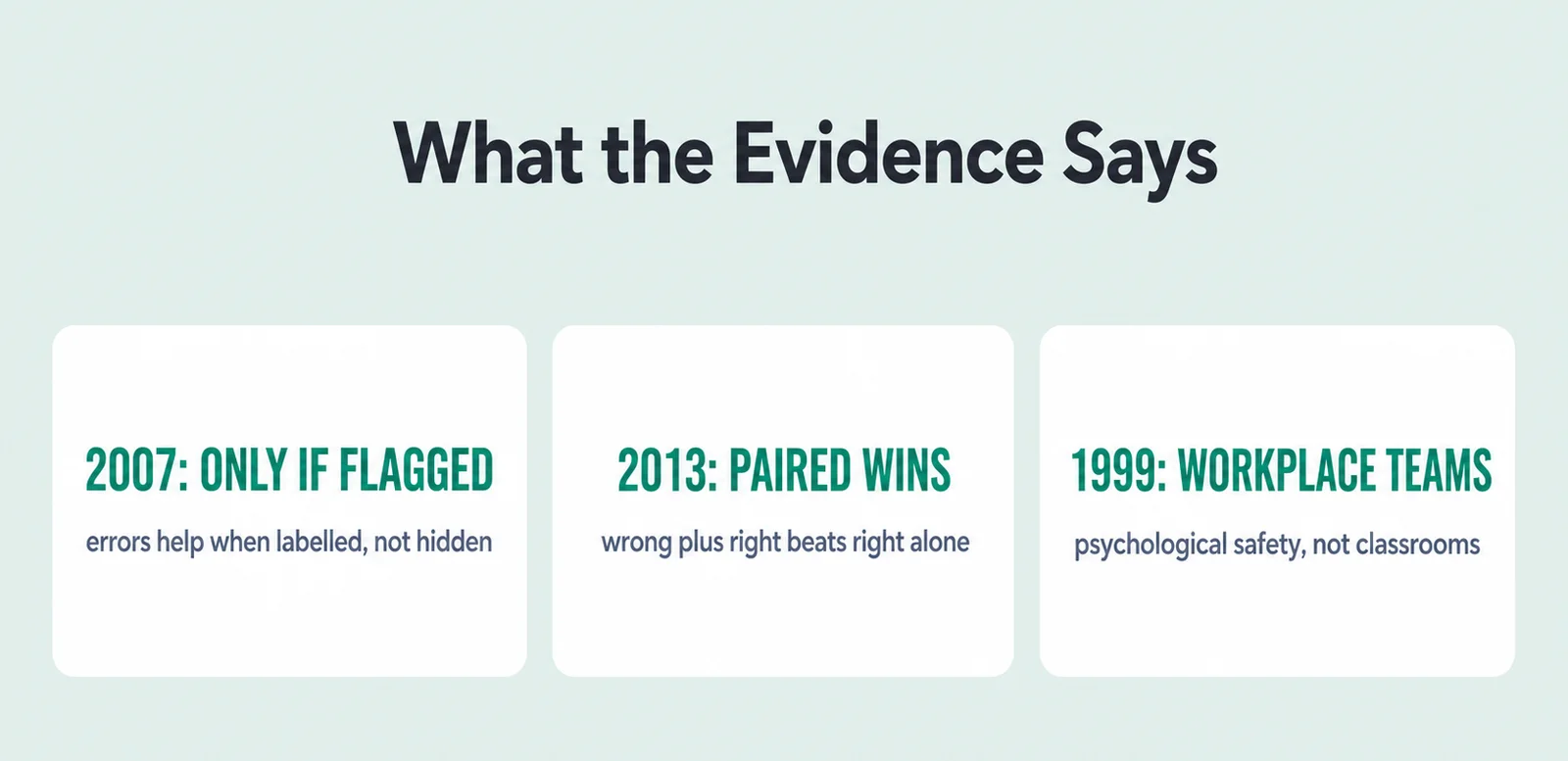
Grosse and Renkl (2007) found that erroneous worked examples helped only learners with higher prior knowledge, and only when the errors were explicitly flagged rather than left to be discovered. Booth and colleagues (2013) found that studying incorrect algebra examples alongside correct ones improved conceptual knowledge and transfer more than correct examples alone. The pattern in both is the same: paired and labelled works, unmarked and alone does not.
Practically, that means never leaving a wrong answer on the board unresolved for the sake of open-mindedness. Name it as wrong, put the right version next to it, and say what the difference is.
Two further literatures are often cited here and both need labelling. Edmondson's (1999) work on psychological safety is about workplace teams, not classrooms. Keith and Frese's (2008) meta-analysis of error-management training used adult training samples. Both point the right way and neither is evidence about children.
It is announced rather than built. A teacher who says "mistakes are how we learn" and then sighs at a wrong answer has taught the class which of the two signals to believe.
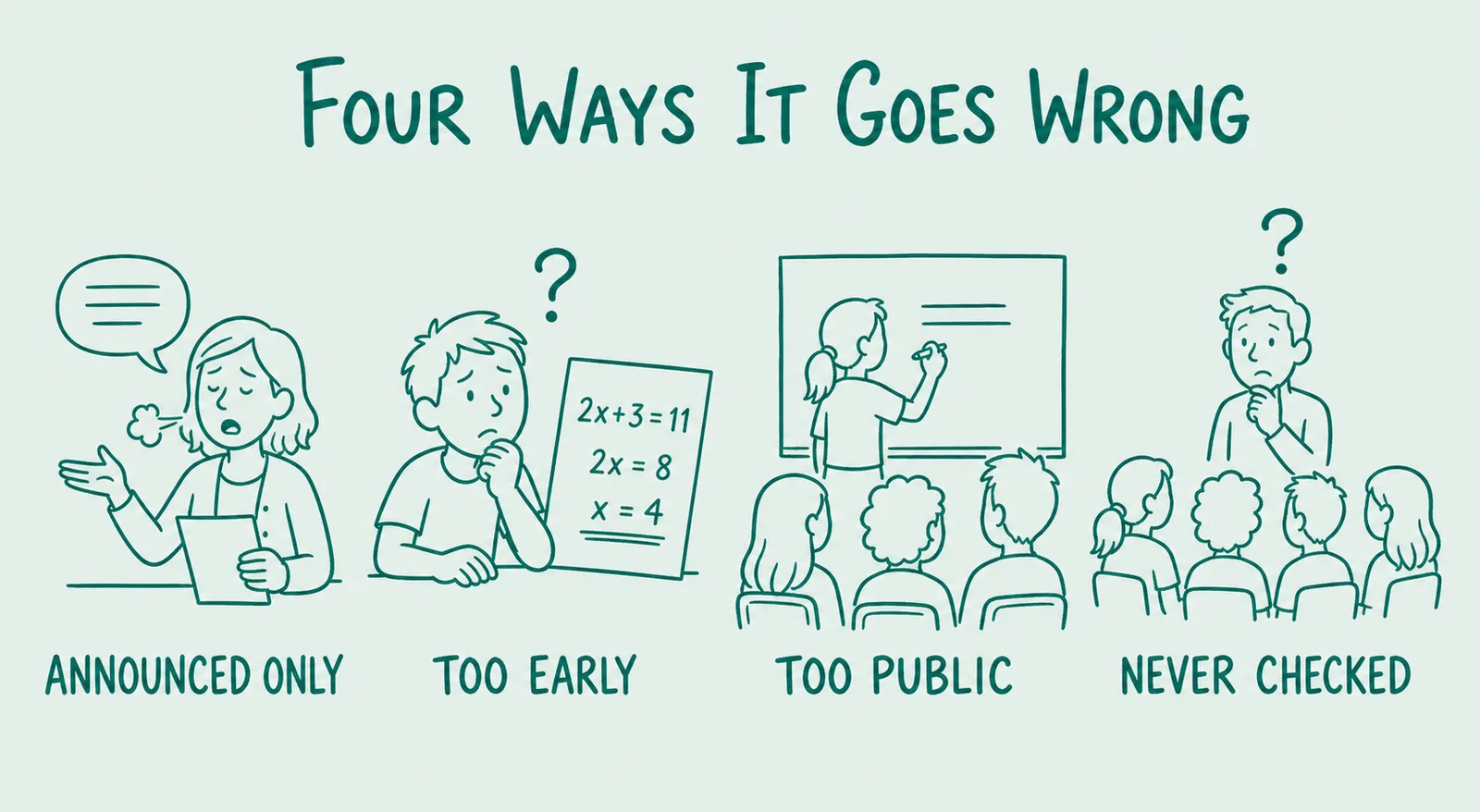
The novice is not the expert. The evidence says learners with less prior knowledge gain least from working on errors. Early in a topic, show correct examples; save the error analysis for when there is something to compare it against.
The public error is not free. Analysing a mistake in front of the class loads working memory and exposes the learner socially at the same moment. Alloway and colleagues (2009) describe the roughly one child in ten for whom working memory is the binding constraint, and that child is being asked to do two hard things at once. Anonymise the error, or pose it as a hypothetical, and you keep the learning without the cost. Our guide to show call covers the same trade-off for written work.
Safety is unfalsifiable from the front. Whether your class experiences an error as useful or humiliating is a judgement made by thirty people you cannot poll. The Education Endowment Foundation's guidance on special educational needs opens with creating a positive and supportive environment for all pupils without exception, and that is a harder standard than it sounds.
The mechanism is well evidenced and the classroom technique is not. No study tests Culture of Error by name; what is tested is learning from errors, largely in laboratories and in mathematics, plus two adjacent literatures drawn from adults at work. Metcalfe states her conclusions as holding at least for neurologically typical learners, which is a boundary worth carrying rather than smoothing over.
A classroom where being wrong carries no social cost, so learners reveal their thinking rather than hiding it. It is technique 12 in Teach Like a Champion 3.0 and the precondition for the techniques that expose thinking publicly.
The confident ones. The hypercorrection effect is that errors committed with high confidence are the most likely to be corrected and to stay corrected. A learner who is sure and wrong is the most valuable person in the room.
Not unless they already know the topic well. Errors helped learners with higher prior knowledge, and only when the error was explicitly flagged. For a novice, an unlabelled error is just a second thing to learn wrongly.
Culture of Error is one of the 63 moves in our complete guide to Teach Like a Champion.
Two techniques sit closest to this one: right is right, which decides what counts as a finished answer.