Updated on
September 24, 2026
Show Call: The Technique Nobody Has Studied
Show Call puts a learner’s work on the board and teaches from it. No study of it exists, and the nearest evidence favours showing correct work over wrong.


Updated on
September 24, 2026
Show Call puts a learner’s work on the board and teaches from it. No study of it exists, and the nearest evidence favours showing correct work over wrong.
What is Show Call in Teach Like a Champion?
Show Call is technique 13 in Teach Like a Champion 3.0, in the chapter on checking for understanding. The teacher takes a learner’s written work, displays it to the whole class on a visualiser or as a photograph, and teaches directly from it, including from its errors. It is paired in the book with Culture of Error, technique 12, which is the condition that makes it safe.
Show Call is the technique teachers are most nervous about and the one with the least evidence behind it. Those two facts are related, and neither is a reason to drop it.
Show Call means taking a learner's written work, putting it in front of the whole class on a visualiser or a photograph, and teaching directly from it, including from what is wrong with it. It is technique 13 in Teach Like a Champion 3.0 (Lemov, 2021), in the chapter on checking for understanding, and it is paired there with Culture of Error, technique 12. A teacher circulating during independent work photographs one learner's answer, puts it on the board, and the class spends four minutes on the line where it goes wrong.
Here is the finding that should shape how you use it. A systematic search of the education research databases returns no empirical study of Show Call, and none of publicly displaying an individual learner's written work as an instructional move. ERIC returns zero records for the technique by name. It is a practice claim drawn from watching successful teachers, not a tested intervention, and Lemov has never said otherwise.
That leaves the adjacent evidence, and it is more awkward than the technique's rationale assumes. The largest recent synthesis of learning from examples, Barbieri and colleagues (2023), screened 8,033 abstracts and pooled 181 effect sizes in mathematics. Worked examples helped overall, at g = 0.48. But studies using correct examples alone produced larger effects than those using incorrect examples, alone or in combination. Their own conclusion is that correct examples are particularly beneficial for learning overall.
Show Call is the act of making one learner's written work visible to the whole class and then teaching from it in real time. The teacher circulates, finds a piece of work worth everyone seeing, puts it up, and talks the class through what it does well or where it goes wrong. Its purpose is to make written work public property, so that the standard is visible rather than described.
Three things, and they are different jobs. It shows the class what a good answer actually looks like rather than what you said it should look like. It raises the stakes of written work, because anything might be shown. And it lets a misconception be examined by everyone at once instead of corrected thirty times in a marking pile.
The third of those is the strongest argument for it, and it is the one that depends most on the class feeling safe.
There is no direct evidence, some useful adjacent evidence, and a finding in that adjacent evidence that runs against the technique's usual rationale. Taken together the honest position is that Show Call is plausible, unstudied, and worth doing carefully rather than confidently.
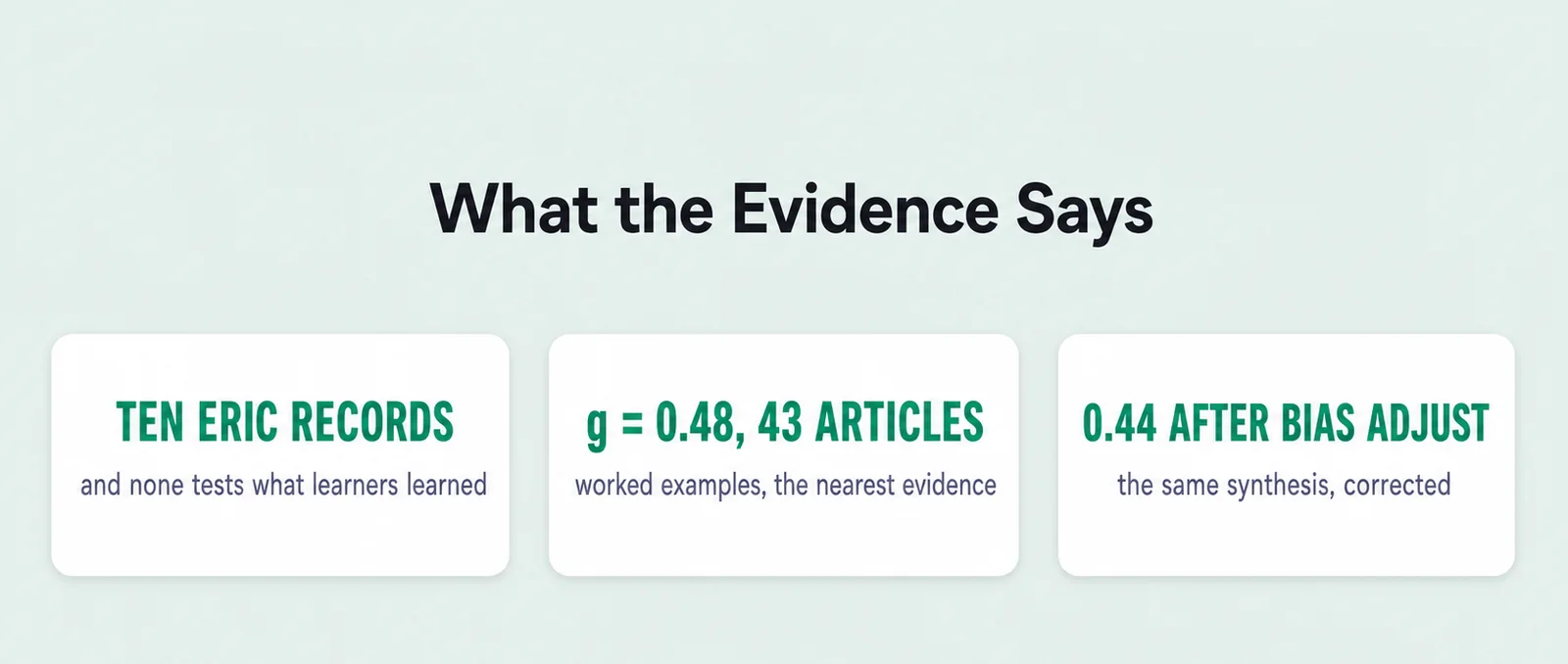
This is a measured result rather than an impression. Searches of ERIC by title and description, of OpenAlex and of Semantic Scholar across several phrasings return nothing that evaluates Show Call, or public display of an individual's written work, against learner outcomes. The ten ERIC records for "Teach Like a Champion" are Lemov's own books, a magazine piece, an article about teacher residencies, and one doctoral dissertation on the effect of the training on teacher self-efficacy, not on what learners learned.
Say that plainly rather than dressing the technique in borrowed evidence. Field observation of teachers whose classes did well is how the book was written, and it is a legitimate way to generate a hypothesis.
The nearest research base is worked examples. Sweller and Cooper (1985) established that studying a worked solution can beat solving the problem yourself while you are still learning, and the effect has held up. Barbieri and colleagues (2023) is the recent synthesis: 43 articles, 181 effect sizes, overall g = 0.48, and 0.44 after adjusting for publication bias.
The moderator is the part that matters here. Correct examples alone outperformed incorrect examples alone, and outperformed correct and incorrect together. If your reason for Show Calling a wrong answer is "the research on worked examples supports it", the most recent synthesis of that research does not, at least in mathematics.
That is not the end of the argument, because learning from errors has its own literature and it is real. Metcalfe's (2017) review concludes that error avoidance appears to be the rule in classrooms and may be counterproductive, and that errorful learning followed by corrective feedback benefits learning. She adds a caveat worth carrying: the conclusion is stated as holding at least for neurologically typical learners.
The closest single study to what Show Call actually does is Heemsoth and Heinze (2016), a field experiment with secondary learners reflecting on the reasoning behind their own errors. It supports the mechanism. It differs from Show Call in the way that matters most: the reflection was private.
The specific thing Show Call adds to all of the above is publicity, and publicity is exactly the variable nobody has isolated. There is research on displaying aggregate clicker results to a class, which is anonymous, and research on collective quiz feedback, one paper on which describes the effect in its own title as a double-edged sword. Neither tests putting one identifiable learner's work on the board.
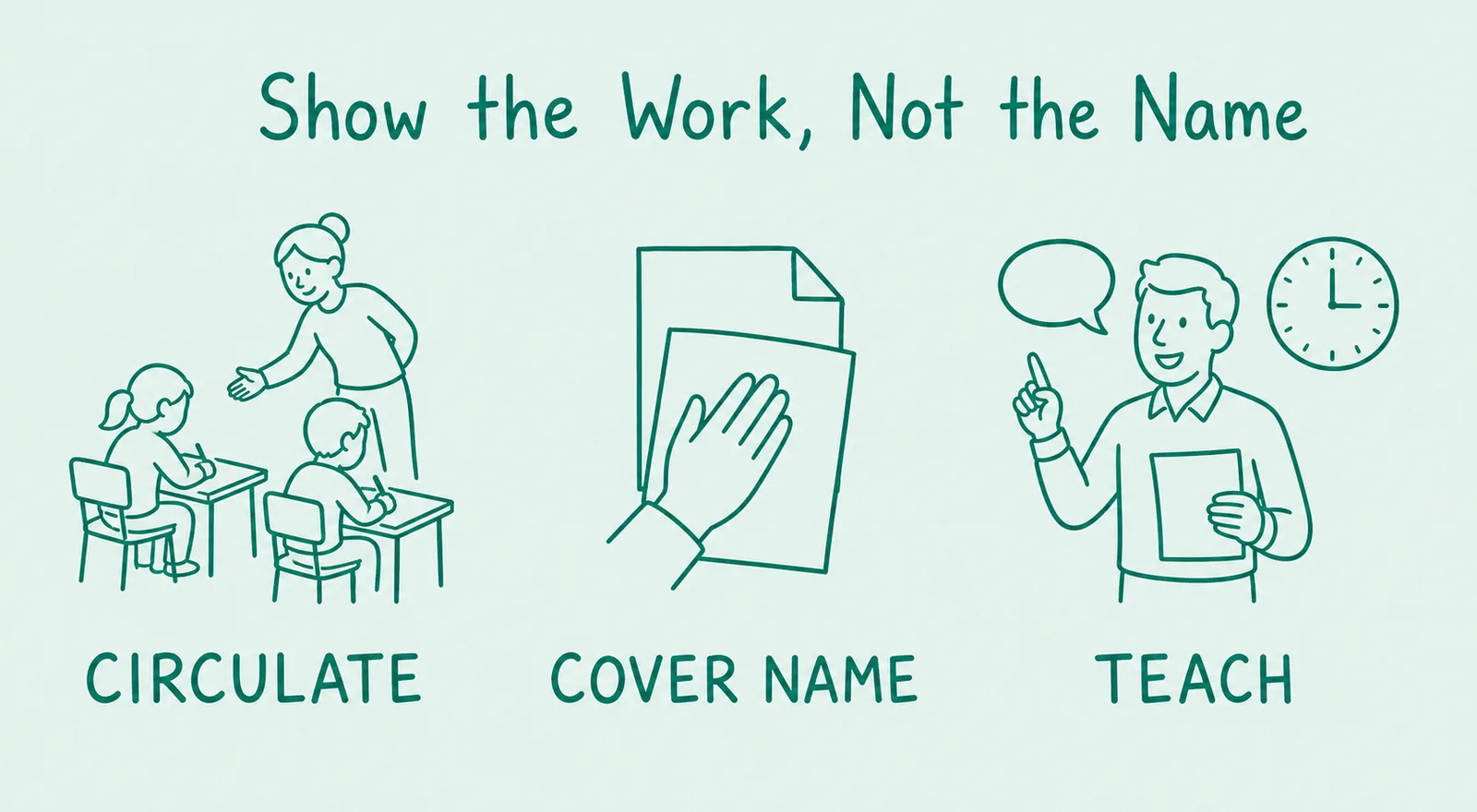
Because the untested variable is publicity, every safeguard here works by reducing the exposure while keeping the teaching. Show the work rather than the writer, ask before you display until the class no longer needs asking, show more correct work than incorrect, and keep the commentary on the work rather than the person. Four rules, and they do most of the work.
Show the work, not the writer. Nothing in the technique requires the class to know whose book it is. Cover the name, or photograph the work without it. A teacher who says "look at this" rather than "look at Jamie's" gets the entire instructional benefit and almost none of the social cost.
Ask first, at least until the culture holds. Circulating and saying quietly "can I put this up?" costs three seconds. Once a class has watched errors discussed usefully a dozen times, you will find you no longer need to ask, and that is the signal the culture has arrived rather than a reason to skip the step.
Show more correct work than incorrect. This follows the evidence rather than the folklore. If the ratio in your lessons is mostly errors, the class learns that being shown means being wrong, and the technique starts to work against itself.
Teach from the work, not about the learner. "This line is where it goes wrong, and it is the commonest place to go wrong" keeps the analysis on the mathematics. "Who can tell me what they did wrong here?" invites the class to evaluate a person.
Show Call depends completely on what you already know about the class, because you have to find work worth showing while circulating. It sits in the same chapter as the other checking moves in our complete guide to Teach Like a Champion.
The publicity that makes Show Call powerful is the same thing that makes it risky, and the risk is not evenly distributed across a class. Anxious learners, learners whose handwriting marks them out, and learners with low confidence in the subject all carry more of it than their classmates do, and none of that is visible from the front of the room.
For an anxious learner, the possibility is the problem, not the event. If any book might go up, a learner who fears it will spend the lesson managing that rather than working. Naming the rule out loud, that you always ask first, removes the fear without removing the technique.
For a learner whose handwriting or spelling marks them out, displaying the page displays the difficulty, whatever the intended focus. Type it up, or transcribe the relevant line onto the board, and the reasoning is still there for the class to work on.
For a learner with low confidence in the subject, being shown as the example of the misconception confirms what they already believe about themselves. Metcalfe's caveat is relevant here too: the learning-from-errors literature reports its conclusions for neurologically typical learners, and the transfer to everyone else is an assumption.
Anonymise by default and you keep almost everything. The instructional value is in the work. The only thing the name adds is exposure, and there is no evidence that exposure is the active ingredient. Our guide to SEND-friendly classrooms covers the wider principle.
Show Call is a plausible technique with an evidence base that does not exist yet, and one adjacent finding pointing the other way. It has never been tested by name, its usual justification cites a literature whose moderator runs against it, and the safety condition it depends on cannot be checked from where the teacher is standing. Three qualifications matter.
It has never been tested. Not once, by name, against learner outcomes. Anyone presenting it as evidence-based is describing the confidence of the book, not the state of the research.
Its usual justification cites work that does not support it. The worked-examples literature is cited in defence of showing wrong answers, and the most recent meta-analysis of that literature finds correct examples do better. Citing the source without the moderator misrepresents it.
The safety condition is doing all the work and is unfalsifiable from the front of the room. Whether a class experiences an error being discussed as useful or as humiliating is a judgement made by thirty people you cannot poll. A teacher who believes their culture of error is strong may be right, and has no way of knowing from where they are standing.
It is technique 13, in the checking for understanding chapter. The teacher takes a learner's written work, displays it to the whole class on a visualiser or as a photograph, and teaches directly from it, including from its errors.
No direct evidence exists. Searches of the education research databases return no empirical study of the technique. The adjacent worked-examples and learning-from-errors literatures are relevant, and the worked-examples meta-analysis actually favours showing correct work over incorrect.
There is no reason to. The instructional value sits entirely in the work. Anonymising keeps the teaching and removes almost all of the social risk, and nothing in the evidence suggests exposure is the active ingredient.
Yes, at least while you are building the culture. It costs a few seconds while circulating. When you find you no longer need to ask, that is a signal the class has accepted error as normal, which is what the technique needs to work.
It is technique 12, in the same chapter, and it is the precondition for Show Call. It means making being wrong normal and safe so that misconceptions surface early rather than staying hidden until the test.
Every reference below was checked twice: once to confirm it exists, and again to confirm the record it resolves to is the study being cited. Where a claim is that something does NOT exist, the searches run to establish that are described in the article rather than left as an assertion.