Updated on
September 24, 2026
Context-Dependent Learning: Memory Cues and Exam Recall
Context-dependent learning explains how matching cues support recall. Use varied settings and mental reinstatement to help learners remember in exams.

Updated on
September 24, 2026
Context-dependent learning explains how matching cues support recall. Use varied settings and mental reinstatement to help learners remember in exams.
Context-dependent learning can help teachers think carefully about where and how learners practise retrieval. The evidence shows that environmental and internal cues can support recall, especially in free-recall tasks, but classroom use should be modest: vary practice, teach mental reinstatement, and avoid promising dramatic exam gains from room changes alone.
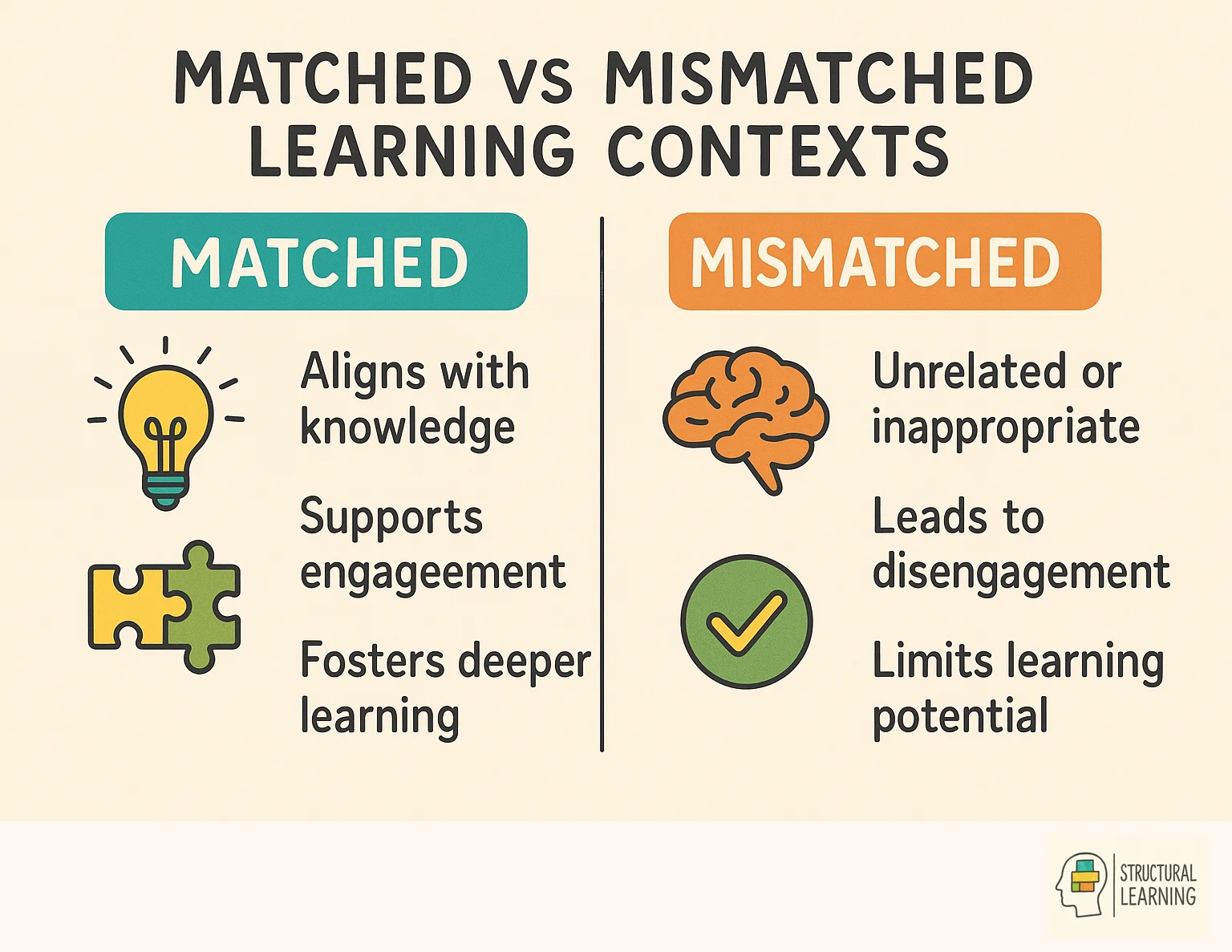
This frustrating phenomenon has a scientific explanation. Context-dependent learning describes how the context in which we learn becomes linked to what we learn. When retrieval context matches learning context, memory works well. When contexts differ, retrieval becomes harder, even though the information is still there.
Context affects memory, so vary learning. Exams differ from lessons. Teachers can design learning objectives with this in mind. Varying contexts helps learners transfer knowledge. Explain context's role to improve learning strategies.
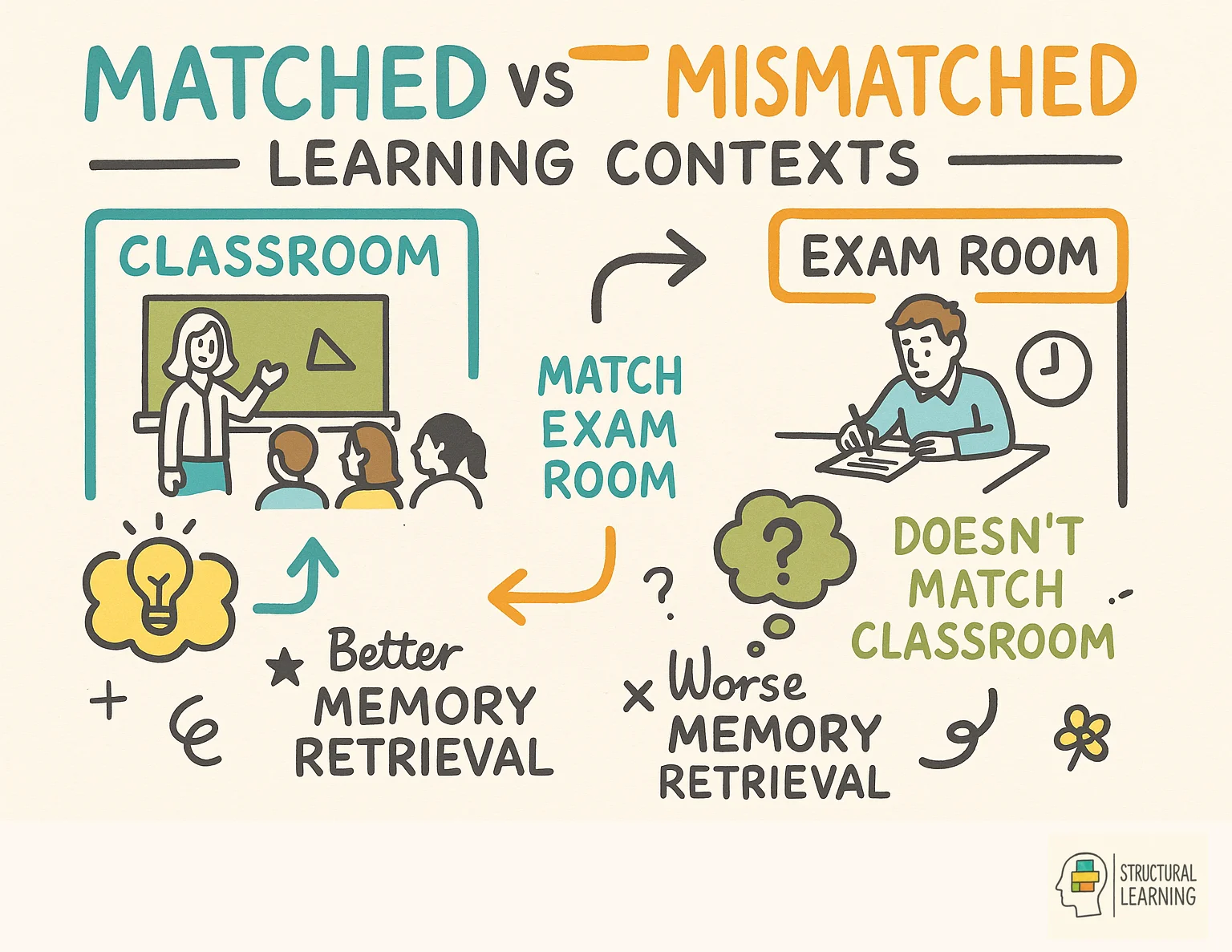
Context-dependent learning means students remember information better when the retrieval environment matches where they learned it. The physical location, sounds, and even smells during learning become retrieval cues that help access memories. Teachers can improve student performance by varying practise contexts and explicitly teaching about these memory effects.
This concept has implications for learning. Godden and Baddeley (1975) showed recall is better when the learning and testing environments match. The senses experienced during learning, like sights and sounds, become memory cues (Smith, 1979).
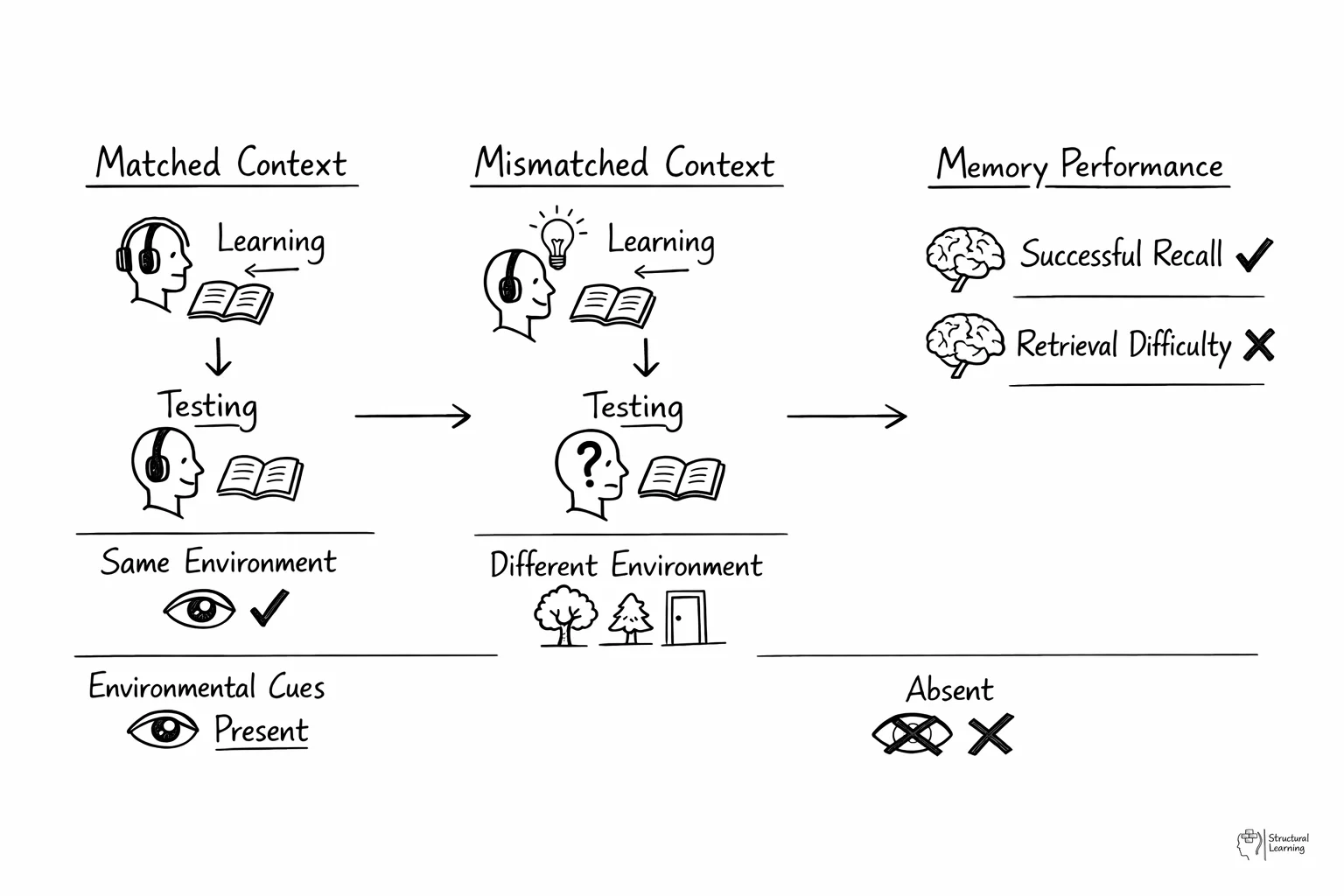
The classic demonstration comes from Godden and Baddeley's 1975 experiment with scuba divers. Divers learned word lists either underwater or on dry land, then were tested in either the same or different environment. Those tested in the same environment they learned in remembered about 50% more than those tested in a different environment.
Murre et al (2021) could not repeat Godden and Baddeley's (1975) scuba study in Royal Society Open Science. This suggests context memory effects exist but are less strong than initially thought. Smith and Vela's (2001) review gives more support for the idea. Reminding learners about the context still helps if they cannot go back.
This finding has been replicated across many contexts. This finding has been replicated across many contexts, from oracy skillsdevelopment to academic subjects. Students who learn in one classroom and are tested in another often perform worse than those tested where they learned. Even subtle environmental changes can affect retrieval.
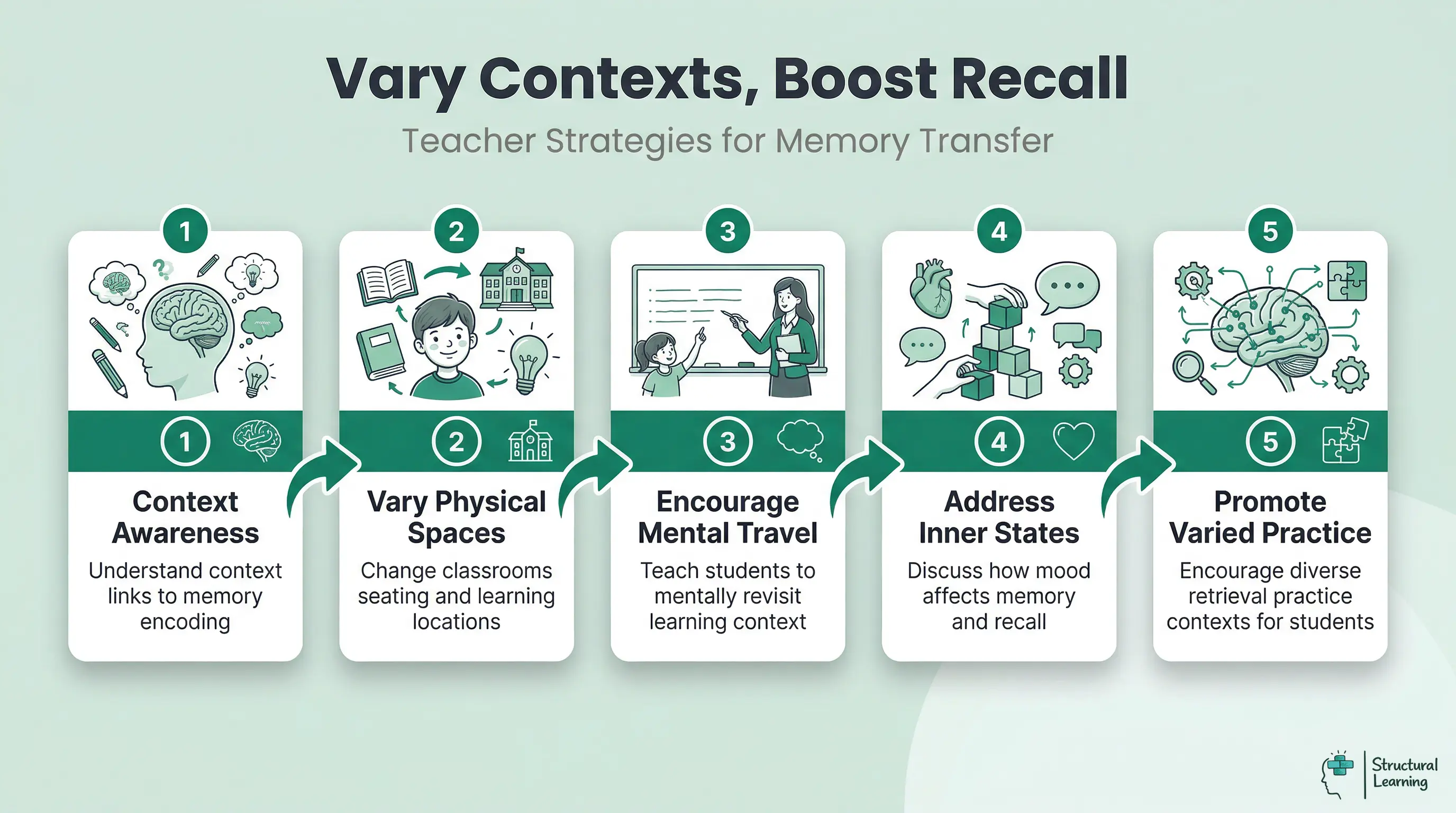
Context dependence reflects a fundamental feature of how memory works. Memories aren't stored as isolated files but as patterns of neural activation that include contextual elements. When you encounter the same context again, those contextual cues help reactivate the complete memory pattern.
Smith (1979) showed that environmental context can cue recall, while Smith and Vela (2001) found that the overall effect is modest and task-dependent. Context is most useful when learners need free recall and have few other retrieval cues. This makes context a helpful design factor, not the whole explanation for memory.
Understanding why context matters helps teachers design instruction that builds transferable knowledge.
Endel Tulving's encoding specificity principle states that retrieval cues are effective only to the extent that they were encoded along with the target information. Information is always learned in a context, and that context becomes part of what's encoded.
When you learn something in a particular room, aspects of that room become associated with the memory. The colour of the walls, the arrangement of desks, the ambient sounds all get encoded alongside the academic content. These contextual elements then serve as retrieval cues.
Tulving and Thomson (1973) argued that retrieval works best when the cues available at recall overlap with the cues encoded during learning. Classroom context, task format and emotional state can all become cues, but well-organised knowledge and retrieval practice can reduce dependence on any single cue.
In a familiar classroom, the visual environment activates memories of previous learning in that space. This contextual priming makes related academic content more accessible. In an unfamiliar exam hall, these cues are absent.
Smith (1979) found mental reinstatement helps learners recall information. Learners can mentally picture the original learning place. This helps them access memories, even in a new place (Godden & Baddeley, 1975).
This has practical implications. Teaching students to visualise where they learned information, what was happening, and how they felt can support retrieval in novel contexts.
State-dependent memory means learners recall facts when their mood matches the learning context. (Bower, 1981). A calm learner may struggle to recall facts when anxious (Godden & Baddeley, 1975). Teachers can teach relaxation and vary practise conditions (Smith, 1979).
State-dependent memory, like context memory, affects recall. Internal states at learning and retrieval influence a learner's memory (Godden & Baddeley, 1975; Smith, 1979; Eich, 1980; Bower, 1981).
Memories encoded in a particular mood are more accessible when that mood recurs. Happy memories are more easily retrieved when happy; sad memories when sad. This creates self-reinforcing patterns that can contribute to depression or anxiety.
For teachers, this suggests that creating positive emotional states during learning may support retrieval in similar positive states. However, since exams often produce anxiety, learning in consistently positive states might create a mismatch.
Studies have shown that memory is better when the pharmacological state at retrieval matches encoding. Students who drink coffee while studying retrieve better when caffeinated during testing than when uncaffeinated, for example.
This isn't an argument for constant caffeine consumption, but it illustrates how internal states, like external contexts, become associated with memories.
Learners' physical states affect memory. Hunger, tiredness or inactivity all impact recall (Smith, 1979). These state-dependent effects complicate retrieval in varied contexts (Godden & Baddeley, 1975; Tulving & Thomson, 1973).
Vary practice locations and task conditions when the goal is flexible recall. Smith and Vela (2001) support the general principle that context can affect memory, while Bjork (1994) explains why carefully varied practice can build more durable learning. Keep the changes purposeful: switch room, seating, task format or retrieval cue only when it supports the learning goal.
Context dependence has several practical implications for teaching and learning.
Students typically learn in familiar classrooms but take high-stakes exams in unfamiliar halls. This context mismatch can impair retrieval, adding to exam anxiety a genuine cognitive disadvantage.
Schools can address this by:
If learning is too tied to a single context, knowledge becomes inflexible. Students may know something perfectly in the classroom where they learned it but struggle to apply the same knowledge elsewhere.
Varied practise helps learners retrieve information in different contexts. Encoding across environments links knowledge to cues (Smith, 1979). This helps learners access information from many situations (Godden & Baddeley, 1975; Bjork, 1994).
This principle explains why learning only in the classroom can produce poor transfer to real-world applications. Varied learning contexts produce more flexible, applicable knowledge.
Homework can change the retrieval context, but that does not automatically improve learning. Learners should practise retrieving important knowledge in more than one setting, then check whether they can recall it without the original notes, room or prompts. This uses context variation as a retrieval cue strategy rather than as a generic homework claim.
When learners revise in only one place, their recall can become tied to that setting. Use occasional context variation and retrieval without notes to check whether knowledge is accessible beyond the original learning environment (Smith, 1979; Smith & Vela, 2001).
Interleaving practise in classrooms helps learners. Vary the physical space; this improves learning (Rohrer, 2009). Learners teaching peers in varied locations builds understanding (Nestojko et al., 2014). Practise tests in the exam room help learners adjust (Agarwal et al., 2012).
Several strategies help students build context-independent knowledge.
When possible, vary where learning and practise occur. Conduct some revision in different classrooms, outside spaces, or even corridors. The variety produces memories associated with multiple contexts.
This is especially important for content that students will need to retrieve in novel situations, such as exam halls or real-world applications.
Learners can build more than one retrieval route when they meet the same idea through explanation, diagrams, examples, discussion and independent recall. This is better framed as varied encoding and retrieval practice. Match the activity to the later task: if learners must explain, make them practise explaining.
Dual coding, presenting information both verbally and visually, creates multiple encoding routes tha t don't all depend on the same contextual cues.
Practising the same type of problem repeatedly in the same format creates context-dependent procedural knowledge. Varying problem formats, wordings, and presentation styles builds more flexible skills.
Interleaving different problem types naturally varies context, as does mixing old and new content in practice sessions.
If exams will occur in unfamiliar environments, practise retrieval in varied and unfamiliar settings. This builds tolerance for context change and creates memories associated with multiple contextual cues.
Retrieval practice conducted only in the regular classroom produces retrieval skills tuned to that context. Retrieval practised across contexts produces more strong skills.
Students can partly compensate for context mismatch by mentally reinstating the learning context. Before attempting retrieval, they visualise where they learned the material, what was happening, and how they felt.
This technique doesn't fully eliminate context effects, but it can help bridge the gap between learning and testing environments. Students facing exams in unfamiliar halls might benefit from spending a moment visualising their classroom before beginning.
While external context is hard to control, internal cues can be made more consistent. Encouraging students to adopt consistent pre-study and pre-exam routines may create state-dependent bridges between learning and testing.
Taking a few deep breaths, reviewing key concepts briefly, or engaging in a consistent mental preparation routine could help align internal states across contexts.
Transfer improves when students practise applying knowledge in multiple contexts from the beginning rather than mastering it in one setting first. Teachers should explicitly connect new situations to previous learning and help students identify underlying principles that remain constant across contexts. Using real-world examples and field trips provides authentic contexts that enhance transfer.
Context dependence relates closely to transfer of learning: the application of knowledge and skills to new situations.
Transfer is difficult partly because learning contexts differ from application contexts. Knowledge encoded in a classroom context may not activate when needed in a workplace, home, or novel problem-solving situation.
The more learning is tied to specific contextual cues, the harder transfer becomes. This is why transfer of learning requires deliberate attention rather than occurring automatically.
To support transfer, learning should occur across varied contexts and with explicit attention to how knowledge applies beyond the immediate situation. Discuss when and where the learning would be useful. Practise applying knowledge to varied scenarios.
Learners apply abstract principles better than specific procedures because context matters less (Barnett & Ceci, 2002). Present underlying ideas with clear examples to encourage flexible thinking (Anderson et al., 1996; Bransford et al., 1999).
Knowledge intended for real-world use should be practised in contexts approximating real-world conditions. Learning only in idealised classroom conditions can produce knowledge that feels unavailable when actually needed.
This is why practical applications, field trips, simulations, and authentic tasks support transfer. They create learning associated with contexts similar to eventual use.
Context effects vary by task, material and assessment format. Free recall tends to show stronger context dependence than recognition, and transfer is harder when learners only practise in one narrow format. Treat subject examples as planning prompts rather than fixed percentages or rankings unless a study directly reports that outcome for the same task.
Context effects appear across all subject areas, though their strength varies.
Language learningshows strong context effects. Vocabulary learned in classroom drills may not come to mind in actual conversations. Phrases practised in one context may feel unavailable in another.
This argues for practising language in varied communicative contexts rather than only through repetitive drills. Role plays, conversations about varied topics, and language use outside formal lessons all build more flexible linguistic knowledge.
Mathematical procedures learned in textbook problem contexts may not transfer to word problems, real-world applications, or differently formatted questions. The surface features of how problems appear can create context dependence.
Learners gain flexible maths skills by seeing varied problem types and styles (Brownell, 1942). Unfamiliar features in problems reduce context dependency (Kaminski et al., 2008; Goldstone & Sakamoto, 2003).
This disconnect highlights a critical challenge for science education. Scientific knowledge often struggles to transfer to real-world situations. Learners might ace science tests, yet hold onto misconceptions outside the classroom (Smith, 1991; Driver et al., 1994).
Researchers (Osborne & Dillon, 2008) say science should link to real life. Learners need to practise reasoning in different situations, not just lessons (Abrahams & Millar, 2008). This approach makes science more meaningful (DeBoer, 1991).
Historical knowledge can become tied to the specific narratives and contexts in which it was taught. Students may struggle to recognise the same historical principles operating in unfamiliar periods or regions.
Instructors must compare cases to build learners' historical reasoning. Parallels across time periods, noted by (Lee, 1983), aid transfer. Practice with diverse examples, shown by (Counsell, 2004), improves historical thought. (Wineburg, 2001) also found this effective.
Some researchers hypothesise that students with anxiety, ADHD, or autism spectrum conditions may show stronger context-dependent effects, as environmental changes could be more transformative to their cognitive processes. However, research in this area remains limited and findings are mixed. Younger students and those new to a subject also rely more heavily on contextual cues. Teachers can provide extra support by gradually introducing context variations and teaching explicit memory strategies.
Students vary in how strongly context affects their memory.
Research by Unsworth (2007) shows learners with strong working memory use internal strategies. These learners rely less on context for retrieval, suggest Kane and Engle (2000). This might help them recall information independently, according to Jarrold and Towse (2006).
Research by Jarodzka et al. (2017) found consistency helps learners. Sweller et al. (1998) suggest intensive practise helps learners, too. Baddeley's (2003) mental reinstatement strategies may also help learners with memory limits.
(Malpass & Beckmann, 2017) find anxious learners show stronger context effects. Anxiety uses mental resources that help flexible recall. (Eysenck et al., 2007) state high-stakes tests make learners anxious. This is problematic (Hodges & Sokolowski, 2020).
Anxiety can affect attention and recall. Use familiarisation with assessment settings, low-stakes retrieval and clear routines as practical supports, while keeping clinical or diagnostic claims outside the scope of this memory article.
Students with strong prior knowledge can rely more on internal conceptual connections and less on external contextual cues. Their knowledge is better integrated into stable schemas that don't depend heavily on context for activation.
Building strong conceptual understanding, not just isolated facts, produces more context-independent knowledge.
Students should study in multiple locations and vary their study conditions, including noise levels and time of day. Creating mental contexts through visualision and self-testing in different environments builds stronger, more flexible memories. Teaching the material to others and using varied practise problems helps develop understanding that transcends specific contexts.
Students can use context research to improve their own learning and revision.
Rather than always studying in the same place, varying study locations produces memories associated with multiple contexts. This reduces dependence on any single environment for retrieval.
Practise some retrieval under exam-like conditions, but do not make all practice sterile or stressful. Use a mix: some recall in the usual classroom, some in a quiet timed setting, and some in new contexts. This helps learners separate the knowledge from one room or mood while still preparing for assessment demands.
Before attempting recall, mentally return to where the learning occurred. Visualise the room, the page, the discussion. This partial reinstatement can improve retrieval even when physical context differs.
Bjork (1994) supports the broader idea that useful difficulty can strengthen later learning, while Smith (1979) and Smith and Vela (2001) show why context cues matter. The classroom translation is not constant novelty; it is planned variation plus retrieval so learners can access knowledge beyond the original lesson setting.
Metacognitive awareness of how memory works can support better study choices. Teach learners why rereading in one comfortable place can feel fluent, then ask them to retrieve in a different setting or format to test whether the knowledge is portable (Bjork, 1994; Rohrer, 2009).
Godden and Baddeley (1975) showed that context can matter, and later reviews show the effect is usually smaller in ordinary conditions. Use familiar assessment settings when possible, but also teach learners to retrieve in varied places and to mentally reinstate the lesson context when they face an unfamiliar room.
Context-dependent learning reveals that memory is not just about what we learn but where and how we learn it. This has practical implications for instruction, revision, and assessment.
Teachers can support context-independent learning by:
Students can reduce context dependence by:
The goal isn't to eliminate context effects, which are deeply embedded in how memory works, but to build knowledge flexible enough to survive context changes.
Context-dependent memory is the brain's tendency to recall information more effectively when the retrieval environment matches the original learning environment. Put simply, students remember better when they're in the same place, mood, or situation where they first learnt the material. This phenomenon, first demonstrated by Godden and Baddeley's 1975 underwater study, shows that divers who learnt word lists underwater recalled them better underwater than on dry land, and vice versa.
The implications for teaching are profound. When students revise exclusively in their bedrooms, their memory becomes tied to that specific context; the familiar posters, desk arrangement, and even background sounds all become retrieval cues. Move them to an unfamiliar exam hall, and these contextual anchors vanish, making recall significantly harder. This explains why capable students sometimes underperform in tests despite knowing the material well.
Context extends beyond physical location. Internal states matter too: if students learn whilst relaxed and well-rested, they may struggle to access that knowledge when anxious during exams. Even seemingly trivial details like background music, room temperature, or the presence of classmates can become part of the memory trace.
As teachers, we can turn this principle to our advantage. Try teaching the same topic in different classrooms, or occasionally hold revision sessions in the sports hall where exams take place. Encourage students to vary their study locations at home, perhaps alternating between the kitchen table, library, and bedroom. When introducing crucial exam content, deliberately create neutral conditions that mirror test environments: silence, individual work, and timed practise. This builds what researchers call "context-independent" memories that remain accessible regardless of surroundings.
Godden and Baddeley showed that context helps memory. Learners recall information better when the environment matches. This principle means learners may struggle on exams in different locations (Godden & Baddeley).
The core mechanism involves environmental cues becoming encoded alongside the actual learning material. When students study in their usual classroom, everything from the wall displays to the seating arrangement becomes part of their memory network. Remove these cues, and accessing the information becomes significantly harder, even though the knowledge remains intact.
For teachers, this is both tricky and useful. Assessments differ from learning places. Understand this, and prepare learners for context changes. Rotate teaching locations weekly. Try the library, outdoors, or change classroom furniture. This builds "context-independent memories" (Godden & Baddeley, 1975; Smith, 1979).
Researchers have found learners benefit from internal context cues. Before key topics, teach learners a specific posture. They could also use breathing patterns or visualisation techniques. Encourage learners to recreate these cues during exams, as per research. These cues replace missing environmental reminders.
Talk to your learners about varied practise. Understanding improves exam results (Rohrer, 2009). Learners then accept, not reject, learning environment changes. Metacognition makes context-dependent learning a tool for success (Bjork, 1994; Kornell, 2009).
The brain doesn't store memories as isolated facts; it weaves them into rich networks that include sensory details from the learning environment. When students study in your classroom, their brains automatically encode the squeaky chair, the poster on the wall, even the smell of whiteboard markers alongside the curriculum content. These environmental cues become retrieval triggers, helping students access information later.
This happens through a process called encoding specificity. During learning, the hippocampus, your brain's memory hub, binds together the content (what you're learning) with the context (where and how you're learning it). Later, when students encounter similar environmental cues, these act as memory prompts, making recall easier. However, when the context changes dramatically, such as moving from a familiar classroom to an exam hall, students lose these helpful triggers.
Research by Godden and Baddeley demonstrated this powerfully: divers who learnt word lists underwater recalled them better underwater than on land, and vice versa. While we can't submerge our students, we can apply this principle practically. Try teaching the same topic in three different locations: your regular classroom, the library, and outdoors. This forces students' brains to create multiple retrieval routes to the same information, reducing dependence on any single context.
Another effective strategy involves teaching students to become aware of their internal context. Before a lesson, ask students to note their mood and energy level. Then, during revision, encourage them to practise recalling information whilst deliberately varying their internal state: when tired, alert, anxious, or calm. This builds context-independent memory that survives the stress and unfamiliarity of exam conditions.
Context-dependent learning is best used as a practical memory-design principle, not as evidence for a separate DfE framework or inspection requirement. Teachers can document how they vary retrieval conditions, familiarise learners with assessment settings and teach mental reinstatement, but those decisions should remain tied to curriculum aims and learner need.
For example, a geography teacher might revisit coastal erosion in the classroom, with diagrams, in a short outdoor walk and through an exam-style written explanation. The point is not novelty for its own sake; it is to help learners retrieve the same concept when surface cues change.
Keep implementation proportionate. Some consistency helps learners feel secure, while some variation helps them avoid over-reliance on one room, prompt or activity. Check impact with delayed retrieval, explanation and transfer questions rather than assuming context variation has worked.
Context-dependent learning means students remember information better when the retrieval environment matches where they learned it. The physical location, sounds, and even smells during learning become retrieval cues that help access memories. This explains why students who know material perfectly in class may struggle in unfamiliar exam halls.
Teachers should vary where and how students practise important concepts rather than always using the same classroom setup. This includes changing seating arrangements, using different rooms, and practising skills in conditions similar to assessment environments. Teachers should also familiarise students with exam venues before tests and teach mental reinstatement techniques.
Context-dependent memory concerns external cues such as location, sound or room layout, while state-dependent memory concerns internal cues such as mood or physiological state. Godden and Baddeley (1975), Smith (1979), Eich (1980), and Bower (1981) support the broad distinction.
Students experience context mismatch when they learn in familiar classrooms but take exams in unfamiliar halls, creating a genuine cognitive disadvantage. The visual environment of their regular classroom activates memories of previous learning, whilst unfamiliar exam halls lack these contextual cues. This context dependence adds to exam anxiety and can impair memory retrieval.
Practise retrieval in different locations, familiarise learners with exam venues where possible and teach mental reinstatement. Before a test, learners can briefly visualise where they learned the material, what the task looked like and the explanation they used. Smith (1979) and Smith and Vela (2001) support this as a plausible, low-cost strategy.
Godden and Baddeley's 1975 experiment showed that divers who were tested in the same environment they learned in remembered about substantially more than those tested in a different environment. This classic study demonstrates that memories aren't stored as isolated files but as patterns that include contextual elements. When you encounter the same context again, those cues help reactivate the complete memory pattern.
Presenting learners with varied learning contexts can support transfer when the variation highlights the underlying principle rather than just changing the scenery. Bjork (1994), Barnett and Ceci (2002), and Morris, Bransford and Franks (1977) support this point about transfer.
These sources draw on traceable DOI records directly relevant to context-dependent memory, encoding specificity, state dependence, transfer and varied practice.