Updated on
September 24, 2026
Call and Response: 112 Calls, and the Evidence
Attention chants have no research behind them. Choral response to content has a little. The difference matters, and so does what unison answers hide from you.


Updated on
September 24, 2026
Attention chants have no research behind them. Choral response to content has a little. The difference matters, and so does what unison answers hide from you.
What is call and response in the classroom?
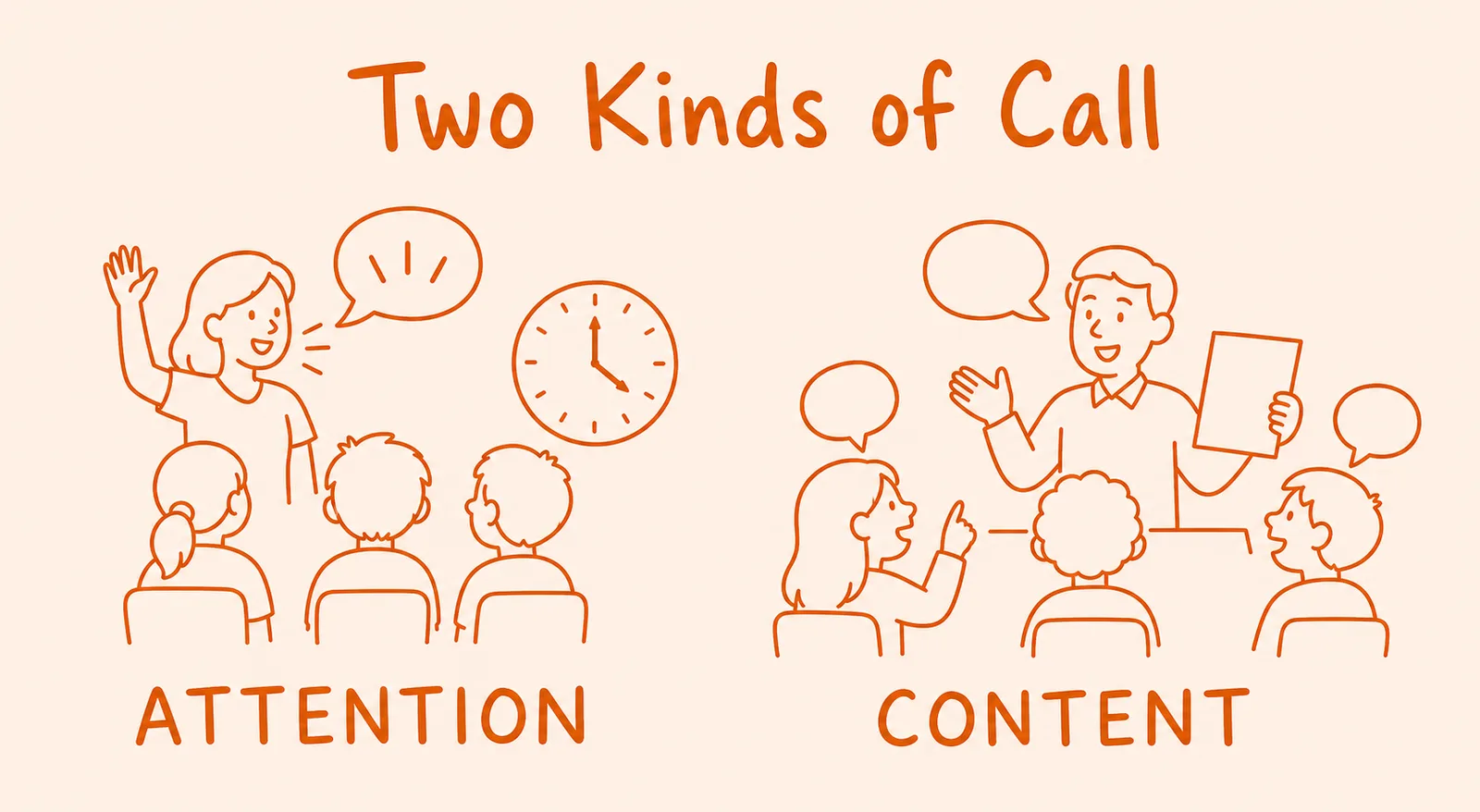
Call and response is any classroom routine where the teacher gives a cue and the whole class answers together in unison. It covers two different things: attention signals such as “one, two, three, eyes on me”, and choral response to academic content, where the class rehearses knowledge aloud together. UK teachers usually call the second version call and respond.
Search for call and response in the classroom and you will get lists of chants. Say "macaroni and cheese", the class says "everybody freeze". None of those pages cite a study, and there is a straightforward reason for that. No study exists.
Call and response is a teaching move in which the teacher says something and the whole class answers together, in unison, on cue. In practice it covers two quite different things: attention signals, which are chants used to stop the room, and choral response to academic content, where the class rehearses knowledge out loud together. British teachers who use the second version usually call it call and respond.
The evidence splits along exactly that line. Attention-getter chants have, as far as a careful search of the literature goes, no empirical base at all. Choral responding to academic content does have a research base, in the behaviour-analytic and special education journals, and it is real but much smaller and narrower than the confident advice around it suggests. The main review, Haydon, Marsicano and Scott (2013), found six studies that met its inclusion criteria, every participant had a disability, and the authors call their own results preliminary. Not one primary study is a randomised trial.
If you came here for the calls themselves, skip to the bank of 60, grouped by what each one is for.
There is a third thing the education blogs borrow without acknowledging. Call and response is a form with a long history in West African and African American musical and civic life, where the response is a community answering and it changes what the leader does next. A classroom attention chant inverts that: it is compliance on cue, and the response changes nothing.
Call and response is any routine where the teacher gives a cue and the whole class replies together in unison. It comes in two forms that serve completely different purposes. One is a management signal used to gather attention, such as "one, two, three, eyes on me". The other is a participation technique used to rehearse subject knowledge aloud. Knowing which one you are running determines whether any of the evidence below applies to you.
"Class, class." "Yes, yes." "One, two, three, eyes on me." "One, two, eyes on you." This is the version that dominates American elementary practice and every listicle on the subject. Its purpose is to stop the room quickly without raising your voice.
It may well work for that. What it does not have is a study. A careful search of the empirical literature returns nothing testing attention-getter chants as an intervention. That does not make them bad practice, and it does mean nobody should present them as evidence-based. They are a convention, and conventions can be perfectly sensible.
The teacher asks a question with one correct answer and the whole class says it together. "The capital of Peru is..." "Lima." "Six sevens are..." "Forty-two." Doug Lemov codifies this as Call and Response, technique 35 in Teach Like a Champion 3.0, in the chapter on building ratio through questioning. In the UK, Craig Barton has given the same move a whole book under the name Call and Respond.
This is the version with a research base, and the rest of this article is mostly about it. It sits alongside cold calling in the same chapter of Lemov's book, and the two techniques solve opposite problems: cold call makes one learner accountable, call and response makes everyone participate. Both belong to the wider set of classroom talk routines covered in the importance of oracy in learning.
The honest summary is that choral responding has a consistent direction of effect across a number of small studies, almost all in special education settings, and no trial. The strongest evidence in the whole area is for a neighbouring technique that fixes choral response's biggest flaw. That contrast is the most useful thing here.
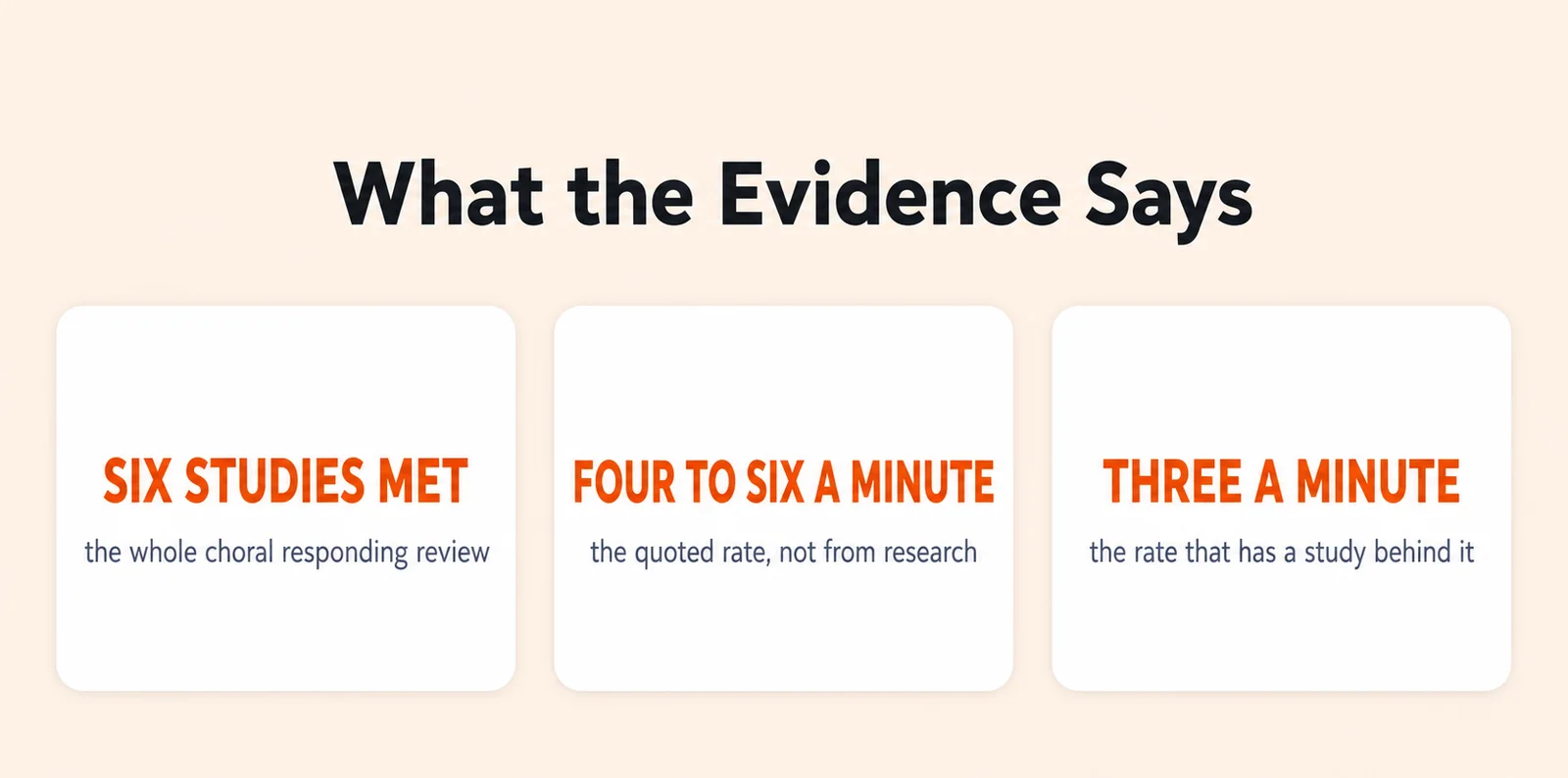
Haydon, Marsicano and Scott (2013) reviewed the literature comparing choral and individual responding. Six studies met inclusion. Participants ran from pre-school to grade 12 and all had disabilities. Choral responding beat individual responding on active responding, correct responses and on-task behaviour, and the effectiveness rose when individual responses were interspersed.
The authors describe their own results as preliminary rather than comprehensive and definitive. They report no effect sizes. Every primary study underneath the review is a single-case design, several with participant numbers in single figures. The right sentence is "a consistent direction of effect across many small studies in special education settings". The wrong sentence is "research shows".
It is worth knowing that the most widely circulated document on choral responding, a manuscript titled "Good Noise!", never completed peer review. Its own title page asks readers not to quote or disseminate it without permission. It is cited across the internet as though it were a paper. When a field's best-known source is an unfinished manuscript, that tells you something about the field.
Randolph's (2007) meta-analysis of response cards is the one properly meta-analytic piece of work in this area, and it is not about choral responding at all. Response cards are written and individually visible: every learner holds up their own answer. Choral responding is spoken and collective.
That difference is the argument. The best-evidenced version of "get everyone answering" is the one where you can see each individual answer. Choral response gets everyone answering and hides who got it wrong. If you want the participation benefit without the blind spot, mini whiteboards do the same job with the information intact.
This is the central weakness, and unusually it has been studied directly rather than merely asserted.
In a unison answer, a learner who does not know can mouth along a fraction of a second behind everyone else and be completely undetectable. The confident half of the class carries the sound. You hear a correct answer from the room and conclude the room knows it, which is the "everyone said it so everyone knows it" fallacy.
Foster and colleagues (2009) worked with learners who responded at low levels during whole-group choral responding and interspersed targeted individual questions to them. Their responding rose, accuracy held or improved, and their participation went up. So the fix is not to abandon choral response. It is to break it with named individual questions often enough that mouthing along stops being a viable strategy.
Call and Response is one of the 63 moves set out in our complete guide to Teach Like a Champion. Almost every page about opportunities to respond quotes a rate: four to six responses per minute for new material, eight to twelve for review. Those figures are repeated across the professional literature and thousands of blog posts as though they were an empirical finding.
They trace to the Council for Exceptional Children's 1987 Academy for Effective Instruction, a professional development manual for teachers of, in its own subtitle, "mildly handicapped students". It is not a study. It is not peer reviewed. It is thirty-nine years old and it is not readily available to read.
The rate that does have a study behind it is lower. MacSuga-Gage and Gage (2015) support a criterion of at least three opportunities to respond per minute, with the explicit caveat that higher rates may help but the research is not there yet.
So the honest version for a UK secondary classroom in 2026 is: aim for at least three a minute, and treat four to six as a training-manual convention rather than a target with evidence behind it.
Call and response is a musical and civic form that developed in western and central Africa, travelled to the Americas through the Middle Passage, and shaped the ring shout, the spirituals, gospel, blues and jazz. It is much older than the classroom, and crediting it properly is not decoration. It changes how you read what happens when a class chants back on cue.
Call and response as a musical and social pattern developed in western and central Africa and travelled to the Americas through the Middle Passage. It shaped the ring shout, the spirituals that grew from it, and in turn gospel, blues and jazz. In parts of African civic life the same alternation between one voice and the group operates well beyond music, in public gatherings and collective deliberation. Burnim and Maultsby's African American Music: An Introduction is the standard scholarly treatment, and the Smithsonian and the Library of Congress both hold accessible public collections on the subject.
The point that matters for a classroom is what the response is for. In the original form, the community's answer is genuinely an answer, and it changes what the leader does next. In a classroom attention chant, the response is a signal of compliance and it changes nothing. The academic version sits somewhere between: the class answers with content, and if you are listening properly the answer should change what you do next. If it does not, you have borrowed the form and left the function behind.
The inclusion picture is more interesting than the usual warnings suggest. Choral speech is actively recommended for learners with selective mutism, because the group provides cover. Classroom acoustics are the real constraint, and they are governed by statute in England and Wales. And several widely repeated concerns about this technique turn out to have no evidence behind them at all.
You would expect a technique built on speaking aloud to be a problem for a learner with selective mutism. The guidance says the opposite.
Choral speech is treated as a low-communication-risk activity: chanting, singing and repeated lines in a story all provide group cover, so no individual is exposed. UK guidance from the Selective Mutism Information and Research Association points this way, and so does guidance from the Child Mind Institute. What harms these learners is being put on the spot individually, or being required to produce speech on demand in front of others.
Now hold that beside the masking fix above. Interspersing named individual questions is the measured remedy for choral response's biggest weakness, and it is precisely the move that damages a learner with selective mutism. The technique's cure and its inclusion hazard are the same action. No page on this subject holds both facts at once, and a teacher planning a lesson genuinely needs both.
The resolution is not to abandon either. It is to know which learners in the room are which, agree an alternative in advance with the ones who need it, and never make that alternative visible to the class.
This is the best-evidenced inclusion angle, and it is nearly always missed. A chanting class is a loud class, and volume degrades the listening conditions the technique depends on.
Classroom acoustics in England and Wales are governed by Building Bulletin 93, which sets performance standards for reverberation and ambient noise in schools. A room with hard surfaces, high ceilings and no soft furnishing will smear a chanted response into noise long before it reaches a learner using a hearing aid or a cochlear implant. The National Deaf Children's Society publishes practical mitigations that cost almost nothing: fabric on display boards, soft table coverings, suspended displays, carpeted areas.
Practically, if you have a deaf learner in the room, the useful moves are to face the class when you give the call, keep the response short, and give the same content in writing as well. A one-word choral answer is far more legible than a chanted sentence.
Several plausible inclusion claims about this technique have no located evidence base, and it is more useful to say so than to repeat them with a confident tone.
It is not clear whether choral responding works the same way for learners with English as an additional language, because the studies come from American special education. It is not clear how choral responding affects learners with auditory processing difficulty. Nor is it clear whether sensory sensitivity to noise makes choral response aversive for autistic learners. That last one is widely asserted. It is plausible, it is worth considering when you plan, and it is not a finding.
Grouped by what the call is for rather than by where the reference comes from, because a purpose survives a change of country and a pop-culture reference does not. There are no American college or sports chants here on purpose: they are the thing every competing list has and the thing a class in Manchester or Dubai will not recognise. Pick two, teach them properly, and use those two.
Jump to: Stop and Look · Reset the Volume · Line Up and Move · Non-Verbal, for When the Room Is Too Loud · Subject Vocabulary and Number Drill · Start and End of Lesson · Primary Classroom · International and EAL Classrooms.
For the moment you need every head up. Short, two beats, and always the same one.
| You call | They respond |
|---|---|
| "One, two, three" | "Eyes on me" |
| "Hands and eyes" | "Hands and eyes" (hands still, eyes front) |
| "Pause" | "And listen" |
| "Stop, look" | "Listen, learn" |
| "Give me five" | Silence, five fingers up, counted down to a fist |
| "All set?" | "All set!" |
| "Ready to learn" | "Ready to go" |
| "Eyes this way" | "Ears switched on" |
| "Freeze" | "And focus" |
| "Marker down" | "Looking up" |
| "Track me" | "Tracking" (eyes follow whoever is speaking) |
| "Three, two, one" | "Voices done" |
| "Pens down" | "Eyes up" |
| "Give me five" | "Eyes, ears, mouth, hands, feet" (counted on fingers) |
| "Stop and look" | "Looking" |
| "Are we ready?" | "We are ready" |
For a room that is working but has crept too loud. These lower the noise without stopping the work.
| You call | They respond |
|---|---|
| "Volume check" | "Level two" (agree a numbered scale first) |
| "Too loud" | "Turn it down" |
| "Working voices" | "Table only" |
| "Whisper it" | The class repeats the last instruction in a whisper |
| "Two more minutes" | "Two more minutes" (echoed back at working volume) |
| "If you can hear me" | "Hands on your head" then quieter each time |
| "Shhh" | Held finger, no words, class copies |
| "Down to a hum" | "Down to a hum" |
| Count backwards from five | Class joins in from three |
| "Silent stars" | Class raises one hand and stops talking |
| "Volume check" | "Level two" (against a displayed 0 to 3 scale) |
| "Bring it down" (said quietly) | The room drops to match your volume |
| "Whisper it to me" | The answer, whispered back |
| "Working voices" | "Working voices" |
| "Sound off" | "Silent" |
| "Zero noise in" | "Three, two, one" |
For transitions, where the call carries the instruction as well as the attention.
| You call | They respond |
|---|---|
| "Chairs in" | "Standing behind" |
| "Line up" | "Silently, single file" |
| "Ready to move" | "Bags on, chairs in, eyes front" |
| "When I say go, not before" | "Not before" |
| "Row one" | "Row one, standing" |
| "Walking pace" | "Walking pace" |
| "Left side first" | "Left side, go" |
| "Coats and bags" | "Coats and bags, thirty seconds" |
| "Door in silence" | "Door in silence" |
| "Last one out" | "Lights off" |
| "Stand behind your chair" | "Chairs in" |
| "Ready to move" | "Ready" (bags on shoulders, nothing left out) |
| "Line leader" | "Leading" |
| "Doorway" | "Single file" |
| "Coats and bags" | "On and packed" |
| "Walking" | "Not talking" |
A verbal call needs to be heard to work. These do not, which makes them the fallback when the room has already gone. They are also the accessible option for a learner who cannot process a chant over noise.
| You call | They respond |
|---|---|
| Hand raised, silent | Learners raise a hand and stop talking as they notice |
| Lights off for two seconds | Class stops, no words needed |
| Teacher stands still in one agreed spot | Class settles because the position means "about to start" |
| A written number on the board | Class reads it and matches that volume level |
| Chime, bell or single note | One sound, always the same, never repeated twice |
| Countdown written, not spoken | 5, 4, 3, 2, 1 wiped one at a time |
| Two claps, class copies | Works through noise where a voice will not |
| Hand on the door frame | The agreed signal that the lesson is about to end |
| Rotate the visualiser off | The screen going blank pulls eyes forward |
| Point to the displayed instruction | No talking at all, and it re-reads the task |
| Raised hand, palm open | Hands go up, talking stops, no word said |
| Two slow claps | Two slow claps back, then silence |
| You point at the board | The class reads the instruction there, aloud |
| You hold up three fingers and count down | The room settles by zero |
| You stand still at the front and say nothing | The class notices and settles itself |
This is the version with an evidence base behind it. The class rehearses content, not compliance, and the answer has one correct form.
| You call | They respond |
|---|---|
| "The capital of Peru is" | "Lima" |
| "Six sevens are" | "Forty-two" |
| "Photosynthesis needs" | "Light, water and carbon dioxide" |
| "An adverb modifies" | "A verb" |
| "The Treaty of Versailles was signed in" | "Nineteen nineteen" |
| "Force equals" | "Mass times acceleration" |
| "Il y a means" | "There is, or there are" |
| "A simile uses" | "Like or as" |
| "The denominator is" | "The number on the bottom" |
| "Igneous rock forms from" | "Cooled magma" |
| "Photosynthesis needs" | "Light, water and carbon dioxide" |
| "Area of a rectangle" | "Length times width" |
| "Seven eights" | "Fifty-six" |
| "A noun is" | "A person, a place or a thing" |
| "An adverb tells us" | "How, when or where" |
| "The three states of matter" | "Solid, liquid, gas" |
| "Perimeter is" | "The distance all the way around" |
| "Comment tu t'appelles?" | "Je m'appelle..." |
| "The subject of a sentence" | "Does the verb" |
| "Acid plus base" | "Salt plus water" |
Bookends. The value is that they are identical every single lesson, so they cost no thinking.
| You call | They respond |
|---|---|
| "Good morning, Year Eight" | "Good morning, Miss" |
| "Do Now" | "Started" |
| "Title and date" | "Underlined" |
| "Pens down" | "Pens down" |
| "Three things we learned" | Class offers three, called at random |
| "Was that our best?" | "Not yet" |
| "Homework is" | "On the board" |
| "Equipment away" | "Away" |
| "Thank you, Year Eight" | "Thank you, Miss" |
| "See you" | "Thursday" |
| "Good morning, Year 7" | "Good morning" (named greeting back) |
| "Do Now in" | "Silence" |
| "Homework is" | "In the planner" |
| "Before you go" | "Check your area" |
| "Chairs" | "Under" |
| "One thing you learned" | One sentence each, round the room |
Teach the response before you need it, in a calm lesson, and practise it twice. A call introduced during the moment you need it is an instruction, not a routine, and it will not work.
Then use two, not twenty. The list above is a menu to choose from, not a rota. A class that knows exactly two calls responds faster than one that is guessing which of six is coming.
Rhyme and rhythm carry a call further with younger learners, and the response should be physical as well as spoken so you can see who is with you.
| You call | They respond |
|---|---|
| "One, two" | "Eyes on you" |
| "Hands on top" | "Everybody stop" (hands go on heads) |
| "Ready to listen" | "Ready to learn" |
| "Marshmallow feet" | "Quiet feet" |
| "Waterfall" | "Shhhh" (a fading whisper, then silence) |
| "Tidy up time" | "Everybody helps" |
| "Carpet spaces" | "Legs crossed, hands still" |
Every call here survives a learner who has been in the country a fortnight. No idiom, no cultural reference, and nothing that has to be explained before it can be used.
| You call | They respond |
|---|---|
| "Listening" | "Ready" (two words, no idiom to decode) |
| "Ready?" | "Ready!" (survives any home language) |
| You hold up one finger | The class says "one" in the language of the week |
| "Silencio" | "Silencio" |
| "Bonjour la classe" | "Bonjour" (named greeting back) |
| You count down from five on your fingers, silently | The room settles with nothing said aloud |
Four decisions separate a call and response that teaches from one that just makes noise. Use it only for answers that should become automatic. Give an identical cue every time. Break the chorus with named individuals often. Then follow it with something written that shows you individual answers. All four follow from the evidence above rather than from taste.
Use it for the answers that should become automatic. Number bonds, key vocabulary, a definition, a formula, a date. Unison rehearsal suits material where there is one right answer and fluency is the goal. It is the wrong tool for anything requiring reasoning, because a chorus cannot disagree. When you want reasoning, turn and talk is the routine that produces it.
Give a clear, identical cue every time. The class needs to know that this is a moment to answer together, not a rhetorical question. A cue that varies produces a ragged half-response, which teaches learners that answering is optional.
Break it with named individuals, often. This is the measured fix for masking and it is not optional. Every few rounds, ask one learner by name. Learners who could mouth along stop being able to rely on it.
Follow it with something that shows you individual answers. A choral round tells you the room can say it. Mini whiteboards, an exit ticket or a written response tell you who actually knows it. Use the chorus for rehearsal and something written for the check, and do not confuse the two.
Mini app · Say It · Questioning
You name who answers, not the hands. The app spreads the questions and keeps the ones who said "not yet" in the queue.
Paste your own register over the sample. Nothing leaves the page and nothing is saved.
Making it safe as well as sharp
Think time comes before the name. Ask, pause for everyone, then say who is answering. Naming first tells the other twenty-nine to switch off.
Warn the learner you know is anxious, privately. Telling them at the door which question is coming is not a lower expectation, it is a fair one.
A prepared answer still counts. Reading out what they wrote in the Do Now is a real answer, and for some learners it is the route into speaking at all.
"Not yet" is a return, not a let-off. Come back after a scaffold, a partner talk or another learner's answer, and take a fuller response the second time.
Spreading the questions is the easy half. What makes cold calling worth doing is what you do with the learner who cannot answer yet.
The technique is cheap, popular and much less well evidenced than it sounds. The studies are small and drawn from a different population, the outcomes measured are participation rather than understanding, and the format cannot carry disagreement. Four qualifications matter before this becomes a department expectation.
The evidence is small-n and from a different population. Nearly every study is a single-case design conducted with learners with disabilities in American settings. Generalising to a mainstream UK secondary or an international school is an extrapolation, and it should be described as one.
It measures participation, not understanding. The outcomes in these studies are typically active responding, correct responses and on-task behaviour. Those are worth having. They are not the same as learning, and a technique that reliably raises the number of words said in a lesson has not thereby raised what anyone knows.
A chorus cannot express uncertainty. The format has exactly one channel, and it carries the majority answer. A learner who thinks the answer might be something else has no way to say so, and the room's confident sound makes disagreement socially expensive.
The energy is doing work you may not have chosen. Chants raise the pace and feel of a room, which is often why teachers value them. That is a management effect rather than an instructional one, and it is worth being clear with yourself about which you are buying.
It is any routine where the teacher gives a cue and the class answers in unison. It covers two different things: attention signals such as "one, two, three, eyes on me", and choral response to academic content, where the class rehearses knowledge aloud together.
Probably, as a management routine, but there is no research on them. A search of the empirical literature returns no study testing attention-getter chants as an intervention. They are a convention rather than an evidence-based practice, which is worth saying plainly.
Intersperse named individual questions. This is the one fix that has been measured: when targeted individual questions were put to low-responding learners, their responding rose and their accuracy held. Follow the chorus with something written so you see individual answers.
At least three, which is the rate with a study behind it. The widely quoted four to six for new material and eight to twelve for review come from a 1987 professional development manual, not from research.
No, the reverse. Choral speech is treated as a low-risk activity because the group provides cover and no individual is exposed. The thing to avoid for these learners is the individual named question, which is also the fix for choral response's masking problem.
Not quite. Choral reading has the class read a text aloud together. Call and response has the teacher give a cue and the class supply an answer. Both rely on group cover, and both hide who is not participating.
Every reference below was checked twice: once to confirm it exists, and again to confirm the record it resolves to is the study being cited. Two candidate references were discarded during that second check because they resolved cleanly to different papers in the same journal and issue. Links go to the original publisher rather than to an aggregator.