Dr. Tony Richardson explains how the Historical Log and Human-AI Dialectic Loop help teachers preserve student agency, audit thinking processes, and move beyond unreliable AI detection tools.
The current concerns about generative AI in education mirror anxieties we have seen before. When electronic calculators were introduced in the 1970s, educators worried that offloading arithmetic would destroy students' mathematical reasoning and numeracy skills, effectively "de-skilling" a generation (Akgun & Toker, 2024).
However, evidence now suggests something different happened. When the mechanical burden of calculation was offloaded, students were liberated to focus on higher-order conceptual problem-solving such as retrieval practice (Hembree & Dessart, 1986). This suggests that technology does not inherently cause cognitive decline. Instead, it allows for curriculum evolution where the focus moves from manual computation to understanding the logic underpinning the tool's output (Cuban, 1986).
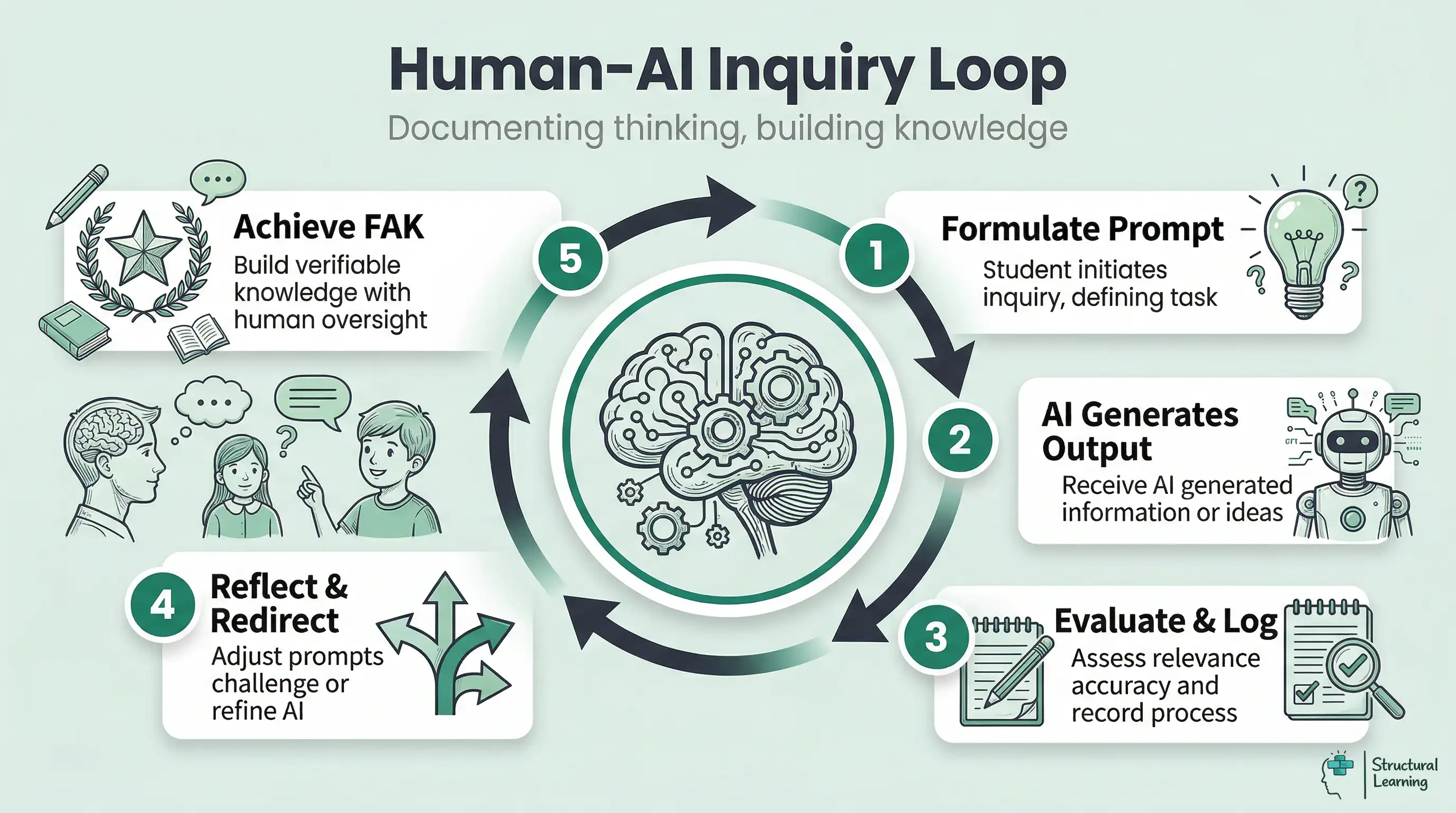
The same principle could apply to AI today. The key difference is that unlike calculators, which provided only static final answers, the Human-AI Dialectic Loop (Richardson & O'Neill, 2026) provides a visible "Audit Trail" of iterative thinking.
Key Takeaways
Historical precedent matters: Past technology fears (calculators in the 1970s) proved unfounded when learners focused on process rather than computation. The same principle applies to AI.
Documentation is essential: The Historical Log transforms AI from a shortcut into a catalyst for Future Actionable Knowledge (FAK), knowledge that is verifiable and ready for professional application (Richardson et al., 2020).
Process beats product: By documenting every prompt and redirection, a "cognitive pivot," the log ensures students remain active drivers of inquiry rather than passive recipients of synthetic content.
Teacher-Architect replaces plagiarism police: Teachers shift from unsustainable plagiarism detection to architectural design of inquiry loops, reviewing logs to identify the structural integrity of student logic.
FAK powers the future: As AI content generation becomes ubiquitous, the true metric for success shifts toward directing, orchestrating, and verifying information, a skill the Historical Log develops.
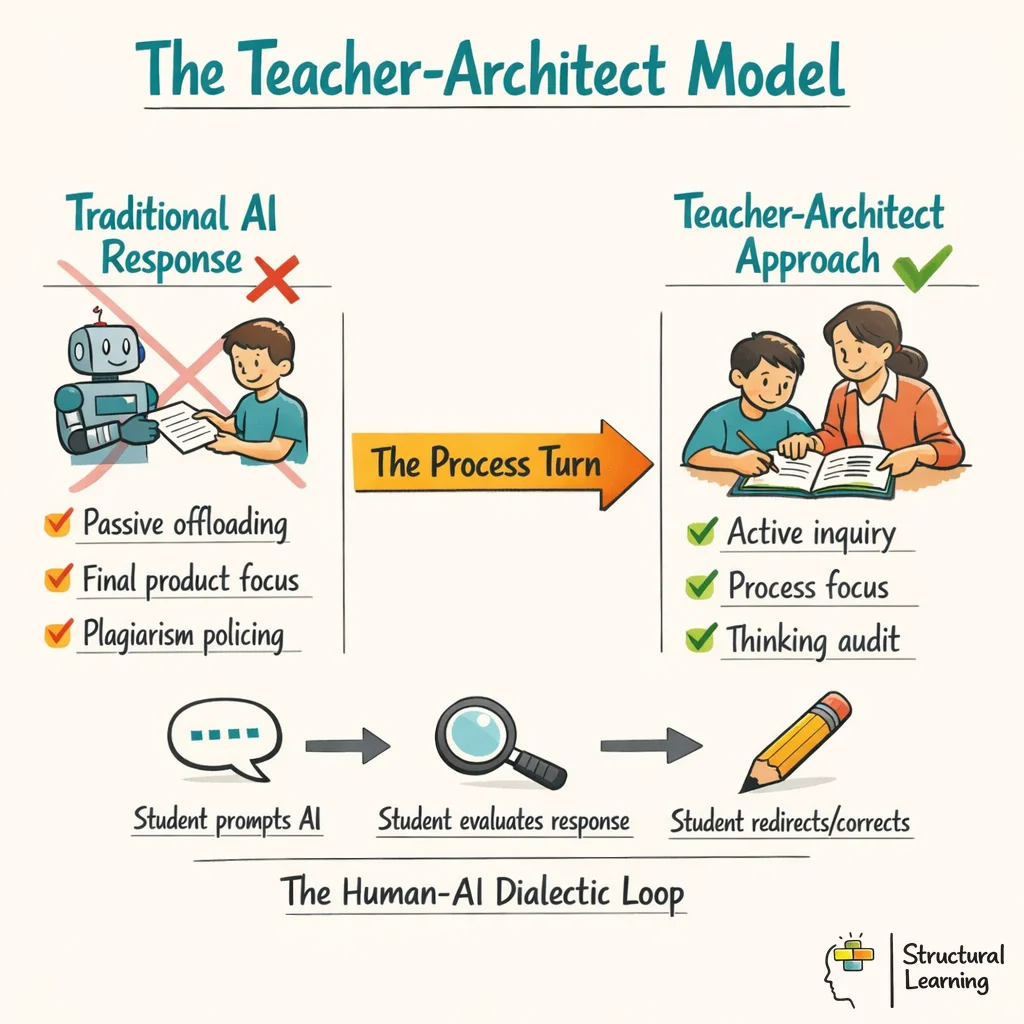
The Teacher-Architect Model
From Black Box to Audit Trail
This paper, by Dr. Tony Richardson, operationalizes the Human-AI Dialectic Loop, a research methodology designed to reclaim intellectual sovereignty in a post-generative landscape. Instead of using AI as a content producer, Richardson positions it as a Cognitive Adversary designed to challenge the author's logic and assumptions.
This shift, called the "Process-Turn," moves the locus of academic value away from validating the final written product. Instead, it focuses on the forensic validation of the teaching and learning journey of intellectual construction. By documenting rigorous interrogation and redirection of algorithmic outputs, Richardson proves that Future Actionable Knowledge is synthesised not through passive acceptance of machine content, but through transparent, audited, human-led inquiry.
For educators, this raises a critical question: How do we prevent students from passively offloading their thinking to AI, and instead use AI as a tool for deeper learning?
The Audit Trail of Thought
The Historical Log functions as a metacognitive anchor, ensuring that students remain cognitively present throughout their interaction with AI. When students are required to document their inquiry process, something important happens.
Cognitive offloading, using external tools to reduce cognitive demand, becomes a risk primarily when the "internal processing" of inquiry is hidden from view (Risko & Gilbert, 2016). By externalising every prompt, correction, and redirection, the log forces the student to evaluate their own thinking, much like graphic organisers make thought processes visible. The log forces learners to assess their thinking patterns alongside the AI's output. This act of "logging" creates metacognitive reflective practice, where the student must decide which AI suggestions possess structural integrity and which are hallucinations or irrelevant (Flavell, 1979).
The value of FAK, according to Richardson et al. (2020), is not found in the final information retrieved, but in the student's ability to document and justify the pathway taken to reach that information. The log is not merely a record, it is an active cognitive exercise designed to combat "passive offloading." Without this documented dialogue, students risk "cognitive atrophy," where reliance on automated answers diminishes their ability to synthesise complex information independently, weakening working memory capacity (Carr, 2020).
Research findings on documentation
Research into computer-supported collaborative learning shows something striking: students required to document their inquiry process demonstrate significantly higher retention and critical thinking scores than those focusing purely on terminal output (Ataş & Yildirim, 2024).
This matters especially in the context of generative AI. The machine's "fluency" often creates a "fluency illusion", where the user believes they understand a topic simply because the AI has summarised it clearly and confidently (Bjork et al., 2013). The Audit Trail disrupts this illusion by requiring students to "show the work" of their logic, much like traditional formative assessment practices.
Ethan Mollick (2024) argues that the most effective use of AI involves a "Human-in-the-Loop" strategy where the human must continuously audit, prompt, and refine the AI's logic to maintain intellectual agency.
Shifting pedagogical gravity
By adopting the Historical Log, the pedagogical "centre of gravity" shifts fundamentally from the final product to the documented evolution of thought. This allows the Teacher-Architect to see the scaffolding of the student's mind.
Evidence indicates that when students are assessed on their process rather than just the result, they demonstrate increased intrinsic motivation and higher tolerance for complex problem-solving (Dweck, 2017). This aligns with principles of growth mindset, where students see struggle and iteration as indicators of learning rather than failure.
Since the student has navigated the dialectic loop and documented every decision point, they possess the "forensic" evidence of their learning. Such transparency prepares students for tertiary environments where the ability to audit and justify one's logic is considered a primary indicator of academic maturity (Fullan, 2023).
Detecting Authentic Inquiry
One concern for educators is whether students might ask AI to retroactively simulate a "History Log" for a finished paper. However, there is a technical reality that provides protection.
Large Language Models (LLMs) struggle to replicate the non-linear, staccato nature of authentic human inquiry (Marcus & Davis, 2019). While an AI can generate a list of prompts, it typically produces a hyper-rationalised, linear sequence that lacks the genuine "trial and error" and deep conceptual "stumbles" inherent in real learning (Mitchell et al., 2023). A simulated log appears "too perfect," failing to reflect the iterative cognitive friction required to generate Future Actionable Knowledge (FAK).
The authenticity of a Human-AI Dialectic Loop is verified through "Human Interruptions", a concept adapted from McFarlane (2002), which posits that effective human-computer coordination relies on negotiated interruptions rather than passive observation. When a student identifies a logic flaw, they undergo a "Cognitive Pivot" (Richardson & O'Neill, 2026): the internal mental shift from being a recipient of information to becoming a forensic auditor.
The fingerprints of real learning
These "adversarial" interactions are the fingerprints of a human mind at work. Research indicates that AI models, when asked to simulate a dialogue, default to a "cooperative" tone that lacks the abrasive, critical scepticism a student displays when truly grappling with difficult concepts (Bender et al., 2021). Thus, the presence of "Intellectual Friction" (Richardson & O'Neill, 2026) within the log serves as a validated marker of human agency.
The Teacher-Architect can also utilise metadata and temporal logic as a forensic tool. A genuine dialectic occurs over hours or days, showing clear temporal evolution of thought, whereas a synthetic log lacks the chronological "gaps" and rhythmic inconsistencies of human labour. As Mollick (2024) suggests, the "rhythm of work" is a primary indicator of authenticity.
Current research into "stylometric burstiness" and "perplexity" suggests that AI-generated text lacks the varied complexity of human drafting, making retroactive simulation detectable through algorithmic and human audit (Sadasivan et al., 2023; Liang et al., 2023).
Reclaiming Teacher Agency
The current crisis in schools involves two interconnected problems: teacher burnout and erosion of academic integrity. Richardson suggests the Historical Log offers a transformative solution to both.
Transitioning to process-based assessment through the Historical Log restores teacher agency and alleviates the unsustainable workload imposed by AI-driven plagiarism detection. Prioritising formative "process" auditing over summative "product" grading significantly reduces time spent on administrative "policing" whilst increasing the quality of pedagogical feedback (Wiliam, 2018).
Teachers currently dedicate excessive hours to "AI detectors" that are notoriously unreliable, frequently producing false positives (Weber-Wulff et al., 2023). By mandating a documented log, the Teacher-Architect no longer needs to speculate on the origin of the work. The evidence of thought is made visible through a transparent "audit trail" (Cadmus, 2024).
Surgical intervention at the point of need
This shift enables "Surgical Intervention" (Richardson & O'Neill, 2026), where expert guidance is applied to modify behaviour at the exact point of error. When an educator reviews a Historical Log, they can pinpoint the specific "Cycle Number" where a student's logic faltered. This precision ensures feedback is actionable and timely, fulfilling FAK requirements and empowering the teacher to act as a true architect (Richardson et al., 2022).
Instead of reactive plagiarism detection, teachers become designers of inquiry-based learning pathways. Instead of grading final products, they audit thinking processes. This represents a fundamental shift in what it means to teach in the age of AI.
Future Actionable Knowledge
Richardson argues that the evolution of generative AI necessitates a fundamental re-evaluation of what achievement means. As the ability to generate static content becomes ubiquitous, the true metric for success shifts.
Modern industry no longer requires employees who can simply generate text. It requires professionals who can validate AI outputs and maintain intellectual agency over automated systems (Bearman & Ajjawi, 2023). Recent workforce analyses suggest the "Human-in-the-Loop" strategy is the most critical competency for the future of work (World Economic Forum, 2023).
The capacity to direct, orchestrate, and verify information becomes more valuable than information itself. Academic rigour is now more accurately found in the student's ability to act as the "architect" of their inquiry, managing AI as a sophisticated tool rather than a substitute for thought (Lodge et al., 2023; Luckin, 2024).
Ultimately, FAK provides evidence that the value of a degree lies in the ability to produce verifiable, actionable knowledge through technology.
What This Means for Your Classroom
This research has practical implications for how you teach with AI. Consider implementing these approaches:
Require documented inquiry: Ask students to maintain a log of their prompts, AI responses, and their own thinking about whether each response is useful or flawed. This transforms AI from a shortcut into a thinking tool. You might ask: "Show me your conversation with the AI. Where did you disagree with it? Why?"
Audit the process, not just the product: Shift your assessment focus from the final essay or assignment to the documented journey of creating it. Use questioning strategies that explore student decisions: "Why did you ask the AI this specific question? What did you learn when it gave you this answer?"
Teach with cognitive load theory in mind: Use AI to offload mechanical tasks (generating initial drafts, brainstorming ideas, creating examples), freeing students to focus on higher-order thinking, evaluating arguments, synthesising multiple perspectives, and building deep schema in their subject area.
Model intellectual friction: Show students how you use AI critically. Think aloud about hallucinations you catch, questions you need to ask, and ways you challenge the AI's assumptions. This demonstrates that engagement with AI is fundamentally adversarial and rigorous, not passive consumption.
Conclusion
The Historical Log stands as the definitive bridge between current pedagogical anxieties and a future of educational excellence centred on intellectual agency. By transforming the "black box" of generative AI into a transparent, documented dialogue, the Human-AI Dialectic Loop shifts focus from an unreliable final product to a verifiable, "load bearing" process.
This architectural approach allows the Teacher-Architect to reclaim professional agency in an era where AI tools are ubiquitous but understanding remains rare. In an era of automated fluency, the value of education is no longer found in the possession of information, but in the ability to orchestrate, audit, and justify the logic behind its creation.
For students, the Historical Log ensures they remain active agents in their learning rather than passive recipients of synthetic content. For teachers, it restores agency and reduces burnout by shifting from plagiarism detection to pedagogical architecture. For institutions, it provides evidence of authentic learning and intellectual rigour in the age of AI.
References
Akgun, M., & Toker, S. (2024). Evaluating the effect of pretesting with conversational AI on retention of needed information. arXiv. https://doi.org/10.48550/arXiv.2412.13487
Ataş, A. H., & Yildirim, Z. (2024). A shared metacognition-focused instructional design model for online collaborative learning environments. Educational Technology Research and Development, 72(1), 567-613. https://doi.org/10.1007/s11423-024-10423-4
Bearman, M., & Ajjawi, R. (2023). Learning to work with the black box: Pedagogy for a world with artificial intelligence. British Journal of Educational Technology, 54(5), 1160-1173. https://doi.org/10.1111/bjet.13337
Bender, E. M., Gebru, T., McMillan-Major, A., & Shmitchell, S. (2021). On the dangers of stochastic parrots: Can language models be too big? FAccT '21: Proceedings of the 2021 ACM Conference on Fairness, Accountability, and Transparency, 610-623. https://doi.org/10.1145/3442188.3445922
Bjork, R. A., Dunlosky, J., & Kornell, N. (2013). Self-regulated learning: Beliefs, techniques, and illusions. Annual Review of Psychology, 64, 417-444. https://doi.org/10.1146/annurev-psych-113011-143823
Carr, N. (2020). The shallows: What the Internet is doing to our brains (2nd ed.). W. W. Norton & Company
Cuban, L. (1986). Teachers and machines: The classroom use of technology since 1920. Teachers College Press.
Dweck, C. S. (2017). Mindset: The new psychology of success. Penguin Random House.
Flavell, J. H. (1979). Metacognition and cognitive monitoring: A new area of cognitive-developmental inquiry. American Psychologist, 34(10), 906-911. https://doi.org/10.1037/0003-066X.34.10.906
Fullan, M., Quinn, J., & McEachen, J. (2023). Deep learning: Engage the world change the world (2nd ed.). Corwin Press.
Hembree, R., & Dessart, D. J. (1986). Effects of hand-held calculators in pre-college mathematics education: A meta-analysis. Journal for Research in Mathematics Education, 17(2), 83-99. https://doi.org/10.2307/749257
Liang, W., Yuksekgonul, M., Mao, Y., Wu, E., & Zou, J. (2023). GPT detectors are biased against non-native English writers. Patterns, 4(7), 100779. https://doi.org/10.1016/j.patter.2023.100779
Lodge, J. M., Howard, S. K., & Thompson, K. (2023). Assessment in the age of generative artificial intelligence. Australian Educational Computing, 38(1). https://doi.org/10.21153/aec2023vol38no1art1757
Luckin, R. (2024). AI for education: A guide for teachers and school leaders. Routledge.
Marcus, G., & Davis, E. (2019). Rebooting AI: Building artificial intelligence we can trust. Pantheon.
Mitchell, E., Yoon, C., Rothe, A., & Manning, C. D. (2023). DetectGPT: Zero-shot machine-generated text detection using probability curvature. arXiv. https://doi.org/10.48550/arXiv.2301.11305
Mollick, E. (2024). Co-intelligence: Living and working with AI. Portfolio.
Pasquale, F. (2015). The black box society: The secret algorithms that control money and information. Harvard University Press.
Richardson, T. (2022). Future Actionable Knowledge, Deep Learning and Education. Higher Education Digest, (27), 38-41.
Richardson, T., Thao, D. T. H., Trang, N. T. T., & Anh, N. N. (2020). Assessment to learning: Improving the effectiveness of a teacher's feedback to the learner through future actionable knowledge. Vietnam Journal of Educational Sciences, 16(1), 32-37.
Richardson, T., & O'Neill, S. (2026). The Human-AI Dialectic Loop: Forensic auditing in education [Manuscript in preparation]. School of Education and Tertiary Access, University of the Sunshine Coast.
Risko, E. F., & Gilbert, S. J. (2016). Cognitive offloading. Trends in Cognitive Sciences.
Sadasivan, V. S., Kumar, A., Balasubramanian, S., Wang, W., & Feizi, S. (2023). Can AI-generated text be reliably detected? (arXiv:2303.11156). arXiv. https://doi.org/10.48550/arXiv.2303.11156
Weber-Wulff, D., Anohina-Naumeca, A., Bjelobaba, S., Foltýnek, T., Guerrero-Dib, J., Popoola, O., Šigut, P., & Waddington, L. (2023). Testing of detection tools for AI-generated text. International Journal for Educational Integrity, 19(1), Article 26. https://doi.org/10.1007/s40979-023-00146-z
Wiliam, D. (2018). Embedded formative assessment (2nd ed.). Solution Tree Press.
The current concerns about generative AI in education mirror anxieties we have seen before. When electronic calculators were introduced in the 1970s, educators worried that offloading arithmetic would destroy students' mathematical reasoning and numeracy skills, effectively "de-skilling" a generation (Akgun & Toker, 2024).
However, evidence now suggests something different happened. When the mechanical burden of calculation was offloaded, students were liberated to focus on higher-order conceptual problem-solving such as retrieval practice (Hembree & Dessart, 1986). This suggests that technology does not inherently cause cognitive decline. Instead, it allows for curriculum evolution where the focus moves from manual computation to understanding the logic underpinning the tool's output (Cuban, 1986).
The same principle could apply to AI today. The key difference is that unlike calculators, which provided only static final answers, the Human-AI Dialectic Loop (Richardson & O'Neill, 2026) provides a visible "Audit Trail" of iterative thinking.
Key Takeaways
Historical precedent matters: Past technology fears (calculators in the 1970s) proved unfounded when learners focused on process rather than computation. The same principle applies to AI.
Documentation is essential: The Historical Log transforms AI from a shortcut into a catalyst for Future Actionable Knowledge (FAK), knowledge that is verifiable and ready for professional application (Richardson et al., 2020).
Process beats product: By documenting every prompt and redirection, a "cognitive pivot," the log ensures students remain active drivers of inquiry rather than passive recipients of synthetic content.
Teacher-Architect replaces plagiarism police: Teachers shift from unsustainable plagiarism detection to architectural design of inquiry loops, reviewing logs to identify the structural integrity of student logic.
FAK powers the future: As AI content generation becomes ubiquitous, the true metric for success shifts toward directing, orchestrating, and verifying information, a skill the Historical Log develops.
The Teacher-Architect Model
From Black Box to Audit Trail
This paper, by Dr. Tony Richardson, operationalizes the Human-AI Dialectic Loop, a research methodology designed to reclaim intellectual sovereignty in a post-generative landscape. Instead of using AI as a content producer, Richardson positions it as a Cognitive Adversary designed to challenge the author's logic and assumptions.
This shift, called the "Process-Turn," moves the locus of academic value away from validating the final written product. Instead, it focuses on the forensic validation of the teaching and learning journey of intellectual construction. By documenting rigorous interrogation and redirection of algorithmic outputs, Richardson proves that Future Actionable Knowledge is synthesised not through passive acceptance of machine content, but through transparent, audited, human-led inquiry.
For educators, this raises a critical question: How do we prevent students from passively offloading their thinking to AI, and instead use AI as a tool for deeper learning?
The Audit Trail of Thought
The Historical Log functions as a metacognitive anchor, ensuring that students remain cognitively present throughout their interaction with AI. When students are required to document their inquiry process, something important happens.
Cognitive offloading, using external tools to reduce cognitive demand, becomes a risk primarily when the "internal processing" of inquiry is hidden from view (Risko & Gilbert, 2016). By externalising every prompt, correction, and redirection, the log forces the student to evaluate their own thinking, much like graphic organisers make thought processes visible. The log forces learners to assess their thinking patterns alongside the AI's output. This act of "logging" creates metacognitive reflective practice, where the student must decide which AI suggestions possess structural integrity and which are hallucinations or irrelevant (Flavell, 1979).
The value of FAK, according to Richardson et al. (2020), is not found in the final information retrieved, but in the student's ability to document and justify the pathway taken to reach that information. The log is not merely a record, it is an active cognitive exercise designed to combat "passive offloading." Without this documented dialogue, students risk "cognitive atrophy," where reliance on automated answers diminishes their ability to synthesise complex information independently, weakening working memory capacity (Carr, 2020).
Research findings on documentation
Research into computer-supported collaborative learning shows something striking: students required to document their inquiry process demonstrate significantly higher retention and critical thinking scores than those focusing purely on terminal output (Ataş & Yildirim, 2024).
This matters especially in the context of generative AI. The machine's "fluency" often creates a "fluency illusion", where the user believes they understand a topic simply because the AI has summarised it clearly and confidently (Bjork et al., 2013). The Audit Trail disrupts this illusion by requiring students to "show the work" of their logic, much like traditional formative assessment practices.
Ethan Mollick (2024) argues that the most effective use of AI involves a "Human-in-the-Loop" strategy where the human must continuously audit, prompt, and refine the AI's logic to maintain intellectual agency.
Shifting pedagogical gravity
By adopting the Historical Log, the pedagogical "centre of gravity" shifts fundamentally from the final product to the documented evolution of thought. This allows the Teacher-Architect to see the scaffolding of the student's mind.
Evidence indicates that when students are assessed on their process rather than just the result, they demonstrate increased intrinsic motivation and higher tolerance for complex problem-solving (Dweck, 2017). This aligns with principles of growth mindset, where students see struggle and iteration as indicators of learning rather than failure.
Since the student has navigated the dialectic loop and documented every decision point, they possess the "forensic" evidence of their learning. Such transparency prepares students for tertiary environments where the ability to audit and justify one's logic is considered a primary indicator of academic maturity (Fullan, 2023).
Detecting Authentic Inquiry
One concern for educators is whether students might ask AI to retroactively simulate a "History Log" for a finished paper. However, there is a technical reality that provides protection.
Large Language Models (LLMs) struggle to replicate the non-linear, staccato nature of authentic human inquiry (Marcus & Davis, 2019). While an AI can generate a list of prompts, it typically produces a hyper-rationalised, linear sequence that lacks the genuine "trial and error" and deep conceptual "stumbles" inherent in real learning (Mitchell et al., 2023). A simulated log appears "too perfect," failing to reflect the iterative cognitive friction required to generate Future Actionable Knowledge (FAK).
The authenticity of a Human-AI Dialectic Loop is verified through "Human Interruptions", a concept adapted from McFarlane (2002), which posits that effective human-computer coordination relies on negotiated interruptions rather than passive observation. When a student identifies a logic flaw, they undergo a "Cognitive Pivot" (Richardson & O'Neill, 2026): the internal mental shift from being a recipient of information to becoming a forensic auditor.
The fingerprints of real learning
These "adversarial" interactions are the fingerprints of a human mind at work. Research indicates that AI models, when asked to simulate a dialogue, default to a "cooperative" tone that lacks the abrasive, critical scepticism a student displays when truly grappling with difficult concepts (Bender et al., 2021). Thus, the presence of "Intellectual Friction" (Richardson & O'Neill, 2026) within the log serves as a validated marker of human agency.
The Teacher-Architect can also utilise metadata and temporal logic as a forensic tool. A genuine dialectic occurs over hours or days, showing clear temporal evolution of thought, whereas a synthetic log lacks the chronological "gaps" and rhythmic inconsistencies of human labour. As Mollick (2024) suggests, the "rhythm of work" is a primary indicator of authenticity.
Current research into "stylometric burstiness" and "perplexity" suggests that AI-generated text lacks the varied complexity of human drafting, making retroactive simulation detectable through algorithmic and human audit (Sadasivan et al., 2023; Liang et al., 2023).
Reclaiming Teacher Agency
The current crisis in schools involves two interconnected problems: teacher burnout and erosion of academic integrity. Richardson suggests the Historical Log offers a transformative solution to both.
Transitioning to process-based assessment through the Historical Log restores teacher agency and alleviates the unsustainable workload imposed by AI-driven plagiarism detection. Prioritising formative "process" auditing over summative "product" grading significantly reduces time spent on administrative "policing" whilst increasing the quality of pedagogical feedback (Wiliam, 2018).
Teachers currently dedicate excessive hours to "AI detectors" that are notoriously unreliable, frequently producing false positives (Weber-Wulff et al., 2023). By mandating a documented log, the Teacher-Architect no longer needs to speculate on the origin of the work. The evidence of thought is made visible through a transparent "audit trail" (Cadmus, 2024).
Surgical intervention at the point of need
This shift enables "Surgical Intervention" (Richardson & O'Neill, 2026), where expert guidance is applied to modify behaviour at the exact point of error. When an educator reviews a Historical Log, they can pinpoint the specific "Cycle Number" where a student's logic faltered. This precision ensures feedback is actionable and timely, fulfilling FAK requirements and empowering the teacher to act as a true architect (Richardson et al., 2022).
Instead of reactive plagiarism detection, teachers become designers of inquiry-based learning pathways. Instead of grading final products, they audit thinking processes. This represents a fundamental shift in what it means to teach in the age of AI.
Future Actionable Knowledge
Richardson argues that the evolution of generative AI necessitates a fundamental re-evaluation of what achievement means. As the ability to generate static content becomes ubiquitous, the true metric for success shifts.
Modern industry no longer requires employees who can simply generate text. It requires professionals who can validate AI outputs and maintain intellectual agency over automated systems (Bearman & Ajjawi, 2023). Recent workforce analyses suggest the "Human-in-the-Loop" strategy is the most critical competency for the future of work (World Economic Forum, 2023).
The capacity to direct, orchestrate, and verify information becomes more valuable than information itself. Academic rigour is now more accurately found in the student's ability to act as the "architect" of their inquiry, managing AI as a sophisticated tool rather than a substitute for thought (Lodge et al., 2023; Luckin, 2024).
Ultimately, FAK provides evidence that the value of a degree lies in the ability to produce verifiable, actionable knowledge through technology.
What This Means for Your Classroom
This research has practical implications for how you teach with AI. Consider implementing these approaches:
Require documented inquiry: Ask students to maintain a log of their prompts, AI responses, and their own thinking about whether each response is useful or flawed. This transforms AI from a shortcut into a thinking tool. You might ask: "Show me your conversation with the AI. Where did you disagree with it? Why?"
Audit the process, not just the product: Shift your assessment focus from the final essay or assignment to the documented journey of creating it. Use questioning strategies that explore student decisions: "Why did you ask the AI this specific question? What did you learn when it gave you this answer?"
Teach with cognitive load theory in mind: Use AI to offload mechanical tasks (generating initial drafts, brainstorming ideas, creating examples), freeing students to focus on higher-order thinking, evaluating arguments, synthesising multiple perspectives, and building deep schema in their subject area.
Model intellectual friction: Show students how you use AI critically. Think aloud about hallucinations you catch, questions you need to ask, and ways you challenge the AI's assumptions. This demonstrates that engagement with AI is fundamentally adversarial and rigorous, not passive consumption.
Conclusion
The Historical Log stands as the definitive bridge between current pedagogical anxieties and a future of educational excellence centred on intellectual agency. By transforming the "black box" of generative AI into a transparent, documented dialogue, the Human-AI Dialectic Loop shifts focus from an unreliable final product to a verifiable, "load bearing" process.
This architectural approach allows the Teacher-Architect to reclaim professional agency in an era where AI tools are ubiquitous but understanding remains rare. In an era of automated fluency, the value of education is no longer found in the possession of information, but in the ability to orchestrate, audit, and justify the logic behind its creation.
For students, the Historical Log ensures they remain active agents in their learning rather than passive recipients of synthetic content. For teachers, it restores agency and reduces burnout by shifting from plagiarism detection to pedagogical architecture. For institutions, it provides evidence of authentic learning and intellectual rigour in the age of AI.
References
Akgun, M., & Toker, S. (2024). Evaluating the effect of pretesting with conversational AI on retention of needed information. arXiv. https://doi.org/10.48550/arXiv.2412.13487
Ataş, A. H., & Yildirim, Z. (2024). A shared metacognition-focused instructional design model for online collaborative learning environments. Educational Technology Research and Development, 72(1), 567-613. https://doi.org/10.1007/s11423-024-10423-4
Bearman, M., & Ajjawi, R. (2023). Learning to work with the black box: Pedagogy for a world with artificial intelligence. British Journal of Educational Technology, 54(5), 1160-1173. https://doi.org/10.1111/bjet.13337
Bender, E. M., Gebru, T., McMillan-Major, A., & Shmitchell, S. (2021). On the dangers of stochastic parrots: Can language models be too big? FAccT '21: Proceedings of the 2021 ACM Conference on Fairness, Accountability, and Transparency, 610-623. https://doi.org/10.1145/3442188.3445922
Bjork, R. A., Dunlosky, J., & Kornell, N. (2013). Self-regulated learning: Beliefs, techniques, and illusions. Annual Review of Psychology, 64, 417-444. https://doi.org/10.1146/annurev-psych-113011-143823
Carr, N. (2020). The shallows: What the Internet is doing to our brains (2nd ed.). W. W. Norton & Company
Cuban, L. (1986). Teachers and machines: The classroom use of technology since 1920. Teachers College Press.
Dweck, C. S. (2017). Mindset: The new psychology of success. Penguin Random House.
Flavell, J. H. (1979). Metacognition and cognitive monitoring: A new area of cognitive-developmental inquiry. American Psychologist, 34(10), 906-911. https://doi.org/10.1037/0003-066X.34.10.906
Fullan, M., Quinn, J., & McEachen, J. (2023). Deep learning: Engage the world change the world (2nd ed.). Corwin Press.
Hembree, R., & Dessart, D. J. (1986). Effects of hand-held calculators in pre-college mathematics education: A meta-analysis. Journal for Research in Mathematics Education, 17(2), 83-99. https://doi.org/10.2307/749257
Liang, W., Yuksekgonul, M., Mao, Y., Wu, E., & Zou, J. (2023). GPT detectors are biased against non-native English writers. Patterns, 4(7), 100779. https://doi.org/10.1016/j.patter.2023.100779
Lodge, J. M., Howard, S. K., & Thompson, K. (2023). Assessment in the age of generative artificial intelligence. Australian Educational Computing, 38(1). https://doi.org/10.21153/aec2023vol38no1art1757
Luckin, R. (2024). AI for education: A guide for teachers and school leaders. Routledge.
Marcus, G., & Davis, E. (2019). Rebooting AI: Building artificial intelligence we can trust. Pantheon.
Mitchell, E., Yoon, C., Rothe, A., & Manning, C. D. (2023). DetectGPT: Zero-shot machine-generated text detection using probability curvature. arXiv. https://doi.org/10.48550/arXiv.2301.11305
Mollick, E. (2024). Co-intelligence: Living and working with AI. Portfolio.
Pasquale, F. (2015). The black box society: The secret algorithms that control money and information. Harvard University Press.
Richardson, T. (2022). Future Actionable Knowledge, Deep Learning and Education. Higher Education Digest, (27), 38-41.
Richardson, T., Thao, D. T. H., Trang, N. T. T., & Anh, N. N. (2020). Assessment to learning: Improving the effectiveness of a teacher's feedback to the learner through future actionable knowledge. Vietnam Journal of Educational Sciences, 16(1), 32-37.
Richardson, T., & O'Neill, S. (2026). The Human-AI Dialectic Loop: Forensic auditing in education [Manuscript in preparation]. School of Education and Tertiary Access, University of the Sunshine Coast.
Risko, E. F., & Gilbert, S. J. (2016). Cognitive offloading. Trends in Cognitive Sciences.
Sadasivan, V. S., Kumar, A., Balasubramanian, S., Wang, W., & Feizi, S. (2023). Can AI-generated text be reliably detected? (arXiv:2303.11156). arXiv. https://doi.org/10.48550/arXiv.2303.11156
Weber-Wulff, D., Anohina-Naumeca, A., Bjelobaba, S., Foltýnek, T., Guerrero-Dib, J., Popoola, O., Šigut, P., & Waddington, L. (2023). Testing of detection tools for AI-generated text. International Journal for Educational Integrity, 19(1), Article 26. https://doi.org/10.1007/s40979-023-00146-z
Wiliam, D. (2018). Embedded formative assessment (2nd ed.). Solution Tree Press.
{"@context":"https://schema.org","@graph":[{"@type":"Article","headline":"The Teacher-Architect: Using Historical Logs to Preserve Human Agency in AI-Assisted Education","description":"Dr. Tony Richardson explains how the Historical Log and Human-AI Dialectic Loop help teachers preserve student agency, audit thinking processes, and move beyond unreliable AI detection tools.","datePublished":"2026-02-24T09:18:15.639Z","author":{"@type":"Person","name":"Dr. Tony Richardson","jobTitle":"International Education Consultant & Researcher","affiliation":{"@type":"Organization","name":"University of the Sunshine Coast"}},"publisher":{"@type":"Organization","name":"Structural Learning"}},{"@type":"BreadcrumbList","itemListElement":[{"@type":"ListItem","position":1,"name":"Home","item":"https://www.structural-learning.com/"},{"@type":"ListItem","position":2,"name":"Blog","item":"https://www.structural-learning.com/blog"},{"@type":"ListItem","position":3,"name":"The Teacher-Architect: Using Historical Logs to Preserve Human Agency in AI-Assisted Education"}]}]}