Sherborne Developmental Movement: The Complete Teacher's Guide to Movement and Relationship PlaySherborne Developmental Movement: The Complete Teacher's Guide to Movement and Relationship Play - educational concept illustration

Updated on  

January 23, 2026

Sherborne Developmental Movement: The Complete Teacher's Guide to Movement and Relationship Play

|

January 16, 2026

Implement Sherborne Developmental Movement with this guide to body awareness and relationship play. Learn the three relationship types and activities for all abilities.

Course Enquiry
Copy citation

Main, P. (2026, January 20). Sherborne Developmental Movement: The Complete Teacher's Guide to Movement and Relationship Play. Retrieved from https://www.structural-learning.com/post/sherborne-developmental-movement-complete

If you're looking to bring Sherborne Developmental Movement into your classroom, this complete teacher's guide will show you exactly how to plan, structure, and deliver effective SDM sessions. Sherborne Developmental Movement (SDM) is a powerful, movement-based approach that helps children develop body awareness and build meaningful relationships through simple, playful activities rooted in Rudolf Laban's movement theory. Whether you're teaching in a special school or mainstream setting, you'll discover practical strategies for creating safe spaces where children can build confidence, trust, and social connections through non-verbal interaction. Ready to transform how your students connect with their bodies and each other?

Key Takeaways

  1. Start with Trust Through 'Caring' Relationships: Begin every SDM session with nurturing activities where one partner supports another (such as cradling or gentle sliding) before progressing to shared or challenging movements. This foundation of physical trust enables children to feel safe enough to engage in more complex relationship work later.
  2. Address Both Body and Relationship Awareness: Plan activities that develop children's awareness of their own bodies (through rolling, crawling, and weight transfer exercises) alongside partner work that builds social connections. Children who struggle with clumsiness or personal space often lack body awareness, which SDM addresses through direct physical experience.
  3. Structure Sessions in Progressive Phases: Follow a consistent pattern: gathering (5 minutes), body awareness work (10 minutes), caring relationships (10 minutes), shared relationships (10 minutes), optional against relationships (5-10 minutes), and calming (5 minutes). This predictable structure helps children feel secure whilst building from individual work to increasingly complex partner interactions.
  4. Make Movement Playful, Not Clinical: Present all activities as games rather than exercises, using simple movements like sliding, rocking, and crawling that feel natural and fun. This playful approach creates emotional safety, making SDM particularly effective for children with special needs, autism, or communication difficulties who may struggle with verbal instruction.
The Three Pillars of Sherborne Developmental Movement infographic for teachers
The Three Pillars of Sherborne Developmental Movement

Key Takeaways

  • Two Fundamental Needs: Veronica Sherborne identified that all children need to feel at home in their own bodies (body awareness) and need to form relationships with others. SDM addresses both through purposeful movement activities
  • Three Relationship Types: Activities fall into three categories: "caring" relationships (with), where one partner supports another; "shared" relationships (together), where partners move as equals; and "against" relationships, where partners playfully resist each other to build strength and confidence
  • Non-Verbal Connection: SDM communicates through touch, movement, and physical closeness rather than words. This makes it accessible to learners with communication difficulties, autism, and profound learning needs
  • Trust Before Challenge: Sessions always begin with nurturing, supportive activities before introducing any challenge. Building trust is the foundation; activities that involve resistance or independence come later
  • Understanding Sherborne Developmental Movement Principles

    Sherborne Developmental Movement is a play-based therapeutic approach that develops children's body awareness and relationship skills through structured movement activities. Created by Veronica Sherborne using Rudolf Laban's movement principles, SDM uses physical interaction rather than verbal instruction to build trust, confidence and social connections.

    Sherborne Developmental Movement is a practical approach to using movement experiences to develop two key areas: awareness of self (body awareness) and awareness of others (relationship building).

    Veronica Sherborne developed the approach during her work at Bristol University and at Harperbury Hospital School from the 1960s onwards. Her method drew on Rudolf Laban's movement analysis, her training in physical education and physiotherapy, and careful observation of how children naturally play and develop.

    Sherborne observed that children need to feel physically competent and emotionally secure in their bodies before they can fully engage with learning and relationships. Many children with special needs had missed early movement experiences that typically developing children gain through play. SDM provides structured opportunities to have these experiences at any age.

    The approach is grounded in play. Activities feel like games, not exercises. Partners work together, creating shared experiences of fun, trust, and physical connection. This playfulness is essential; it creates the emotional safety needed for learning.

    Building Body and Relationship Awareness

    SDM focuses on two fundamental learning objectives: developing body awareness so children feel comfortable in their own bodies, and building relationship skills through purposeful physical interaction with others. These objectives address children's need for physical confidence and social connection through non-verbal movement experiences.

    Body Awareness: Developing Self-Awareness

    Body awareness activities help individuals feel where their body is, what it can do, and how it moves through space. This includes:

    Body Part Awareness:

    • Knowing where body parts are without looking
    • Feeling different body parts against surfaces
    • Moving individual body parts in isolation
    • Physical Competence:

      • Rolling, sliding, crawling, climbing
      • Supporting own body weight
      • Moving from one position to another
      • Using strength and control

      Spatial Awareness:

      • Understanding personal space
      • Moving through space with awareness
      • Judging distances and directions
      • Navigating around obstacles

      Weight Awareness:

      • Feeling the pull of gravity
      • Using body weight in movement
      • Being heavy or light intentionally
      • Transferring weight

      Children who have not developed body awareness may appear clumsy, have difficulty with physical tasks, invade others' personal space, or seem disconnected from their bodies. SDM activities address these difficulties through direct physical experience.

      Relationship Awareness: Connecting with Others

      Relationship activities help individuals connect with others through shared physical experiences. Sherborne identified three types of relationship:

      "Caring" Relationships (With):

      One partner takes the caring role, supporting, containing, or moving the other. The caring partner gives security and takes responsibility. The cared-for partner experiences trust and being safely held.

      Examples:

      • Cradling a partner in your arms
      • Sliding a partner gently across the floor
      • Rocking a partner
      • Supporting a partner's weight

      "Shared" Relationships (Together):

      Both partners contribute equally, moving as a unit, making decisions together, matching each other's movements and efforts.

      Examples:

      • Back-to-back sitting and standing together
      • Rocking together as a pair
      • Moving through space connected
      • Mirroring each other's movements

      "Against" Relationships:

      Partners playfully resist each other, using strength against strength. This is not aggression but controlled, boundaried opposition that builds confidence and physical awareness.

      Examples:

      • Pushing hands against partner's hands
      • Trying to roll a partner who resists
      • Gentle wrestling with clear rules
      • Pulling in opposite directions

      The sequence matters: caring relationships come first to build trust, shared relationships develop partnership, and against relationships are introduced only when partners feel safe enough to engage in playful opposition.

      How to Plan Effective SDM Sessions

      Effective SDM sessions follow a structured progression: gathering (5 minutes), body awareness work (10 minutes), caring relationships (10 minutes), shared relationships (10 minutes), optional against relationships (5-10 minutes), and calming (5 minutes). This predictable framework builds from individual work to complex partner interactions.

      Session Structure

      A typical SDM session follows this pattern:

      | Phase | Focus | Duration |

      Infographic showing the six-step Sherborne Developmental Movement session structure process diagram
      SDM Session Structure

      |-------|-------|----------|

      | Gathering | Coming together, establishing safety | 5 minutes |

      | Body Awareness | Individual work on floor or standing | 10 minutes |

      | Caring Relationships | Partner work with one caring | 10 minutes |

      | Shared Relationships | Equal partnership activities | 10 minutes |

      | Against Relationships (if appropriate) | Playful resistance activities | 5-10 minutes |

      | Calming | Gentle closing activities | 5 minutes |

      Adjust timing based on the group's needs. Some groups may spend entire sessions on caring relationships before progressing.

      Environment

      Create a safe physical space:

      • Soft flooring (mats, carpet, or padded surface)
      • Clear of furniture and obstacles
      • Warm enough for floor work
      • Quiet enough to focus
      • Large enough for the group to spread out

      Grouping

      SDM works in various configurations:

      • One-to-one: Adult and child
      • Pairs: Two children, or adult and child
      • Small groups: 4-6 participants
      • Large groups: Whole class with multiple adults

      The adult-to-child ratio is important. In early stages, every child needs an adult partner. As children develop, they may partner with peers.

      Body Awareness Activities for Children

      Floor-Based Activities

      Body awareness activities for children include curling and stretching movements that help develop spatial understanding and physical self-recognition. Curling and Stretching:

      • From lying flat, curl into the smallest ball possible
      • Stretch out as long as possible
      • Feel the difference between curled (flexion) and stretched (extension)

      Rolling:

      • Log roll with body straight
      • Curl and roll like a ball
      • Roll slowly, feeling each part touch the floor

      Sliding:

      • Slide on back across smooth floor
      • Slide on tummy
      • Feel friction and momentum

      Crawling:

      • Crawl on all fours
      • Commando crawl on tummy
      • Bear walk (hands and feet, bottom high)

      Standing Activities

      Weight Transfer:

      • Shift weight from foot to foot
      • Balance on one foot
      • Feel stability and instability

      Moving Through Space:

      • Walk with awareness of where body is
      • Change direction on signal
      • Navigate around objects

      Levels:

      • High, medium, low positions
      • Rising and sinking
      • Moving at different levels

      Caring Relationship Activities and Games

      Caring relationship activities in Sherborne Developmental Movement include cradling, which builds trust and emotional connection between partners through gentle, supportive movements. Cradling:

      Adult sits with child on lap, gently rocking. Child experiences being safely held.

      Sliding:

      Child lies on back. Adult gently slides child across floor while maintaining contact.

      Tipping:

      Child stands on adult's feet. Adult tips child slowly backwards, supporting at all times.

      Tunnels:

      Adult makes arch shape. Child crawls underneath, feeling contained and protected.

      Enveloping:

      Adult wraps around child (from behind), creating sense of being held.

      Swinging:

      Two adults swing child between them, or adult swings child in arms.

      In all caring activities, the caring partner is responsible for the other's safety and comfort. The activity should feel nurturing, not threatening.

      From Trust to Challenge: The SDM Session Process infographic for teachers
      From Trust to Challenge: The SDM Session Process

      Shared Relationship Activities and Games

      Shared relationship activities and games in Sherborne Developmental Movement include Back-to-Back Stand, which builds trust and communication between partners through coordinated movement patterns. Back-to-Back Stand:

      Partners sit back to back, arms linked. Push against each other to stand up together.

      Seesaw:

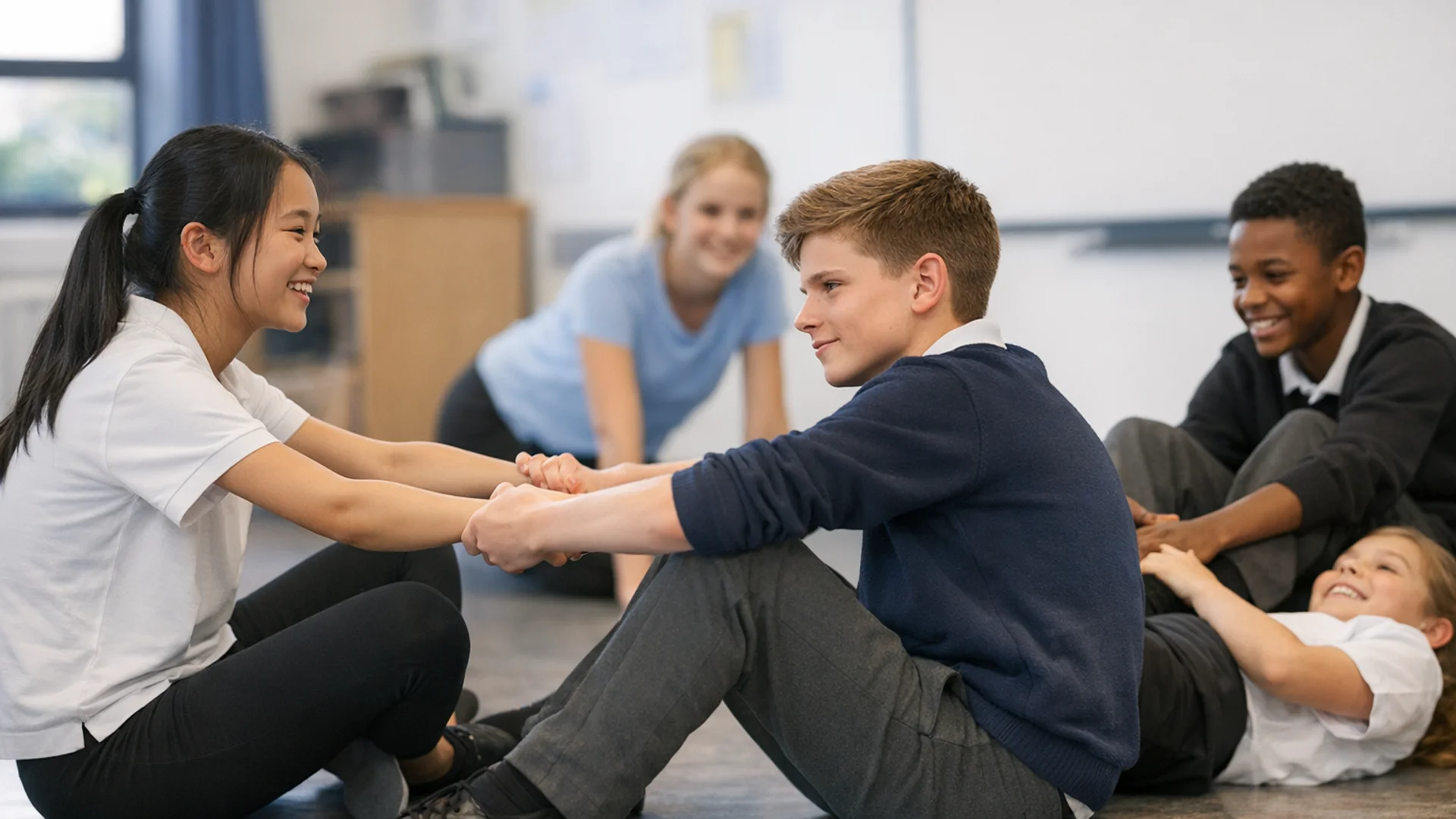
      Sitting facing each other, feet touching, holding hands. Rock forwards and backwards like a seesaw.

      Mirror Moving:

      One partner moves slowly, other mirrors exactly. Then switch roles.

      Connected Walking:

      Partners move through space while maintaining physical contact (hands, shoulders, backs).

      Rocking Together:

      Partners find ways to rock together as a unit.

      Rolling Together:

      Partners hold hands and roll across floor together.

      Against Relationship Activities and Games

      Hand Push serves as an effective against relationship activity that allows children to explore boundaries and resistance through controlled physical opposition. Hand Push:

      Partners face each other, hands palm to palm. Push against each other, trying to make the other move back.

      Turtle:

      One partner curls in tight ball (turtle). Other tries to gently roll them over. Turtle resists.

      Starfish:

      One partner lies spread out. Other tries to move them while they spread wide and resist.

      Controlled Wrestling:

      Clear rules about what is allowed. Partners try to move each other while resisting movement.

      Tug of War:

      Partners pull in opposite directions, feeling each other's strength.

      Against relationships must always feel safe. The aim is playful resistance, not winning or dominance. Stop immediately if either partner becomes distressed.

      SDM for Children with Special Needs

      SDM effectively supports children with special educational needs, autism, and communication difficulties because it uses non-verbal, physical interaction rather than spoken instruction. The approach builds trust through caring touch and structured movement, making it particularly accessible for children with profound learning needs.

      SDM for Children with Autism

      SDM can support autistic children through:

      • Predictable structure and routine
      • Deep pressure and proprioceptive input
      • Non-verbal interaction
      • Building trust with specific adults
      • Gradual extension of physical contact tolerance

      Considerations:

      • Respect sensory sensitivities
      • Allow opt-out options
      • Build slowly over many sessions
      • Use consistent partners

      SDM for Children with PMLD

      SDM is highly valuable for learners with profound and multiple learning difficulties:

      • Activities happen at physical level they can access
      • Touch provides direct sensory input
      • Relationships develop through physical presence
      • No verbal communication required
      • Builds awareness in accessible way

      Adapt activities for physical limitations. Any shared movement experience has value.

      SDM session structure flow diagram showing 6 progressive phases from gathering to calming activities
      Flow diagram: SDM Session Structure, Progressive Phases

      SDM for Children with Physical Disabilities

      Adapt activities to individual physical abilities:

      • Use whatever movement is possible
      • Support as needed
      • Focus on relationship not physical achievement
      • Celebrate any movement, however small

      SDM for Emotional and Behavioural Difficulties

      SDM builds trust and relationships that may be difficult to establish verbally:

      • Physical care provides emotional security
      • Boundaries in against activities teach self-regulation
      • Shared activities build connection
      • Success experiences build confidence

      SDM Research and Educational Benefits

      SDM has been used for over 50 years, with research demonstrating positive outcomes:

      • Studies show positive effects on psychophysical development in 3-6 year olds
      • Research documents improvements in relationship skills and body awareness
      • Qualitative studies capture bonding between parent and child through shared movement
      • Practise-based evidence from special schools supports effectiveness

      The approach is recognised by Sherborne Developmental Movement UK (the professional body) and is used internationally, particularly in the UK, Australia, and across Europe.

      SDM Training and Certification Requirements

      Several professional training and certification programmes exist for SDM practitioners, including foundational courses, advanced specialisation modules, and supervised practise requirements leading to formal accreditation. Practitioners must understand Laban's movement principles, safety protocols, and how to adapt activities for different needs. Certification ensures competent, safe delivery of SDM programmes.SDM training requires completion of accredited courses that cover movement theory, relationship dynamics, and practical application techniques. Practitioners must understand Laban's movement principles, safety protocols, and how to adapt activities for different needs. Certification ensures competent, safe delivery of SDM programmes.

      To use SDM effectively, practitioners need training:

      Introductory Level:

      One-day workshops introducing basic concepts and activities

      Foundation Level:

      Multi-day training covering all relationship types and applications

      Practitioner Level:

      Extended training for those leading SDM programmes

      Trainer Level:

      For those training others in the approach

      Training is offered through Sherborne Developmental Movement UK and accredited providers internationally.

      Frequently Asked Questions

      What Age Groups Benefit from SDM?

      Teachers frequently ask about SDM's age range, adaptation methods, and effectiveness across different populations. Activities are adapted for developmental stage rather than chronological age. Adults with learning disabilities benefit as much as young children.

      How often should SDM sessions happen?

      Regular sessions (at least weekly) maintain momentum and build relationships. Some settings offer daily sessions. Consistency matters more than duration.

      Using SDM in Mainstream Classrooms

      Yes. Many mainstream primary schools use SDM, especially in early years and for children needing additional support. It builds community and relationships for all children.

      Managing Children Who Avoid Physical Contact

      Never force physical contact. Offer activities at a distance first. Build trust gradually. Some children may watch for many sessions before joining. Respect their pace.

      SDM vs Physiotherapy: Key Differences

      No. SDM is an educational/developmental approach, not therapy. It does not treat specific conditions but develops body awareness and relationships through movement experiences.

      Why Movement Matters: SDM Benefits for All Learners infographic for teachers
      Why Movement Matters: SDM Benefits for All Learners

      Core Principles of Sherborne Developmental Movement

      Understanding the fundamental principles of Sherborne Developmental Movement gives teachers the theoretical foundation needed to deliver meaningful sessions. At its heart, SDM builds on Rudolf Laban's movement analysis and Veronica Sherborne's observations about how children naturally develop through physical interaction.

      The first principle centres on developmental progression. Just as children learn to roll before they crawl, SDM activities follow natural developmental patterns. Teachers should introduce floor-based movements like rolling and sliding before progressing to kneeling, then standing activities. For instance, when teaching body awareness, start with children exploring weight transfer whilst lying on mats, then progress to crawling through tunnels, and finally to standing balance games. This progression mirrors typical motor development and ensures success for children at all ability levels.

      The second principle involves relationship through touch and movement. SDM recognises that physical contact, when appropriately managed, builds trust and social understanding. Activities always involve consent and choice; children learn to communicate non-verbally about pressure, speed, and comfort levels. A practical example is the 'sliding on backs' activity where one child lies on their back whilst their partner gently pulls them across the floor. The child being pulled controls the experience by using hand signals to indicate 'faster', 'slower', or 'stop'.

      The third principle emphasises movement qualities over perfect technique. Rather than correcting specific positions, teachers observe and encourage different movement qualities: strong/gentle, fast/slow, direct/flexible. This approach celebrates individual expression whilst building movement vocabulary. When children push against each other's hands in 'against' relationships, success isn't measured by who's stronger, but by their ability to match their partner's effort and maintain connection.

      Building Relationships Through Movement Play

      Movement play builds relationships by creating non-verbal opportunities for children to develop trust, communication skills, and social connections through structured physical activities and partner interactions. In Sherborne Developmental Movement, relationship play involves carefully structured partner activities that progress from simple support to complex interaction, allowing children to build trust and understanding through physical experience.

      The beauty of relationship play lies in its non-threatening approach. Children who struggle with traditional social skills often excel when communication happens through movement. For instance, in a 'rock the boat' activity, two children sit facing each other with legs outstretched and feet touching. As they gently rock back and forth together, they must tune into each other's rhythm and respond accordingly. This simple exercise teaches turn-taking, mutual adjustment, and shared control without requiring a single word.

      Teachers can introduce relationship play through three progressive stages. Start with 'caring' relationships where one child actively supports another, such as pulling a partner across the floor on a blanket. Next, move to 'shared' relationships where both children contribute equally, like creating mirror movements or building counter-balances. Finally, for children who are ready, introduce 'against' relationships through playful resistance activities like back-to-back pushing.

      Research by Hill and Larkin (2013) demonstrates that movement-based relationship work significantly improves peer interaction in children with autism and social communication difficulties. The physical nature of these activities bypasses many social anxieties, as children focus on the immediate sensory experience rather than complex social rules. Teachers consistently report that children who rarely interact during conventional playtime often seek out their movement partners throughout the school day, suggesting that the bonds formed through movement play transfer into broader social contexts.

      How Movement Supports Child Development

      Movement forms the foundation of how children learn about themselves and their world. Through Sherborne Developmental Movement, you're not just getting pupils active; you're supporting their neurological, social, and emotional growth in measurable ways. Understanding these developmental benefits helps you articulate SDM's value to colleagues, parents, and leadership teams whilst informing your session planning.

      Physical movement directly strengthens children's proprioception, the internal sense that tells us where our body parts are without looking. When a child crawls through a tunnel or takes weight on their hands during 'wheelbarrow' games, they're building neural pathways that improve handwriting, PE performance, and even sitting posture. Research by Ayres (2005) demonstrates that children with poor proprioception often struggle with 'heavy' or 'light' touch, explaining why some pupils break pencils whilst others barely make marks on paper.

      The relationship aspects of SDM address crucial social development milestones. When children practise 'with' relationships through mirroring activities, they're developing joint attention skills essential for classroom learning. Try this: have pairs sit back-to-back and slowly stand up together. This simple activity requires non-verbal communication, trust, and physical cooperation, skills that transfer directly to group work and playground interactions.

      Perhaps most significantly, SDM supports emotional regulation through its predictable structure and emphasis on body awareness. Children learn to recognise tension and relaxation in their own bodies, providing them with concrete strategies for managing anxiety or excitement. One effective approach involves teaching 'strong' and 'gentle' movements: have children push against a wall with full force for five seconds, then stroke the wall softly. This contrast helps them understand and control their emotional and physical responses, particularly valuable for children who struggle with self-regulation.

      Complete Guide Specifications and Contents

      This comprehensive teacher's guide provides everything you need to implement Sherborne Developmental Movement successfully in your classroom. The complete package includes detailed session plans, assessment tools, and video demonstrations that show each movement activity in action.

      The guide covers three core movement categories essential to SDM practise. First, you'll find 25 body awareness activities organised by developmental stage, from simple rolling patterns suitable for early years through to complex weight-bearing exercises for older students. Each activity includes clear photographs, step-by-step instructions, and differentiation strategies. Second, the relationship play section features 30 partner activities divided into caring, shared, and against categories, with specific guidance on pairing students and managing group dynamics. Third, the resource includes 15 whole-class games that reinforce SDM principles whilst accommodating larger groups.

      Supporting materials enhance your teaching effectiveness. The assessment toolkit provides observation sheets aligned with EHCP targets and developmental milestones, helping you track progress in motor skills, social interaction, and emotional regulation. You'll also receive printable visual cards showing key movements, which prove particularly helpful for students with communication difficulties or those who benefit from visual schedules. The guide includes a troubleshooting section addressing common challenges, such as students who resist physical contact or those who become overstimulated during movement work.

      Additional components support professional development and parent engagement. The CPD module offers reflective questions and practical tasks to deepen your understanding of movement theory, whilst the parent information sheets help families continue SDM principles at home. Research summaries link each activity type to evidence from occupational therapy and developmental psychology, strengthening your rationale when discussing the approach with colleagues or during Ofsted inspections.

      Essential Companion Resources for Teachers

      Whilst the core principles of Sherborne Developmental Movement provide a strong foundation, many teachers find that supplementary resources significantly enhance their practise. Building a comprehensive SDM toolkit helps you adapt activities for different abilities, maintain engagement across year groups, and document pupil progress effectively.

      Visual support materials prove particularly valuable when introducing SDM concepts. Picture cards showing movement sequences help children understand what's expected before they begin, reducing anxiety and supporting those with communication difficulties. Many teachers create their own laminated cards featuring pupils demonstrating movements like 'rock and roll' or 'partner sliding', which proves more meaningful than abstract illustrations. Session planning templates also save considerable preparation time; a simple grid showing warm-up, body awareness, relationship phases, and cool-down activities helps maintain the essential structure whilst allowing flexibility for individual class needs.

      Music resources transform the atmosphere of SDM sessions. Rather than relying solely on verbal instructions, carefully selected instrumental tracks guide the pace and quality of movement naturally. Slow, rhythmic music supports caring relationships activities, whilst livelier percussion tracks energise shared movement games. Teachers often compile playlists organised by SDM phases, using consistent opening and closing tracks to signal transitions. This musical framework particularly benefits children with additional needs who respond better to auditory cues than spoken directions.

      Assessment tools designed specifically for movement observation help track progress beyond traditional academic measures. Simple observation sheets focusing on relationship skills (initiating contact, maintaining appropriate pressure, responding to partner's movements) provide evidence of development that standard assessments might miss. Video recording equipment, even basic tablets, allows you to capture breakthrough moments and share progress with parents and support staff who can't attend sessions directly.

      Training Programmes and Implementation Support

      Implementing Sherborne Developmental Movement effectively requires proper training and ongoing support. Whilst the basic principles may seem straightforward, understanding how to adapt activities for different abilities and manage group dynamics takes practise and guidance. Fortunately, several pathways exist to help teachers develop their SDM skills and bring this approach confidently into their classrooms.

      The Sherborne Association UK offers accredited training courses at different levels. Foundation courses typically run over two days and provide hands-on experience of all core activities, along with theoretical understanding of Laban's movement principles. Teachers practise being both participant and facilitator, gaining insight into how movements feel from a child's perspective. Advanced courses focus on adapting SDM for specific populations, such as children with profound and multiple learning difficulties or those on the autism spectrum.

      Many local authorities now include SDM training within their continuing professional development programmes. For instance, some councils offer twilight sessions where teachers can learn basic SDM activities to use immediately in their classrooms. These shorter sessions work well for whole-school training, ensuring all staff share common language and approaches. Schools often find that having multiple trained staff members creates opportunities for peer observation and collaborative planning.

      Beyond formal training, implementation support comes through regional networks and mentoring schemes. Experienced SDM practitioners often visit schools to model sessions, observe teacher-led activities, and provide constructive feedback. Online communities and resource banks also offer lesson plans, video demonstrations, and forums where teachers share adaptations that have worked well with their pupils. This combination of initial training, ongoing professional development, and peer support helps ensure SDM becomes embedded within school practise rather than remaining a standalone intervention.

      Summary

      Sherborne Developmental Movement provides teachers with a comprehensive approach using movement and relationship play to develop children's body awareness, social skills, and emotional wellbeing through structured physical activities. By addressing Veronica Sherborne's two fundamental needs (feeling at home in the body and forming relationships), SDM supports social, emotional, and physical development in an integrated way.Sherborne Developmental Movement offers a powerful way to develop body awareness and relationship skills through playful physical activities. By addressing Veronica Sherborne's two fundamental needs (feeling at home in the body and forming relationships), SDM supports social, emotional, and physical development in an integrated way.Sherborne Developmental Movement is a comprehensive approach that uses movement and relationship play to develop children's body awareness, social skills, and emotional wellbeing through structured physical activities. By addressing Veronica Sherborne's two fundamental needs (feeling at home in the body and forming relationships), SDM supports social, emotional, and physical development in an integrated way.Sherborne Developmental Movement offers a powerful way to develop body awareness and relationship skills through playful physical activities. By addressing Veronica Sherborne's two fundamental needs (feeling at home in the body and forming relationships), SDM supports social, emotional, and physical development in an integrated way.

      The three relationship types (caring, shared, and against) provide a framework for activities that build trust, connection, and confidence progressively. The non-verbal nature of the approach makes it accessible to learners who struggle with language-based interventions.

      Success with SDM requires training, appropriate facilities, and consistent practise. When these elements are in place, the shared movement experiences create connections between people that words alone cannot achieve.

      Further Reading: Key Research Papers

      These peer-reviewed studies provide the research foundation for the strategies discussed in this article:

      Classroom Movement Breaks and Physically Active Learning Are Feasible, Reduce Sedentary Behaviour and Fatigue, and May Increase Focus in University Students: A Systematic Review and Meta-Analysis View study ↗
      23 citations

      Julia Lynch et al. (2022)

      This comprehensive review of research shows that incorporating simple movement breaks and physical activity into classroom lessons successfully reduces student fatigue and helps them stay more focused during learning. The study proves these strategies are practical to implement in real educational settings, not just theoretical ideas. For teachers at any level, this research provides strong evidence that getting students moving, even briefly, can improve their attention and reduce the negative effects of sitting for long periods.

      A Cognitive Linguistic Approach to Piano Sight-Reading Instruction View study ↗

      Ruiqing Rui et al. (2025)

      Researchers developed and tested a new way to teach piano sight-reading to children aged 7-11 by connecting physical movements with mental understanding, using the body's natural learning patterns. This approach recognises that children learn best when they can physically experience concepts, not just think about them abstractly. The findings offer valuable insights for any teacher working with young learners, showing how connecting physical movement with cognitive tasks can make complex skills more accessible and enjoyable.

      Classroom-based physical activity and teachers' instructions on students' movement in conventional classrooms and open learning spaces View study ↗
      15 citations

      Jani Hartikainen et al. (2022)

      This Finnish study compared how students move and learn in traditional classrooms versus flexible, open learning spaces, finding that the physical environment significantly affects both student activity levels and academic engagement. Teachers in open learning spaces naturally gave different types of movement instructions, leading to more active learning throughout the day. The research helps educators understand how classroom design and teaching approaches can work together to promote both physical activity and better learning outcomes.

      Integrating Art and Craft into Early Childhood Education: A Pathway to Comprehensive Skill Development in Nigeria View study ↗

      Shagaya, Mashood Olanrewaju (2025)

      This study demonstrates that art and craft activities support children's development across all areas, including thinking skills, physical coordination, emotional growth, social abilities, and language development. By engaging in creative hands-on activities, young children naturally develop multiple skills simultaneously rather than learning them in isolation. Early childhood educators will find this research particularly valuable as it shows how creative movement and artistic expression can address diverse learning goals within a single, engaging activity.

      A INFLUÊNCIA DAS TECNOLOGIAS NO DESENVOLVIMENTO MOTOR E SOCIAL DOS ESTUDANTES EM AULAS DE EDUCAÇÃO FÍSICA View study ↗

      A. Reis et al. (2025)

      This research examines how digital technologies in physical education classes affect students' movement skills and social development, revealing both benefits and potential drawbacks of tech integration. The study highlights the importance of balancing technological tools with hands-on physical experiences to ensure students develop proper motor skills and social interaction abilities. Physical education teachers and classroom educators incorporating movement will find this research helpful for making informed decisions about when and how to use technology while maintaining the essential human and physical elements of learning.

    Loading audit...

    If you're looking to bring Sherborne Developmental Movement into your classroom, this complete teacher's guide will show you exactly how to plan, structure, and deliver effective SDM sessions. Sherborne Developmental Movement (SDM) is a powerful, movement-based approach that helps children develop body awareness and build meaningful relationships through simple, playful activities rooted in Rudolf Laban's movement theory. Whether you're teaching in a special school or mainstream setting, you'll discover practical strategies for creating safe spaces where children can build confidence, trust, and social connections through non-verbal interaction. Ready to transform how your students connect with their bodies and each other?

    Key Takeaways

    1. Start with Trust Through 'Caring' Relationships: Begin every SDM session with nurturing activities where one partner supports another (such as cradling or gentle sliding) before progressing to shared or challenging movements. This foundation of physical trust enables children to feel safe enough to engage in more complex relationship work later.
    2. Address Both Body and Relationship Awareness: Plan activities that develop children's awareness of their own bodies (through rolling, crawling, and weight transfer exercises) alongside partner work that builds social connections. Children who struggle with clumsiness or personal space often lack body awareness, which SDM addresses through direct physical experience.
    3. Structure Sessions in Progressive Phases: Follow a consistent pattern: gathering (5 minutes), body awareness work (10 minutes), caring relationships (10 minutes), shared relationships (10 minutes), optional against relationships (5-10 minutes), and calming (5 minutes). This predictable structure helps children feel secure whilst building from individual work to increasingly complex partner interactions.
    4. Make Movement Playful, Not Clinical: Present all activities as games rather than exercises, using simple movements like sliding, rocking, and crawling that feel natural and fun. This playful approach creates emotional safety, making SDM particularly effective for children with special needs, autism, or communication difficulties who may struggle with verbal instruction.
    The Three Pillars of Sherborne Developmental Movement infographic for teachers
    The Three Pillars of Sherborne Developmental Movement

    Key Takeaways

  • Two Fundamental Needs: Veronica Sherborne identified that all children need to feel at home in their own bodies (body awareness) and need to form relationships with others. SDM addresses both through purposeful movement activities
  • Three Relationship Types: Activities fall into three categories: "caring" relationships (with), where one partner supports another; "shared" relationships (together), where partners move as equals; and "against" relationships, where partners playfully resist each other to build strength and confidence
  • Non-Verbal Connection: SDM communicates through touch, movement, and physical closeness rather than words. This makes it accessible to learners with communication difficulties, autism, and profound learning needs
  • Trust Before Challenge: Sessions always begin with nurturing, supportive activities before introducing any challenge. Building trust is the foundation; activities that involve resistance or independence come later
  • Understanding Sherborne Developmental Movement Principles

    Sherborne Developmental Movement is a play-based therapeutic approach that develops children's body awareness and relationship skills through structured movement activities. Created by Veronica Sherborne using Rudolf Laban's movement principles, SDM uses physical interaction rather than verbal instruction to build trust, confidence and social connections.

    Sherborne Developmental Movement is a practical approach to using movement experiences to develop two key areas: awareness of self (body awareness) and awareness of others (relationship building).

    Veronica Sherborne developed the approach during her work at Bristol University and at Harperbury Hospital School from the 1960s onwards. Her method drew on Rudolf Laban's movement analysis, her training in physical education and physiotherapy, and careful observation of how children naturally play and develop.

    Sherborne observed that children need to feel physically competent and emotionally secure in their bodies before they can fully engage with learning and relationships. Many children with special needs had missed early movement experiences that typically developing children gain through play. SDM provides structured opportunities to have these experiences at any age.

    The approach is grounded in play. Activities feel like games, not exercises. Partners work together, creating shared experiences of fun, trust, and physical connection. This playfulness is essential; it creates the emotional safety needed for learning.

    Building Body and Relationship Awareness

    SDM focuses on two fundamental learning objectives: developing body awareness so children feel comfortable in their own bodies, and building relationship skills through purposeful physical interaction with others. These objectives address children's need for physical confidence and social connection through non-verbal movement experiences.

    Body Awareness: Developing Self-Awareness

    Body awareness activities help individuals feel where their body is, what it can do, and how it moves through space. This includes:

    Body Part Awareness:

    • Knowing where body parts are without looking
    • Feeling different body parts against surfaces
    • Moving individual body parts in isolation
    • Physical Competence:

      • Rolling, sliding, crawling, climbing
      • Supporting own body weight
      • Moving from one position to another
      • Using strength and control

      Spatial Awareness:

      • Understanding personal space
      • Moving through space with awareness
      • Judging distances and directions
      • Navigating around obstacles

      Weight Awareness:

      • Feeling the pull of gravity
      • Using body weight in movement
      • Being heavy or light intentionally
      • Transferring weight

      Children who have not developed body awareness may appear clumsy, have difficulty with physical tasks, invade others' personal space, or seem disconnected from their bodies. SDM activities address these difficulties through direct physical experience.

      Relationship Awareness: Connecting with Others

      Relationship activities help individuals connect with others through shared physical experiences. Sherborne identified three types of relationship:

      "Caring" Relationships (With):

      One partner takes the caring role, supporting, containing, or moving the other. The caring partner gives security and takes responsibility. The cared-for partner experiences trust and being safely held.

      Examples:

      • Cradling a partner in your arms
      • Sliding a partner gently across the floor
      • Rocking a partner
      • Supporting a partner's weight

      "Shared" Relationships (Together):

      Both partners contribute equally, moving as a unit, making decisions together, matching each other's movements and efforts.

      Examples:

      • Back-to-back sitting and standing together
      • Rocking together as a pair
      • Moving through space connected
      • Mirroring each other's movements

      "Against" Relationships:

      Partners playfully resist each other, using strength against strength. This is not aggression but controlled, boundaried opposition that builds confidence and physical awareness.

      Examples:

      • Pushing hands against partner's hands
      • Trying to roll a partner who resists
      • Gentle wrestling with clear rules
      • Pulling in opposite directions

      The sequence matters: caring relationships come first to build trust, shared relationships develop partnership, and against relationships are introduced only when partners feel safe enough to engage in playful opposition.

      How to Plan Effective SDM Sessions

      Effective SDM sessions follow a structured progression: gathering (5 minutes), body awareness work (10 minutes), caring relationships (10 minutes), shared relationships (10 minutes), optional against relationships (5-10 minutes), and calming (5 minutes). This predictable framework builds from individual work to complex partner interactions.

      Session Structure

      A typical SDM session follows this pattern:

      | Phase | Focus | Duration |

      Infographic showing the six-step Sherborne Developmental Movement session structure process diagram
      SDM Session Structure

      |-------|-------|----------|

      | Gathering | Coming together, establishing safety | 5 minutes |

      | Body Awareness | Individual work on floor or standing | 10 minutes |

      | Caring Relationships | Partner work with one caring | 10 minutes |

      | Shared Relationships | Equal partnership activities | 10 minutes |

      | Against Relationships (if appropriate) | Playful resistance activities | 5-10 minutes |

      | Calming | Gentle closing activities | 5 minutes |

      Adjust timing based on the group's needs. Some groups may spend entire sessions on caring relationships before progressing.

      Environment

      Create a safe physical space:

      • Soft flooring (mats, carpet, or padded surface)
      • Clear of furniture and obstacles
      • Warm enough for floor work
      • Quiet enough to focus
      • Large enough for the group to spread out

      Grouping

      SDM works in various configurations:

      • One-to-one: Adult and child
      • Pairs: Two children, or adult and child
      • Small groups: 4-6 participants
      • Large groups: Whole class with multiple adults

      The adult-to-child ratio is important. In early stages, every child needs an adult partner. As children develop, they may partner with peers.

      Body Awareness Activities for Children

      Floor-Based Activities

      Body awareness activities for children include curling and stretching movements that help develop spatial understanding and physical self-recognition. Curling and Stretching:

      • From lying flat, curl into the smallest ball possible
      • Stretch out as long as possible
      • Feel the difference between curled (flexion) and stretched (extension)

      Rolling:

      • Log roll with body straight
      • Curl and roll like a ball
      • Roll slowly, feeling each part touch the floor

      Sliding:

      • Slide on back across smooth floor
      • Slide on tummy
      • Feel friction and momentum

      Crawling:

      • Crawl on all fours
      • Commando crawl on tummy
      • Bear walk (hands and feet, bottom high)

      Standing Activities

      Weight Transfer:

      • Shift weight from foot to foot
      • Balance on one foot
      • Feel stability and instability

      Moving Through Space:

      • Walk with awareness of where body is
      • Change direction on signal
      • Navigate around objects

      Levels:

      • High, medium, low positions
      • Rising and sinking
      • Moving at different levels

      Caring Relationship Activities and Games

      Caring relationship activities in Sherborne Developmental Movement include cradling, which builds trust and emotional connection between partners through gentle, supportive movements. Cradling:

      Adult sits with child on lap, gently rocking. Child experiences being safely held.

      Sliding:

      Child lies on back. Adult gently slides child across floor while maintaining contact.

      Tipping:

      Child stands on adult's feet. Adult tips child slowly backwards, supporting at all times.

      Tunnels:

      Adult makes arch shape. Child crawls underneath, feeling contained and protected.

      Enveloping:

      Adult wraps around child (from behind), creating sense of being held.

      Swinging:

      Two adults swing child between them, or adult swings child in arms.

      In all caring activities, the caring partner is responsible for the other's safety and comfort. The activity should feel nurturing, not threatening.

      From Trust to Challenge: The SDM Session Process infographic for teachers
      From Trust to Challenge: The SDM Session Process

      Shared Relationship Activities and Games

      Shared relationship activities and games in Sherborne Developmental Movement include Back-to-Back Stand, which builds trust and communication between partners through coordinated movement patterns. Back-to-Back Stand:

      Partners sit back to back, arms linked. Push against each other to stand up together.

      Seesaw:

      Sitting facing each other, feet touching, holding hands. Rock forwards and backwards like a seesaw.

      Mirror Moving:

      One partner moves slowly, other mirrors exactly. Then switch roles.

      Connected Walking:

      Partners move through space while maintaining physical contact (hands, shoulders, backs).

      Rocking Together:

      Partners find ways to rock together as a unit.

      Rolling Together:

      Partners hold hands and roll across floor together.

      Against Relationship Activities and Games

      Hand Push serves as an effective against relationship activity that allows children to explore boundaries and resistance through controlled physical opposition. Hand Push:

      Partners face each other, hands palm to palm. Push against each other, trying to make the other move back.

      Turtle:

      One partner curls in tight ball (turtle). Other tries to gently roll them over. Turtle resists.

      Starfish:

      One partner lies spread out. Other tries to move them while they spread wide and resist.

      Controlled Wrestling:

      Clear rules about what is allowed. Partners try to move each other while resisting movement.

      Tug of War:

      Partners pull in opposite directions, feeling each other's strength.

      Against relationships must always feel safe. The aim is playful resistance, not winning or dominance. Stop immediately if either partner becomes distressed.

      SDM for Children with Special Needs

      SDM effectively supports children with special educational needs, autism, and communication difficulties because it uses non-verbal, physical interaction rather than spoken instruction. The approach builds trust through caring touch and structured movement, making it particularly accessible for children with profound learning needs.

      SDM for Children with Autism

      SDM can support autistic children through:

      • Predictable structure and routine
      • Deep pressure and proprioceptive input
      • Non-verbal interaction
      • Building trust with specific adults
      • Gradual extension of physical contact tolerance

      Considerations:

      • Respect sensory sensitivities
      • Allow opt-out options
      • Build slowly over many sessions
      • Use consistent partners

      SDM for Children with PMLD

      SDM is highly valuable for learners with profound and multiple learning difficulties:

      • Activities happen at physical level they can access
      • Touch provides direct sensory input
      • Relationships develop through physical presence
      • No verbal communication required
      • Builds awareness in accessible way

      Adapt activities for physical limitations. Any shared movement experience has value.

      SDM session structure flow diagram showing 6 progressive phases from gathering to calming activities
      Flow diagram: SDM Session Structure, Progressive Phases

      SDM for Children with Physical Disabilities

      Adapt activities to individual physical abilities:

      • Use whatever movement is possible
      • Support as needed
      • Focus on relationship not physical achievement
      • Celebrate any movement, however small

      SDM for Emotional and Behavioural Difficulties

      SDM builds trust and relationships that may be difficult to establish verbally:

      • Physical care provides emotional security
      • Boundaries in against activities teach self-regulation
      • Shared activities build connection
      • Success experiences build confidence

      SDM Research and Educational Benefits

      SDM has been used for over 50 years, with research demonstrating positive outcomes:

      • Studies show positive effects on psychophysical development in 3-6 year olds
      • Research documents improvements in relationship skills and body awareness
      • Qualitative studies capture bonding between parent and child through shared movement
      • Practise-based evidence from special schools supports effectiveness

      The approach is recognised by Sherborne Developmental Movement UK (the professional body) and is used internationally, particularly in the UK, Australia, and across Europe.

      SDM Training and Certification Requirements

      Several professional training and certification programmes exist for SDM practitioners, including foundational courses, advanced specialisation modules, and supervised practise requirements leading to formal accreditation. Practitioners must understand Laban's movement principles, safety protocols, and how to adapt activities for different needs. Certification ensures competent, safe delivery of SDM programmes.SDM training requires completion of accredited courses that cover movement theory, relationship dynamics, and practical application techniques. Practitioners must understand Laban's movement principles, safety protocols, and how to adapt activities for different needs. Certification ensures competent, safe delivery of SDM programmes.

      To use SDM effectively, practitioners need training:

      Introductory Level:

      One-day workshops introducing basic concepts and activities

      Foundation Level:

      Multi-day training covering all relationship types and applications

      Practitioner Level:

      Extended training for those leading SDM programmes

      Trainer Level:

      For those training others in the approach

      Training is offered through Sherborne Developmental Movement UK and accredited providers internationally.

      Frequently Asked Questions

      What Age Groups Benefit from SDM?

      Teachers frequently ask about SDM's age range, adaptation methods, and effectiveness across different populations. Activities are adapted for developmental stage rather than chronological age. Adults with learning disabilities benefit as much as young children.

      How often should SDM sessions happen?

      Regular sessions (at least weekly) maintain momentum and build relationships. Some settings offer daily sessions. Consistency matters more than duration.

      Using SDM in Mainstream Classrooms

      Yes. Many mainstream primary schools use SDM, especially in early years and for children needing additional support. It builds community and relationships for all children.

      Managing Children Who Avoid Physical Contact

      Never force physical contact. Offer activities at a distance first. Build trust gradually. Some children may watch for many sessions before joining. Respect their pace.

      SDM vs Physiotherapy: Key Differences

      No. SDM is an educational/developmental approach, not therapy. It does not treat specific conditions but develops body awareness and relationships through movement experiences.

      Why Movement Matters: SDM Benefits for All Learners infographic for teachers
      Why Movement Matters: SDM Benefits for All Learners

      Core Principles of Sherborne Developmental Movement

      Understanding the fundamental principles of Sherborne Developmental Movement gives teachers the theoretical foundation needed to deliver meaningful sessions. At its heart, SDM builds on Rudolf Laban's movement analysis and Veronica Sherborne's observations about how children naturally develop through physical interaction.

      The first principle centres on developmental progression. Just as children learn to roll before they crawl, SDM activities follow natural developmental patterns. Teachers should introduce floor-based movements like rolling and sliding before progressing to kneeling, then standing activities. For instance, when teaching body awareness, start with children exploring weight transfer whilst lying on mats, then progress to crawling through tunnels, and finally to standing balance games. This progression mirrors typical motor development and ensures success for children at all ability levels.

      The second principle involves relationship through touch and movement. SDM recognises that physical contact, when appropriately managed, builds trust and social understanding. Activities always involve consent and choice; children learn to communicate non-verbally about pressure, speed, and comfort levels. A practical example is the 'sliding on backs' activity where one child lies on their back whilst their partner gently pulls them across the floor. The child being pulled controls the experience by using hand signals to indicate 'faster', 'slower', or 'stop'.

      The third principle emphasises movement qualities over perfect technique. Rather than correcting specific positions, teachers observe and encourage different movement qualities: strong/gentle, fast/slow, direct/flexible. This approach celebrates individual expression whilst building movement vocabulary. When children push against each other's hands in 'against' relationships, success isn't measured by who's stronger, but by their ability to match their partner's effort and maintain connection.

      Building Relationships Through Movement Play

      Movement play builds relationships by creating non-verbal opportunities for children to develop trust, communication skills, and social connections through structured physical activities and partner interactions. In Sherborne Developmental Movement, relationship play involves carefully structured partner activities that progress from simple support to complex interaction, allowing children to build trust and understanding through physical experience.

      The beauty of relationship play lies in its non-threatening approach. Children who struggle with traditional social skills often excel when communication happens through movement. For instance, in a 'rock the boat' activity, two children sit facing each other with legs outstretched and feet touching. As they gently rock back and forth together, they must tune into each other's rhythm and respond accordingly. This simple exercise teaches turn-taking, mutual adjustment, and shared control without requiring a single word.

      Teachers can introduce relationship play through three progressive stages. Start with 'caring' relationships where one child actively supports another, such as pulling a partner across the floor on a blanket. Next, move to 'shared' relationships where both children contribute equally, like creating mirror movements or building counter-balances. Finally, for children who are ready, introduce 'against' relationships through playful resistance activities like back-to-back pushing.

      Research by Hill and Larkin (2013) demonstrates that movement-based relationship work significantly improves peer interaction in children with autism and social communication difficulties. The physical nature of these activities bypasses many social anxieties, as children focus on the immediate sensory experience rather than complex social rules. Teachers consistently report that children who rarely interact during conventional playtime often seek out their movement partners throughout the school day, suggesting that the bonds formed through movement play transfer into broader social contexts.

      How Movement Supports Child Development

      Movement forms the foundation of how children learn about themselves and their world. Through Sherborne Developmental Movement, you're not just getting pupils active; you're supporting their neurological, social, and emotional growth in measurable ways. Understanding these developmental benefits helps you articulate SDM's value to colleagues, parents, and leadership teams whilst informing your session planning.

      Physical movement directly strengthens children's proprioception, the internal sense that tells us where our body parts are without looking. When a child crawls through a tunnel or takes weight on their hands during 'wheelbarrow' games, they're building neural pathways that improve handwriting, PE performance, and even sitting posture. Research by Ayres (2005) demonstrates that children with poor proprioception often struggle with 'heavy' or 'light' touch, explaining why some pupils break pencils whilst others barely make marks on paper.

      The relationship aspects of SDM address crucial social development milestones. When children practise 'with' relationships through mirroring activities, they're developing joint attention skills essential for classroom learning. Try this: have pairs sit back-to-back and slowly stand up together. This simple activity requires non-verbal communication, trust, and physical cooperation, skills that transfer directly to group work and playground interactions.

      Perhaps most significantly, SDM supports emotional regulation through its predictable structure and emphasis on body awareness. Children learn to recognise tension and relaxation in their own bodies, providing them with concrete strategies for managing anxiety or excitement. One effective approach involves teaching 'strong' and 'gentle' movements: have children push against a wall with full force for five seconds, then stroke the wall softly. This contrast helps them understand and control their emotional and physical responses, particularly valuable for children who struggle with self-regulation.

      Complete Guide Specifications and Contents

      This comprehensive teacher's guide provides everything you need to implement Sherborne Developmental Movement successfully in your classroom. The complete package includes detailed session plans, assessment tools, and video demonstrations that show each movement activity in action.

      The guide covers three core movement categories essential to SDM practise. First, you'll find 25 body awareness activities organised by developmental stage, from simple rolling patterns suitable for early years through to complex weight-bearing exercises for older students. Each activity includes clear photographs, step-by-step instructions, and differentiation strategies. Second, the relationship play section features 30 partner activities divided into caring, shared, and against categories, with specific guidance on pairing students and managing group dynamics. Third, the resource includes 15 whole-class games that reinforce SDM principles whilst accommodating larger groups.

      Supporting materials enhance your teaching effectiveness. The assessment toolkit provides observation sheets aligned with EHCP targets and developmental milestones, helping you track progress in motor skills, social interaction, and emotional regulation. You'll also receive printable visual cards showing key movements, which prove particularly helpful for students with communication difficulties or those who benefit from visual schedules. The guide includes a troubleshooting section addressing common challenges, such as students who resist physical contact or those who become overstimulated during movement work.

      Additional components support professional development and parent engagement. The CPD module offers reflective questions and practical tasks to deepen your understanding of movement theory, whilst the parent information sheets help families continue SDM principles at home. Research summaries link each activity type to evidence from occupational therapy and developmental psychology, strengthening your rationale when discussing the approach with colleagues or during Ofsted inspections.

      Essential Companion Resources for Teachers

      Whilst the core principles of Sherborne Developmental Movement provide a strong foundation, many teachers find that supplementary resources significantly enhance their practise. Building a comprehensive SDM toolkit helps you adapt activities for different abilities, maintain engagement across year groups, and document pupil progress effectively.

      Visual support materials prove particularly valuable when introducing SDM concepts. Picture cards showing movement sequences help children understand what's expected before they begin, reducing anxiety and supporting those with communication difficulties. Many teachers create their own laminated cards featuring pupils demonstrating movements like 'rock and roll' or 'partner sliding', which proves more meaningful than abstract illustrations. Session planning templates also save considerable preparation time; a simple grid showing warm-up, body awareness, relationship phases, and cool-down activities helps maintain the essential structure whilst allowing flexibility for individual class needs.

      Music resources transform the atmosphere of SDM sessions. Rather than relying solely on verbal instructions, carefully selected instrumental tracks guide the pace and quality of movement naturally. Slow, rhythmic music supports caring relationships activities, whilst livelier percussion tracks energise shared movement games. Teachers often compile playlists organised by SDM phases, using consistent opening and closing tracks to signal transitions. This musical framework particularly benefits children with additional needs who respond better to auditory cues than spoken directions.

      Assessment tools designed specifically for movement observation help track progress beyond traditional academic measures. Simple observation sheets focusing on relationship skills (initiating contact, maintaining appropriate pressure, responding to partner's movements) provide evidence of development that standard assessments might miss. Video recording equipment, even basic tablets, allows you to capture breakthrough moments and share progress with parents and support staff who can't attend sessions directly.

      Training Programmes and Implementation Support

      Implementing Sherborne Developmental Movement effectively requires proper training and ongoing support. Whilst the basic principles may seem straightforward, understanding how to adapt activities for different abilities and manage group dynamics takes practise and guidance. Fortunately, several pathways exist to help teachers develop their SDM skills and bring this approach confidently into their classrooms.

      The Sherborne Association UK offers accredited training courses at different levels. Foundation courses typically run over two days and provide hands-on experience of all core activities, along with theoretical understanding of Laban's movement principles. Teachers practise being both participant and facilitator, gaining insight into how movements feel from a child's perspective. Advanced courses focus on adapting SDM for specific populations, such as children with profound and multiple learning difficulties or those on the autism spectrum.

      Many local authorities now include SDM training within their continuing professional development programmes. For instance, some councils offer twilight sessions where teachers can learn basic SDM activities to use immediately in their classrooms. These shorter sessions work well for whole-school training, ensuring all staff share common language and approaches. Schools often find that having multiple trained staff members creates opportunities for peer observation and collaborative planning.

      Beyond formal training, implementation support comes through regional networks and mentoring schemes. Experienced SDM practitioners often visit schools to model sessions, observe teacher-led activities, and provide constructive feedback. Online communities and resource banks also offer lesson plans, video demonstrations, and forums where teachers share adaptations that have worked well with their pupils. This combination of initial training, ongoing professional development, and peer support helps ensure SDM becomes embedded within school practise rather than remaining a standalone intervention.

      Summary

      Sherborne Developmental Movement provides teachers with a comprehensive approach using movement and relationship play to develop children's body awareness, social skills, and emotional wellbeing through structured physical activities. By addressing Veronica Sherborne's two fundamental needs (feeling at home in the body and forming relationships), SDM supports social, emotional, and physical development in an integrated way.Sherborne Developmental Movement offers a powerful way to develop body awareness and relationship skills through playful physical activities. By addressing Veronica Sherborne's two fundamental needs (feeling at home in the body and forming relationships), SDM supports social, emotional, and physical development in an integrated way.Sherborne Developmental Movement is a comprehensive approach that uses movement and relationship play to develop children's body awareness, social skills, and emotional wellbeing through structured physical activities. By addressing Veronica Sherborne's two fundamental needs (feeling at home in the body and forming relationships), SDM supports social, emotional, and physical development in an integrated way.Sherborne Developmental Movement offers a powerful way to develop body awareness and relationship skills through playful physical activities. By addressing Veronica Sherborne's two fundamental needs (feeling at home in the body and forming relationships), SDM supports social, emotional, and physical development in an integrated way.

      The three relationship types (caring, shared, and against) provide a framework for activities that build trust, connection, and confidence progressively. The non-verbal nature of the approach makes it accessible to learners who struggle with language-based interventions.

      Success with SDM requires training, appropriate facilities, and consistent practise. When these elements are in place, the shared movement experiences create connections between people that words alone cannot achieve.

      Further Reading: Key Research Papers

      These peer-reviewed studies provide the research foundation for the strategies discussed in this article:

      Classroom Movement Breaks and Physically Active Learning Are Feasible, Reduce Sedentary Behaviour and Fatigue, and May Increase Focus in University Students: A Systematic Review and Meta-Analysis View study ↗
      23 citations

      Julia Lynch et al. (2022)

      This comprehensive review of research shows that incorporating simple movement breaks and physical activity into classroom lessons successfully reduces student fatigue and helps them stay more focused during learning. The study proves these strategies are practical to implement in real educational settings, not just theoretical ideas. For teachers at any level, this research provides strong evidence that getting students moving, even briefly, can improve their attention and reduce the negative effects of sitting for long periods.

      A Cognitive Linguistic Approach to Piano Sight-Reading Instruction View study ↗

      Ruiqing Rui et al. (2025)

      Researchers developed and tested a new way to teach piano sight-reading to children aged 7-11 by connecting physical movements with mental understanding, using the body's natural learning patterns. This approach recognises that children learn best when they can physically experience concepts, not just think about them abstractly. The findings offer valuable insights for any teacher working with young learners, showing how connecting physical movement with cognitive tasks can make complex skills more accessible and enjoyable.

      Classroom-based physical activity and teachers' instructions on students' movement in conventional classrooms and open learning spaces View study ↗
      15 citations

      Jani Hartikainen et al. (2022)

      This Finnish study compared how students move and learn in traditional classrooms versus flexible, open learning spaces, finding that the physical environment significantly affects both student activity levels and academic engagement. Teachers in open learning spaces naturally gave different types of movement instructions, leading to more active learning throughout the day. The research helps educators understand how classroom design and teaching approaches can work together to promote both physical activity and better learning outcomes.

      Integrating Art and Craft into Early Childhood Education: A Pathway to Comprehensive Skill Development in Nigeria View study ↗

      Shagaya, Mashood Olanrewaju (2025)

      This study demonstrates that art and craft activities support children's development across all areas, including thinking skills, physical coordination, emotional growth, social abilities, and language development. By engaging in creative hands-on activities, young children naturally develop multiple skills simultaneously rather than learning them in isolation. Early childhood educators will find this research particularly valuable as it shows how creative movement and artistic expression can address diverse learning goals within a single, engaging activity.

      A INFLUÊNCIA DAS TECNOLOGIAS NO DESENVOLVIMENTO MOTOR E SOCIAL DOS ESTUDANTES EM AULAS DE EDUCAÇÃO FÍSICA View study ↗

      A. Reis et al. (2025)

      This research examines how digital technologies in physical education classes affect students' movement skills and social development, revealing both benefits and potential drawbacks of tech integration. The study highlights the importance of balancing technological tools with hands-on physical experiences to ensure students develop proper motor skills and social interaction abilities. Physical education teachers and classroom educators incorporating movement will find this research helpful for making informed decisions about when and how to use technology while maintaining the essential human and physical elements of learning.

    SEND

    Back to Blog