Updated on
September 1, 2026
Working Memory: Model, Capacity and Cognitive Load
Working memory holds and processes information for learning. Explore Baddeley's model, capacity limits, overload signs and practical classroom support.


Updated on
September 1, 2026
Working memory holds and processes information for learning. Explore Baddeley's model, capacity limits, overload signs and practical classroom support.
What is working memory?
Working memory is the limited mental workspace used to hold and manipulate information while completing a task. Teachers can protect it by keeping goals and steps visible, integrating information that must be used together, and removing avoidable search or simultaneous verbal demands.
Working memory is the small mental space we use to hold and work with information during a task. It helps a learner follow two linked steps. For example, in a Year 6 fractions lesson, it lets them hold a multiplier while they change both parts of a fraction. They also use it when they link a new idea to what they already know.
Working memory is not a box with one set limit. The task matters. Prior knowledge matters too. The way we group information and direct attention can also change how much feels manageable. Teachers should ask, “What must this task make the learner hold and use at the same time?”
Working memory holds facts and lets us work with them. Short-term memory mainly holds facts for a brief time. Repeating a phone number uses short-term memory. Holding two numbers while choosing an operation uses working memory.
Baddeley and Hitch (1974) proposed a system with several parts. One short-term store could not explain the research. The difference matters in class.
Copying a sentence and linking two ideas may look alike on a worksheet. The second task needs more active thought.
Working memory also links with attention and long-term memory. A learner cannot use an instruction that they did not hear, see or grasp. Familiar subject knowledge can turn several details into one useful chunk. The Information Processing Theory guide explains how this links with attention, encoding and recall.
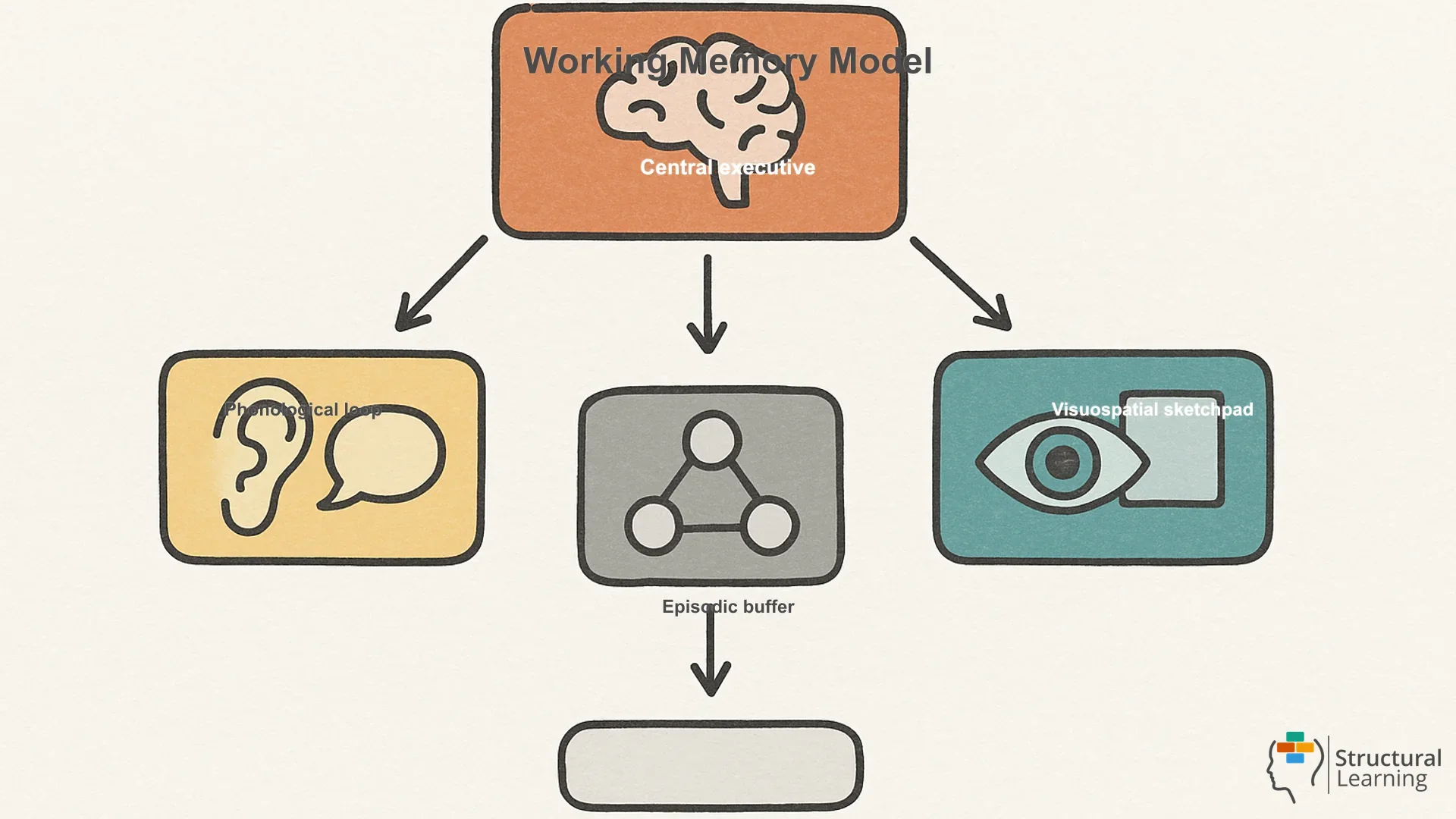
Baddeley's model has four main parts. The central executive guides attention, while the phonological loop deals with words and sounds. The visuospatial sketchpad deals with sights and space. The episodic buffer links these sources with knowledge from long-term memory.
| Component | Main role | Classroom demand | Useful support |
|---|---|---|---|
| Central executive | Directs attention and coordinates processing | Switching between instructions, sources or operations | One clear goal and a stable task sequence |
| Phonological loop | Maintains verbal and sound-based information | Remembering spoken steps while reading or writing | Short phrasing and essential words kept visible |
| Visuospatial sketchpad | Maintains visual and spatial information | Tracking a diagram, layout or movement | A stable model with the relevant feature marked |
| Episodic buffer | Binds verbal, visual and long-term knowledge | Building one coherent account from several sources | A worked example that links words, representations and prior knowledge |
Baddeley (2000) added the episodic buffer. It explains how the mind can bind sources into one account. The four parts are a research model, not real boxes in the brain.
They can help a teacher inspect a task. They do not support fixed “auditory” or “visual” learner types.
Working-memory capacity is limited. Yet teachers should not plan around one set number of items or seconds. The material and the task both matter. Rehearsal, grouping and prior knowledge also change how well we cope.
Cowan's review (2001) put the central limit nearer four chunks in some test conditions. A chunk is not always one word, digit or step. It is one meaningful unit.
An expert reader may treat a familiar phrase as one unit. A novice may need to deal with each new part in turn.
This is why “give no more than three instructions” is a weak rule. One task might ask learners to open a graph, find its steepest part and explain the change. It has three steps, but it also needs word knowledge, visual search and causal thought. Even a short instruction can be hard when key knowledge is weak.
A learner may lose their place in a task with several steps. They may start well but miss a later step. Copying while listening may lead to errors. The same learner may succeed when key steps stay visible.
They may also forget a value during a sum. These signs call for a closer look, not a diagnosis.
Memory scores are linked with attainment in group studies. In one UK study, Gathercole and colleagues (2000) studied seven-year-olds with low National Curriculum results. Many had marked problems on memory tests. Gathercole and colleagues (2006) also studied memory patterns in children with reading needs.
These group results cannot explain one unfinished task. Unclear words or lost attention may look the same. So can gaps in subject knowledge.
Hearing, vision, worry, tiredness and poor layout can also play a part. Compare tasks and change one demand at a time.
A Year 6 class is comparing fractions with unlike denominators. One learner succeeds when a times table grid and worked example stay visible. Without them, the learner changes the denominator but forgets the numerator. This points to a task demand that the teacher can test.
This change protects the maths. It does not lower the goal or assume a lasting memory problem. If the learner still struggles with the link in view, weak prior knowledge may be the cause. Temporary storage may not be the main issue.
Good support cuts needless demand but keeps the subject thinking. Cowan's review for education (2014) supports matching materials to the memory skills learners have. The ideas below improve task design. They are not memory tricks.
Write the goal in words learners can use. Show the current step beside it. No learner should have to rebuild the task from a long talk. Clear routines also reduce the mental cost of finding what to do next.
Place labels beside the right part of a diagram. Put each worked step next to its problem. Do not make learners search across the board, a book and a task sheet. Our Dual Coding guide shows how words and visuals can give one clear account.
A worked example should show the choice, not just the final answer. Mark what the teacher sees. Name the fact they recall.
Explain why the next step follows. Then remove one support after success. The Scaffolding guide shows how to keep the challenge as help fades.
Knowledge in long-term memory can make a task feel smaller. Known words, number facts and patterns let learners group details as one unit. This does not mean drilling every fact first. Find the exact knowledge that the next lesson needs.
Do not ask for detailed notes while showing a new diagram. The same applies while reading hard text aloud. Pause first.
Then ask learners to record the key link. More teacher talk can make access worse when two word-based tasks compete.
Help during first learning can hide weak recall. Return later and ask learners to recall before showing the model. Use errors to repair the missing fact.
Then test again with a new example. The Retrieval Practice guide covers cues and feedback.
Cognitive load theory asks how teaching demands use limited working memory. Sweller (1988) found that some problem formats use mental effort without producing the intended learning. This link helps teachers separate useful challenge from needless task demand.
The answer is not to make every task easy. Some difficulty comes from the topic and what the learner knows. Other demand comes from poor task design.
Teachers can order linked ideas, remove needless search and use worked examples while knowledge is new. The Cognitive Load Theory guide explains the full model.
Working-memory support should start with access and the task. Some learners may face extra demands due to dyslexia, language needs or attention needs. Yet a label does not show which change will help in one lesson. Test the demand rather than guessing from a category.
Collect evidence over time. Involve the learner, family and relevant experts when problems persist. Support should make thought possible.
It should not turn one classroom sign into a clinical label. Our guide to working-memory adjustments explores common failures in more detail.
Working-memory training often improves tasks much like the ones used in practice. The wider gains are far less clear. Strong studies find little benefit for general intelligence or school attainment. This matters when a programme promises broad change.
Sala and Gobet (2020) reviewed 41 studies with 2,375 children. They found small to medium gains on similar memory tasks. With strong control groups, maths, language and general thinking saw almost no gain.
Schools should be wary of broad claims for memory training. There is a clearer case for good teaching of subject knowledge. Teachers can also cut needless demand and move complex steps onto the page.
A learner may still practise a memory method for one task. That is not the same as growing a general mental capacity.
Use this mini app to inspect one hard classroom task. It makes a plan you can print and use. It does not test memory or diagnose a learner. Instead, it helps you find what the task asks learners to hold, use and ignore.
Choose one task. Record what must stay mentally active and what can be moved into the environment.
Four myths cause most poor classroom decisions about working memory. A fixed seven-item limit, instant diagnosis from a missed instruction, decorative visuals and broad claims for memory games all go beyond the evidence. The corrections below keep the model useful without turning it into a rule.
Seven plus or minus two came from a range of judgement and memory tasks. It is not a universal classroom rule. Capacity depends on how information is grouped, what the learner knows and what the task requires them to do.
The learner may not have heard, understood or attended to the instruction. Check access and language before interpreting the failure as memory.
A visual helps when it represents the relation being explained. Decorative or competing material creates another search. Words and visuals should form one explanation.
Practice can improve the practised task and closely related tests. Strong evidence does not support broad transfer to intelligence, reading or mathematics for typically developing children.
Baddeley's model has great value, but it is not the only account. Experts still debate its parts. They also debate how memory links with attention. Work with adults in a lab may not map neatly onto how children learn in class.
Memory tests also mix several demands. A low score may reflect attention, speed, language, method, worry or a new task. Short-term storage is only one possible cause.
The model works best when it leads to a testable question. It works poorly as a fixed label for a learner.
Working memory is only one part of learning. Feelings, trust, language, access and subject knowledge matter too. Use the model with evidence from teaching, not instead of it. Our guide to working memory in the classroom gives more routines once you find the task demand.
These short answers cover the questions teachers most often need before changing a task. They define working memory, separate it from short-term memory and set out the safest teaching response. They also explain why memory training should not be sold as a broad route to attainment.
Working memory is the small mental space used to hold and work with facts during a task. It supports instructions, sums, reading and thought.
Short-term memory mainly keeps facts for a brief time. Working memory also lets us work with those facts while we use them.
Keep goals and steps in view. Put linked information together. Model each new choice, then remove needless search and competing word-based tasks.
Training tends to improve similar memory tasks. Wider school gains are weak. Teachers have a stronger basis for better task design, clear prior teaching and useful methods.
These eight primary and review sources support the model, the capacity discussion and the teaching implications used in this guide. They also support the boundary placed around memory training. Follow each linked title to inspect the research record and judge how closely it fits your context.