Wellbeing in Schools: A Teacher's Guide
Explore effective strategies to foster a culture of wellbeing for staff and students in schools, ensuring a supportive and thriving educational environment.


Explore effective strategies to foster a culture of wellbeing for staff and students in schools, ensuring a supportive and thriving educational environment.
Schools can address post-pandemic wellbeingby implementing evidence-based strategies that target the doubled rates of student mental illness. The most effective approach involves making wellbeing a strategic priority at the senior leadership level, moving beyond individual interventions to create whole-school ecosystems. This includes introducing practical measures like gratitude diaries, tech-free lunchtimes, and structured positive psychology programs.
The measures put in place to protect people during the Covid-19 pandemic have had a significant and long-lasting impact on student wellbeing. This observation has been appropriately called the Pandemic Paradox (Bradbury-Jones & Isham, 2020), the methods used to protect our physical health have directly harmed our mental health.
Now that the periods of lockdown are over and the coronavirus pandemic is largely under control, we must start to address the global decline in pupils' wellbeing that is being seen as early as primary school.

Research has shown that students' wellbeing is deteriorating as they move through secondary school and college, with female students being more likely to experience mental health issues than males (Arslan & Burke, 2021; Owens et al., 2022).
The number of students leaving secondary with a mental health condition has doubled over the last three years. We need a recovery plan to prevent a new pandemic of mental illness in young people; one of the most effective ways we can do this is if senior leaders in schools and colleges make wellbeing a strategic priority.
Research shows that student wellbeing deteriorates throughout secondary school, with female students experiencing higher rates of mental health issues. Studies indicate that effective wellbeing interventions must be embedded into daily school life rather than delivered as one-off lessons. The most successful programs use positive psychology frameworks that address emotional, social, and academic aspects simultaneously.
Historically, it might have been challenging to find relevant research for developing whole-school approaches to wellbeing. There is now an abundance of research into whole school wellbeing programmes, advice for school leaders, and interventions available to promote positive mental health, physical health and emotional health in schools.
It is well-documented (and unsurprising) that students' learning and achievement at school deteriorate if they have poor mental health (Van Zyl & Stander, 2019). It is less well-known that teachers' wellbeing also has a detrimental effect on pupils' mental health (Evans et al., 2022).
For this reason, any whole school wellbeing programme or policy recognises the importance of teachers' wellbeing. School leaders should incorporate strategies to support the wellbeing of the whole community in their strategic development plans.
With this in mind, you will find below summaries of research-backed strategies that have been shown to improve wellbeing in schools.
We must prioritise our own mental health before we can effectively help others to improve theirs. Think of wellbeing as operationalised happiness. Psychologists have identified traits that are associated with preventing pathology and enabling people to flourish (positive psychology, Seligman, 2018).
Positive education is the use of research-informed strategies to develop those traits. By increasing our understanding of what makes us feel happy, we can put strategies in place to improve our own wellbeing.
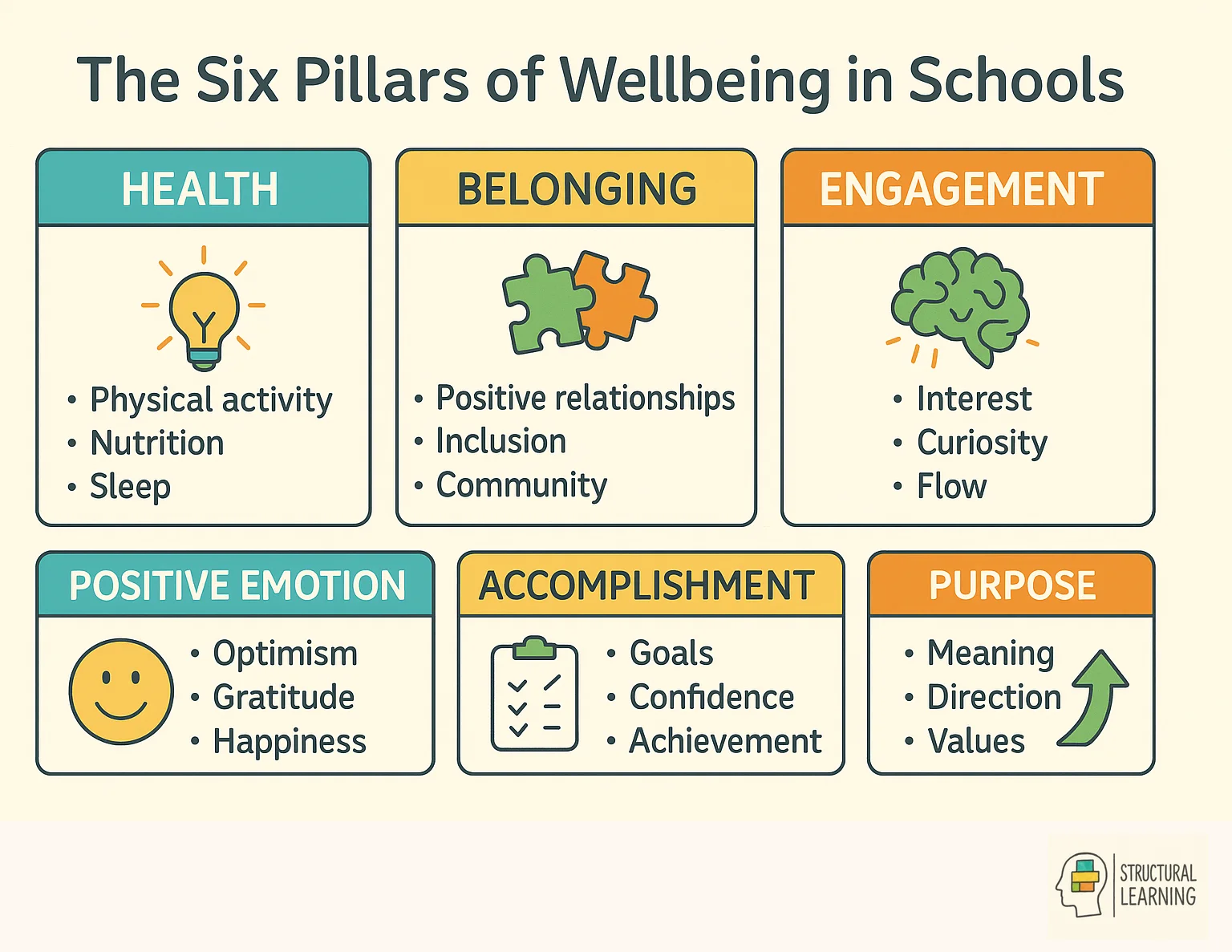
Here are the six widely accepted pillars of wellbeing and how each one can be achieved:
Positive Emotions. This includes gratitude, self-control, and displaying emotional intelligence. Keeping a gratitude diary or listing three things you have been grateful for at the end of each day can help to encourage positive emotions.
Engagement. This occurs when you feel motivated, curious, or have opportunities to be creative. Find an activity you can be fully absorbed in; it could be reading, completing sudoku, knitting, drawing, running, anything that takes all of your focus.
Relationships. Being physically away from other people was one of the greatest challenges during the pandemic. Feeling connected to others, working together, leadership, and forgiveness will all improve the positive impact of relationships.
Meaning. Having a sense of purpose, caring for others, and understanding our core values all help to give our life meaning. Doing a random act of kindness or making a donation to charity can help achieve this pillar.
Achievement. This refers to achievement and accomplishment in every sense. It could be academic (e.g. Completing a Masters), professional (e.g. A promotion), physical (e.g. Achieving a new personal best), or personal (e.g. Meeting up with friends when you would have preferred to stay home). Recognising every achievement, no matter how small, can help us to feel happier.
Health. This refers to physical health, such as getting enough sleep or eating a balanced diet, and also having an awareness of the mind-body connection. Meditation can help to calm the mind.
Schools can improve student wellbeing by embedding positive psychology into school policies, curriculums, and extracurricular activities. This complete approach requires training for teachers and staff to promote positive mental health strategies consistently. By implementing evidence-based interventions, schools can create an environment that creates resilience and improves student outcomes.
A recent randomised control trial by Tosevska et al. (2021) found that positive psychology interventions improved student wellbeing by encouraging engagement, optimism, and resilience. Here are some practical strategies for promoting student wellbeing:
It is imperative that these strategies are embedded throughout the school, becoming a part of the school's ethos, rather than being delivered as one-off interventions.
In education, wellbeing refers to the operationalised happiness and flourishing of both pupils and staff. It moves beyond simply being happy to include positive emotions, engagement, relationships, meaning, achievement, and physical health.
Teachers can support wellbeing by introducing small, practical habits like gratitude diaries or listing three positive things at the end of the day. Providing opportunities for students to be fully absorbed in creative activities or reading also helps them find focus and engagement.
Research indicates that teacher stress levels have a direct impact on the mental health of the pupils they teach. When staff are supported through autonomy and meaningful professional development, it helps break the cycle of stress and creates a more positive environment for achievement.
Studies show that wellbeing interventions are most successful when they are embedded into the daily life of the school rather than delivered as isolated lessons. Effective programmes use frameworks that simultaneously address the emotional, social, and academic needs of the entire community.
A frequent error is treating wellbeing as a series of one-off interventions instead of making it a strategic priority for senior leadership. Schools should avoid short-term fixes and instead focus on building long-term habits that support the flourishing of every individual.
Schools can address the impact of the pandemic paradox by implementing evidence-based recovery plans that target the doubled rates of student mental illness. This requires making mental health a strategic priority and moving toward a whole-school ecosystem of support.
Prioritising student wellbeing in schools is not merely a reactive measure to the post-pandemic mental health crisis, but a proactive investment in the future success and happiness of young people. By embedding positive psychology principles and evidence-based strategies into the fabric of school life, we can creates environments where students flourish academically, emotionally, and socially. The key lies in adopting a whole-school approach that recognises the interconnectedness of student, teacher, and staff wellbeing, ensuring that mental health is a strategic priority at all levels.
Through practical measures such as gratitude diaries, tech-free lunchtimes, and comprehensive SEL programs, schools can cultivate a culture of resilience, empathy, and engagement. By providing adequate support and training for teachers, and prioritising their wellbeing, schools can break the cycle of stress and create a positive ripple effect throughout the entire school community. Ultimately, by creating a supportive and nurturing environment, schools can helps students to navigate challenges, build meaningful relationships, and achieve their full potential.
External References: EEF: Social and Emotional Learning | Anna Freud Centre: Schools and Colleges Resources

Schools can address post-pandemic wellbeingby implementing evidence-based strategies that target the doubled rates of student mental illness. The most effective approach involves making wellbeing a strategic priority at the senior leadership level, moving beyond individual interventions to create whole-school ecosystems. This includes introducing practical measures like gratitude diaries, tech-free lunchtimes, and structured positive psychology programs.
The measures put in place to protect people during the Covid-19 pandemic have had a significant and long-lasting impact on student wellbeing. This observation has been appropriately called the Pandemic Paradox (Bradbury-Jones & Isham, 2020), the methods used to protect our physical health have directly harmed our mental health.
Now that the periods of lockdown are over and the coronavirus pandemic is largely under control, we must start to address the global decline in pupils' wellbeing that is being seen as early as primary school.

Research has shown that students' wellbeing is deteriorating as they move through secondary school and college, with female students being more likely to experience mental health issues than males (Arslan & Burke, 2021; Owens et al., 2022).
The number of students leaving secondary with a mental health condition has doubled over the last three years. We need a recovery plan to prevent a new pandemic of mental illness in young people; one of the most effective ways we can do this is if senior leaders in schools and colleges make wellbeing a strategic priority.
Research shows that student wellbeing deteriorates throughout secondary school, with female students experiencing higher rates of mental health issues. Studies indicate that effective wellbeing interventions must be embedded into daily school life rather than delivered as one-off lessons. The most successful programs use positive psychology frameworks that address emotional, social, and academic aspects simultaneously.
Historically, it might have been challenging to find relevant research for developing whole-school approaches to wellbeing. There is now an abundance of research into whole school wellbeing programmes, advice for school leaders, and interventions available to promote positive mental health, physical health and emotional health in schools.
It is well-documented (and unsurprising) that students' learning and achievement at school deteriorate if they have poor mental health (Van Zyl & Stander, 2019). It is less well-known that teachers' wellbeing also has a detrimental effect on pupils' mental health (Evans et al., 2022).
For this reason, any whole school wellbeing programme or policy recognises the importance of teachers' wellbeing. School leaders should incorporate strategies to support the wellbeing of the whole community in their strategic development plans.
With this in mind, you will find below summaries of research-backed strategies that have been shown to improve wellbeing in schools.
We must prioritise our own mental health before we can effectively help others to improve theirs. Think of wellbeing as operationalised happiness. Psychologists have identified traits that are associated with preventing pathology and enabling people to flourish (positive psychology, Seligman, 2018).
Positive education is the use of research-informed strategies to develop those traits. By increasing our understanding of what makes us feel happy, we can put strategies in place to improve our own wellbeing.
Here are the six widely accepted pillars of wellbeing and how each one can be achieved:
Positive Emotions. This includes gratitude, self-control, and displaying emotional intelligence. Keeping a gratitude diary or listing three things you have been grateful for at the end of each day can help to encourage positive emotions.
Engagement. This occurs when you feel motivated, curious, or have opportunities to be creative. Find an activity you can be fully absorbed in; it could be reading, completing sudoku, knitting, drawing, running, anything that takes all of your focus.
Relationships. Being physically away from other people was one of the greatest challenges during the pandemic. Feeling connected to others, working together, leadership, and forgiveness will all improve the positive impact of relationships.
Meaning. Having a sense of purpose, caring for others, and understanding our core values all help to give our life meaning. Doing a random act of kindness or making a donation to charity can help achieve this pillar.
Achievement. This refers to achievement and accomplishment in every sense. It could be academic (e.g. Completing a Masters), professional (e.g. A promotion), physical (e.g. Achieving a new personal best), or personal (e.g. Meeting up with friends when you would have preferred to stay home). Recognising every achievement, no matter how small, can help us to feel happier.
Health. This refers to physical health, such as getting enough sleep or eating a balanced diet, and also having an awareness of the mind-body connection. Meditation can help to calm the mind.
Schools can improve student wellbeing by embedding positive psychology into school policies, curriculums, and extracurricular activities. This complete approach requires training for teachers and staff to promote positive mental health strategies consistently. By implementing evidence-based interventions, schools can create an environment that creates resilience and improves student outcomes.
A recent randomised control trial by Tosevska et al. (2021) found that positive psychology interventions improved student wellbeing by encouraging engagement, optimism, and resilience. Here are some practical strategies for promoting student wellbeing:
It is imperative that these strategies are embedded throughout the school, becoming a part of the school's ethos, rather than being delivered as one-off interventions.
In education, wellbeing refers to the operationalised happiness and flourishing of both pupils and staff. It moves beyond simply being happy to include positive emotions, engagement, relationships, meaning, achievement, and physical health.
Teachers can support wellbeing by introducing small, practical habits like gratitude diaries or listing three positive things at the end of the day. Providing opportunities for students to be fully absorbed in creative activities or reading also helps them find focus and engagement.
Research indicates that teacher stress levels have a direct impact on the mental health of the pupils they teach. When staff are supported through autonomy and meaningful professional development, it helps break the cycle of stress and creates a more positive environment for achievement.
Studies show that wellbeing interventions are most successful when they are embedded into the daily life of the school rather than delivered as isolated lessons. Effective programmes use frameworks that simultaneously address the emotional, social, and academic needs of the entire community.
A frequent error is treating wellbeing as a series of one-off interventions instead of making it a strategic priority for senior leadership. Schools should avoid short-term fixes and instead focus on building long-term habits that support the flourishing of every individual.
Schools can address the impact of the pandemic paradox by implementing evidence-based recovery plans that target the doubled rates of student mental illness. This requires making mental health a strategic priority and moving toward a whole-school ecosystem of support.
Prioritising student wellbeing in schools is not merely a reactive measure to the post-pandemic mental health crisis, but a proactive investment in the future success and happiness of young people. By embedding positive psychology principles and evidence-based strategies into the fabric of school life, we can creates environments where students flourish academically, emotionally, and socially. The key lies in adopting a whole-school approach that recognises the interconnectedness of student, teacher, and staff wellbeing, ensuring that mental health is a strategic priority at all levels.
Through practical measures such as gratitude diaries, tech-free lunchtimes, and comprehensive SEL programs, schools can cultivate a culture of resilience, empathy, and engagement. By providing adequate support and training for teachers, and prioritising their wellbeing, schools can break the cycle of stress and create a positive ripple effect throughout the entire school community. Ultimately, by creating a supportive and nurturing environment, schools can helps students to navigate challenges, build meaningful relationships, and achieve their full potential.
External References: EEF: Social and Emotional Learning | Anna Freud Centre: Schools and Colleges Resources
<script type="application/ld+json">{"@context":"https://schema.org","@graph":[{"@type":"Article","@id":"https://www.structural-learning.com/post/wellbeing-in-schools#article","headline":"Wellbeing in Schools","description":"Explore effective strategies to foster a culture of wellbeing for staff and students in schools, ensuring a supportive and thriving educational environment.","datePublished":"2022-12-19T16:53:03.928Z","dateModified":"2026-03-02T11:01:03.880Z","author":{"@type":"Person","name":"Paul Main","url":"https://www.structural-learning.com/team/paulmain","jobTitle":"Founder & Educational Consultant"},"publisher":{"@type":"Organization","name":"Structural Learning","url":"https://www.structural-learning.com","logo":{"@type":"ImageObject","url":"https://cdn.prod.website-files.com/5b69a01ba2e409e5d5e055c6/6040bf0426cb415ba2fc7882_newlogoblue.svg"}},"mainEntityOfPage":{"@type":"WebPage","@id":"https://www.structural-learning.com/post/wellbeing-in-schools"},"image":"https://cdn.prod.website-files.com/5b69a01ba2e409501de055d1/695260ac2d35fe9676917949_695260ab7923951d43cdffc1_wellbeing-in-schools-infographic.webp","wordCount":1453},{"@type":"BreadcrumbList","@id":"https://www.structural-learning.com/post/wellbeing-in-schools#breadcrumb","itemListElement":[{"@type":"ListItem","position":1,"name":"Home","item":"https://www.structural-learning.com/"},{"@type":"ListItem","position":2,"name":"Blog","item":"https://www.structural-learning.com/blog"},{"@type":"ListItem","position":3,"name":"Wellbeing in Schools","item":"https://www.structural-learning.com/post/wellbeing-in-schools"}]},{"@type":"FAQPage","mainEntity":[{"@type":"Question","name":"What does wellbeing mean in a school context?","acceptedAnswer":{"@type":"Answer","text":"In education, wellbeing refers to the operationalised happiness and flourishing of both pupils and staff. It moves beyond simply being happy to include positive emotions, engagement, relationships, meaning, achievement, and physical health."}},{"@type":"Question","name":"How do teachers implement wellbeing strategies in the classroom?","acceptedAnswer":{"@type":"Answer","text":"Teachers can support wellbeing by introducing small, practical habits like gratitude diaries or listing three positive things at the end of the day. Providing opportunities for students to be fully absorbed in creative activities or reading also helps them find focus and engagement."}},{"@type":"Question","name":"What are the benefits of teacher wellbeing for learning?","acceptedAnswer":{"@type":"Answer","text":"Research indicates that teacher stress levels have a direct impact on the mental health of the pupils they teach. When staff are supported through autonomy and meaningful professional development, it helps break the cycle of stress and creates a more positive environment for achievement."}},{"@type":"Question","name":"What does the research say about wellbeing interventions in schools?","acceptedAnswer":{"@type":"Answer","text":"Studies show that wellbeing interventions are most successful when they are embedded into the daily life of the school rather than delivered as isolated lessons. Effective programmes use frameworks that simultaneously address the emotional, social, and academic needs of the entire community."}},{"@type":"Question","name":"What are common mistakes when using wellbeing strategies?","acceptedAnswer":{"@type":"Answer","text":"A frequent error is treating wellbeing as a series of one-off interventions instead of making it a strategic priority for senior leadership. Schools should avoid short-term fixes and instead focus on building long-term habits that support the flourishing of every individual."}},{"@type":"Question","name":"How can schools address student wellbeing after the pandemic?","acceptedAnswer":{"@type":"Answer","text":"Schools can address the impact of the pandemic paradox by implementing evidence-based recovery plans that target the doubled rates of student mental illness. This requires making mental health a strategic priority and moving toward a whole-school ecosystem of support."}}]}]}</script>