Updated on
July 14, 2026
Dual Coding vs Multimedia Overload: When Visuals Fail
Dual coding theory: why words + pictures boost memory. When adding images backfires (cognitive overload), and practical classroom tools for every subject.

Updated on
July 14, 2026
Dual coding theory: why words + pictures boost memory. When adding images backfires (cognitive overload), and practical classroom tools for every subject.
What is dual coding?
Dual coding is a learning strategy that combines words with images so ideas are easier to understand and remember, because the brain has both a verbal and a visual route to retrieve them. For teachers it means pairing clear explanation with relevant diagrams or sketches—not decorative pictures—so the two channels reinforce each other.
Dual coding is a learning strategy that combines words and images so ideas are easier to understand and remember. When information is presented in both verbal and visual forms, the brain has more than one route to make sense of it and retrieve it later. In practice, that could mean matching key vocabulary to diagrams, turning notes into labelled sketches, or using worked examples with both text and visuals. The real power of dual coding lies in how simple it is, and once you see it in action, you may start spotting opportunities to use it everywhere.
For a broader view of how this fits alongside other classroom methods, see our guide to evidence-based pedagogy.
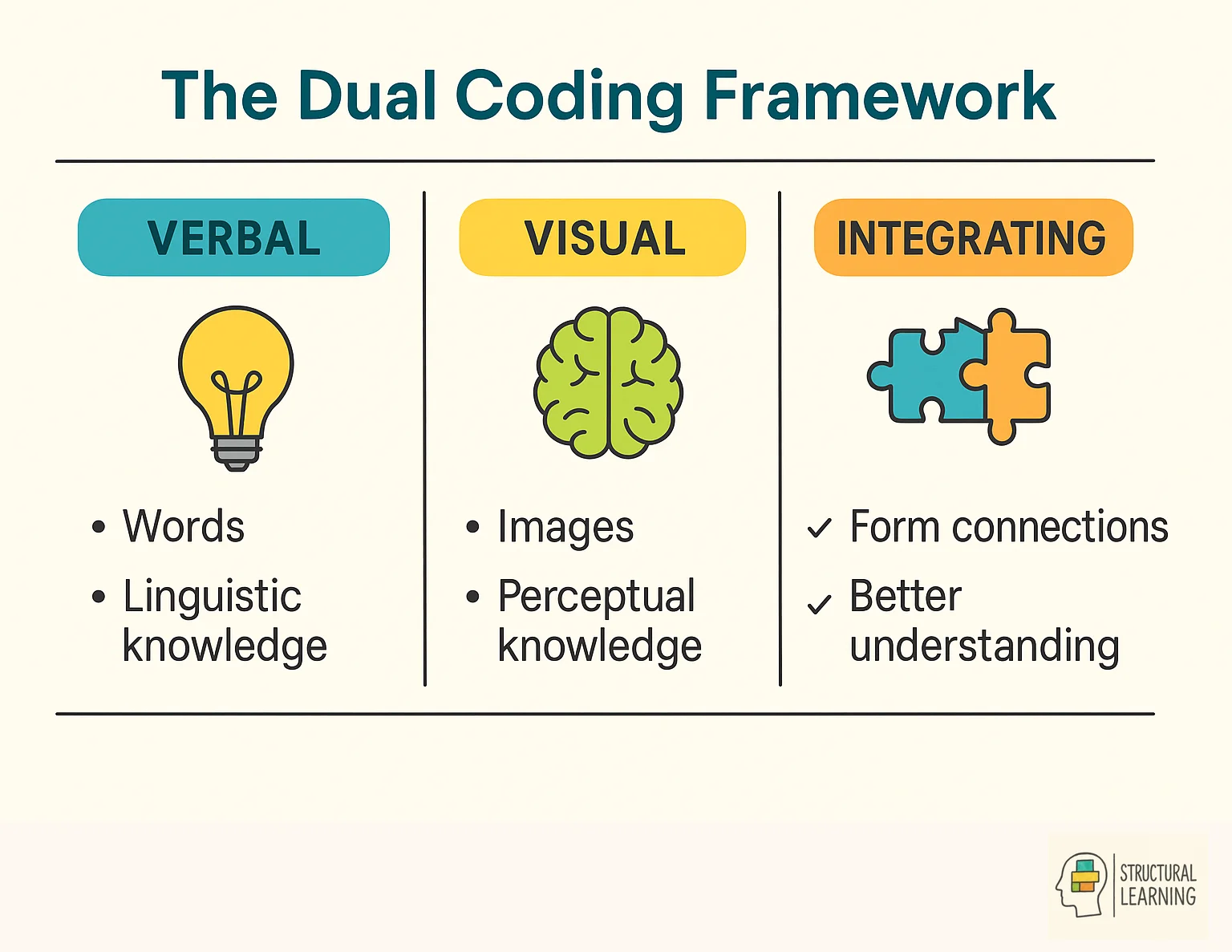
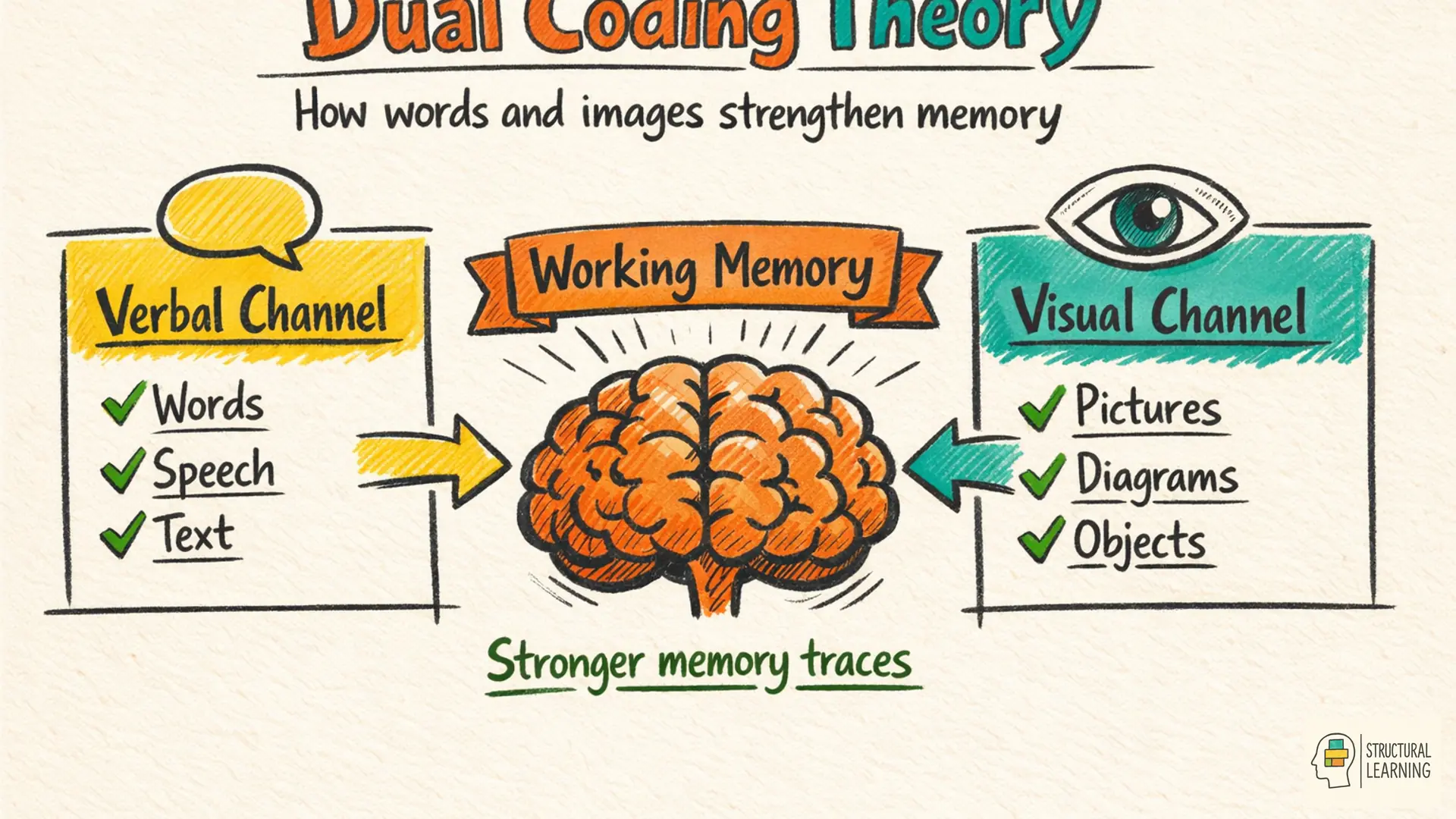
Paivio's dual coding theory (1971, 1986) says we use two systems to represent knowledge. The verbal system processes language in order; words spark other words. The imagery system uses mental images to represent knowledge (Paivio, 1971, 1986). Both systems have strengths, depending on the information.
Paivio's research shows a strong concreteness effect. Learners recall concrete nouns, like 'bicycle', better than abstract ones, like 'justice'. Paivio (1971, 1986) suggests concrete words use verbal and imagery systems. Abstract words mainly use verbal encoding. Dual coding provides better recall as it gives more retrieval options.
Paivio said words and images link, (1971). "Elephant" activates related words and an image. This differs from Baddeley's (1992) working memory model. Baddeley looked at short-term processing. Paivio theorised long-term knowledge coding. Both answer different questions.
Concreteness and dual coding affect teaching. Use visual s with verbal explanations for harder ideas. This gives learners another way to remember facts (Paivio, 1971). Choose visuals that add something new. Words and images should both offer unique details (Sadoski, 2005).
Dual coding is the deliberate combination of words and visuals to strengthen understanding, encoding and long-term recall. Teachers should use diagrams alongside explanations to aid memory. Research shows this helps learners understand better.
Dual coding combines words and visuals to improve learner understanding (Paivio, 1971). Learners process words and visuals differently, boosting memory (Clark & Paivio, 1991). Use diagrams and text together for any subject. You may already use dual coding techniques (Sadoski, 2005).
Paivio (1986) said verbal information saves as logogens, images as imagens. Logogens connect to word networks. Imagens link to spatial features. When learners read "volcano" with a diagram, logogens and imagens activate. Paivio found these connections help recall as brains use two paths.
Cognitive psychologists found six effective learning strategies. Dual coding helps build long-term memory. Learners see and hear information at the same time (Paivio, 1971). This gives them two routes to remember knowledge (Clark & Paivio, 1991). Retrieving information then becomes much easier.
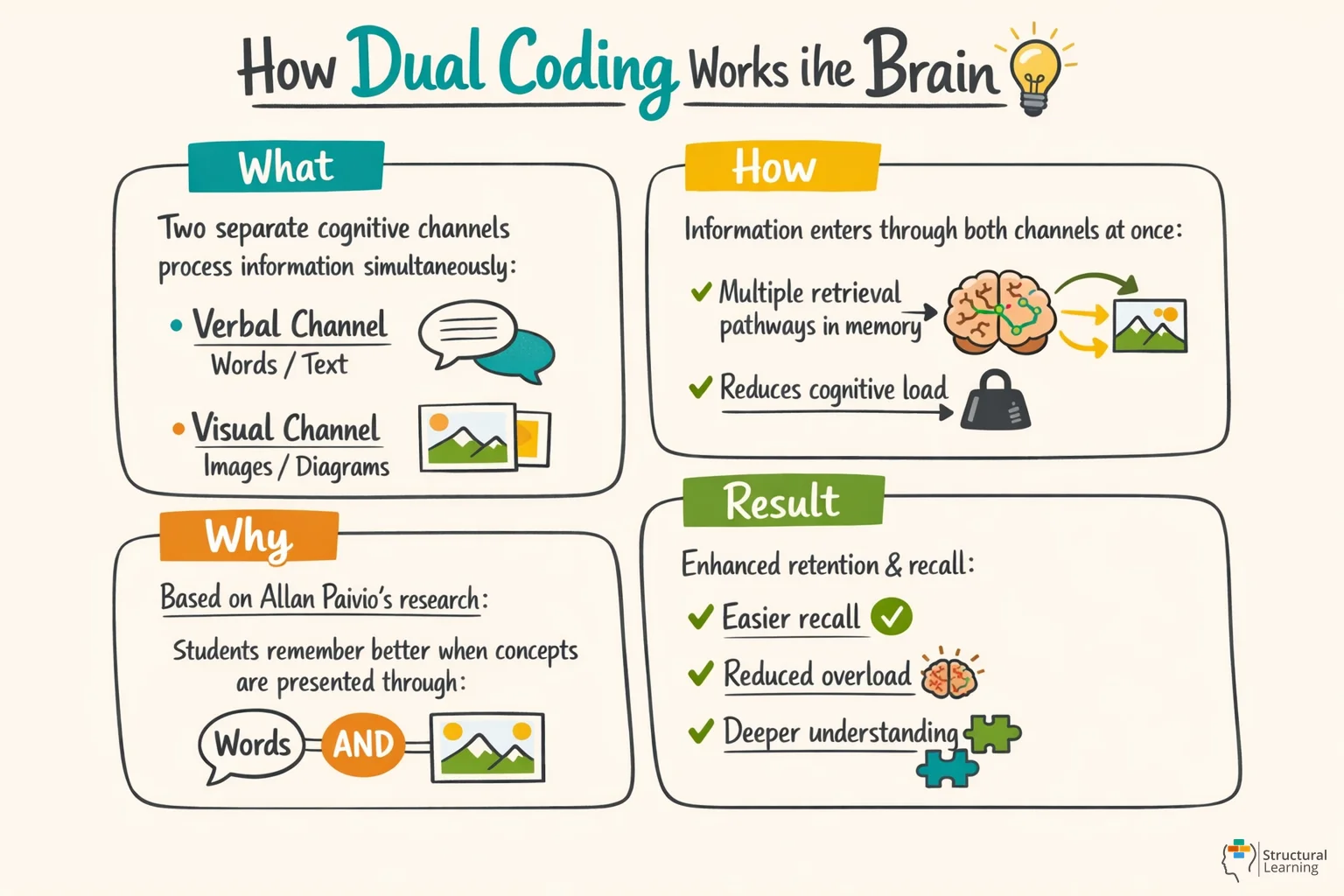
Key benefits of Dual Coding include:
Teachers can use Dual Coding through a variety of visual formats, including:
Cognitive Load Theory is more useful than learning styles now. The EEF promotes Dual Coding to help learners (Paivio, 1971). Applying Dual Coding can boost understanding in classrooms (Clark & Paivio, 1991).
Teachers combine visuals and words. Learners process information better this way. This boosts understanding and long-term memory (Paivio, 1971; Sadoski, 2005). Mayer's Multimedia Learning (2009) and Clark and Lyons' Graphics for Learning are consistent with dual coding principles and give design guidance for combining words and visuals.
Common dual coding mistakes are unclear combinations of words and visuals that create clutter, distraction and unnecessary cognitive load. Some classrooms add images and text badly, increasing mental effort. Teachers wrongly assume all images help or overcrowd slides (Paivio, 1986). This overwhelms the learner.
Clark and Paivio (1991) showed that learners need both words and visuals. Understanding dual coding helps fix common errors easily. Research by Sorden (2005) and Mayer (2009) supports this.
Mayer (2014) showed that generic images distract learners. They can actually hurt understanding. Visuals that closely match lesson content help learners more. Hegarty (2011) and Sweller (2020) stated that complex topics like photosynthesis need focused images.
Teachers think pictures always help learning. Mayer (2009) found some images just decorate. These decorative visuals do not help learners. Instructional visuals explain content, said Mayer (2009). Decorative images distract learners, not teach.
The fix: Every image must answer a question that the text poses, or illustrate a concept that words describe. The test: if you remove the image, does the explanation lose essential information? If not, remove it. A labelled diagram of a leaf's internal structure carries meaning. A photo of a forest does not (unless you're specifically teaching forest ecosystems, in which case label the relevant features).
Learners understand better with labelled diagrams (Mayer, 2009). Use these instead of generic photos. A chloroplast diagram shows light entry and glucose creation. This image matches the words' teaching power.
Mayer (2009) says learners understand better with mixed visuals and text. Do not show the water cycle image with "Water evaporates, condenses, precipitates." This overwhelms learners with information.
Teachers want to be clear. They use different ways to explain things. Dual coding works best when pictures and words show the same ideas. This creates two linked memory paths.
The fix: Let words describe processes and relationships, and let images show structure and spatial detail. For the water cycle: words describe the mechanism ("When water molecules gain heat energy, they change from liquid to gas and rise as invisible vapour"). The image shows the cycle's geography, where evaporation happens, where clouds form, where precipitation falls. Each channel does different cognitive work.
Use words to explain chemical reactions, like plant respiration. It breaks glucose into CO₂ and energy. (Ainsworth, 2006) Images should show pathways, with arrows moving carbon. This connects atmosphere, organisms, and soil. (Mayer, 2009; Sweller, 1988) Visual and verbal cues then complement each other.
The mistake: A diagram appears at the bottom of the slide, and the explanation is at the top. Or the image is on the left, the text on the right, with no visual link between them. Learners have to actively search for the connection.
Design software often defaults to top-left layouts. Teachers may not consider how this design increases cognitive load. This makes learners mentally search for spatial relationships (Sweller, 1988; Chandler & Sweller, 1991).
Place text close to the matching image part. Use arrows and colour-coding to connect words and visuals. Mayer (2009) says keep explanations near diagrams. This contiguity principle reduces how hard learners must think.
Classroom example: When labelling a plant cell, don't write the organelle names in a list on the right and show the cell on the left. Instead, draw the cell, position each label immediately adjacent to the structure it names (with a line pointing to it), and use consistent positioning so learners develop a spatial mental model. Learners then remember where the organelle is in relation to other structures, not just its name.
This causes too much thinking effort (Sweller, 1988). Learners struggle when you talk while showing complex pictures. Working memory can only process a certain amount (Baddeley, 2000). Mayer and Moreno (2003), in 'Nine ways to reduce cognitive load in multimedia learning', argued that poorly designed multimedia presentations can overload working memory and described design methods for reducing it.
Why it happens: Teachers think "more information channels = more learning." But working memory is a bottleneck. When visual and verbal information are both complex and arrive simultaneously, learners can't hold them both in mind (Baddeley, 2003).
Stagger learning. Show images silently first (10-15 seconds) for learners to look (Mayer, 2014). Explain the image afterwards, or reveal it piece by piece as you speak. This segmentation reduces how hard learners' brains work (Mayer, 2014).
Teach atom structure by showing the nucleus first. Explain its components clearly to each learner. Then add electron shells and explain their function. Finally, add charge details. Learners build knowledge with simple steps, as Kirschner (2002) suggests.
Teachers should check learners understand complex diagrams (circuits, timelines, food webs). Many learners may misinterpret them or focus on irrelevant details. Don't assume understanding (Schnotz, 2014; Lowe, 2003).
Why it happens: Teachers see the image and immediately understand its logic. They forget that interpreting a diagram is itself a skill, learners need to know what to look for, in what order, and why.
The fix: Scaffold the visual interpretation explicitly. Ask guiding questions: "What does this image show? Where does the process start? What happens next? What do the arrows represent?" Annotate the image with numbers or letters to guide learner attention in the intended sequence. For KS2, provide a written guide: "Look at: 1. The title. 2. The labels. 3. The arrows. 4. What each arrow represents."
Classroom example: When presenting a food web to KS3 learners, don't assume they'll understand the direction of arrows (energy flow, not just "connection"). Explicitly label: "The arrow points from food to feeder, it shows energy moving into the organism." Then ask learners to trace a path: "Energy enters as sunlight. Where does it go first?" This scaffolding transforms the image from confusing to transparent.
Dual coding uses visuals and words together to support learners. Paivio (1971) found this creates helpful mental representations. Mayer (2009) showed integrated images with clear explanations work best. Sweller (1988) noted extra or unclear images can actually block learning.
Butcher (2006) found that combining diagrams with text significantly improved learner understanding. Mayer (2009) showed that multimedia learning with dual coding led to substantial gains in test scores compared with text-only instruction. The EEF Teaching and Learning Toolkit estimates that collaborative learning approaches have an average impact of about five additional months' progress, but this is not a specific estimate for visual tools. See our Rosenshine's principles article for more advice.
Dual coding in the brain involves linked verbal and visual systems that work together to strengthen memory and recall. Sadoski (2005) and Clark & Paivio (1991) found using both helps recall. Combining words and visuals can reduce how much effort the learner uses.
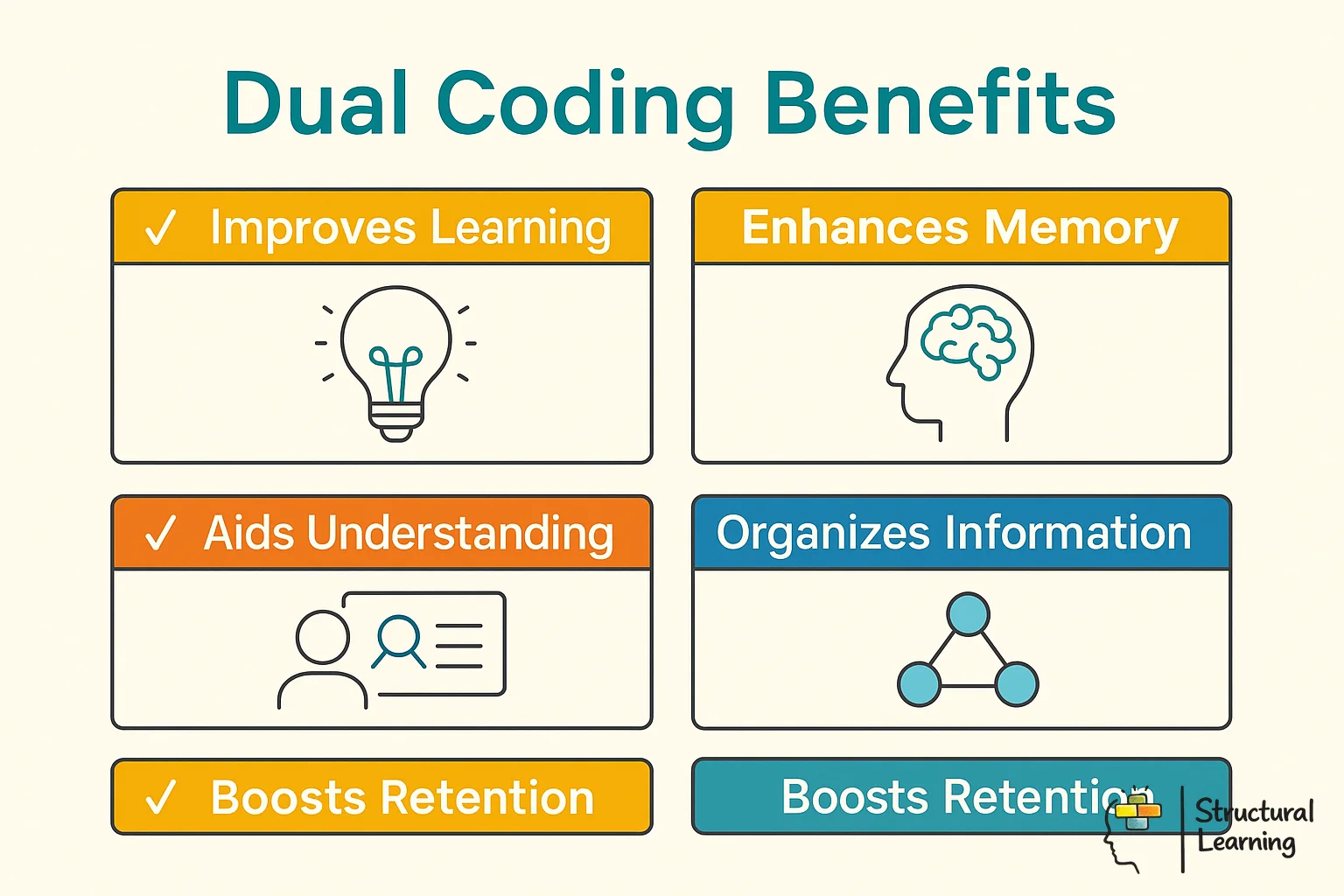
Using words and pictures helps learner memory. Teachers can use this in memory tasks. Smith (2020) found that asking questions and explaining ideas help memory. These methods make learners think actively about the topic.
Paivio's Dual-Coding Theory helps learners grasp tough concepts. (Paivio). Blend images with text to cut down on learner overwhelm. This boosts learner recall and their level of understanding.
Paivio (1971) found learners process visuals and words separately, but together. His theory suggests combining words with images helps learners understand (Paivio, 1971).
Paivio's (1971) Dual-Coding Theory suggests combined visuals and words help learners. Teachers sharing both may improve knowledge processing and memory. Research by Sadoski and Paivio (2001) supports this.
The educational phenomena of Dual coding is based on scientific evidence. It's , which deals with students deciding how they believe they learn best. Dual coding primarily relates to how the brain processes information.
Alan Baddeley's Working Memory Model suggests audio and visual brain routes build good memories. This approach echoes research (Paivio, 1971; Mayer & Moreno, 2003; Sweller, 1988). Learners remember better by combining what they see and hear.
Paivio's (1971) Dual-Coding Theory says learners use visual and verbal systems. Using both systems helps learners grasp new concepts better. Sweller (1988) proved lowering cognitive load helps learning. This aligns with how cognition works (Sweller, 1988).
Dual coding helps learning, says science. Visual aids (diagrams, graphs) paired with words improve understanding. This reduces brain strain, helping learners connect ideas (Paivio, 1971; Sadoski, 2001; Clark & Paivio, 1991). Learners remember information better, say researchers.
Dual coding uses visuals and words to boost memory. Teachers can reduce learner workload with this approach (Paivio, 1971). Incorporating dual coding helps learners grasp concepts better (Sadoski, 2005; Clark & Paivio, 1991).

| Aspect | Verbal Channel | Visual Channel | Dual Coding Advantage |
|---|---|---|---|
| Processing System | Phonological loop; sequential processing of language | Visuospatial sketchpad; thorough processing of images | Two independent channels = doubled working memory capacity |
| Memory Encoding | Creates verbal memory traces; stored as linguistic representations | Creates imaginal memory traces; stored as mental pictures | Multiple retrieval pathways; if one fails, the other remains |
| Information Type | Abstract concepts, definitions, procedures, sequences | Concrete objects, spatial relationships, comparisons | Abstract concepts become memorable through visual anchors |
| Example Format | Written text, spoken explanation, lists, narratives | Diagrams, timelines, concept maps, icons, photographs | Text with integrated visuals creates strongest encoding |
| Retention Impact | ~10% retention after 3 days (words alone) | ~35% retention after 3 days (pictures alone) | ~65% retention when words and pictures combined |
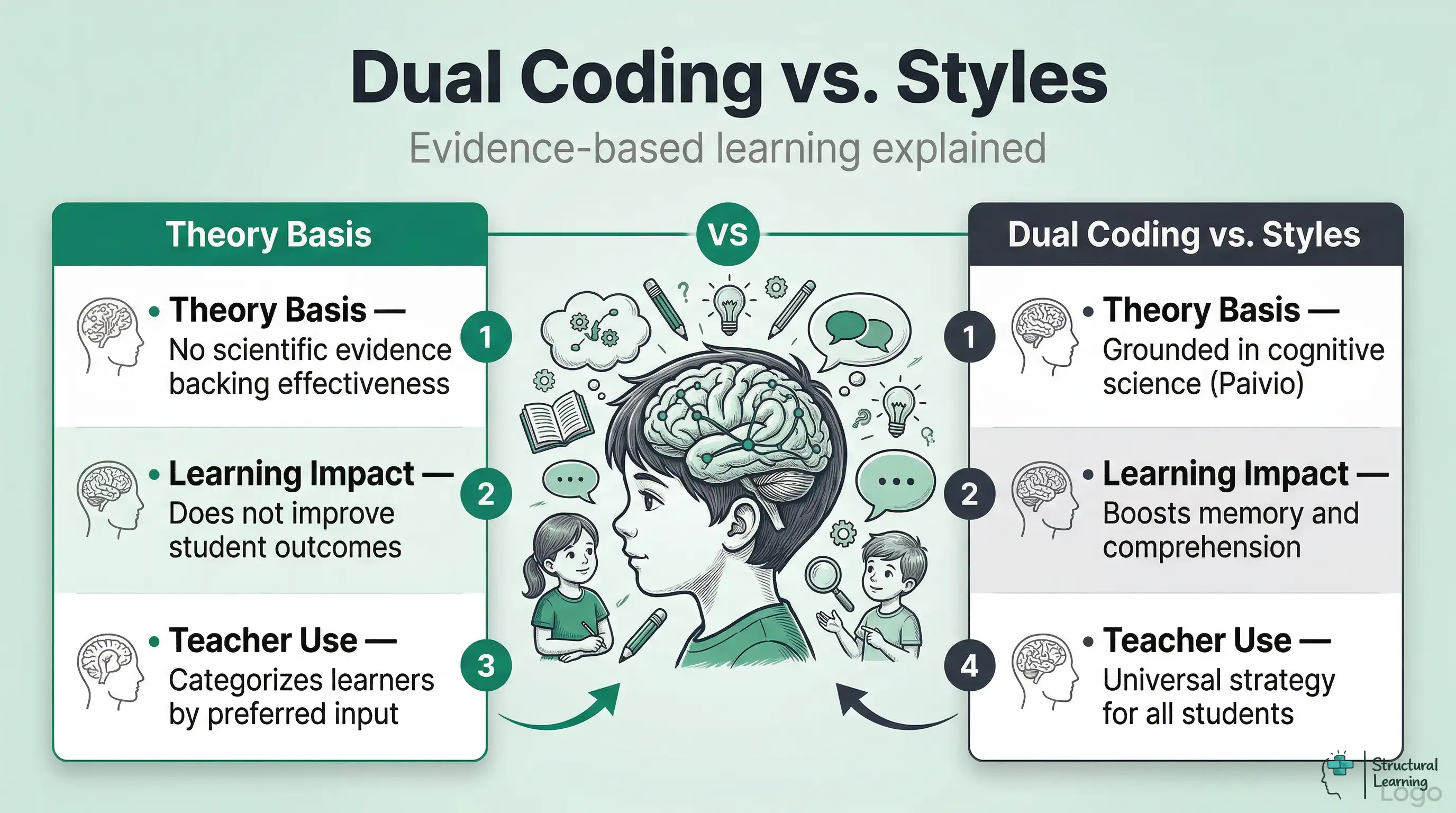
Paivio (1971, 1986) and Mayer (2001) offer a structure with dual coding and multimedia learning. Medina (2008) notes pictures help learners remember more easily.
Sadoski and Paivio (2001) link Dual Coding Theory to how learners read. Effective readers use language and their imagination together. Learners picture stories, making mental images that aid understanding. These images connect to words. Texts lacking imagery are harder for learners (Sadoski & Paivio, 2001).
Paivio's concreteness effect shows that learners grasp concrete words quickly. Pressley (1977) found that images improve vocabulary recall more than repetition. Pictures support learners if they forget specific words. Studies show that actively creating images helps learning better than just viewing them.
Clark and Paivio (1991) showed pictures are easier to remember than words. This "picture superiority effect" helps early learners. Books with pictures let learners use images to aid reading. Graphic novels use this idea, engaging learners with words and pictures. Research suggests this supports comprehension and motivation. Evidence quality varies (Clark & Paivio, 1991).
Dual coding helps EAL learners facing language challenges. Learners translating words use the verbal system (Clark & Paivio, 1991). Imagery like pictures creates a connection, not just translation. This image offers a retrieval route, independent of language. Imagistic encoding assists bilingual learners more; the image bridges languages (Clark & Paivio, 1991).
Using dual coding in daily lessons involves pairing explanations with purposeful visuals to organise ideas and improve understanding and recall. Teachers can model with timelines (Mayer, 2021). Guide learners to create diagrams (Clark & Paivio, 1991). Use annotated diagrams for science (Ainsworth, 2006), flow charts, and mind maps (Buzan, 2000).
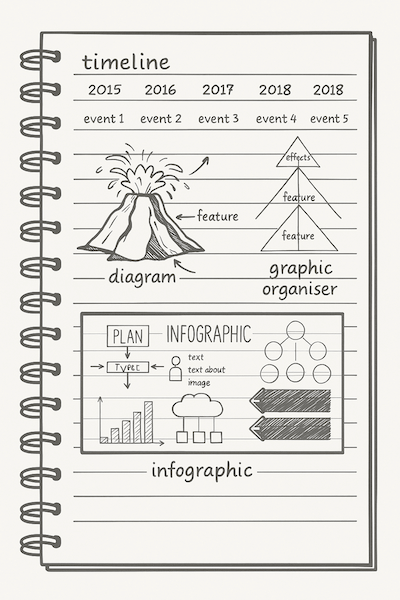
Dual coding helps learners understand with words and visuals. Pair explanations with drawings, as Paivio (1971) suggested. Learners remember information better using this method (Sadoski, 2005; Clark & Paivio, 1991).
Here's a step-by-step guide to using Dual Coding in the classroom:
1. Identify and Analyse Visuals
Encourage your learners to find visuals in their course materials. These might include diagrams, infographics, or timelines.
Ask them to analyse how the words explain the visuals, focusing on what key details are emphasised.
2. Reverse the Process
Learners examine images. They then decide how visuals represent written text. This exercise supports visual literacy skills (Jewitt, 2005). Visual literacy is key for learning (Kress & van Leeuwen, 2006).
This makes the link between visual and verbal information stronger. It helps learners to remember things better.
3. Describe in Their Own Words
Ask students to explain the concept in their own words, summarising the key ideas from both the text and the visuals.
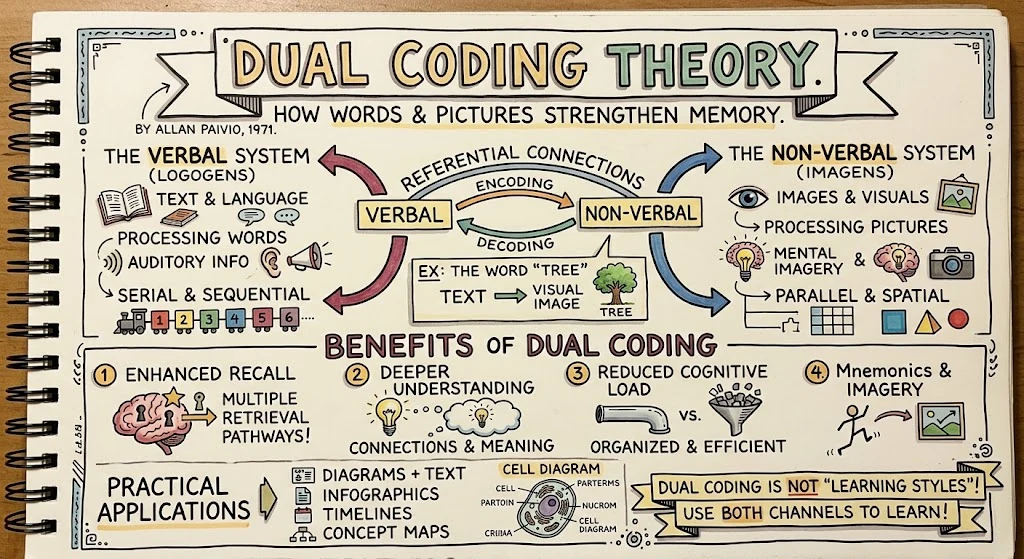
This encourages active processing, rather than passive viewing.
4. Create Their Own Visual Representations
Willingham (2009) found visuals help learners demonstrate understanding. Diagrams and sketches work well for this. Sousa (2017) and Fiorella & Mayer (2015) say visuals let learners represent information.
Learners must create meaningful structures from abstract information. This step helps them learn deeply (Bransford et al., 2000; Brown et al., 2014). Cognitive load theory (Sweller, 1988) shows how this impacts learning. Research by Kirschner et al. (2006) provides more context.
Learners remember better when activities change. Paivio (1971) proved Dual Coding helps learning with visuals. Varied formats assist learners to recall information well.
Larkin and Simon (1987) compared text and diagrams for maths and physics problems. They found diagrams help learners process information faster than text. Diagrams group related items, so learners see relationships more easily. Force diagrams show directions clearly, unlike sentences. Larkin and Simon (1987) suggest diagrams reduce memory load in maths.
Ainsworth (2006) showed multiple formats help science learners. Diagrams and graphs show concepts in different ways. Ainsworth thinks one format makes another clearer. Learners understand more by linking these formats. Ainsworth found this increases workload. This happens when learners struggle or formats lack support. Don't show everything at once. Help learners make connections themselves.
History uses timelines; learners link names and dates to images showing time. Events close in time appear close together, according to Paivio (1991). Geography uses maps; spatial relationships mirror real-world ones, says Clark (1986). Music needs notation; notes' stave position shows pitch and timing, according to Sadoski (2001). Readers translate notation into sound, with verbal cues less vital.
Ainsworth (2006) and Mayer (2009) showed dual coding has limits. Complex diagrams raise cognitive load if learners struggle to understand them. A detailed mitosis diagram may overwhelm biology learners. Simple visuals paired with words work better initially. Introduce complex diagrams slowly, adding detail as learners improve.
Dual coding across subjects means linking words and images so learners connect representations and deepen understanding in different disciplines. Students need to check: how do these words explain what's present in the pictures? How do the representative images depict what's given in the text?
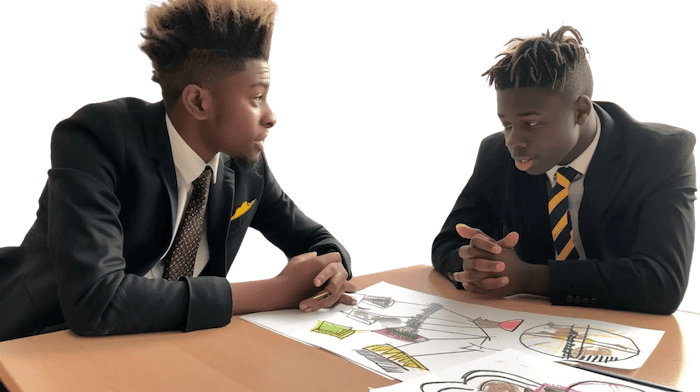
There are specific kinds of visuals that go very well with specific kinds of materials. For instance, a diagram may help very well with concepts of biology and a timeline may do very well to remember history. Students must show creativity while drawing the visual materials. They don't have to reproduce the same visuals they've seen in their class materials. However, the representative images must depict what they saw in words in their class materials.
After using the dual coding, students need to do the following:
After comparing words with the visual, students must explain the concept they're trying to learn. This is the time to retrieve the details on their own. Students must continue to practise until they reach a point where they can put away their class material and write their class material in words and draw visuals, representative images and other graphics according to the class material.
Larkin and Simon (1987) found diagrams help learners in maths and physics. Diagrams let learners group information spatially, which boosts understanding. Diagrams also remove the need to read long texts. Force diagrams show directional links clearly, unlike sentences. This suggests diagrams lessen memory load, aiding learner reasoning.
Ainsworth (2006) found diagrams, graphs, and text help science learners. Representations clarify ideas; they work together to boost understanding. One format helps learners grasp another (Ainsworth, 2006). Learners can feel overwhelmed by knowledge gaps when using representations. Explicit teaching guides learners to better understand different formats.
Timelines use text and images to show events across time. Events closer together appear nearer on timelines. Maps show real-world locations and spatial links. Music notation shows pitch and timing. Learners turn notation into sound (Paivio, 1991; Sadoski & Paivio, 2013).
Ainsworth (2006) and Mayer (2009) show dual coding can backfire. Complex diagrams demand translation, adding to cognitive load. A detailed mitosis diagram may overwhelm new learners. Use simple images first, then add detail as learners gain fluency.
Mayer's (2009) CTML uses Paivio's ideas for teaching, based on many experiments. Mayer builds on Paivio's two systems but adds cognitive load theory. Learners process words and visuals separately with limits, says Mayer (2009). Good multimedia design uses both channels well without overload. Twelve research-backed principles guide effective learning, found Mayer.
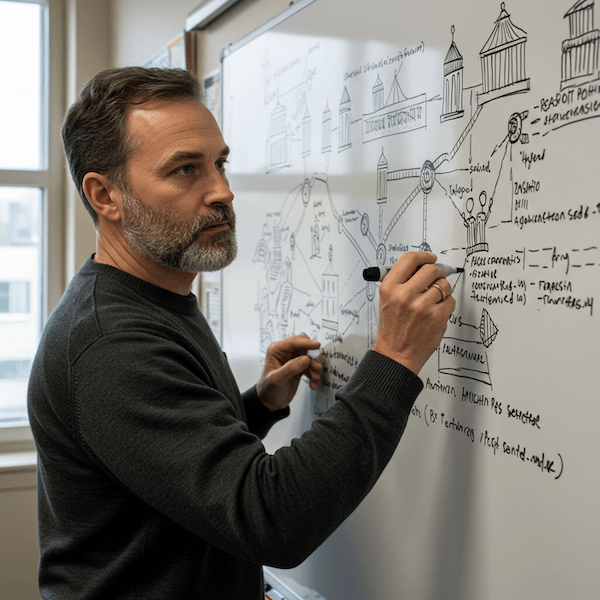
Mayer (2021) states learners learn more when you reduce unnecessary information. Mayer (2021) finds that signalling, like headings, helps learners to focus. Use narration with animations instead of text with animation, says Mayer's (2021) redundancy principle. Mayer's (2021) spatial contiguity means keep words close to related images. Show words and images at the same time, as Mayer's (2021) temporal contiguity suggests.
Kalyuga (2007) found Mayer's principles vary across learners. Examples help new learners, Kalyuga (2007) noted. Experts perform worse with examples due to a reversal effect. Remove supports as learners gain knowledge, Kalyuga (2007) suggests. Teachers should reduce visuals as expertise grows.
Mayer (2009) recommends using narration with water cycle diagrams on slides. Sweller (1988) showed that narrated text avoids coherence problems. Paivio (1986) found learners remember more when graphs and notes are together.
Digital tools for dual coding are apps and platforms that combine text, images and annotation to support clearer learning. Learners use tablets or computers for notes. Apps let them draw, type, and add pictures. Online platforms make sharing resources easy.
Paivio (1971) showed dual coding helps learners grasp concepts. Using images with words makes lessons more interesting. Technology easily combines these, easing teacher burden. Clark and Lyons (2011) offer helpful resources for education.
Clark and Lyons (2016) say presentation software shows learners text and images. This helps learners understand information better. Online tools let learners work together visually. Mayer (2009) found images and videos make concepts clearer.
Multimedia supports dual coding. Videos and simulations give learners engaging experiences. This links visuals with words (Paivio, 1971; Sadoski, 2005; Clark & Paivio, 1991).
Dual coding with tech helps teachers. It makes learning better for everyone and aids understanding. This approach supports learners' success (Paivio, 1971).
Learners make audio-visual aids with digital tools, which improves learning. These interactive lessons boost dual coding activities (Paivio, 1971). Dual coding with tech uses words and pictures to help learners understand.
Dual coding improves memory by linking visual and verbal information to strengthen understanding and long-term recall. It uses visual and verbal methods to strengthen memory (Paivio, 1971). Clark and Paivio (1991) found combined methods improve test scores and retention. Sadoski (2005) showed it helps struggling learners grasp concepts.
Clark and Paivio (1991) found teachers often use discussion or text for learning. Visual aids, they said, can make information much clearer for the learner.
For instance, if a teacher says the word 'tree' to the students, when the students hear the word, they'll also create a mental image of what a tree looks like. Both word and visual images can be used to remember the information stored in the brain.
Cognitive Phenomena explain that a teacher's students try to remember everything said by the teacher in the classroom. However, our brains are created to only hold a small fraction of knowledge at one time. A lot of information delivered verbally is immediately forgotten. Dual coding enables students to remember a large amount of information. Following are some of the dual coding examples that can be used to teach students:
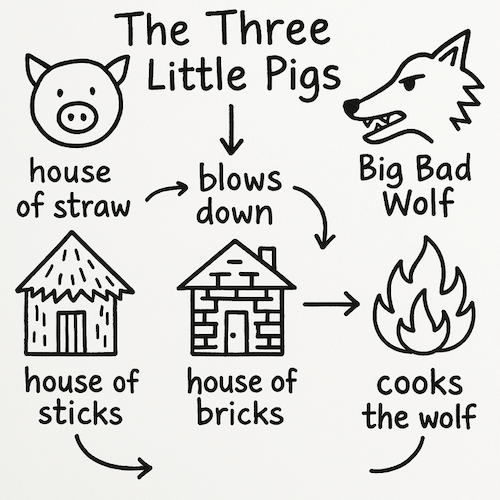 reading comprehension
Sadoski and Paivio (2001) linked dual coding theory to reading and writing. They argued that good reading uses imagination, not just language. Readers mentally picture stories as they read (Sadoski & Paivio, 2001). Imagery and words work together for understanding. Learners struggle when text lacks images (Sadoski & Paivio, 2001). New topics are harder because learners have no images to use.
Paivio's idea says learners grasp concrete words faster. Pressley (1977) showed imagery helps vocabulary recall better than just repeating words. Images give learners a backup retrieval route. Learners must actively make images, not just see them (Pressley, 1977). Self-made images create stronger links (Pressley, 1977).
Clark and Paivio (1991) found pictures help learners remember things. Learners often recall pictures better than words alone. Images aid early readers as their verbal skills grow. Graphic novels use pictures to increase learner engagement. Research suggests they can support reading and motivation. Study quality does, however, vary.
Dual coding aids EAL learners facing language challenges. Translation keeps learners within the verbal system (Clark & Paivio, 1991). Pictures and gestures link new words to images. This creates a non-verbal memory aid, usable across languages.
Getting started with dual coding involves pairing concise words with simple, labelled visuals to introduce new topics clearly. Simple labelled diagrams or charts work well initially. Model dual coded notes using templates, (Paivio, 1971). Learners can create their own notes gradually, (Sadoski & Paivio, 2001).
Researchers Paivio (1971) and Sadoski (2005) found dual coding improves learning. Teachers can use timelines, as specified by research by Levin & Mayer (1993) and Clark & Paivio (1991), to help learners remember dates.
Also, an English Teacher must look at the lesson plan and make decisions about the key concept for the next class. It's always better to simplify the topic as much as possible.
Researchers (e.g., Ainsworth, 2006; Mayer, 2009) suggest teachers choose visuals that clearly show a concept. Teachers should remove background distractions so learners focus better (Chandler & Sweller, 1991). Give learners time to view visuals before you begin teaching (Schnotz, 2014).
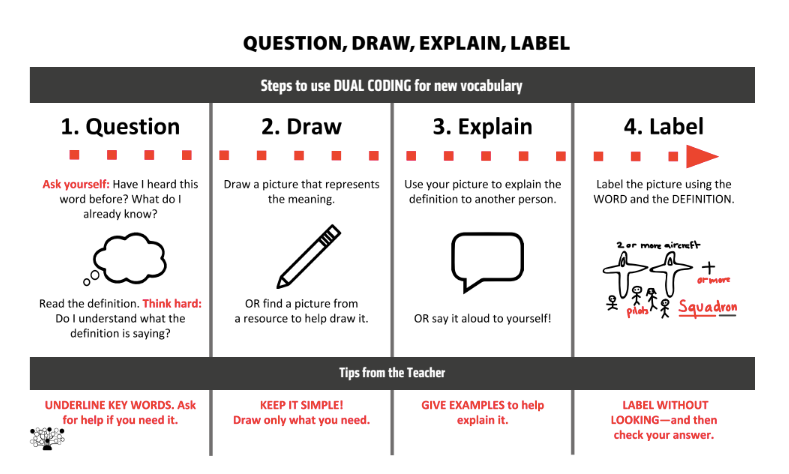
How to Create a Perfect Visual Representation
One may paste an image on a PowerPoint slide and call it dual coding. In reality, it isn't dual coding.
According to Paivio (1971), pictures need clear links to words for dual coding. Research by Sadoski and Paivio (2001) shows this strengthens learner recall. Clark and Paivio (1991) suggest this helps learners process information better.
Photographs and videos are considered to be less effective in dual coding, as they hold too much background detail. According to the theories of Cognitive Science, these might make students overwhelmed. For dual coding, visual images should be very clear with little background information.
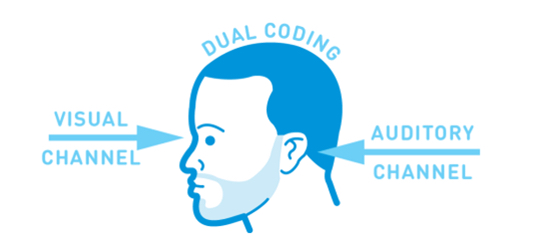
To be perfect for dual coding, visual images must be:
Learners should focus on clear illustration, not artistic skill, in dual coding. Teachers should encourage learners to create and compare visuals (Sadoski, 2001). Big differences between text and images might overload the learner's mind (Sweller, 1988). Where possible, we must avoid:
Principles for effective dual coding are practical rules for linking simple visuals with words to support learning without cognitive overload. Simple visuals help learners grasp key ideas, preventing overload (Sweller, 1988). Consistency and practise help learners use dual coding well (Clark & Paivio, 1991).
Dual coding boosts learner memory skills, say Paivio (1971) and Sadoski (2001). It impacts recall, linguistic tasks, and cognitive work. Research by Clark and Paivio (1991) shows benefits for description and naming.
Dual coding aids learner retention and lowers mental effort (Paivio, 1971). Teachers may reduce workload by using strategic support. Secondary teachers see benefits of this method. Learners grasp concepts better by combining visuals with explanations (Sadoski, 2001; Clark & Paivio, 1991).
It may take some time to find or create the perfect visuals, but you'll be amazed to see its impact. Use dual coding and take benefit from its application in learning. If you're interested in exploring a new theory of cognition, make sure you explore structured thinking approaches's webpage.
Dual coding CPD for teachers is professional development that builds confidence in using visual and verbal strategies across the curriculum. They help teachers use visuals and words confidently. These courses align with current evidence. Oliver Caviglioli creates visual guides for UK learners. The Education Endowment Foundation (EEF) toolkit summarises this evidence.
For further reading on this topic, explore our guide to Getting Started with Metacognition.
The 15 dual coding strategies for teachers are practical classroom approaches that combine words and images to strengthen understanding and recall. Teachers use words and images together. This strengthens learning and improves understanding, Paivio (1986) showed.
According to Paivio (1971, 1986), dual coding aids memory. Learners remember when pictures link to words. Research shows effective visuals support the content (Sadoski, 2005; Mayer, 2009). Do not just add decoration; meaningfully link visuals and text.
Classroom examples of dual coding are practical teaching methods that combine words and visuals to improve understanding and memory. Teachers can use these practical steps across year groups. Research by Clark and Paivio (1991) supports this effective learning strategy.
A Year 8 science teacher introduces digestion with a body outline. She draws and labels organs, explaining their function. Learners copy descriptions and diagrams (Baddeley, 1992). Learners then explain the process aloud, pointing to drawings in pairs (Paivio, 1971; Sweller, 1988).
Adaptive teaching with dual coding is a teaching approach that combines concise explanation with simple visuals to reduce working memory demands. It pairs clear explanations with simple pictures. This lowers the strain on working memory. Learners do not have to hold as much in their minds at once. This is vital when working memory is weak. This matters a lot for neurodiversity. Many neurodivergent learners struggle with working memory. This is also true for other learners with SEND. A weak working memory often leads to lower grades (Alloway
In England, this fits current policy better than old-style grouping. The ITTECF (DfE, 2024) puts adaptive teaching in Standard 5. It warns against making easier tasks for different groups. The Ofsted framework (Ofsted, 2025) focuses on what learners actually learn. In practice, this means Quality First Teaching (QFT). Everyone gets the same high goals. You provide clearer explanations, better hints, and fewer memory demands.
In a Year 7 science lesson on food chains, the teacher projects a simple diagram of sun, grass, rabbit, fox, points to each arrow, and says, “Track the energy, then say the sentence.” Learners copy the sequence, label each organism, and write one line: “Energy moves from the sun to the fox through the food chain.” The learner who would usually think, “I have forgotten step two,” can now use the diagram to rehearse the order and produce a complete answer.
That is inclusive pedagogy because the support sits inside the main explanation, not in a later rescue plan. It can also form part of reasonable adjustments for disabled learners: a labelled timeline, worked example, or image-supported vocabulary strip can make abstract language concrete and reduce overload in the moment, which sits well with the SEND Code of Practise (DfE and DHSC, 2015) and evidence on mainstream SEND support (Cullen et al., 2020). The discipline is to keep the visual tight and purposeful, because cluttered slides create more load, not less.
Visual scaffolds for adaptive teaching are structured visual supports that clarify ideas, preserve challenge, and improve access for all learners. It adds visual support while keeping challenge and access for everyone. In England, this matches current policy language. Adaptive teaching means responsive adjustment and targeted support. It does not mean giving easier tasks to different groups (Department for Education, 2021). This matters. Good SEND provision is often about making core explanations clearer. It is not about producing three different tasks.
Processing load is the main barrier for some learners with SEND and neurodiversity. Motivation is not the problem. Spoken explanations can vanish quickly for learners with poor working memory. They often lack time to organise their thoughts. Therefore, a labelled diagram, flow chart or visual model helps. It acts as cognitive scaffolding while they listen, think and write. This fits with EEF guidance. The EEF treats verbal, visual and written scaffolds as high-quality teaching.
In practice, this might look like a Year 5 science teacher keeping one ambitious task for everyone while dual coding the explanation on the board. She says, “Track the arrows with me: evaporation up, condensation in the cloud, precipitation down. Now label the diagram, then turn those labels into two full sentences.” Learners produce the same annotated water-cycle sketch and short explanation, but the visual sequence helps learners who might otherwise lose the thread halfway through.
This shows inclusive pedagogy in action. The support sits inside the shared lesson and benefits the whole class. Teachers can slowly remove it once understanding is secure. This avoids marking some learners out as different (Florian and Black-Hawkins, 2011). It also matches inspection expectations. Teachers must present information clearly and check understanding. They must adapt teaching while staying ambitious for learners with SEND (Ofsted, 2024).
Responsive teaching with visual supports is an approach that maintains high expectations while using visuals to make learning more accessible. The current Department for Education guidance is clear that adaptive teaching should not mean creating separate tasks for groups or lowering expectations; it means responsive support while keeping ambition high for everyone (Department for Education, 2024). For teachers, that makes dual coding a practical Quality First Teaching (QFT) move: one curriculum goal, two routes into the idea.
This matters in classes with more SEND and more visible neurodiversity. The EEF’s five-a-day model places scaffolding at the centre of high-quality teaching for learners with SEND, and stresses that these approaches tend to support all learners while being especially helpful for many who need more help (EEF, 2025). It also fits Universal Design for Learning (UDL), where teachers offer multiple forms of representation from the start rather than waiting for learners to fail first (CAST, 2024).
In a Year 5 science lesson on the water cycle, the teacher does not hand out three versions of a worksheet. She says, “Draw the cycle, label each stage, then add one short sentence to explain each arrow,” while modelling the diagram live on the visualiser. Learners hear the explanation, see the process mapped out, and produce a page of labels, arrows and brief notes; a learner who might lose the thread in a long verbal explanation now has a clear visual path to think with.
That is why dual coding works as a Tier 1 intervention. It is whole-class scaffolding that helps teachers make sensible reasonable adjustments, such as pre-labelled diagrams, symbol-supported vocabulary or chunked note frames, without lowering the bar. Used this way, dual coding is not an add-on for a few learners. It is a disciplined way to keep the same high expectations for all while making the learning more accessible.
Avoiding lethal mutations in dual coding means using visuals to explain content rather than adding decorative images that distract learners. Current EEF guidance on cognitive science translation makes the same point: teachers need a secure grasp of memory and cognitive load before turning a principle into a routine, otherwise promising ideas harden into weaker classroom habits (EEF, 2024; Perry et al., 2021). If every bullet point comes with an icon, learners are not automatically getting a second route to memory. They may just be getting more to look at within tight working memory limits.
This is where the redundancy effect, split-attention effect and seductive details matter. A decorative graphic that merely repeats a heading, or adds mood without meaning, gives the eye something else to process but nothing useful to learn, and irrelevant details have long been shown to depress recall and transfer (Harp & Mayer, 1998). Likewise, when learners must keep flicking between a paragraph, an unlabeled diagram and a separate key, the split-attention effect increases unnecessary load. When text and image say the same thing in clumsy ways, the redundancy effect does the same (Perry et al., 2021).
Imagine a Year 8 science slide on photosynthesis made in Canva, with leaf icons beside each bullet, a stock photo of a forest, and a labelled chloroplast tucked in the corner. A better piece of instructional design is one clear diagram of the chloroplast with short labels and a brief teacher prompt: “Keep your eyes on this one image. Which part takes in light, and where is glucose made?” Learners then annotate the diagram and produce a short explanation linked to specific labels, instead of trying to decode clip art that adds nothing.
The practical test is simple. Keep visuals that clarify, organise, or show something hard to say in words alone, and cut decorative graphics that can be removed with no loss of meaning. That is dual coding done properly, not over-visualising. It also matches recent evidence that representational pictures can help, while decorative ones do not improve performance and may distract from the real thinking required (Lindner, 2020).
Prove to yourself how pairing words with images improves memory. Study two sets of facts and compare your recall.
Dual coding is the theory that memory is stronger when information is presented in two forms at the same time, verbal and visual. When you see both a word and an image together, your brain creates two separate pathways to retrieve that fact. This is why pairing text with icons, diagrams or pictures helps you remember things longer.
| Component | How it helps | Classroom application |
|---|---|---|
| Text only | Single verbal pathway; requires active effort to visualise | Labelled diagrams, glossary entries, definitions read aloud |
| Text + Image | Dual pathways create stronger, more retrievable memory traces | Infographics, annotated diagrams, illustrated vocabulary, concept maps |
How this works:
Count backwards from 20 to 1, then click the button below.
facts recalled correctly
Count backwards from 20 to 1, then click the button below.
Dual Coding uses words and visuals together to help learners understand information, according to research. Allan Paivio's work shows our brains process information through two channels. This approach boosts learning, unlike some other theories (Paivio, date not provided).
Dual Coding helps learners by linking words with visuals. Teachers can use diagrams with key ideas. Visual timelines work well for history (Paivio, 1971). Annotated diagrams suit science; flow charts explain processes (Clark & Paivio, 1991). Mind maps connect cross-curricular ideas (Sadoski, 2005).
Mayer (2009) found visuals help learners remember information well. Paivio's (1986) theory says structured visuals ease brain strain. Clark and Lyons (2011) state visuals assist all learners to grasp complex concepts. This creates memory paths, and makes recall simpler.
Diagrams greatly help learners (Paivio, 1971). Flow charts and timelines are also useful. Use clear, helpful visuals, not artistic ones (Mayer & Moreno, 2003). This prevents memory overload for the learner (Sweller, 1988).
Teachers should start by showing the technique themselves. Then follow these steps: have students identify and analyse existing visuals. Next, examine how images represent text. Ask students to describe concepts in their own words. Finally, have them create their own visual representations. This progression helps students internalise knowledge in multiple ways and think visually about their learning.
This leads to deeper understanding and improved recall. Paivio's (1971, 1986) Dual Coding Theory suggests that learners process words and images separately. Using both channels creates more ways to remember information. This reduces strain and, according to Sadoski (2001, 2005), boosts learning.
View study ↗
Auditing cognitive load in lessons is a structured review process that evaluates lesson design and improves learning efficiency across eight dimensions. Use our tool to rate your lesson across eight dimensions. You will receive a detailed analysis. Act on our recommendations to improve learning (Sweller, 1988; Mayer, 2009; Clark, Nguyen, & Sweller, 2006).
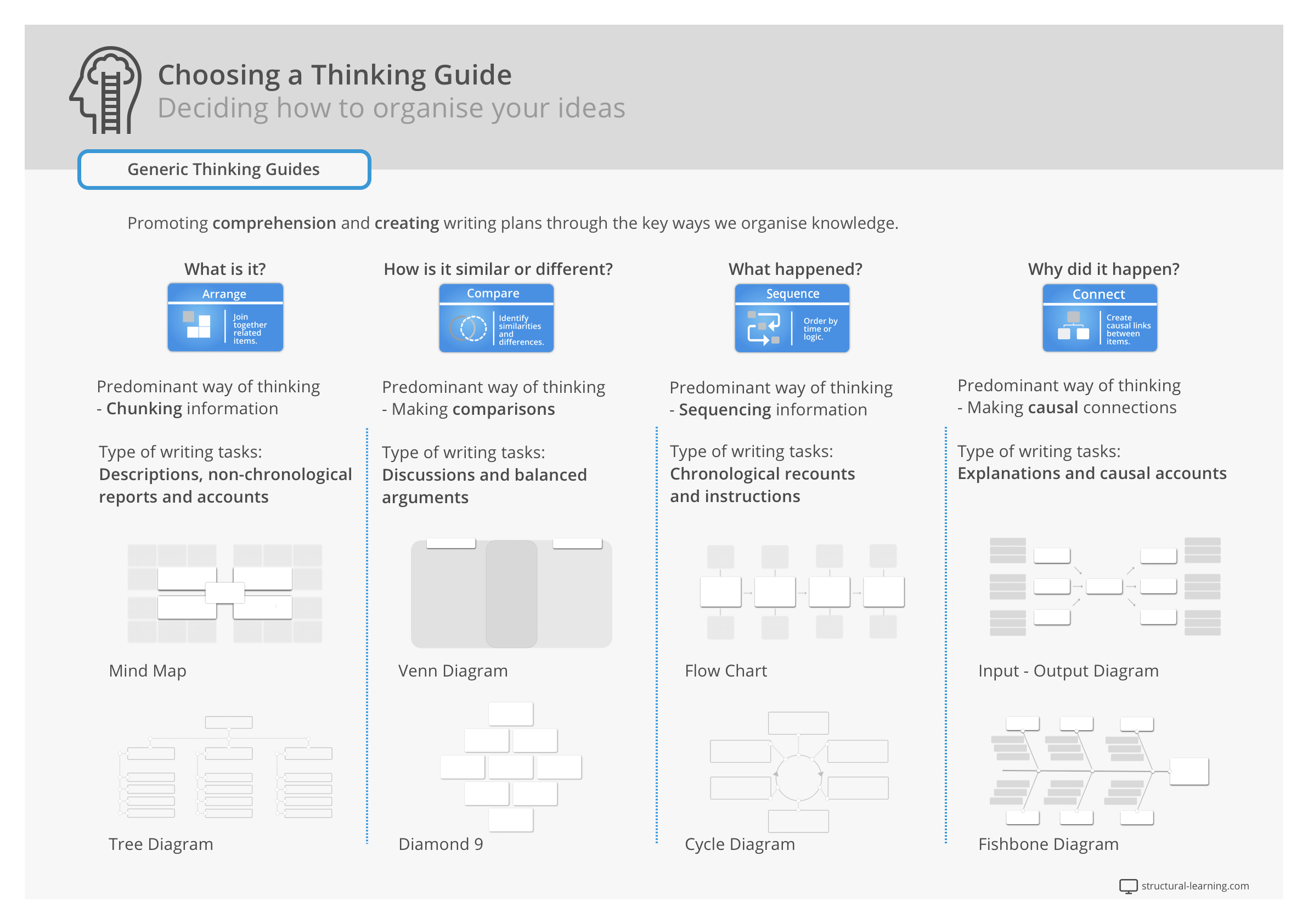
Paivio's dual coding theory explains why graphic organisers help learning. Learners use verbal and visual channels together. Using a Venn diagram, for example, creates two memory traces. Mayer (2009) showed that using both channels improves memory. Therefore, include visuals like concept maps in lessons.
The Map It tool makes this process structured and repeatable. Rather than asking learners to design a graphic organiser from scratch, a teacher can select a ready-made template that matches the thinking type the lesson demands. A compare-and-contrast task calls for a Venn diagram or T-chart; a cause-and-effect task calls for a fishbone or branching diagram; a sequencing task calls for a timeline or flow map. Each choice activates Paivio’s visual channel in a way that directly supports the verbal content learners are processing. Over time, learners internalise these structures, which means they carry the dual coding benefit even when no physical template is in front of them.
For classroom implementation, the simplest starting point is to pair every reading or discussion task with a graphic organiser. A Year 6 class reading about the causes of the First World War could complete a spider diagram as they read, capturing each cause in a node. A GCSE English class analysing a poem could use a two-column table: imagery in the left column, effect on the reader in the right. Both tasks generate the visual trace that dual coding theory predicts will strengthen retention. See the full graphic organiser templates guide for printable templates organised by thinking type.
Storytelling is a fundamental human activity and a potent pedagogical strategy. It naturally engages both the verbal and imagery systems, making it an ideal application of dual coding principles. When learners hear a story, they process the narrative verbally while simultaneously constructing mental images of characters, settings, and events.
This simultaneous processing creates multiple, interconnected memory traces, enhancing recall and comprehension. Paivio's dual coding theory (1971, 1986) suggests that information encoded through both verbal and visual channels is more robustly stored and more easily retrieved. Storytelling thus combats the rapid decay of isolated facts by embedding them in a memorable context.
Consider a science teacher explaining the water cycle. Instead of just listing stages, the teacher narrates the journey of a single water droplet from ocean to cloud to rain and back again. As the teacher describes evaporation, condensation, and precipitation, they might use gestures, draw simple arrows on the board, or show a diagram, prompting learners to visualise the droplet's transformation. Learners could then retell the story using a graphic organiser with spaces for text and corresponding sketches.
| Story Element | Verbal Encoding (Teacher says/Learner hears) | Visual Encoding (Teacher shows/Learner imagines) |
|---|---|---|
| Character | Name, traits, dialogue | Appearance, actions, setting |
| Setting | Location, time, atmosphere | Scenery, objects, colours |
| Plot Event | Sequence of actions, cause/effect | Mental movie of event unfolding |
Dual coding research predominantly focuses on two-dimensional representations, such as diagrams, slides, and printed graphic organisers. However, physical manipulatives offer a powerful, often overlooked, third dimension for encoding information. This tactile engagement provides an additional pathway for the brain to process and store new concepts.
When learners physically interact with objects, they create a concrete, spatial representation alongside verbal explanations. This active construction directly supports the imagery system described by Paivio (1971, 1986). It allows for a richer, multi-sensory encoding that strengthens memory traces.
In a YearundefinedEnglish lesson, learners might use building bricks or modelling clay to construct a physical representation of a story's setting or a character's emotional state. As they build, they simultaneously articulate and write descriptive sentences, linking the tangible model to their verbal output. This process deepens comprehension and aids recall of narrative details.
For example, a teacher might ask learners to "build the dark, spooky forest where the wolf lived" using various materials. While constructing, learners describe their choices, saying, "I used these jagged twigs for the scary trees and dark green clay for the deep shadows." They then write sentences like, "The wolf lurked in the jagged, dark green shadows of the spooky forest," directly connecting their physical creation to their written work.
For primary learners learning fractions, using physical fraction circles or blocks allows them to see, touch, and manipulate parts of a whole. While handling these objects, the teacher explicitly links the physical action to the mathematical vocabulary and written notation, such as "one half" or "1/2". This concrete experience provides a robust foundation for abstract concepts.
This multi-sensory approach is particularly beneficial for students with special educational needs, who often benefit from concrete experiences to grasp abstract ideas. Manipulating objects provides a tangible anchor for verbal information, making complex concepts more accessible and memorable for diverse learners.
These academic studies provide the research base for our strategies. They support the methods discussed in this article:
Dual coding can help learners remember science (Paivio, 1971). Combining words and images aids understanding, according to Clark and Paivio (1991). Research by Sadoski and Paivio (2001) showed improved retention using both.
Visual aids help learners remember science (Paivio, 1971). Diagrams and images, alongside verbal explanations, boost recall. Dual coding tackles forgetting (Clark & Paivio, 1991). Try this research-based method for lasting understanding, not just rote learning.
Multimedia instruction can improve learner satisfaction (View study). Research by various scholars supports this. For example, studies by Mayer (2009) and Clark and Mayer (2016) show this. Also, work by Paivio (1986) and Sweller (1988) explores related cognitive processes.
Snell and Ganguly (2016) found that multimedia improved learner happiness in Bhutan. This shows that technology changes learning even with few resources. Teachers learn dual coding despite classroom limits (unspecified date).
Improving Storytelling through Dual Coding Theory View study ↗
6 citations
Dian Kusumawati & Y. Rachmawati (2016)
Research shows storytelling supports literacy when teachers link words and images (dual coding). The study tackles the decline of storytelling in schools, offering ways to improve it for young learners. Teachers can use these strategies from Clark and Paivio (1991) to build learner comprehension and interest. Baggett (1979) and Mayer (2009) also explored these ideas.
Cognitive Theory of Multimedia Learning (CTML) has evolved (Mayer, 2014). Research by Sweller (1988) and Paivio (1986) shaped initial concepts. Mayer's work (2009) further refined CTML. Current research explores its applications for diverse learners and contexts (Clark & Mayer, 2016). Future studies might examine new technologies and their impact on learning.
Mayer reviewed multimedia learning (various dates). Learners process words and visuals as separate channels with limits. Dual coding aids learning by using both channels, Mayer found. Teachers can use these principles in all subjects.