Cognitive Load Theory: 12 Strategies to Reduce Overload
Reduce cognitive overload in lessons with Sweller’s theory. Diagnose the overload signs, apply 12 evidence-based fixes, and see why multi-tasking fails.


Reduce cognitive overload in lessons with Sweller’s theory. Diagnose the overload signs, apply 12 evidence-based fixes, and see why multi-tasking fails.
What is cognitive load theory?
Cognitive load theory holds that learning is limited by the small capacity of working memory, so lessons should manage how much new information learners process at once. It distinguishes intrinsic, extraneous, and germane load. For teachers, it means cutting distractions, using worked examples, and introducing complexity gradually so working memory is not overwhelmed.
Cognitive Load Theory: 12 Strategies to Reduce Overload is a guide for teachers. It shows how to design lessons around the strict limits of working memory. Research suggests that active processing is closer to three or four chunks than the older seven-item rule many teachers remember (Cowan, 2001). So lesson design has to protect attention, not fill every minute with new material.
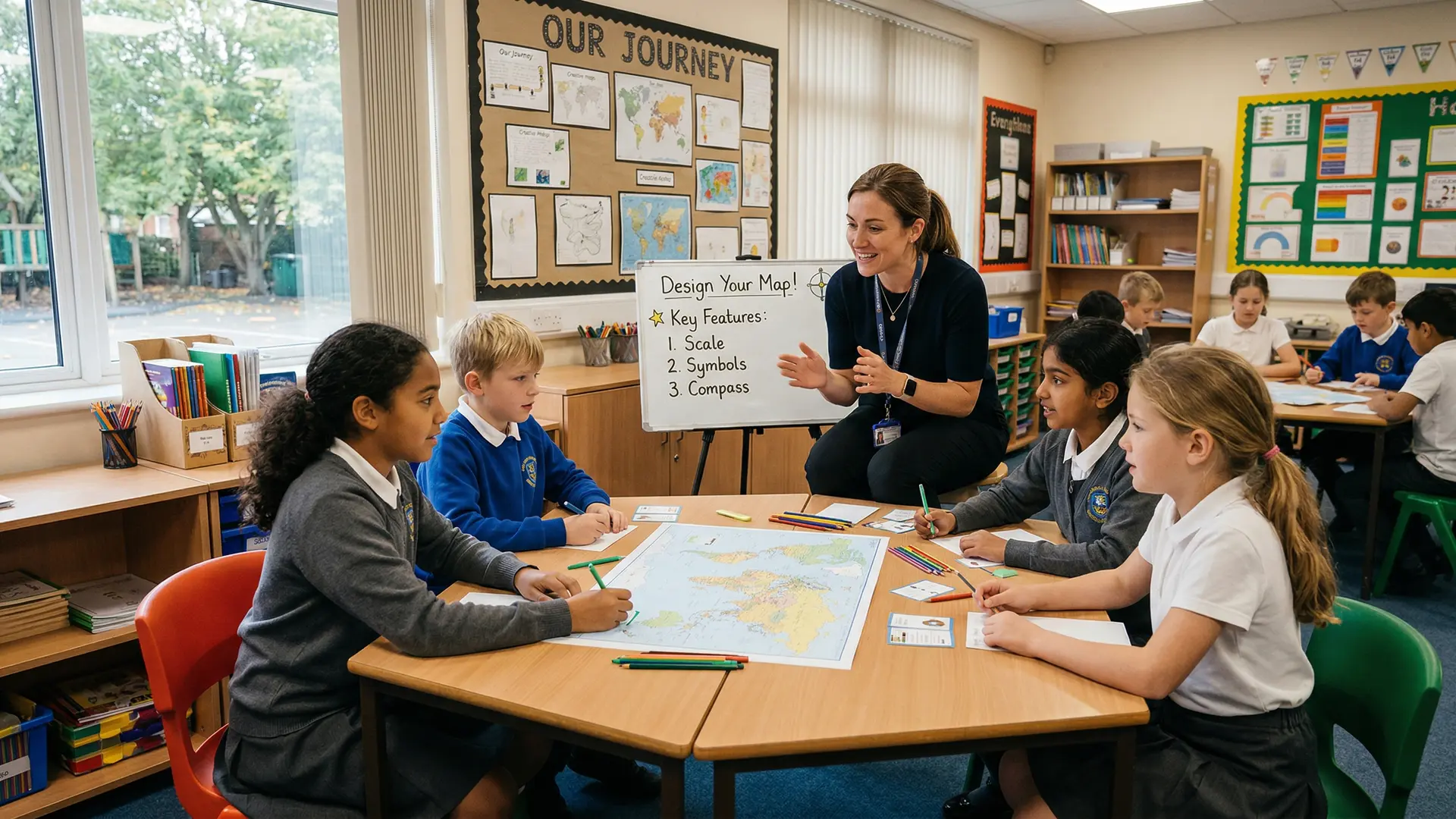
In a Year 7 maths lesson, this means modelling one equation, keeping the worked example visible, then asking learners to complete the final two steps before independent practice. The aim is not easier work. It is clearer sequencing, cleaner resources and better use of cognitive resources so learners can move ideas into long-term memory.
To turn the theory into planning decisions, start with reducing cognitive overload in lesson design, then compare how cognitive load principles change in primary classrooms and secondary classrooms.
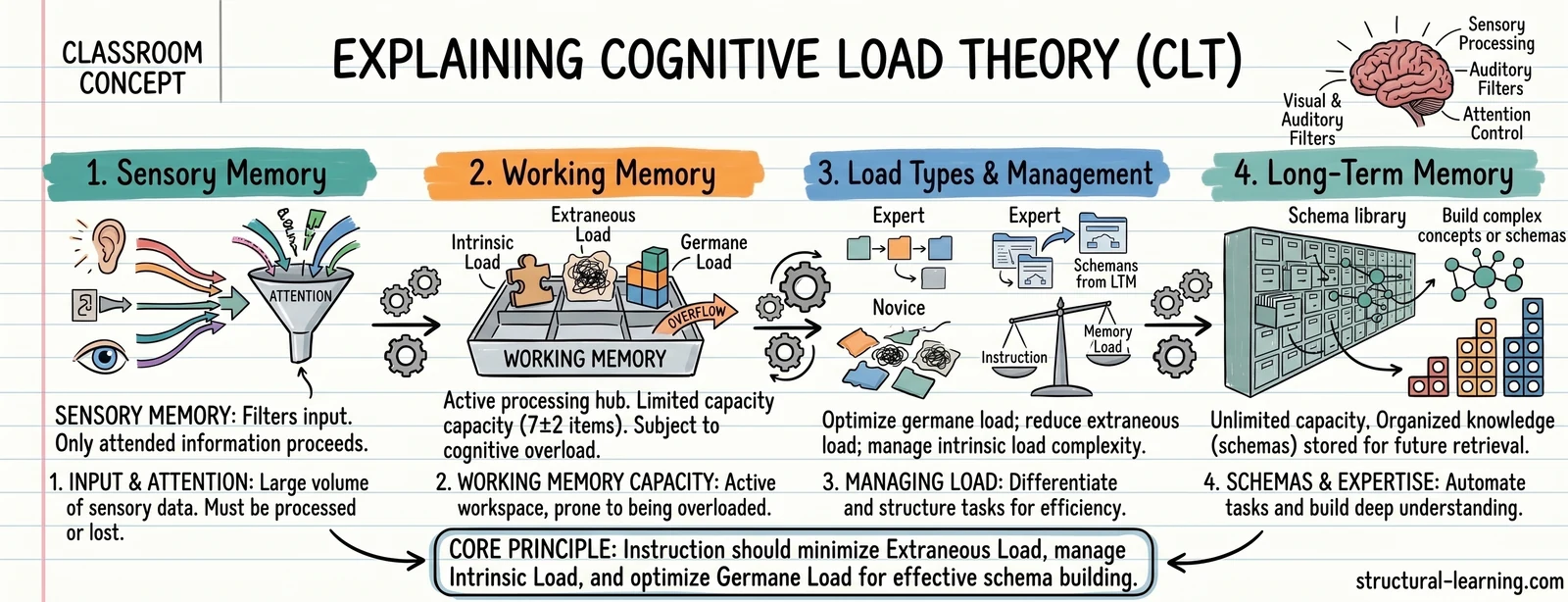
Cognitive load theory explains why learning can stall. This happens when a lesson asks learners to hold too many new ideas in working memory at the same time. In educational psychology and instructional design, teachers can manage intrinsic load by sequencing ideas, cut extraneous cognitive load through clear presentation, and guide cognitive resources towards schema building in long-term memory.
For a broader view of how this fits alongside other classroom methods, see our guide to pedagogy for teaching. Shibli and West (2018) provide a UK classroom translation of cognitive load theory: sequence tasks from simple to complex, integrate information sources and use examples before independent work. This matches the public framing used by Education Northern Ireland, NSW Government, The Decision Lab and EdTech Books, while keeping the classroom test on learning rather than tidy slides.
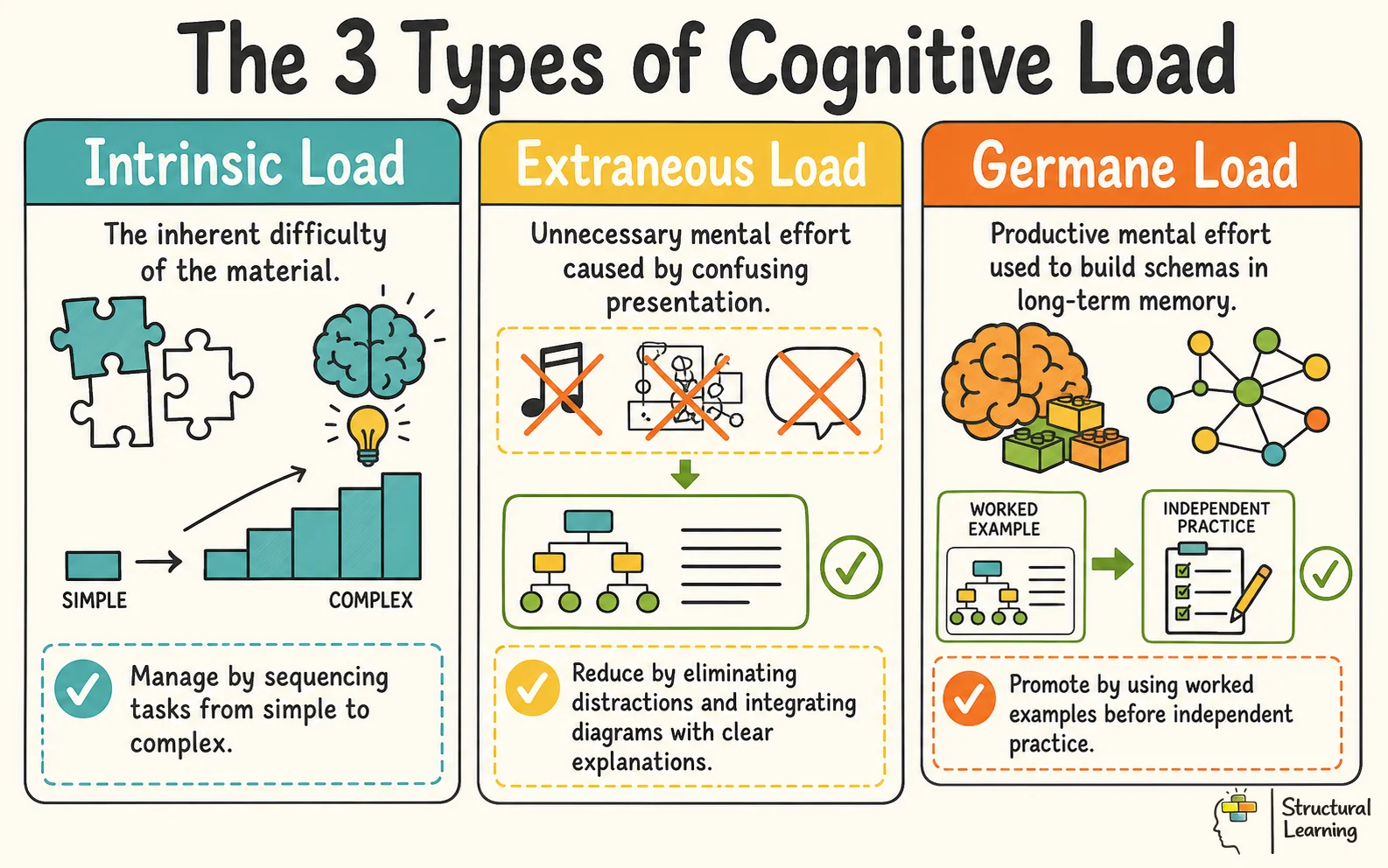
Sweller (1988) first showed how problem solving can overload working memory. Classroom accounts still use three types of cognitive load: intrinsic load, extraneous load and germane load. The modern caution is that germane load is not a third separate pile of mental effort.
Instead, it is the working memory resource learners can use for schema construction. This happens when teachers manage intrinsic and extraneous demands well (Kalyuga, 2011; Sweller, van Merriënboer and Paas, 2019). In practice, teachers sequence content carefully, combine diagrams with clear explanations and use worked examples before independent problem solving.
In a Year 7 maths lesson, the teacher models one equation step by step, talks through each move, and gives two completion problems before independent practice. Learners spend their limited working memory on the method, not on decoding messy instructions or switching between split sources of information.
The completion effect describes how partially completed tasks reduce mental effort while learners still finish the solution. A novice does not face a blank page, but they also do more than copy a full worked example. In maths, the teacher shows the first algebraic steps and asks learners to complete the final transformation.
Paas (1992) showed that learners using completion tasks reported less mental effort. They also did better on transfer tests than learners using normal problems.
This technique changes the balance of guidance and challenge. It reduces extra load by taking away the first 'how to start' problem.
The unfinished ending still makes learners engage with the content.
Completion tasks are simple to create. For maths, give learners the first steps of an equation (Atkinson et al., 2000). Then ask them to finish it.
For science, give learners a diagram to label. In writing, provide an opening paragraph and ask learners to continue the argument (Sweller, 1988). This supports new learners without removing thought.
Graphic organisers help learners sort ideas and see how they connect. They are very useful for Year 8 science learners.
For example, cause-and-effect diagrams can map the factors of photosynthesis. This shows clear links and helps learners understand them (Sweller, 1988).
These organisers also free up thinking space. This helps learners focus better (Sweller, 1988).
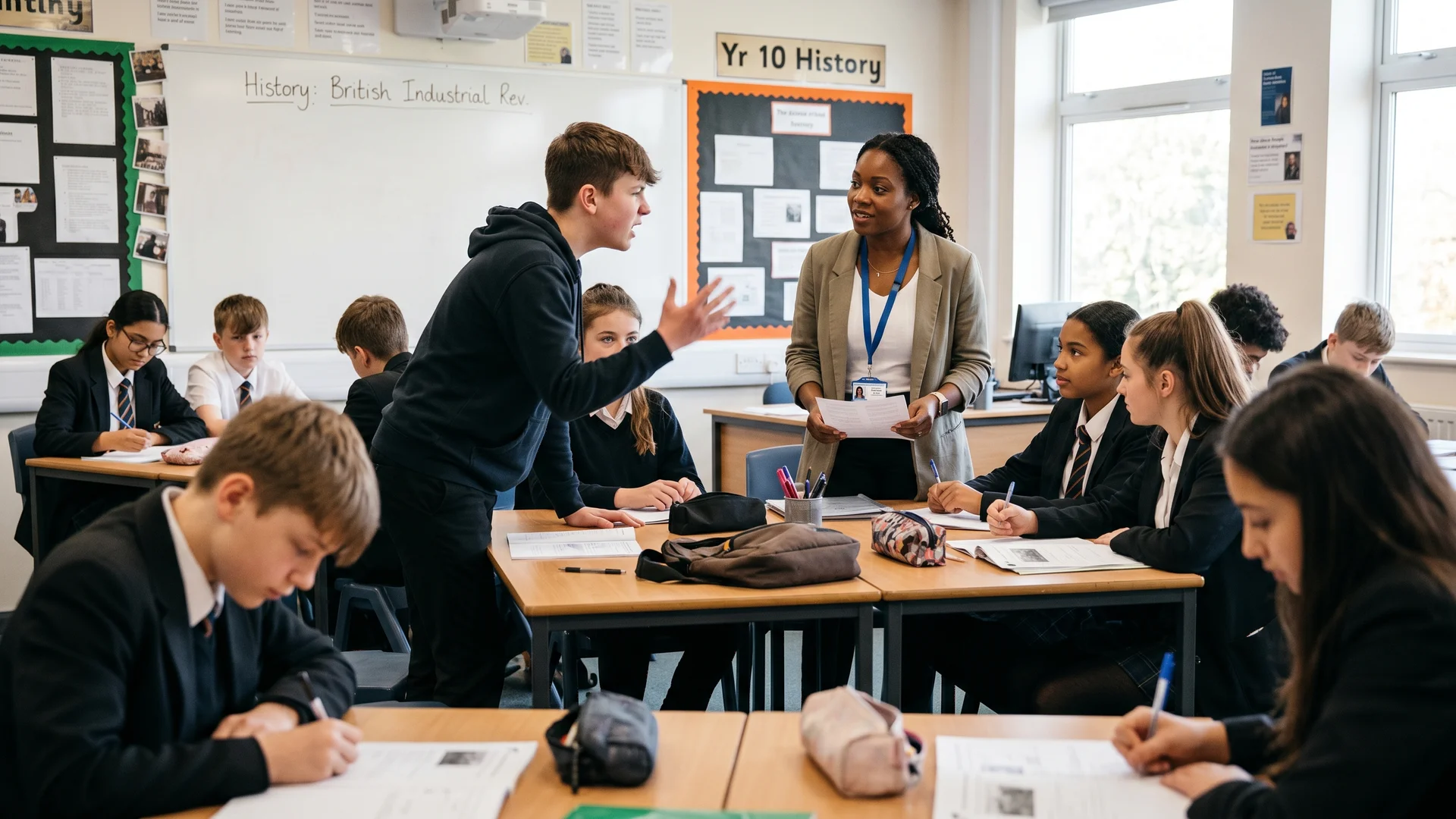
Graphic organisers build schemas when they make relationships visible rather than decorative. A Year 10 history class can compare long-term, short-term and trigger causes of war in a grid, then explain which causes interact. That choice uses cognitive load for analysis rather than transcription (Clark, Nguyen and Sweller, 2006).
Graphic organisers help learners structure their thinking. Learners may recall more when their notes are clearly organised. Map It aids learners with difficult topics. Templates reduce thinking about organisation (Clark, Nguyen, & Sweller, 2006).
Primary and secondary knowledge describe two different types of skill. Primary knowledge means skills we acquire naturally, such as speaking, without direct teaching. Use it as a starting point for professional discussion: identify the learner's current need, record evidence from more than one lesson, and agree the next classroom adjustment with the SENCO or family.
Secondary knowledge needs clear and direct teaching. Sweller's theory notes that reading and maths need this careful instruction (Geary, 2008).
Our brains did not evolve for these secondary skills.
Research shows working memory limits learning (Baddeley & Hitch, 1974). These limits affect reading ability, with Year 3 learners often struggling more with reading than listening tasks (Gathercole et al., 2006). Teachers must support knowledge tasks to reduce cognitive overload (Sweller, 1988).
Teachers should notice which tasks need support and which learners manage alone. Explicit phonics (secondary knowledge) alongside play (primary knowledge) works well. Geary's (2008) theory explains why some learning is easy, and some needs structured teaching.
Multimedia learning and cognitive load involve words and images. Learners process these through separate channels in working memory. Each channel has limited space. Use it as a starting point for professional discussion: identify the learner's current need, record evidence from more than one lesson, and agree the next classroom adjustment with the SENCO or family.
Learners actively process details so they remember them better. Mayer (2009) developed 12 principles of multimedia learning through systematic experimental testing.
Mayer (2009) argues that multimedia learning works best when words and images support the same idea without clutter. This is where the redundancy, split-attention and transient information effects matter. Put labels inside the diagram, remove repeated text, and use narration where it helps. This often works better than asking learners to read dense slide text while listening (Moreno and Mayer, 1999; Mayer and Moreno, 2003; Leahy and Sweller, 2011).
Speak aloud when showing diagrams, instead of using bullet points. Worksheets should merge labels with images, not list them separately. These simple choices reduce strain and help learners build knowledge (Sweller, 1988). Cognitive Load Theory and CTML (Mayer, 2009) are linked in teaching.
The expertise reversal effect describes how instructional guidance that helps beginners hinders learners with greater prior knowledge. Helpful guidance for beginners can become annoying for experts. Beginners learn well from worked examples. However, these same examples slow down learners who know the content. Rey and Buchwald (2011) confirmed this effect across different subjects.
Novices gain from step-by-step guides because they do not yet hold the procedure as a schema. More knowledgeable learners can experience the same support as redundancy because they process the guide alongside knowledge they already hold. This expertise reversal effect makes static worksheets blunt tools; adaptive fading, exit tickets and, increasingly, teacher-reviewed AI tutoring prompts can alter support in response to live performance (Salden et al., 2010; Wang et al., 2024).
Atkinson et al. (2000) showed that worked examples help Year 7 learners learn linear equations. They suggested that repeated examples can bore Year 10 learners who already know this material. Adaptive fading starts with examples, then asks learners to solve problems on their own. Renkl & Atkinson (2007) proved exit tickets reveal a learner's readiness.
Element interactivity means how many parts of new learning learners must think about together before they understand it. Low element interactivity appears in simple naming tasks. High element interactivity appears when learners must link several relationships, such as balancing an equation or explaining a food web. Teaching prerequisite parts first lowers intrinsic load before learners combine them (Chen, Kalyuga and Sweller, 2023).
Sweller (2010) showed naming needs less thought; learners memorise labels. Sweller (2010) also found equation balancing is hard. Learners think about reactants, products, and mass (Sweller, 2010).
Sweller (2010) found reducing extra load barely helps with simple tasks. Intrinsic load is already low enough. Focus instructional design on topics where many concepts interact. Use simpler methods for content learners absorb piece by piece.
The goal-free effect is a problem-solving approach that lowers working-memory demands during learning. It is different from means-ends analysis. Specific goals cause learners to use means-ends analysis, which uses much working memory, said Sweller and Levine (1982). Even if the learner solves the problem, little capacity remains for schema learning.
Ayres (1993) found goal-free instructions helped with maths. Learners calculating values made fewer errors. They found solutions more reliably than those with specific goals. Removing the goal stopped backwards-working. This freed working memory for structural learning, said Ayres (1993).
Goal-free tasks adjust classroom work. Instead of "find angle x," ask Year 8 learners to find angles. Rather than "calculate the shaded area," ask Year 5 learners to calculate anything (Sweller, 1988). Learners still find answers. This frees brain space for relationship noticing, building schemas (Kalyuga, 2015).
The redundancy effect matters because repeated details can waste working memory. But reducing extraneous cognitive load does not mean taking meaning out of a lesson. A history story, a science demonstration or a teacher's worked anecdote can help learners link feeling and cause to long-term memory. Bjork (1994) described desirable difficulties, and Immordino-Yang (2015) showed why emotion shapes learning; the aim is to cut noise, not all texture.
Split attention still needs direct design work. Put labels inside diagrams, keep the worked example visible, and avoid asking learners to move between a worksheet, a slide and a verbal explanation for the same step. In a Year 6 science lesson, one labelled circuit diagram with spoken explanation usually beats a diagram, a separate key and a slide full of repeated text.
For multimedia learning, the design rule is selective richness. Keep the story, image or model that carries the concept. Cut the second explanation, decorative picture or copied text that makes learners process the same information twice (Mayer and Moreno, 2003). This protects working memory while preserving the narrative force that makes new knowledge memorable.
Schemas are organised structures of knowledge. They help learners combine complex facts into single units in working memory. Use it as a starting point for professional discussion: identify the learner's current need, record evidence from more than one lesson, and agree the next classroom adjustment with the SENCO or family.
Complex schemas in long-term memory then act as single items. Thibaut and French (2016) saw chess experts use these patterns.
Schemas reduce the working memory load for a learner. This helps them process new facts more effectively.
Sweller (1994) explained practise makes schemas automatic, which saves working memory space. Fluent readers instantly recognise words, rather than decoding individual letters. This frees up working memory so the learner can understand text. A Year 4 learner who knows times tables can solve problems easily. Classmates who count struggle with reasoning (Sweller, 1994).
Worked examples and organisers help learners build knowledge (Sweller, 1988). Regular practice helps learners make knowledge automatic. Timed retrieval and spacing build automaticity, so recall becomes quicker (Rohrer, 2009; Brown et al., 2014). Automatic knowledge helps learners manage harder tasks (Kirschner, 2002).
| Strategy | Description | Example |
|---|---|---|
| Minimising Extraneous Load | Reduce non-essential information and present content clearly. | Clear diagrams with explanations in a Year 7 maths lesson. |
| Sequencing Content | Break down complex topics into manageable chunks. | Modelling one equation step by step in a Year 7 maths lesson. |
| Worked Examples | Provide learners with step-by-step solutions to problems. | Step-by-step equation solving in a Year 7 maths lesson. |
| Completion Problems | Provide learners with initial steps and ask them to complete the problem. | Equation completion tasks in a Year 7 maths lesson. |
| Structured Thinking | Use graphic organisers to help learners connect ideas. | Cause-and-effect diagrams in Year 8 science lessons. |
Cognitive Load · Try it on yourself
You're about to find your own working-memory limit. We'll show you a string of letters, make you do a quick sum so you can't just repeat them in your head, then ask you to recall them. Each round adds one more letter, until you hit your ceiling.
Sweller, J. (1988) Cognitive Load During Problem Solving. Cognitive Science, 12(2), 257-285. Use it as a starting point for professional discussion: identify the learner's current need, record evidence from more than one lesson, and agree the next classroom adjustment with the SENCO or family.
Paas, F., Renkl, A. & Sweller, J. (2003) Cognitive Load Theory and Instructional Design. Educational Psychologist, 38(1), 1-4.
Education Endowment Foundation (2021) Cognitive Science Approaches in the Classroom.
'; h+='
Cognitive Load Theory is powerful, but it is not a full theory of classroom learning. One criticism is measurement. Use it as a starting point for professional discussion: identify the learner's current need, record evidence from more than one lesson, and agree the next classroom adjustment with the SENCO or family.

Many studies use single-item mental-effort ratings, including the Paas scale. de Jong (2010) argued that these tools can blur task difficulty, learner confidence and actual cognitive processing. Schnotz and Kürschner (2007) also questioned whether intrinsic load, extraneous cognitive load and germane load can always be separated cleanly in empirical work.
A second critique is about the status of germane load. Kalyuga (2011) argued that the theory may work better with only intrinsic and extraneous load. In this view, germane load is the resource learners use for intrinsic load, not a separate category. This matters because teachers can turn the model into three simple boxes and miss how task complexity, prior knowledge and motivation interact.
There are also cultural and inclusion limits. Much CLT research comes from controlled tasks in Western educational psychology. It often uses narrow measures of performance.
Oral storytelling, collaborative talk, movement and emotionally rich examples can look extraneous. Yet they may support attention, identity and memory for some learners. Immordino-Yang (2015) makes this point through work on emotion and learning. Despite these limits, Cognitive Load Theory helps teachers examine working memory demand, lesson sequencing and avoidable overload in a careful way.
'; var blob=new Blob([h],{type:'text/html'}),url=URL.createObjectURL(blob); var w=window.open(url,'_blank'); if(w){w.onload=function(){setTimeout(function(){w.print();URL.revokeObjectURL(url)},400)}} else{var a=document.createElement('a');a.href=url;a.download='cognitive-load-analysis-'+ts+'.html';document.body.appendChild(a);a.click();document.body.removeChild(a);URL.revokeObjectURL(url)} }); showDim(1); })();Authoritative guidance on AI in education: DfE guidance on generative AI in education, DfE support materials for using AI in education settings, Ofsted findings from AI early adopters in schools and FE, EEF Teacher Choices trial on ChatGPT in lesson preparation.
Atkinson et al. (2000).
Cowan (2001).
Gathercole et al. (2006).
Geary (2008).
Kalyuga (2015).
Kirschner (2002).
Mayer (2009).
Mayer and Moreno (2003).
Sweller (1988).
Sweller (2010).
Sweller (1994).