Updated on
September 16, 2026
Powerful Knowledge: Young's 4 Tests and a Unit Audit Tool
Michael Young's powerful knowledge as four tests you can run on one unit, an audit tool and sheet, worked examples by subject, the critics, and the research.

Updated on
September 16, 2026
Michael Young's powerful knowledge as four tests you can run on one unit, an audit tool and sheet, worked examples by subject, the critics, and the research.
Powerful knowledge is Michael Young's term for the specialised, systematic knowledge that academic disciplines produce, knowledge that takes learners beyond the common-sense understanding they hold from everyday life and stays open to challenge and revision by the discipline that produced it. Young set this out in Bringing Knowledge Back In (Young, 2008), defining powerful knowledge by what it does for the learner rather than by a fixed list of content: knowledge that gives reliable explanations or new ways of thinking about the world, and takes a learner past what everyday experience alone could teach them. Young and Muller (2010) tied that claim to disciplinary structure: a curriculum needs clear subject boundaries because systematic, connected knowledge cannot be built without them. Young and Muller (2013) added the condition that matters most today: knowledge stays powerful only while it remains testable and open to revision by the experts who work in that field, and they qualified the claim that STEM subjects are intrinsically more powerful than others, arguing that the idea belongs to the arts and humanities as well. Young draws all this apart from a similar phrase: "knowledge of the powerful" names whatever an elite group controls, while "powerful knowledge" names what any learner's mind can do once they hold it.
This page turns those three papers into something a department can use on a Monday: a ten-minute audit running Young's four tests, specialised, systematic, beyond experience, open to challenge, against a real scheme of work, with what a pass and a fail actually look like. It gives worked examples in geography, history, primary science and English, including English's honest answer to the objection that the idea flattens dialogic subjects. It reports the live staffroom argument as UK and US teachers are actually having it, not as a settled question, and states the academic critics fairly, Beck, White, Alderson and Deng, alongside the research the idea rests on and the parts of school life, primary practice and SEND among them, it has barely reached.
Young's account is an argument against two opposite mistakes, not a single positive checklist. Young and Muller's (2010) three futures paper names both. Future 1 is a traditional curriculum where subject boundaries are fixed and knowledge is handed down as settled fact. Future 2 drops subject boundaries for generic, transferable skills, on the theory that content matters less than the ability to think. Young and Muller argue for a Future 3: boundaries kept deliberately, because a learner needs a discipline's own structure before they can think abstractly within it, or cross into another discipline at all.
Two contrasts make this concrete. In geography, everyday knowledge is knowing a local river floods when it rains heavily, something most learners half-know already. Powerful knowledge is the concept of a drainage basin, a disciplinary model that predicts flood risk on a river nobody in the room has seen. In history, everyday knowledge is a date, that 1066 was "when the Normans invaded". Powerful knowledge is historical causation, the tool that lets a learner weigh why the Conquest succeeded using conflicting evidence, and revise that judgement when a new source appears.
None of this is a list of facts to memorise, and it is not a fixed canon of great texts either. Young's test is about structure and method, whether knowledge is organised and revisable the way a discipline organises and revises it, not about which facts or books appear on a knowledge organiser.
This page treats powerful knowledge as one theoretical justification feeding into wider curriculum planning, not a rival programme. For the practical, whole-school version of building content into a scheme of work, our knowledge-rich curriculum guide covers sequencing and planning in full; treat that as the how, this page as one answer to the why. Powerful knowledge is also easily confused with a different idea Ofsted inspects for: our cultural capital guide sets out that distinction, but in short, powerful knowledge is about disciplinary structure, and cultural capital is about the knowledge and experience a school is expected to give every learner.
Name a unit, pick the subject and the phase, and answer the four questions honestly for that unit as it is taught now, not as the scheme of work describes it. You get a verdict per test, an overall verdict, the one change that would move it most, in your subject's own terms, and a sentence to say to a colleague. Or switch tabs and sort twelve pairs of everyday and powerful knowledge with your department.
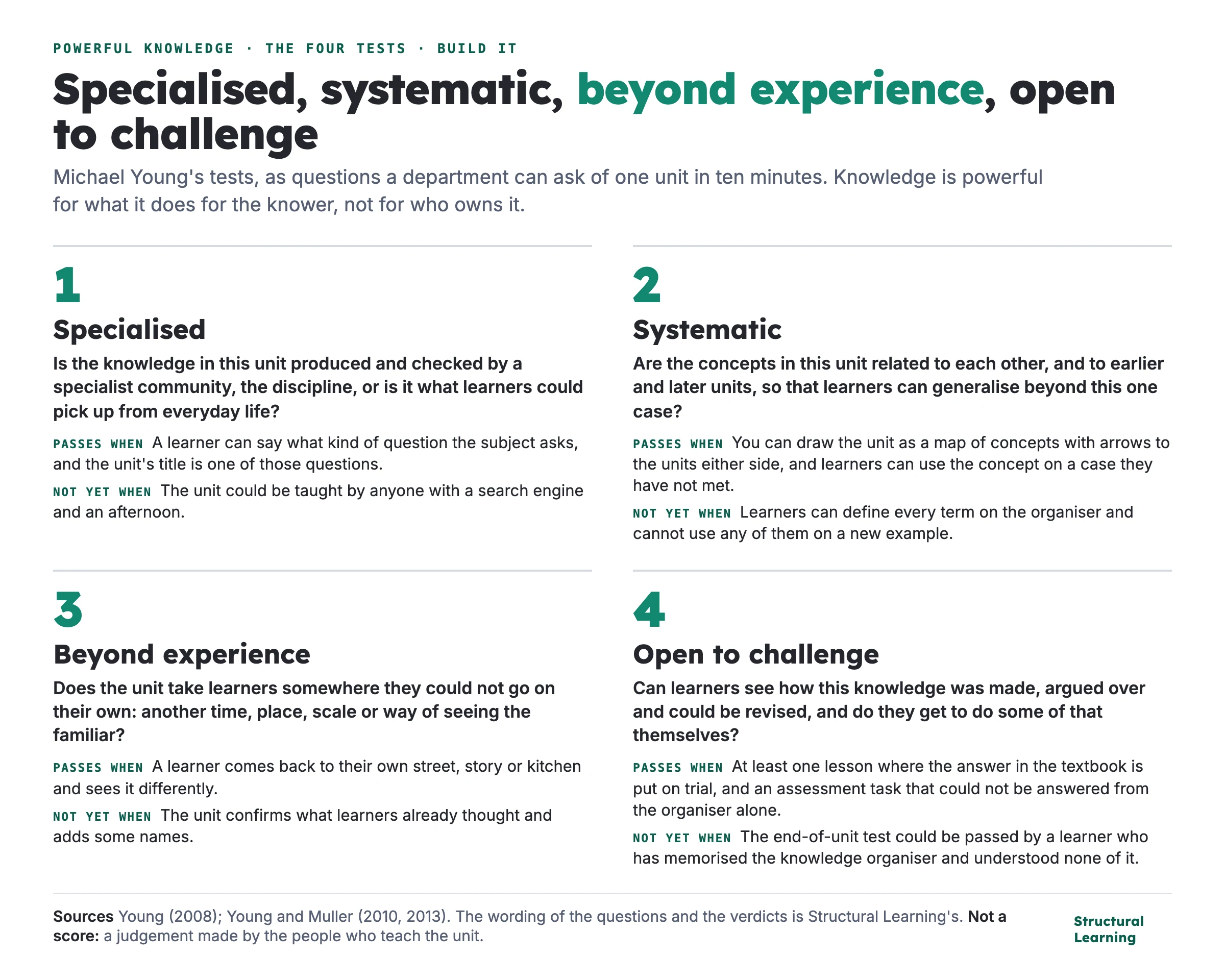
Test 1 · Specialised
Is the knowledge in this unit produced and checked by a specialist community, the discipline, or is it what learners could pick up from everyday life?
Test 2 · Systematic
Are the concepts in this unit related to each other, and to earlier and later units, so that learners can generalise beyond this one case?
Test 3 · Beyond experience
Does the unit take learners somewhere they could not go on their own: another time, place, scale or way of seeing the familiar?
Test 4 · Open to challenge
Can learners see how this knowledge was made, argued over and could be revised, and do they get to do some of that themselves?
Powerful knowledge is not better than everyday knowledge; it does a different job. Everyday knowledge is what you need to get through the day. Powerful knowledge lets you explain, predict and argue about things you have never seen. Sort each pair.
Before the department meeting
Young's tests were written as sociology, not a departmental checklist, but they translate into four questions a subject team can answer about one real unit in around ten minutes. Pick a unit already on the scheme of work, and answer each with yes, partial or no, using actual lesson content as evidence.
| Test | The question to ask of the unit | Passes when | Fails when |
|---|---|---|---|
| Specialised | Could a learner pick this up from home, the news or a school trip, without a subject specialist teaching it? | The unit teaches concepts, methods or vocabulary drawn from the discipline's own tradition | The unit could be replaced by a good documentary or a family day out and nothing disciplinary would be lost |
| Systematic / conceptual | Do this unit's ideas connect explicitly to ideas taught earlier and later in the sequence? | A learner can explain how this unit builds on an earlier one and feeds a later one | The unit is self-contained with no stated link backward or forward in the scheme of work |
| Beyond experience | Does the unit take learners somewhere they could not get to on their own, in place, time or scale? | Learners finish able to think about something outside their own town, era or direct senses | The content mostly restates what learners in the room already believed or knew |
| Open to challenge | Does the unit show how the knowledge was established or contested, or present it as settled fact? | Learners see at least one genuine disagreement, revision or open question inside the discipline | Everything is presented as a fixed, uncontested fact to be memorised |
Most units fail one test, not all four. A unit failing specialised needs the discipline's own method added, how a geographer models or a historian weighs a source, not more content. One failing systematic needs its links to other units written into the scheme before teaching, not discovered afterwards. One failing beyond experience needs a genuinely unfamiliar case swapped for a locally familiar one. One failing open to challenge needs a lesson, sometimes fifteen minutes, on how the field itself argues about the topic. That single change usually moves a fail to at least a partial pass; audit the unit again once it is made.
England's curriculum-planning conversation on X rarely uses Young's vocabulary, but the practice is there under other names. Geography teachers push loudest for Year 7 to open with dense subject content rather than a generic "skills of a geographer" unit (kate_stockings, 10 Jul 2026 and 12 Sep 2026). Primary history teachers post disciplinary-knowledge teaching videos for Key Stage 1 (Mr_S_Tiffany, 5 Aug 2026). A Northern Ireland geography head of department has been writing disciplinary structure into a new national curriculum (lcgeography, 5 Aug 2026). Knowledge organisers, the most visible artefact of the whole decade, are treated as background kit rather than a live debate (PaulWat5, 27 Aug 2026). In the United States, teachers do not use Young's phrase at all; the live vocabulary is knowledge-building, argued through the science of reading. US teachers say phonics alone is not enough for comprehension (karenvaites, 8 Sep 2026, United States), that there is less buy-in for building knowledge than for phonics (natwexler, 5 May 2026, United States), and that skills cannot be taught before knowledge is built (jasso_nm, 16 Sep 2026, United States).
Nobody posts a unit audit. They post the argument about where Year 7 should start, the video they made about disciplinary knowledge, the organiser they printed, and, in the United States, the party at the end of the unit. The evidence column is the research, not the post.
| Routine, as teachers describe it | What you would notice | What the evidence says | Reported by |
|---|---|---|---|
| Start Year 7 geography with substantive knowledge, not a skills unitpractitioner claim | The first half term is a real place and a real question, not 'skills of a geographer'. Map work arrives inside the enquiry. | Young and Muller's second test: concepts placed in a structure that later units build on. A skills unit with no substantive content has nothing for the next unit to rest on. | @kate_stockings 10 Jul 2026 · 51 likes, 11 reposts, 36,837 views What if Y7 geography starts with rich geographical knowledge as opposed to a fluffy unit that lacks foundational substantive knowledge? Open the post |
| Teaching disciplinary knowledge in Key Stage 1 history, and filming itreported practice | Five- and six-year-olds asking how we know, with the source in front of them, on video for other teachers. | The fourth test at the youngest age the literature barely covers: the discipline arrives as a way of asking, not a list. Reported, not trialled. | @Mr_S_Tiffany 5 Aug 2026 · 2 likes, 400 views 2nd KS1 video on teaching disciplinary knowledge is uploading now... :) Open the post |
| Writing a knowledge-rich national geography curriculumreported practice · Northern Ireland | A head of department explaining the sequencing behind a whole curriculum at its launch. Northern Ireland, not England. | The systematic test done at national scale: concepts sequenced across years. Whether it reaches classrooms is the question Enser asks of England. | @lcgeography 5 Aug 2026 · 5 likes, 1 repost, 900 views During the launch of our new knowledge rich NI National Curriculum, I had the chance to share something of the thinking behind the Geography Curriculum. Open the post |
| Knowledge-rich done well: disciplinary, thorough from Year 7, not driven by exam questionspractitioner claim | One school's inspection outcome held up as the model: subject-sensitive teaching, scholarly, and, in the poster's words, packed with joy. | All four tests in one description. It is one school, reported by a consultant who advised it; a claim, not a census. | @Counsell_C 20 Aug 2026 · 63 likes, 13 reposts, 6,854 views Wonderful vindication of knowledge-rich done really, really well. Subject-sensitive disciplinary teaching that is deeply thorough from Y7, scholarly (not driven by GCSE questions) & packed with joy. Open the post |
| A GCSE knowledge organiser as the Year 11 revision toolreported practice | One printed sheet per topic, every fact in a box, used for retrieval before the exam. | An organiser passes no test on its own: it is the second test's failure case (definitions with no threads) unless the lessons around it do the linking. Useful kit, not a curriculum. | @MaryyTeacher 12 May 2026 · 13 likes, 4 reposts, 1,992 views The @ThePiXLNetwork everything GCSE Maths knowledge organiser, has proven to be a hit revision tool for our year 11s! Open the post |
| A tea party to end the first CKLA unitreported practice · United States | A US elementary class celebrating a knowledge-building unit with the book's own world. What American schools photograph is the culminating event. | The US name for this argument is knowledge-building, not powerful knowledge. The third test is visible (a world beyond the child's); the fourth is not in the photo. | @fccrickets 11 Sep 2026 · 2 likes, 61 views Students celebrated the end of their first CKLA unit with a tea party inspired by their Alice in Wonderland book. Open the post |
| A dictated knowledge-building curriculum pitched above most of the classobjection · United States | A Nebraska teacher on a scripted programme whose texts sit above the readers in the room. | Deng's 2022 point in a classroom: a knowledge-rich plan imposed from above can strip the teacher's judgement. The tests are for the unit as taught, which is why this audit asks what happens now. | @AckTeacher 19 Apr 2026 · 459 likes, 17 reposts, 13 replies, 28492 views we have dictated curriculum that is far above most kids abilities (CKLA) Open the post |
None of these posts use the phrase "powerful knowledge" on either side of the Atlantic, which is exactly the gap this page's audit is built to close: Young's actual question, specialised, systematic, beyond experience, open to challenge, applied to a unit that may already be built along roughly the right lines.
The knowledge-rich decade may never have actually reached classrooms, and the term was never properly defined. A curriculum writer asked publicly whether the knowledge-rich era ever really changed lessons, or whether people were writing an obituary for something that had barely lived (EnserMark, 1 Sep 2026 and 2 Sep 2026). An academic argued the whole idea functioned more as an undefined ideological device than an evidenced reform (Keith_Turvey, 2 Sep 2026). A curriculum consultant offered a counter-case: one school, done really well, subject-sensitive and thorough from Year 7 (Counsell_C, 20 Aug 2026). Both are probably true at once; a slogan can spread through inset days faster than it spreads through schemes of work, and one strong example is not evidence of a national shift. The audit above exists so a department can check a real unit rather than trust the label on the door.
PISA 2025 is being claimed as proof of a knowledge-rich curriculum, in both directions. England's 2025 results, science 516, reading 497, maths 492, all above the OECD average, with Scotland and Wales weaker, have been read as vindication of explicit teaching (daisychristo, 10 Sep 2026, twice). A researcher pushed back that one umbrella term is doing the work of several post-hoc justifications, phonics, behaviour policy and maths hubs among them (cbokhove, 13 Sep 2026). Another critic argued curriculum design has little to do with the attendance figures cited in the same argument (_CatintheHat, 10 Sep 2026). This page will not say PISA proves knowledge-rich teaching works; attributing a national score to one philosophy, when several policies moved together, is a claim nobody in this argument has actually isolated.
English, music and the arts argue the construct privileges one kind of knowledge and flattens dialogic subjects. An English specialist argues literature is a dialogic subject, not a science, and teaching it as one is a symptom of powerful-knowledge pedagogy taking over regardless of subject (shabanahfazal, 18 Aug 2026). A music education academic makes the general point that the dominant construct favours knowledge stated as a proposition, exactly where arts subjects struggle to fit (Johnfinney8, 13 Sep 2026). The practical version of the complaint is about starters, not theory: mini-whiteboard retrieval, borrowed from knowledge-rich science and history classrooms, should not be the default opener in English (lcgeography, 13 Sep 2026). The worked English example below answers this honestly rather than argues it away: the discipline is interpretation and argument, not recall.
The academic critique goes deeper than a subject complaint. Beck (2013) argues that treating powerful knowledge as equivalent to specialised disciplines risks reviving esoteric knowledge, content that historically marked out an educated elite, under a more attractive name. White (2018) argues the systematicity test itself does not hold outside STEM: history and literature lack the tightly interlinked, hierarchical structure Young's account assumes, so subjects Young calls powerful may fail his own criterion. White (2025) sharpens this for a policy audience, calling the term emotionally charged and semantically unstable, and recommends government drop it while keeping the underlying commitment to organised subject content. Alderson (2020) argues locating power inside abstract theory alone is a myth, setting out four conditions, the knowledge itself, the knowers, the social context and practical application, all needed before knowledge functions as powerful in a learner's life. Deng (2022) is the most sympathetic of the four: not a rejection of powerful knowledge, but a warning that knowledge-rich curriculum plans built on it can, applied too rigidly, undermine the professional agency of the teachers who are meant to be building the curriculum.
Their words, unedited, are below.
Ask X about powerful knowledge and teachers answer about something else: whether England's knowledge-rich decade ever reached a classroom, what PISA 2025 does and does not prove, and whether the construct fits English and the arts. Their words, unedited, in the order the objections above take them.
People are starting to write the obituary for England's "knowledge-rich" era. Before we bury it, I wanted to check something - was it ever really alive?
the concept of ‘knowledge-rich’ was never convincingly defined. It was more an ideological Trojan horse than a serious evidence informed reform.
Wonderful vindication of knowledge-rich done really, really well. Subject-sensitive disciplinary teaching that is deeply thorough from Y7, scholarly (not driven by GCSE questions) & packed with joy.
Basically, knowledge-based curriculums have succeeded. They work. We have so much evidence that they work.
one term e.g. 'knowledge-rich curriculum' becomes synonymous with all the previously mentioned ingredients. This are mostly post hoc justifications.
English Literature is a dialogic subject, not a science, yet is being taught as one because of the dominance of ‘powerful knowledge’ pedagogy.
The dominant knowledge-rich construct privileges propositional knowledge. This can be problematic in the Arts.
English should not be subjected to a one-size-fits-all appraoch to lesson planning. MWB retrieval should not be the default starter.
Alongside the deficit narratives peddled by many and Ofsted’s total misinterpretation of cultural capital, it’s dangerous.
What this page's research did not find matters as much as what it did. No classroom teacher in either country argued the term "powerful knowledge" itself should be dropped; the live argument is whether the practice arrived, not whether to retire the words. Michael Young the sociologist is almost invisible in teacher talk on either side of the Atlantic; zero US posts named him with curriculum at all, and UK teachers talk "knowledge-rich", not "Future 3". A named unit audit, as a curriculum-planning practice, did not turn up in either country's search; sequencing talk exists, but not as a checklist like the one this page proposes. And "curriculum intent" as live UK teacher talk was dead in this window; every hit was a paid Ofsted-readiness webinar, not a teacher's own post.
| Approach or choice | What it gives you | The staffroom objection |
|---|---|---|
| Auditing a unit against the four tests | A shared, ten-minute language for judging a scheme of work rather than a gut feeling | Reduces a rich unit to four yes or no boxes if used as a compliance tick-list rather than a planning conversation |
| Starting Year 7 with substantive knowledge, not a skills unit | Gives learners real disciplinary content to think with from day one (kate_stockings, 10 Jul 2026) | Risks becoming a fact dump if the "substantive" content never connects to a disciplinary method |
| Knowledge organisers | A shared, checkable core of facts and vocabulary for learners and non-specialist staff alike | Academics warn organisers get treated as the whole of powerful knowledge, when Young's test is about structure and method, not a list |
| Retrieval starters in every subject | Strengthens recall of the substantive knowledge a discipline needs before it can be used at all | Applied as a blanket policy, it flattens dialogic subjects; English specialists argue mini-whiteboard retrieval should not be the default starter (lcgeography, 13 Sep 2026) |
| The cultural capital label on a curriculum document | Signals to inspectors that a school has thought about what learners need beyond the exam | Teachers hear inspection first and curriculum thinking second (SwailesRuth, 7 Aug 2026) |
| Vocational and technical knowledge in the same audit | Extends the entitlement argument to trades and technical routes rather than treating them as lesser (richardtutt, 2 Aug 2026) | Risks stretching the four tests until they no longer mean anything specific to a discipline |
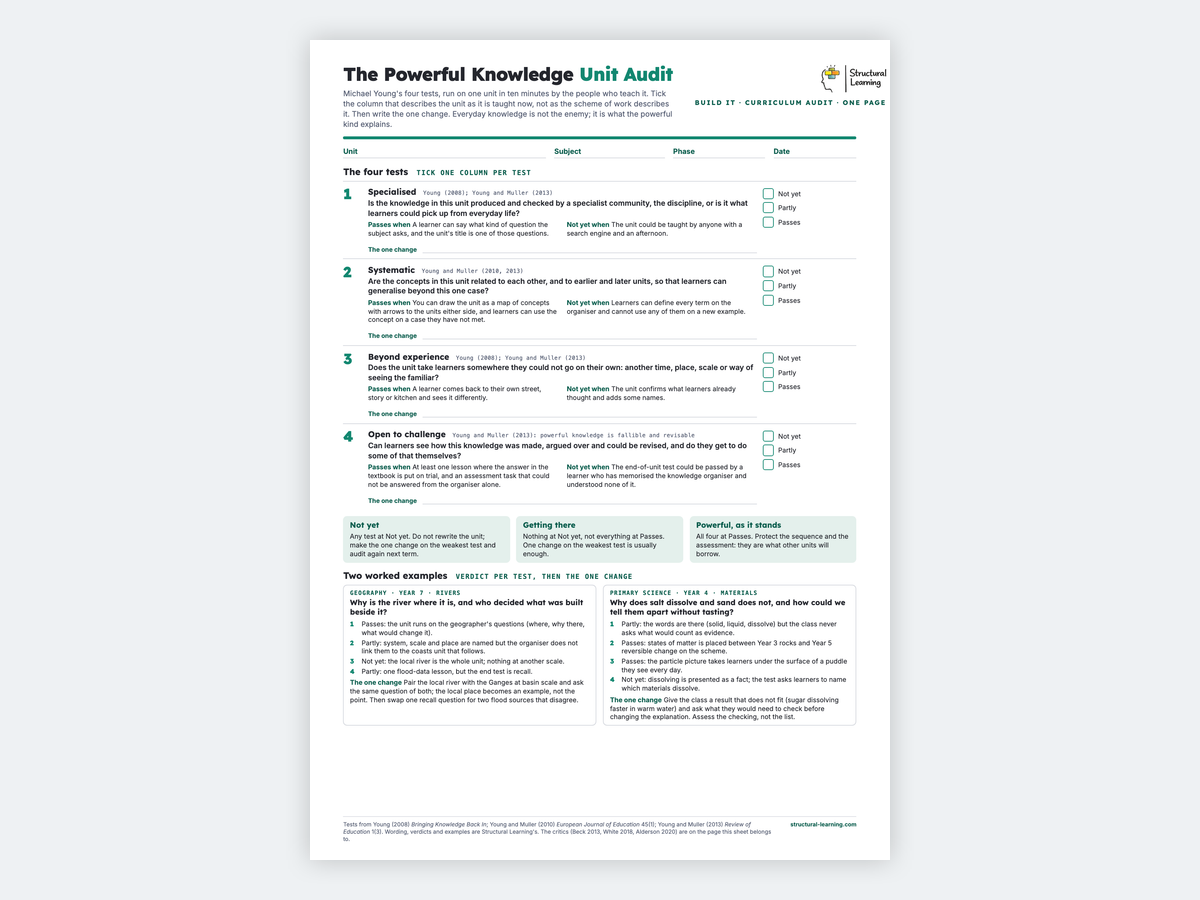
Michael Young's four tests as a tick sheet for one unit, what a pass and a fail look like on each, a line for the one change, the verdict rule, and two worked examples (Year 7 rivers, Year 4 materials), on one A4 page. Print one per unit for the department meeting.
Add your details and we will email the one-page PDF straight to your inbox, ready to print for the next department meeting.
We've also emailed a copy to your inbox. Check your email if it doesn't open automatically.
Download the PDF
The four examples below are Structural Learning's own, run against Young's tests, each ending with a one-line verdict and the one change that moves it further. The English example is the hardest case, since it answers the objection that powerful knowledge flattens subjects built on interpretation rather than hierarchy.
A half-term unit on rivers covers a drainage basin, erosion, transportation and deposition, ending with learners assessing flood risk on one named local river.
The one change: swap the final task for predicting flood risk on an unseen river, stating what learners are unsure of. That fixes the last two tests at once.
A unit on 1066 typically runs as narrative: the succession crisis, Hastings, castles, the Domesday Book.
The one change: introduce a Norman and an English chronicle extract and ask learners which is more reliable, and why. That costs one lesson.
A common Year 4 unit sorts materials, wood, metal, plastic, glass, by their properties and uses.
The one change: build in one test where the expected answer is wrong, so learners revise a prediction using evidence rather than confirm one.
A whole-class novel study is the unit most often accused of forcing English into a shape it does not fit, and the fairest test of that objection.
The one change: replace quotation recall with a structured argument defending one of two plausible readings, using textual evidence. That makes disagreement, not agreement, the thing being assessed.
| Term | Who coined or owns it | What it claims | What it is not |
|---|---|---|---|
| Powerful knowledge | Michael Young, sociologist of education, with Johan Muller from 2010 onwards | Specialised, systematic disciplinary knowledge that takes learners beyond everyday experience and stays open to challenge | A list of facts, a canon of texts, or a policy programme |
| Knowledge-rich curriculum | No single author; a practitioner and policy term used across English curriculum planning, including the 2025 Curriculum and Assessment Review | A whole-school approach that sequences specific, named content deliberately rather than leaving it to chance | The same thing as powerful knowledge; a school can be knowledge-rich without ever engaging Young's theory |
| Cultural capital | Pierre Bourdieu coined it; Ofsted's Education Inspection Framework gave it its meaning in English schools, drawing loosely on the original | The essential knowledge and experiences learners need to succeed in life, which Ofsted expects a curriculum to build | Bourdieu's original concept, which describes how schools reward the cultural habits privileged families already hold at home |
Ofsted's own wording matters here. The Education Inspection Framework has asked schools to build learners' cultural capital since 2019, and the phrase has sat on inspection agendas ever since. Teachers tend to hear that as an inspection requirement first and a curriculum idea second (SwailesRuth, 7 Aug 2026); Ofsted's use of the term sits closer to E.D. Hirsch's cultural literacy than to Bourdieu's original, more critical concept, and conflating the two risks misreading what Bourdieu was arguing. None of that makes cultural capital the same idea as powerful knowledge: one is about disciplinary structure, the other about the knowledge and experience Ofsted judges a school should have given a learner. Our cultural capital guide covers the Ofsted side of that in full.
An American reader will know the same argument by a different name. In this window, US K-12 teachers did not use "powerful knowledge" at all; the live vocabulary is knowledge-building and knowledge-rich, argued through the science of reading and tied to E.D. Hirsch, Natalie Wexler, Core Knowledge, CKLA and Wit and Wisdom rather than to Young's sociology. The four tests above still apply to a CKLA or Core Knowledge unit exactly as they apply to an English scheme of work: they are questions about the knowledge itself, not about which side of the Atlantic wrote the curriculum.
Powerful knowledge is a sociological and philosophical argument, not an intervention with a measured effect size, so its evidence looks different from a classroom strategy like retrieval practice. What follows is the argument's development across three key texts, the strongest critiques, and what the evidence base does not cover.
Young (2008) set the argument out in Bringing Knowledge Back In, defining powerful knowledge by what it does for the learner rather than by its content. His argument was social realist, not empirical: schools exist, in Young's account, to give every learner, especially disadvantaged learners, access to specialised knowledge unlikely to be acquired at home. A phrase often used to summarise this test, that knowledge is powerful "if it predicts, if it explains, if it enables you to envisage alternatives", is widely attributed to Young's later writing in the practitioner sources reviewed for this page, though it sits outside the verified citations here and should not be treated as a checked quotation from the 2008 text itself.
Young and Muller (2010) tied that claim to disciplinary boundaries. Their three educational scenarios paper argued a curriculum dropping subject boundaries for generic skills, their Future 2, leaves learners without the conceptual structure to think abstractly, and proposed a Future 3 keeping boundaries deliberately, as a condition for crossing them later.
Young and Muller (2013) then answered a specific criticism: that treating STEM as the model for systematic knowledge leaves history, literature and the arts looking second-class. Their answer was that the idea belongs to the arts and humanities as well, and that being open to challenge matters as much as being systematic. White (2025) reads a later revision, with Muller in 2019, as borrowing Spinoza's distinction between potestas, power over others, and potentia, the capacity to act and imagine alternatives; that later paper is not in this page's verified list, so the account of it here is White's, not ours.
The critics matter as much as the theory. Beck (2013) argues equating powerful knowledge with specialised academic disciplines risks collapsing it into esoteric knowledge, the kind that historically marked out an educated elite rather than empowering everyone who holds it. White (2018) argues most subjects Young treats as powerful, history and literature especially, lack the tightly hierarchical, deductively linked structure that mathematics has, so the test as stated does not hold for them. White (2025) sharpens this argument for a policy audience, calling the term emotionally charged and arguing it functions rhetorically, discouraging scrutiny, more than as a precise curriculum construct; he recommends government drop the term while keeping the underlying policy of teaching organised subject content. Alderson (2020) argues from a critical realist position that locating power inside abstract theory alone is a myth: she sets out four conditions, the knowledge itself, the knowers, the social context and practical application, all needed before knowledge actually functions as powerful and promotes social justice. Deng (2022) is the most sympathetic of the four: rather than rejecting powerful knowledge, Deng argues knowledge-rich curriculum plans built on it can, if applied too rigidly, undermine the professional agency of the teachers and subject leaders meant to be making the curriculum.
Two limits apply across this whole body of work. Almost none of it is an empirical trial of powerful knowledge as a classroom intervention; the evidence is conceptual and sociological, so treat any claim that a knowledge-rich or powerful-knowledge curriculum raises attainment with real caution, the PISA 2025 objection above is exactly this problem playing out in public. And the primary phase and SEND are both nearly absent from the literature: none of these six writers address directly how the argument should change for a five-year-old or a learner with complex needs.
The literature behind powerful knowledge is heavily secondary and academic; nothing in the sources reviewed explains how a primary generalist teaching ten subjects a week is meant to hold the specialised disciplinary knowledge Young's test demands. A primary subject lead can still use the audit above; run it on one subject at a time, expect early answers to sit at partial rather than yes, and treat threshold concepts, the handful of ideas a subject cannot do without, as the realistic target rather than full disciplinary depth in every unit.
SEND provision gets even less from the literature. Nothing in the sources reviewed tests whether powerful knowledge, delivered a particular way, improves outcomes for learners with SEND, so this page keeps to the routine rather than a promised outcome: the audit tests a scheme of work, not a learner, and adapting how a unit is taught for a class with complex needs is a separate, equally serious decision that deserves its own evidence.
International schools, including many following the IB, will recognise the shape of the argument even where the vocabulary differs. Concept-based curriculum frameworks ask a similar question in different words: does a unit's central idea let learners transfer their understanding beyond the specific facts they were taught. The four tests above translate reasonably well into that language, with beyond experience mapping closely onto a transfer goal, though the two traditions were built separately and should not be treated as the same theory wearing different words.
Powerful knowledge is Michael Young's term for the specialised, systematic knowledge academic disciplines produce, which takes learners beyond the everyday knowledge they already hold and stays open to challenge and revision by the disciplinary community that produced it (Young, 2008; Young and Muller, 2013).
Young and Muller (2010) described three ways a curriculum can be built. Future 1 treats subject boundaries as fixed and knowledge as facts to transmit. Future 2 drops subject boundaries for generic skills. Future 3 keeps subject boundaries because learners need a disciplined starting point before they can think across, or beyond, it.
"Knowledge of the powerful" describes whatever an elite group controls access to, regardless of its intellectual content. "Powerful knowledge" describes what a mind can do once it holds specialised, disciplinary knowledge, whoever teaches it or learns it (Young, 2008).
No. Powerful knowledge is Young's argument for why schools should teach specialised disciplinary knowledge. A knowledge-rich curriculum is the practical, whole-school planning approach many English schools use to put that kind of content into a scheme of work, often without reference to Young's theory at all.
Critics argue it can be. Beck (2013) warns that equating powerful knowledge with specialised academic knowledge risks reinforcing the same elite privilege the idea was meant to challenge. Young's own answer is that withholding specialised knowledge from disadvantaged learners is the more elitist choice, but Alderson (2020) argues social justice needs more than access to the knowledge itself.
Run one unit's scheme of work against the four tests above: specialised, systematic, beyond experience, open to challenge. Answer each with a yes, partial or no, note the evidence from the actual lesson content, and make the one change that moves the weakest answer, rather than rewriting the whole unit.
If the audit above turns up a unit with genuine disciplinary content that still sits flat on the page, Structural Learning's Build It tools at app.structural-learning.com help a department turn that content into lesson activities and organisers learners can actually use. They will not tell you whether a unit meets Young's tests. That judgement, like the rest of this page, stays with the department.
Alderson, P. (2020). Powerful knowledge, myth or reality? Four necessary conditions if knowledge is to be associated with power and social justice. London Review of Education, 18(1). https://doi.org/10.18546/lre.18.1.07
Beck, J. (2013). Powerful knowledge, esoteric knowledge, curriculum knowledge. Cambridge Journal of Education, 43(2). https://doi.org/10.1080/0305764x.2013.767880
Deng, Z. (2022). Powerful knowledge, educational potential and knowledge-rich curriculum: pushing the boundaries. Journal of Curriculum Studies, 54(5). https://doi.org/10.1080/00220272.2022.2089538
White, J. (2018). The weakness of "powerful knowledge". London Review of Education, 16(2). https://doi.org/10.18546/LRE.16.2.11
White, J. (2025). Is it time to drop the terminology of "powerful knowledge" in talking about the school curriculum? UCL Institute of Education Blog, 25 November 2025. blogs.ucl.ac.uk
Young, M. (2008). Bringing Knowledge Back In. Routledge. https://doi.org/10.4324/9780203073667
Young, M. and Muller, J. (2010). Three educational scenarios for the future: lessons from the sociology of knowledge. European Journal of Education, 45(1). https://doi.org/10.1111/j.1465-3435.2009.01413.x
Young, M. and Muller, J. (2013). On the powers of powerful knowledge. Review of Education, 1(3), 229 to 250. https://doi.org/10.1002/rev3.3017


![Restorative Justice in Schools: A Complete Guide [2026]](https://cdn.prod.website-files.com/5b69a01ba2e409501de055d1/69d10d1b8439e584054873c1_69d10d186a5477665840c608_restorative-justice-in-schools-classroom-teaching.webp)