Updated on
September 16, 2026
Echo Reading: 4 Steps, a Script and 6 Passages by Age
Echo reading in four steps with a script, six original passages by age, what UK and US teachers really run, where it falls short, and the research behind it.

Updated on
September 16, 2026
Echo reading in four steps with a script, six original passages by age, what UK and US teachers really run, where it falls short, and the research behind it.
Echo reading is a fluency strategy in which a teacher reads a short phrase or sentence aloud with expression, and the learner immediately reads the same text back, matching the teacher's pace, tone and phrasing. It works because it gives learners a live model of fluent, expressive reading immediately before they attempt the same words themselves, and the National Reading Panel found that this kind of guided, assisted reading produces significant gains in word recognition, fluency and comprehension. Echo reading differs from choral reading in one key way: in echo reading the teacher and learner read one after the other, while in choral reading they read the same words together at the same time.
This page gives you the four-step routine with a script, what UK and US teachers actually photograph and argue about, an honest account of where the technique falls short, three original passages by age with cue marks, a comparison against choral, paired and repeated reading, and the research behind all of it, cautiously stated. The picker below sorts a routine and a timed script to your class, and the printable script sheet a little further down fits on one A4 page.
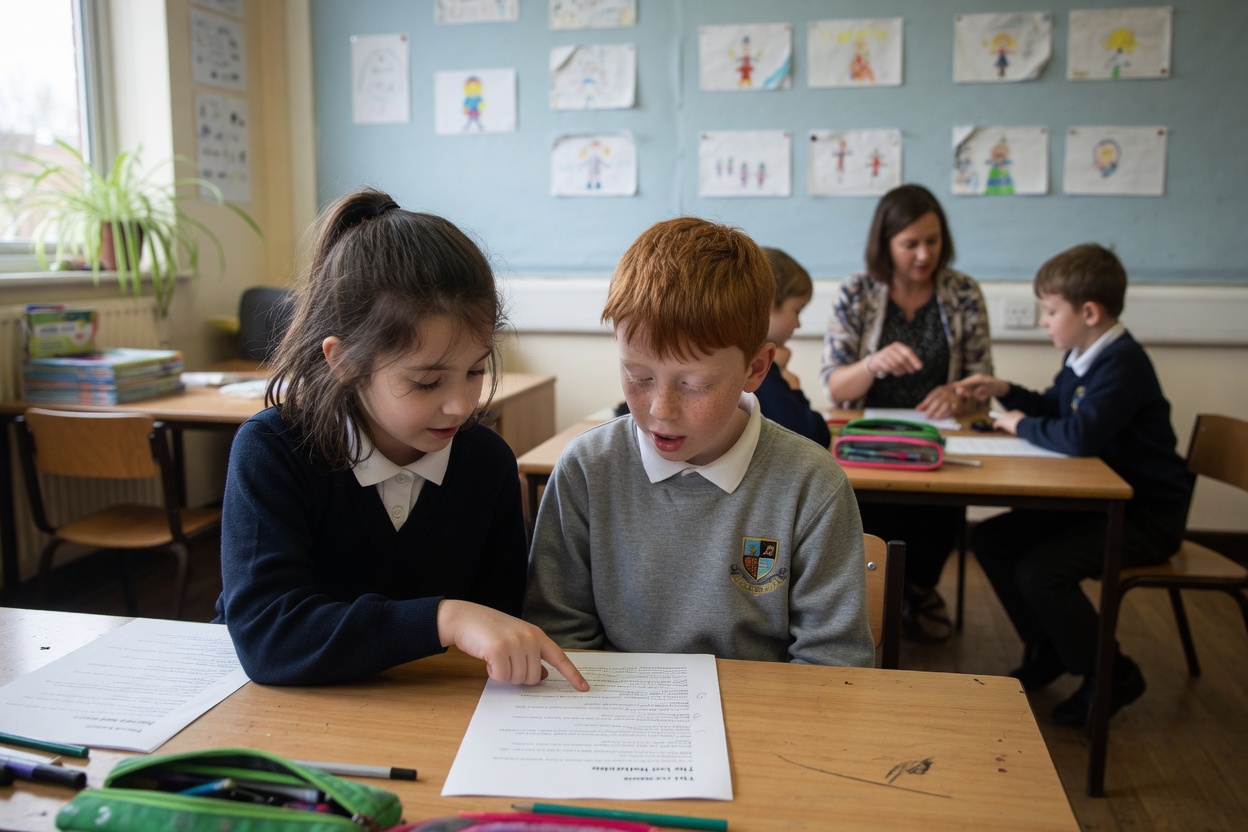
That definition is the one search engines already reach for, and it is accurate. It is not, though, how most UK or US teachers behind this practice would describe their own Monday morning. Across two independent searches of live teacher posts (48 UK searches, 38 US searches, six months of posts), only Nursery and Reception classes in England named "echo reading" outright, and they framed it as oracy rather than fluency work. Key Stage 2 and Key Stage 3 teachers photograph something with the same shape and a different name: two learners at a table, re-reading a short extract for pace and intonation, or a daily guided-reading slot that nobody badges as a named strategy at all. This page uses the search term because that is what people look for, but treats the practice as pairs, guided reading and modelled reading first, because that is what teachers actually run. For the wider set of fluency routines this sits inside, see our reading fluency strategies guide.
Echo reading is one of six routines that share a mechanism: a fluent model, then the learner's own attempt, seconds apart. Say how old they are, what you hear when they read, and who is in the room, and you get the routine, a timed script and the moment to fade it. Or paste a passage and chunk it for the echo.
Before Monday
Every routine here fades: whole class, then pairs, then an invited solo. Nobody is made to read alone. A words-per-minute count is a teacher check for ages 9 and up, kept off the board.
Reading aloud is talk. The Structural Learning app's Say It activities give each learner a talk role for your text and year group in a couple of clicks. Try it on a free account, no card needed.
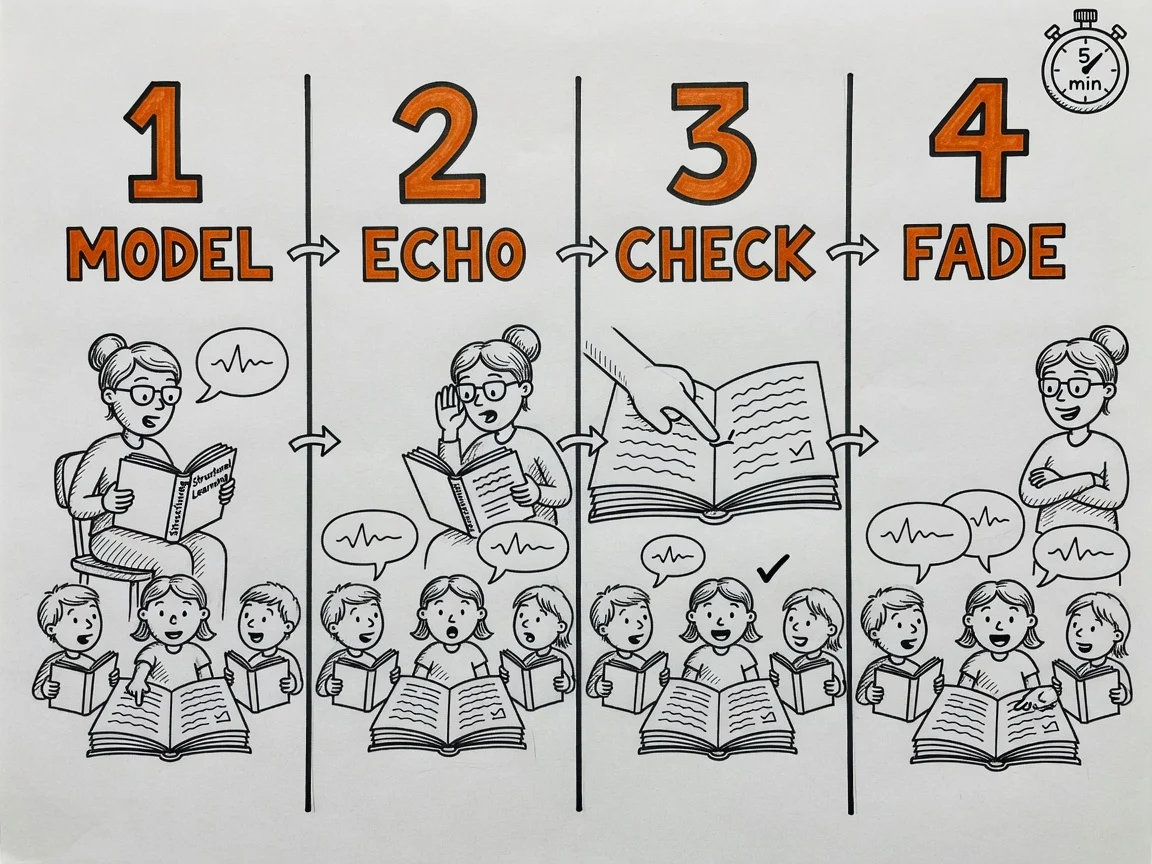
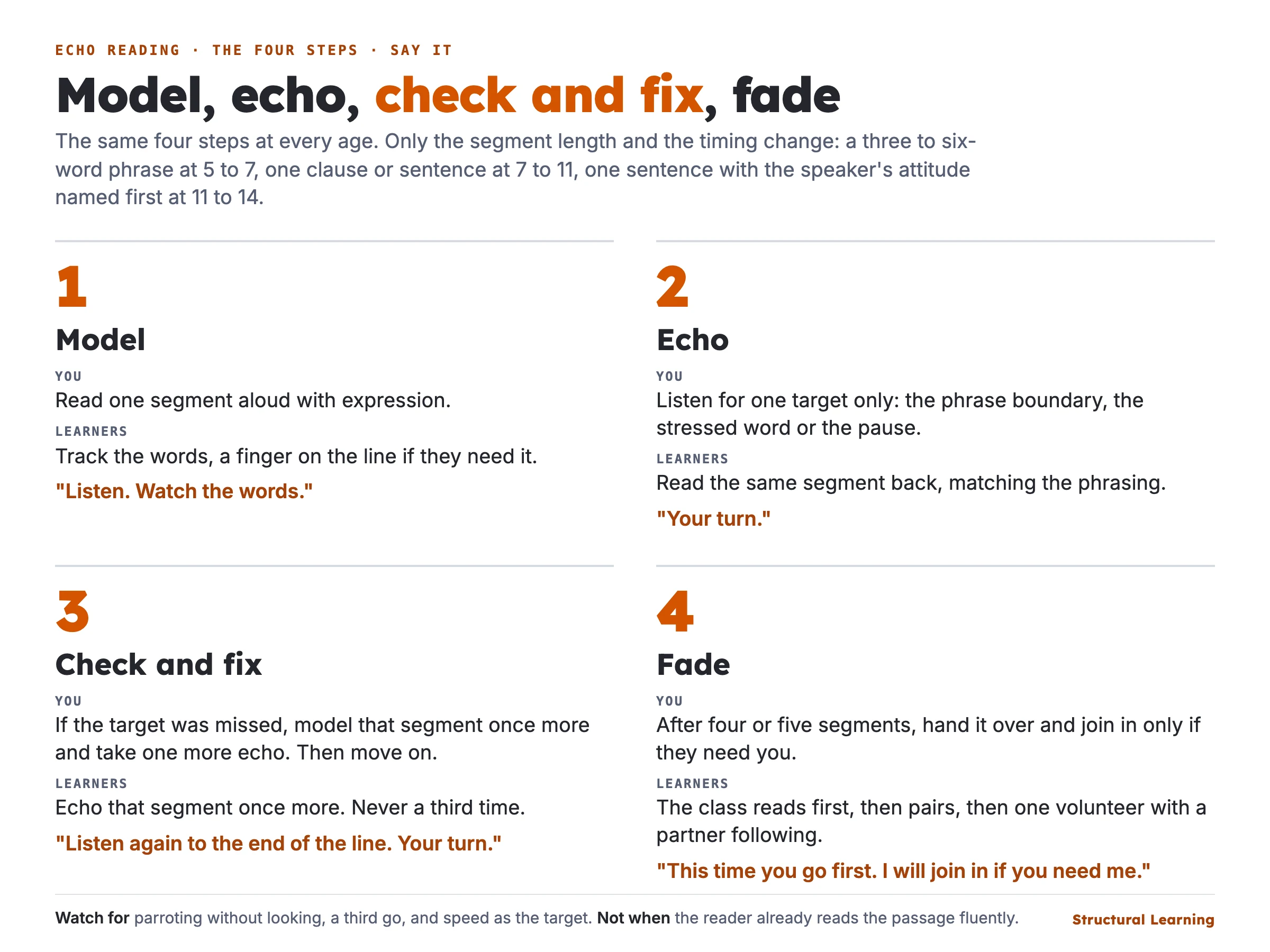
The routine is the same four steps whatever the age group, and only the segment length and the timing change.
Segment length is the lever that does the most work, and it changes by age.
| Age | Segment | Session length | Why |
|---|---|---|---|
| 5 to 7 | 3 to 6 words: a phrase, never a whole sentence | 4 to 6 minutes | Working memory holds a phrase, not a sentence. The echo has to be short enough to copy exactly. |
| 7 to 11 | One clause or one sentence, 6 to 12 words | 6 to 8 minutes | Long enough to carry a phrase boundary and one stressed word, short enough to hold. |
| 11 to 14 | One sentence up to 15 words, with the speaker's attitude named first | 5 to 7 minutes, inside the subject lesson | Older readers echo tone, not just words. Name the attitude and the echo has a target that is not babyish. |
Here is the five-minute version run whole class or in a small group. Set the target before you start: for example, "today we are listening for the pause at the comma." Model the first segment, take the echo, check the target and re-model once if it was missed, then work through segments two to five the same way. At around the four-minute mark, fade: "you go first on the next one," and let the class read that segment together before you join in. In the last minute, pairs read the whole passage, one partner following with a finger while the other reads.
Two mistakes account for most of what goes wrong. The first is parroting without looking: a learner echoes the sound from memory with their eyes on you, not the page. Point at the line and ask for the echo again with fingers on the words. The second is using it with a reader who is already fluent on that text: echo reading practises what a learner cannot yet do alone, so a fluent reader is simply being slowed down. Move a confident reader to leading the echo for a partner instead.
UK schools rarely name the strategy, so the clearest way to see it is in what they actually post. The table below is a working sample from live accounts in both countries, not a survey; each row is labelled by what kind of claim it is, and the evidence column is the research, not the post.
Nobody in either country posts the words "echo reading" about a Year 4 class. They post this. The evidence column is the research, not the post.
| Routine, as teachers describe it | What you would notice | What the evidence says | Reported by |
|---|---|---|---|
| Re-read a short extract three times, for pace, then accuracy, then intonationreported practice | The same page open all week. Pairs at a table, one finger on the line. The third read sounds like a person talking. | Repeated reading with a model and feedback is the best-evidenced fluency routine in Kuhn and Stahl's 2003 review. The gain is in phrasing and comprehension, not raw speed. | @wyndclf 2 Jun 2026 · 173 views The children re-read the text several times to develop pace, accuracy and intonation. Open the post |
| Paired fluency practice, partner follows and listensreported practice | Two heads over one text. The listener has a job: a tick above each pause, a wavy line under a skipped word. | Rasinski and colleagues' 1994 Fluency Development Lesson pairs a teacher model with partner reading; the pair is where the check-and-fix step happens. | @AckworthHoward 9 Sep 2026 · 1 like, 365 views Class Two have been working hard on developing their reading fluency this morning showing superb focus as they worked together in pairs! Open the post |
| Guided reading every morning, a calm startreported practice | A short text, a small group, the teacher reading first. Fluency is practised daily in minutes, not weekly in a lesson. | The National Reading Panel (2000) found guided oral reading with feedback improved word recognition, fluency and comprehension across ages. Frequency matters more than length. | @Herringthorpe 8 Sep 2026 · 1 like, 1 repost, 56 views We start every day with guided reading. A calm start that builds fluency, expands vocabulary and strengthens comprehension Open the post |
| Echo reading a topic story in Nursery and Reception, framed as oracyreported practice | The whole class saying a line back with the adult's rhythm. Nobody reads alone. | The only UK school naming echo reading in the window uses it at the phonics stage, where a phrase-length echo fits working memory. Reported, not trialled. | @LeighPrimary 19 May 2026 · 6 likes, 167 views Nursery/Reception children have enjoyed listening to our topic story and joined in with echo reading. The children have demonstrated fantastic oracy skills. Open the post |
| Novel study read 80 per cent FASE (named readers in planned turns) and 20 per cent choralreported practice · United States | Every learner with their own copy. The teacher names the next reader before the current one stops; short unison bursts break it up. | Pikulski and Chard (2005) describe fluency as the bridge from decoding to comprehension; planned turns keep the print in front of every reader. US practice, a fifth-grade class. | @smorrisey 17 May 2026 · 161 likes, 25344 views During novel study I use an 80/20 approach (FASE/choral reading). Every one of my 5th graders has their own copy of the novel we are reading. Open the post |
| Partner reading by torchlight, a phonics passage, no stated job for the listenerreported practice · United States | Pairs on the carpet, one torch on one passage, first graders taking turns. Fun is doing the work of attention. | Paired reading helps when the listener has a job (a tick for a pause taken well, a mark for a skipped word). The post names none, so the pairing may be practice for one child and a wait for the other. | @StillElem 29 Aug 2026 · 2 likes, 108 views Mrs. O’Brien’s first graders celebrated their first Flashlight Friday with partner reading! Students used flashlights while practicing their UFLI phonics passages and building reading fluency and confidence. Open the post |
| Repeated reading only works when each reread has a purposepractitioner claim · United States | Read one for the words, read two for the phrases, read three for the listener. The class knows why they are reading it again. | A naked reread is the mistake the reviews warn about; the routine in this article gives each pass a target for that reason. | @Mr100Teacher 18 Jul 2026 · 23 likes, 5 reposts, 2 replies, 18 bookmarks, 1772 views My students were bored with traditional repeated reading, so I created Phenomenal F.L.O.W. — a 5-day cycle that gives every reread a purpose. Open the post |
Guided reading of this kind is one step short of full reciprocal reading; once fluency is secure, our reciprocal reading guide covers the four roles that take a group from reading a text together to interrogating it.
Four objections come up in teachers' own words more than any other, and none of them is really about echo reading. They are about reading aloud in general.
Should we still be making children read aloud in front of the whole class? A Scottish author opened this question on X in August and it drew 44 replies (bannon1975, 5 Aug 2026). The replies split two ways: teachers who never force a solo read and invite instead, and adults who still remember reading too fast, making mistakes and hearing the class laugh (EdnaKrabapple1, 11 Aug 2026; Msliterarylover, 12 Aug 2026). The invited-echo routine later in this piece and a considered cold calling policy for who reads solo are two different answers to that same worry.
Pushing speed is counterproductive. A UK primary teacher and author put this plainly, and nearly 64,000 people saw it: any reading researcher with an interest in fluency will tell you that pushing developing readers to read faster works against them (Suchmo83, 22 Aug 2026). Nothing in the routine above races a clock, and the research in the section below explains why: the mechanism is a model, not speed.
Tracking with a ruler is compliance, not intervention. A Year 5 English lead says the ruler is there for accountability, so a teacher can see across the room who is following, and calls it no magic bullet (teachingwrens, 8 Aug 2026). A behaviour consultant sharpens the point: the ruler is a compliance monitoring intervention, not a reading one (tonysammon, 9 Aug 2026). Use a finger or a tracker to keep eyes on print, not as the fix itself.
A naked reread is boring, and each read needs a job. A US teacher built a five-day cycle because his class was bored with traditional repeated reading, and every reread in it now has a purpose (Mr100Teacher, 18 Jul 2026). A literacy academic states the same idea as three short jobs for one text: get it out, make it sound like someone is listening, then read it like you are telling the story rather than decoding it (ChaseJYoung1, 1 Jun 2026).
Their words, unedited, are below. Each card opens the post.
Ask X about echo reading and teachers answer about something else: whether anyone should be made to read aloud at all, whether pushing speed does harm, what the ruler is really for, and why a reread needs a job. Their words, unedited, in the order the four objections above take them.
Should we still be making children read books aloud in front of the whole class? I’d like to hear from people who’ve seen both sides of it.
I don't make them. Instead, I invite them and ask. Some children enjoy it whilst others enjoy the challenge.
When it was my turn to read, I read quickly and tended to make a lot of mistakes. This made my classmates laugh sometimes.
Ask literally any reading researcher with an interest in fluency, and they will tell you that it is counterproductive to push developing readers to just read faster
We do ask chn to track with a ruler primarily for accountability purposes (easy to see across room who's following along or not), but it's not a magic bullet
The ruler isn't a reading intervention. It is a compliance monitoring intervention.
My students were bored with traditional repeated reading, so I created Phenomenal F.L.O.W. — a 5-day cycle that gives every reread a purpose.
Read 1: just get it out Read 2: make it sound like someone is listening Read 3: read like you’re telling the story, not decoding it Same text. Different purpose each time.
What was not found is worth saying plainly, because its absence is itself useful. Across both harvests, nobody called echo, choral or repeated reading babyish for older readers, nobody complained that it takes too long, and nobody said mixed-attainment classes break it. That is not proof these complaints never happen; it is what six months of live teacher posts, searched deliberately for exactly this kind of grumble, actually returned.
| Technique or choice | What it gives you | The staffroom objection |
|---|---|---|
| Echo reading (call and response) | A fresh model seconds before the copy, so a developing reader copies pace and prosody, not just the words | Push it towards speed and it backfires, teachers say (Suchmo83, 22 Aug 2026) |
| Choral reading (unison) | Protects the reader who will not read alone; nobody is the only voice | Hides individual misreads; the quiet many can freewheel behind the loud few |
| Paired re-reading | The routine UK and US schools already photograph; a listener with a job catches what a teacher cannot hear four times over | Without a job, the listener switches off, as in the Flashlight Friday post above |
| Tracking print with a finger or ruler | Keeps eyes on the words instead of drifting or parroting from memory | "It is a compliance monitoring intervention," not a fix on its own (tonysammon, 9 Aug 2026) |
| Repeated reading, a fresh target each pass | Turns "read it again" into "read it again, for a reason": accuracy, then phrasing, then an audience | A naked reread with no new target is boring and learners switch off (Mr100Teacher, 18 Jul 2026) |
| Timing the read in words per minute | Gives a school a number to track over months | Turns fluency into "a personality trait" rather than a skill, teachers argue; keep it a private teacher check, off the board |
The four steps with the words to say, three original passages marked up for ages 5 to 7, 7 to 11 and 11 to 14, the marks key, six things to watch for and the six-routine table, on one A4 page. Print it, keep it by the board.
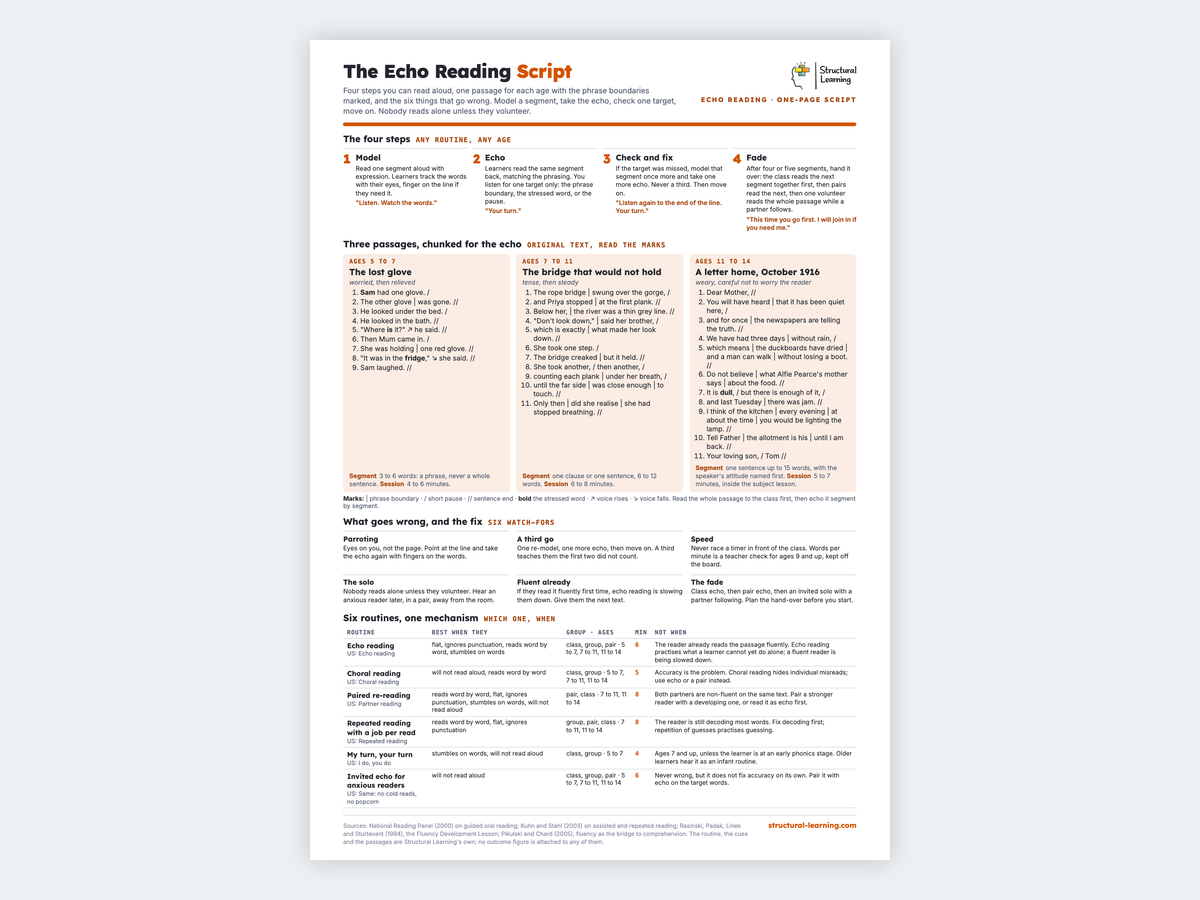
Add your details and we will email the one-page PDF straight to your inbox, ready to print for tomorrow’s fluency slot.
We've also emailed a copy to your inbox. Check your email if it doesn't open automatically.
Download the PDF
Each passage below is Structural Learning's own, written for this page, and uses four marks: a vertical line | shows a phrase boundary, where you take a breath but do not stop; a forward slash / is a short pause; a double slash // marks the end of a sentence; bold is the one word to stress; an arrow shows whether your voice rises ↗ or falls ↘ on that word. Read the marks and the modelling does most of the work for you.
Attitude: worried, then relieved. 43 words, in 3 to 6-word segments.
Sam had one glove. /
The other glove | was gone. //
He looked under the bed. /
He looked in the bath. //
"Where is it?" ↗ he said. //
Then Mum came in. /
She was holding | one red glove. //
"It was in the fridge," ↘ she said. //
Sam laughed. //
Model the first line, take the echo, then move to the next. Keep the whole passage to four to six minutes and stop while the class is still enjoying it.
Attitude: tense, then steady. 76 words, in one-clause or one-sentence segments.
The rope bridge | swung over the gorge, /
and Priya stopped | at the first plank. //
Below her, | the river was a thin grey line. //
"Don't look down," | said her brother, /
which is exactly | what made her look down. //
She took one step. /
The bridge creaked | but it held. //
She took another, / then another, /
counting each plank | under her breath, /
until the far side | was close enough | to touch. //
Only then | did she realise | she had stopped breathing. //
This is long enough to run the full four-step routine with a genuine fade: model the first three segments, then hand the fourth to the class before you join in, then let pairs read the whole thing.
Attitude: weary, careful not to worry the reader. Name that attitude before you read a word; naming it first is what keeps the routine adult enough for a Year 8 room, not an infant one.
Dear Mother, //
You will have heard | that it has been quiet here, /
and for once | the newspapers are telling the truth. //
We have had three days | without rain, /
which means | the duckboards have dried | and a man can walk | without losing a boot. //
Do not believe | what Alfie Pearce's mother says | about the food. //
It is dull, / but there is enough of it, /
and last Tuesday | there was jam. //
I think of the kitchen | every evening | at about the time | you would be lighting the lamp. //
Tell Father | the allotment is his | until I am back. //
Your loving son, / Tom //
Run this one sentence at a time, inside a history lesson rather than an English one if that fits your scheme, and ask what the gap between what Tom says and what he probably means is doing to the reader. That question is the KS3 payoff: the fluency work and the comprehension work happen in the same five minutes.
| Routine | Best for | Group | Minutes | Not when | US name |
|---|---|---|---|---|---|
| Echo reading | Prosody, rate, accuracy | Class, group or pair | 6 | The reader already reads the passage fluently; you would just be slowing them down | Echo reading; often "I read, you read" |
| Choral reading | Confidence, rate | Class or group | 5 | Accuracy is the problem; unison hides individual misreads | Choral reading; US fifth-grade rooms mix roughly 20 per cent choral with 80 per cent FASE |
| Paired re-reading | Rate, prosody, accuracy, confidence | Pair, or a pair reading to a pair | 8 | Both partners are non-fluent on the same text; pair a stronger reader with a developing one | Partner reading |
| Repeated reading, a job per read | Rate, prosody | Group, pair or class | 8 | The reader is still decoding most words; repetition of guesses only practises guessing | Repeated reading; US teachers give each reread a purpose or run a five-day cycle |
| My turn, your turn | Accuracy, confidence | Class or group | 4 | Age 7 and up, unless the learner is at an early phonics stage; older learners hear it as an infant routine | I do, you do |
| Invited echo for anxious readers | Confidence | Class, group or pair | 6 | It does not fix accuracy on its own; pair it with echo on the target words | Same: no cold reads, no popcorn |
The evidence supports the mechanism behind echo reading rather than a single number attached to the strategy by name, and every source below has a limit worth stating alongside the finding.
Kuhn and Stahl's (2003) review of fluency instruction found that assisted reading strategies such as echo and choral reading outperform unassisted repeated reading on their own, because the mechanism is practice with a fluent model immediately before the attempt, not speed. That is the direct answer to the "push them to read faster" objection above: the research points at modelling, not pace.
Pikulski and Chard (2005) describe fluency as the bridge between decoding and comprehension, which is the theoretical reason modelling prosody, the rhythm and expression echo reading targets, matters at all. Fluency is not the destination; once it is secure, reading comprehension in the primary classroom covers what happens on the other side of that bridge.
Rasinski, Padak, Linek and Sturtevant (1994) ran the Fluency Development Lesson, a routine that combines echo, choral and repeated reading and was delivered three to four times a week with urban second-grade readers, and found measurable gains. That study is the honest basis for a "how often" answer: several short sessions most weeks, not one long weekly slot.
The National Reading Panel (2000) reviewed guided, repeated oral reading procedures, a category that groups echo reading with paired reading and several similar routines, and concluded that such procedures had a consistent, and positive impact on word recognition, fluency, and comprehension as measured by a variety of test instruments and at a range of grade levels
(National Reading Panel, 2000, chapter 3, the fluency executive summary; wording checked against the report on 16 September 2026). The Panel could not separate out echo reading's own contribution: sample sizes for each individual routine were too small, and no single guided-reading method was shown to be clearly superior to the others. Read that as support for the family of routines, not a number that belongs to echo reading alone.
The Education Endowment Foundation's (2021) Key Stage 2 literacy guidance recommends modelled, repeated and assisted reading as part of its approach to fluency, consistent with the research above.
Two limits apply across all five sources. Almost all of the underlying trials were run in the United States; large-scale UK-specific trials of echo reading itself are absent from the research base. And the evidence thins sharply past upper primary: the core studies focus on younger and struggling readers, and secondary-age trials for typically developing readers are sparse, which is exactly why the KS3 section below treats itself as an extension of the routine, not a proven programme.
Fluency has a well-documented Year 6 to Key Stage 3 gap. FFT Education put a figure on it: 1 in 3 white disadvantaged pupils leave primary school without reading fluently enough for secondary school.
(FFTEdu, 7 Jul 2026, open the post) A secondary education publication frames the consequence for a subject teacher: in Key Stage 3, struggling readers are not the exception, they are in every lesson (SecEd_Education, 8 Sep 2026, open the post).
The routine that answers this is the same four steps, run on the subject's own text rather than a separate reading exercise. A US high school special education teacher describes exactly this move: I teach high school special ed social studies. I now do a lot of FASE reading in class and am trying to figure out the best strategies to teach history and to teach better reading skills.
(cwshort, 7 Sep 2026, open the post) The My turn, your turn routine above is right for age 5 to 7 and starts to read as an infant routine from about age 7; at KS3, echo or paired reading on a sentence from the actual history, science or geography text, with the speaker's or writer's attitude named first, keeps the work adult enough for a Year 8 room while still doing the same job.
For a learner still building English, echo reading's model of spoken phrasing is a genuine benefit, and it also sits in the thinnest part of the evidence reviewed for this page. The major fluency reviews largely excluded non-native English speakers from their samples, so nobody has isolated what echo reading specifically does for an EAL learner, only that a fluent model of English phrasing is exactly the kind of input EAL teaching already prioritises elsewhere.
For a learner who stammers, or who experiences selective mutism, the routine to reach for is the invited echo, not a cold solo. Everyone reads together, or in a pair; a solo read is offered, never required, and a learner who mouths the words without sound for a week is not a problem to solve quickly. None of the research reviewed for this page covers that group directly, so the caution here is about how you run the room, not a promised outcome.
A teacher or a fluent peer reads a short segment aloud with expression. The learner immediately reads the same segment back, matching the pace, phrasing and tone. The segment gets longer as reading age increases, from a three to six-word phrase to a full sentence.
Four to six minutes for ages five to seven, six to eight minutes for ages seven to eleven, and five to seven minutes for ages eleven to fourteen, run inside the subject lesson rather than as a separate slot.
Most classroom accounts run a short pass once a day. Where echo reading sits inside the wider repeated-reading research, Rasinski, Padak, Linek and Sturtevant (1994) found gains from a routine delivered three to four times a week. Treat daily as the ceiling and three times a week as the floor that still works.
In echo reading, the teacher and the learner read one after the other: the teacher models a segment, then the learner reads it back. In choral reading, everyone reads the same words together, at the same time, from the start.
Echo reading is a live model followed by an immediate copy of a short segment. Repeated reading is the same, usually longer, passage read several times, with a different job on each pass, and it does not require a fresh live model before every read.
It is supported as part of the wider evidence for guided, assisted oral reading with a fluent model, which the National Reading Panel (2000) found improves word recognition, fluency and comprehension. Nobody has isolated echo reading's own effect size from the other routines in that family, and UK-specific trials of the strategy by name do not exist in the research base reviewed here.
If reading aloud is the sticking point in your classroom, Structural Learning's Say It tools at app.structural-learning.com turn a routine like this into a ready script and a timer your class can follow, so the modelling and the fade happen without you juggling both at once.
Education Endowment Foundation (2021). Improving Literacy in Key Stage 2. Guidance report. educationendowmentfoundation.org.uk
Kuhn, M. R. and Stahl, S. A. (2003). Fluency: a review of developmental and remedial practices. Journal of Educational Psychology, 95(1), 3 to 21. https://doi.org/10.1037/0022-0663.95.1.3
National Reading Panel (2000). Teaching Children to Read: Reports of the Subgroups. National Institute of Child Health and Human Development. nichd.nih.gov
Pikulski, J. J. and Chard, D. J. (2005). Fluency: bridge between decoding and reading comprehension. The Reading Teacher, 58(6), 510 to 519. https://doi.org/10.1598/RT.58.6.2
Rasinski, T. V., Padak, N., Linek, W. and Sturtevant, E. (1994). Effects of fluency development on urban second-grade readers. The Journal of Educational Research, 87(3), 158 to 165. https://doi.org/10.1080/00220671.1994.9941237