Behaviour Intervention Plan: A Teacher's Step-by-Step Guide

Updated on  

March 7, 2026

Behaviour Intervention Plan: A Teacher's Step-by-Step Guide

|

March 7, 2026

A Behaviour Intervention Plan (BIP) is an individualised, function-based document that specifies prevention strategies, replacement behaviours, and response protocols for a pupil whose behaviour significantly interferes with learning. Unlike a whole-school behaviour policy, which sets expectations for all pupils, a BIP addresses why a specific pupil behaves in a specific way and builds a targeted plan around that understanding. The critical word is "function." Every challenging behaviour serves a purpose for the pupil, and a BIP that ignores function is a BIP that will fail.

Key Takeaways

  1. Function before intervention: A Functional Behaviour Assessment (FBA) must identify why the behaviour occurs before you write the plan. Without function, you are guessing.
  2. Prevention is more effective than reaction: The strongest BIPs focus on changing the environment and teaching new skills, not on consequences after the behaviour.
  3. Replacement behaviours must serve the same function: Teaching a pupil to raise their hand only works if the function was attention. If the function was escape, they need a different replacement.
  4. Data drives every decision: Collect baseline data before implementing, monitor progress fortnightly, and revise the plan when data shows it is not working.

What Is a Behaviour Intervention Plan?

A BIP is a written plan that specifies three things: what you will change about the environment to prevent the behaviour from occurring (antecedent strategies), what new skill you will teach the pupil to replace the problematic behaviour (replacement behaviour instruction), and how adults will respond when the behaviour does and does not occur (consequence strategies). These three components work together. Removing any one of them weakens the plan significantly.
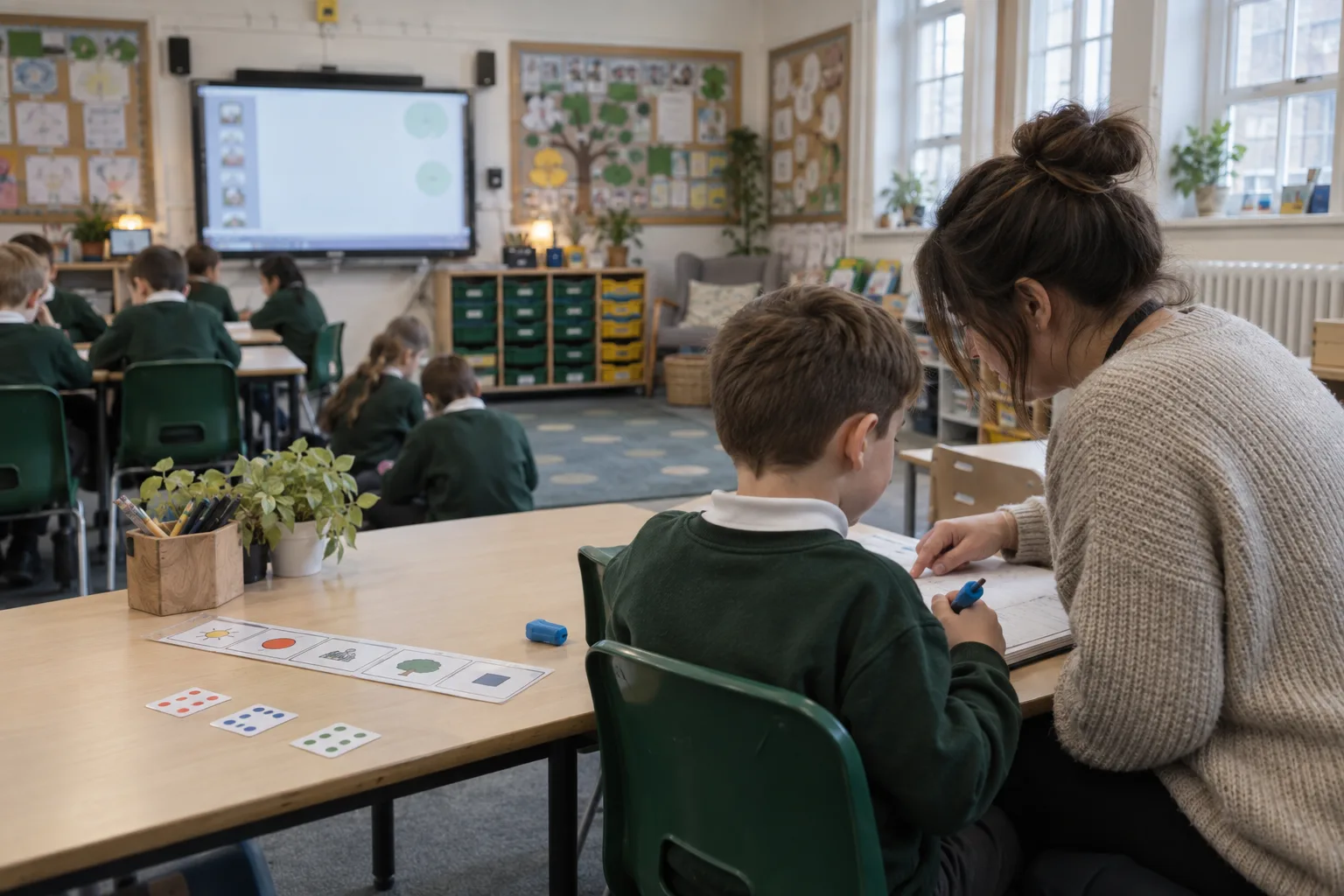
A Year 4 pupil, Callum, throws his pencil case across the room whenever he encounters a maths task he finds difficult. A behaviour policy response might be: warning, then time out, then phone call home. A BIP response starts differently. It asks: what is the function of this behaviour? In Callum's case, the behaviour reliably results in removal from the maths task (he is sent to the corridor). The function is escape from a perceived threat. The BIP would therefore focus on reducing the threat (breaking maths tasks into smaller steps), teaching a replacement ("I need help with this" instead of throwing), and ensuring that throwing does not result in escape from the task.

BIP vs Behaviour Policy

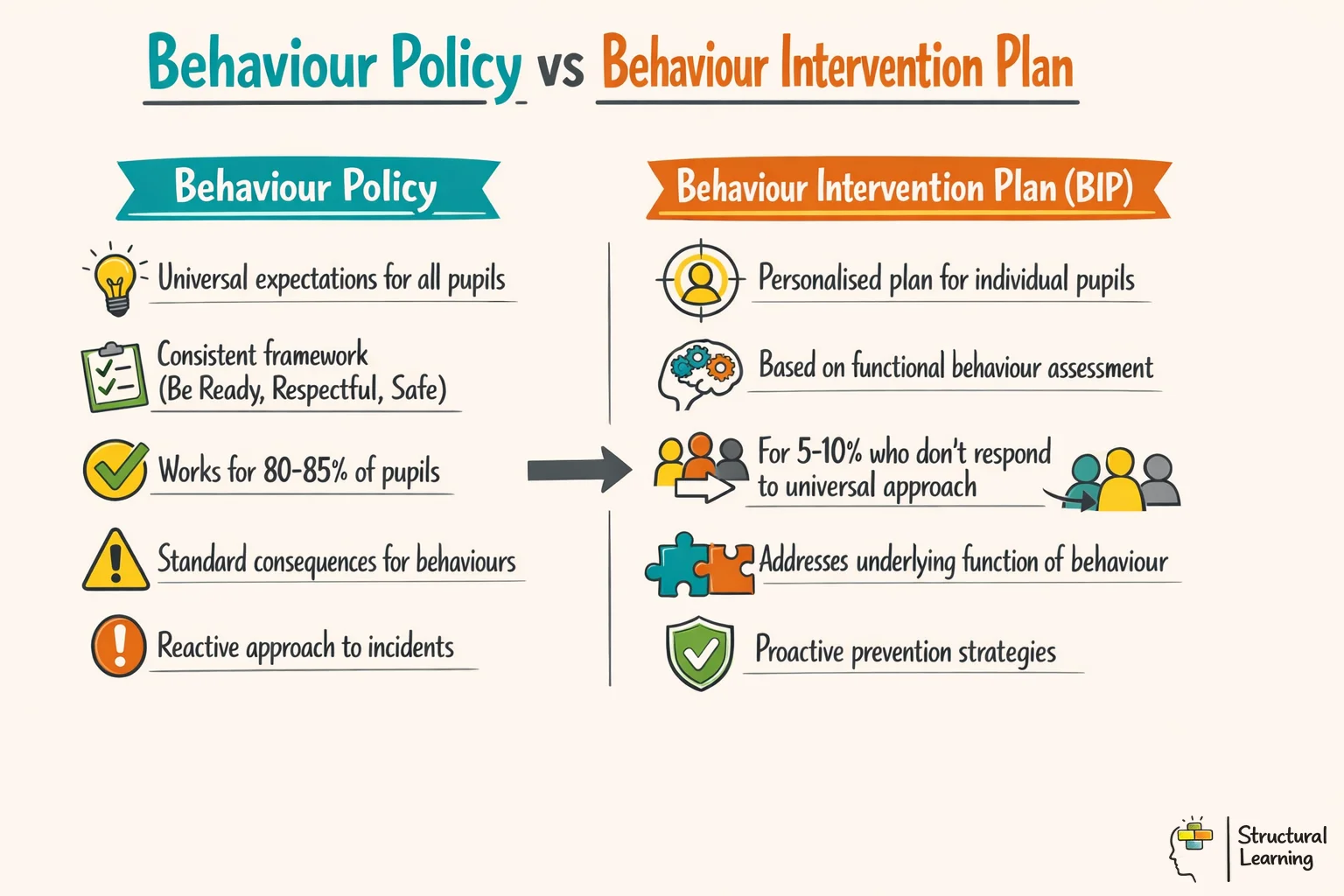
A whole-school behaviour policy sets universal expectations: be ready, be respectful, be safe. It provides a consistent framework that works for roughly 80-85% of pupils (Sugai & Horner, 2002). A BIP is for the 5-10% of pupils whose behaviour does not respond to universal expectations despite consistent implementation.

The distinction matters practically. Applying a behaviour policy to a pupil who needs a BIP is like prescribing paracetamol for a broken leg. The policy is not wrong; it is insufficient. The pupil has an underlying need, an unmet function, that the policy does not address. Repeatedly applying consequences without addressing function typically escalates behaviour rather than reducing it (Crone & Horner, 2003).

A useful rule: if a pupil has received the same consequence for the same behaviour more than five times and the behaviour has not decreased, the consequence is not working. Something else is maintaining the behaviour, and you need a functional analysis to identify what that something is.

Functional Behaviour Assessment

The Functional Behaviour Assessment (FBA) is the diagnostic process that precedes and informs the BIP. Without an FBA, a BIP is based on adult assumptions about why the behaviour occurs. Those assumptions are frequently wrong. Iwata et al. (1994), in the most cited paper in applied behaviour analysis, demonstrated that the same topography of behaviour (hitting, for example) can serve completely different functions for different pupils. Treating all hitting the same way is like treating all headaches the same way.

Identifying the Target Behaviour

The first step is defining the behaviour in observable, measurable terms. "Callum is disruptive" is not a target behaviour. "Callum throws objects (pencil case, rubber, ruler) across the room during independent maths tasks" is a target behaviour. The test: could two independent observers watch Callum and agree on whether the behaviour occurred? If yes, the definition is adequate. If no, it needs refining.

Define the behaviour by what the pupil does, not by what the pupil does not do. "Callum does not stay in his seat" tells you nothing about what is actually happening. "Callum leaves his seat and walks to the window during carpet time" tells you exactly what to observe, count, and target.

Finding the Function

All behaviour serves one of four broad functions (Cooper, Heron & Heward, 2007):

Function What the Pupil Gets Example
Escape/Avoidance Removal of something aversive Pupil disrupts during writing and is sent to the corridor (escapes writing)
Attention Social attention from adults or peers Pupil calls out and teacher responds with a reprimand (gets teacher attention)
Tangible Access to a preferred item or activity Pupil tantrums until given the iPad (gets preferred item)
Sensory/Automatic Internal sensory stimulation Pupil hums and rocks regardless of the social environment (self-stimulation)

Getting the function right is the single most important step in the entire BIP process. A BIP designed for escape-maintained behaviour will not work for attention-maintained behaviour, even if the observable behaviour looks identical. The intervention must match the function.

ABC Data Collection

The primary tool for identifying function is ABC (Antecedent-Behaviour-Consequence) data collection. For each occurrence of the target behaviour, record three things: what happened immediately before (antecedent), exactly what the pupil did (behaviour), and what happened immediately after (consequence).

After collecting 15-20 ABC records, patterns emerge. If the antecedent is consistently "teacher presents a writing task" and the consequence is consistently "pupil is removed from the room," the function is escape from writing. If the antecedent is "teacher is helping another pupil" and the consequence is "teacher turns attention to the target pupil," the function is attention.

A teaching assistant can collect ABC data on a simple grid during lessons. The recording should take no more than 30 seconds per incident. Three to five days of data is usually sufficient to identify a clear pattern. If no pattern emerges after five days, the behaviour may serve multiple functions or the recording needs refining.

Writing a BIP Step by Step

Prevention Strategies

Prevention strategies modify the environment to reduce the likelihood that the behaviour will occur. These are the most important part of the plan because they stop the problem before it starts.

For escape-maintained behaviour, prevention means reducing the aversiveness of the task. If Callum throws objects during difficult maths, prevention strategies include: breaking the task into smaller chunks, providing a worked example, offering a choice of two tasks (both meeting the learning objective), and pre-teaching key vocabulary before the lesson. None of these strategies reward the behaviour. They reduce the trigger.

For attention-maintained behaviour, prevention means providing attention proactively. A teacher who checks in with the pupil every 10 minutes during independent work ("How are you getting on, Maya?") provides the attention the pupil needs before the disruptive behaviour becomes the only way to get it. Planned attention is cheaper than reactive attention.

Teaching Replacement Behaviours

A replacement behaviour is an appropriate alternative that serves the same function as the problem behaviour. This is the part of the BIP that most schools get wrong. The replacement must be functionally equivalent. If the problem behaviour gets the pupil escape from a task, the replacement must also provide escape, but through an acceptable route.

For Callum (escape-maintained throwing): teach him to place a "break card" on his desk when he feels overwhelmed. When he uses the card, he gets a two-minute break before returning to the task. The break card serves the same function (temporary escape) but through an appropriate behaviour. Critically, throwing must no longer result in escape. If throwing still gets Callum sent to the corridor, he has no reason to use the break card.

For Maya (attention-maintained calling out): teach her to raise her hand and wait. When she raises her hand, the teacher responds within 30 seconds. This provides the same function (adult attention) through an appropriate behaviour. If the teacher ignores the raised hand, the replacement will fail because it does not serve the function.

Response Strategies

Response strategies specify what adults do when the problem behaviour occurs (it will still occur, especially in the early stages) and when the replacement behaviour occurs.

When the replacement behaviour occurs: Reinforce it immediately and consistently. Callum uses his break card; the teacher says, "Thank you for telling me you need a break, Callum" and provides the two-minute break. The reinforcement must be reliable and immediate, especially during the teaching phase.

When the problem behaviour occurs: Do not reinforce the function. If Callum throws his pencil case, he does not leave the room (that would reinforce escape). Instead, the teacher calmly redirects: "I can see this is hard. Use your break card." If necessary, a brief planned ignoring period followed by a prompt to use the replacement behaviour. The key principle: make the replacement behaviour easier and more reliable than the problem behaviour.

BIP Examples by Behaviour Type

Work Avoidance and Task Refusal

Function: Escape from non-preferred or difficult academic tasks.

Prevention: Provide choice between two tasks meeting the same objective. Pre-teach key concepts. Break tasks into three-step chunks with a visible checklist. Allow preferred seating during independent work.

Replacement: Teach the pupil to request help using a help card or verbal script: "I need help with this part." When help is requested, provide it within one minute.

Response: When the pupil refuses, offer the choice again calmly. Do not remove the task. When the pupil engages, provide specific praise: "You've completed three problems; that's solid work."

Physical Aggression

Function: Varies (commonly escape or frustration-driven). An FBA is essential; never assume the function of aggression.

Prevention: Identify and reduce triggers (transitions, unexpected changes, specific peers, sensory overload). Provide calming strategies proactively. Teach self-regulation scripts during calm periods. Use visual schedules to reduce uncertainty.

Replacement: Teach the pupil to request a break, use a calm corner, or squeeze a stress ball. The replacement must be taught explicitly during non-crisis periods, practised repeatedly, and reinforced every time it is used.

Response: Ensure safety first. Use de-escalation language (low voice, short sentences, validated emotion). Do not physically block unless safety requires it. After the incident, debrief when the pupil is calm, not during the crisis. Document every incident on the behaviour log.

Disruptive Calling Out

Function: Usually attention (peer or adult).

Prevention: Increase opportunities to respond (mini-whiteboards, choral response, think-pair-share). Provide proactive attention checks every 10 minutes. Assign a classroom job that provides structured attention.

Replacement: Teach hand-raising with a guaranteed response time (teacher responds within 30 seconds of hand being raised). Use a "parking lot" sticky note where the pupil writes their thought for sharing later.

Response: When the pupil calls out, briefly redirect ("Raise your hand and I'll come to you") without extended discussion. When the pupil raises their hand, respond immediately and praise the behaviour: "Thank you for putting your hand up, that's exactly right."

Elopement (Leaving the Classroom)

Function: Commonly escape (from task, sensory environment, or social situation).

Prevention: Identify the specific trigger for leaving (is it always during the same subject? After a specific type of interaction? When noise levels rise?). Address the trigger directly. Provide a designated "safe space" within the classroom where the pupil can go without leaving the room.

Replacement: Teach the pupil to request a break to the designated space: "I need the calm corner" or use a break card. The calm corner must be genuinely calming (not a punishment area) and accessible without adult permission during the teaching phase.

Response: If the pupil leaves, follow the school's safety protocol. Do not chase or shout. When the pupil returns or is found, welcome them back calmly: "I'm glad you're back. Let's use the calm corner next time you need a break." Do not deliver consequences for leaving; doing so reinforces the escape function.

Monitoring and Reviewing the BIP

A BIP without data is a wishful document. Collect the same data you collected during the FBA (frequency, duration, or intensity of the target behaviour) on an ongoing basis. Plot it on a simple chart. The trend line tells you whether the plan is working.

Review the data fortnightly. Apply the four-point decision rule: if four consecutive data points show no improvement, change the plan. Do not wait for the half-termly review. Do not assume the plan needs more time. If the behaviour is not decreasing after two weeks of consistent implementation, something in the plan is wrong: the function may be incorrect, the replacement may not be adequately reinforced, or adults may not be implementing the plan with fidelity.

Implementation fidelity is the most common reason BIPs fail. The plan may be perfect on paper but inconsistently applied in practice. A Year 5 teacher uses the break card system; the supply teacher on Wednesdays sends the pupil to the corridor. That inconsistency undermines the entire plan. All adults who interact with the pupil need training on the BIP, and fidelity should be checked periodically.

Common BIP Mistakes

Writing a BIP without an FBA. This is the most damaging mistake. Without functional analysis, you are guessing at the function and building the plan on that guess. If you guess escape when the function is attention, the plan will not work and may make the behaviour worse.

Choosing a replacement that does not match the function. Teaching a pupil to raise their hand (attention replacement) when the function is escape from the task is futile. The pupil does not want attention; they want out. The replacement must provide the same outcome as the problem behaviour.

Relying solely on consequences. A BIP that reads "If the pupil does X, then the consequence is Y" is not a BIP; it is a consequence schedule. Consequences alone do not change behaviour because they do not address function. Prevention and replacement instruction are the active ingredients.

Not teaching the replacement explicitly. Assuming the pupil knows how to use the break card, raise their hand, or request help is a common error. These are skills that must be taught through direct instruction, modelled by the teacher, practised during calm periods, and reinforced consistently before they can replace an established behaviour pattern.

Inconsistent implementation across adults. Every adult who works with the pupil must know the plan and implement it the same way. One person reinforcing the old behaviour pattern (e.g., sending the pupil out of the room when the BIP says to redirect) undermines the entire intervention.

BIPs Within PBIS and MTSS

A BIP operates at Tier 2 or Tier 3 within a Positive Behavioural Interventions and Supports (PBIS) framework. Tier 1 is the universal behaviour policy that works for most pupils. Tier 2 includes targeted group interventions (social skills groups, check-in/check-out systems) for pupils who need more than universal support. Tier 3 is the individualised BIP for pupils whose behaviour has not responded to Tier 1 and Tier 2 interventions.

Within a Multi-Tiered Systems of Support (MTSS) framework, the BIP sits alongside academic interventions. A pupil who is receiving Tier 3 behaviour support may also need Tier 2 or Tier 3 academic support, because academic failure and challenging behaviour frequently co-occur. The FBA often reveals that the behaviour is maintained by escape from academic tasks that are too difficult, which means the academic intervention is part of the behaviour intervention.

Schools implementing PBIS collect school-wide data (office discipline referrals, suspensions, attendance) that identify which pupils need Tier 2 and Tier 3 support. This data-driven identification prevents the common problem of waiting until behaviour reaches crisis level before providing individualised support. The goal is early identification and proactive intervention, not reactive crisis management.

Next Steps for Your Classroom

Identify one pupil in your class whose behaviour has not responded to your usual strategies despite consistent implementation. Over the next three days, collect ABC data on the target behaviour using a simple grid: date, time, what happened before, what the pupil did, what happened after. After three days, look at the consequence column. What does the pupil consistently get or avoid as a result of the behaviour? That pattern is the function. Write it down. That single insight, the function of the behaviour, changes everything about how you respond.

Further Reading: Key Research on Behaviour Intervention

These studies provide the evidence base for function-based behaviour intervention in schools.

Toward a Technology of "Nonaversive" Behavioral Support View study ↗
1,800+ citations

Horner et al. (1990)

The foundational paper arguing for positive, function-based behaviour support rather than punitive approaches. Established the principle that understanding why behaviour occurs is the essential first step in changing it.

An Experimental Analysis of Self-Injurious Behavior View study ↗
3,200+ citations

Iwata et al. (1994)

The most cited paper in applied behaviour analysis. Demonstrated that identical-looking behaviours serve different functions for different individuals, making functional assessment essential before intervention. This study transformed how behaviour support is designed.

Building Positive Behavior Support Systems in Schools View study ↗
680 citations

Crone & Horner (2003)

A practical guide to implementing function-based behaviour support in school settings. Provides step-by-step protocols for conducting FBAs and writing BIPs that are feasible for classroom teachers, not just specialists.

Applied Behavior Analysis View study ↗
5,100+ citations

Cooper, Heron & Heward (2007)

The comprehensive textbook on applied behaviour analysis that defines the four functions of behaviour. Provides the theoretical and methodological foundation for all function-based assessment and intervention in educational settings.

The School-Wide Evaluation Tool (SET): A Research Instrument for Assessing School-Wide Positive Behavior Support View study ↗
920 citations

Sugai et al. (2001)

Provides the research foundation for assessing how well schools implement positive behaviour support systems. Demonstrates that systematic, data-driven behaviour support produces measurably better outcomes than reactive discipline approaches.

Loading audit...

A Behaviour Intervention Plan (BIP) is an individualised, function-based document that specifies prevention strategies, replacement behaviours, and response protocols for a pupil whose behaviour significantly interferes with learning. Unlike a whole-school behaviour policy, which sets expectations for all pupils, a BIP addresses why a specific pupil behaves in a specific way and builds a targeted plan around that understanding. The critical word is "function." Every challenging behaviour serves a purpose for the pupil, and a BIP that ignores function is a BIP that will fail.

Key Takeaways

  1. Function before intervention: A Functional Behaviour Assessment (FBA) must identify why the behaviour occurs before you write the plan. Without function, you are guessing.
  2. Prevention is more effective than reaction: The strongest BIPs focus on changing the environment and teaching new skills, not on consequences after the behaviour.
  3. Replacement behaviours must serve the same function: Teaching a pupil to raise their hand only works if the function was attention. If the function was escape, they need a different replacement.
  4. Data drives every decision: Collect baseline data before implementing, monitor progress fortnightly, and revise the plan when data shows it is not working.

What Is a Behaviour Intervention Plan?

A BIP is a written plan that specifies three things: what you will change about the environment to prevent the behaviour from occurring (antecedent strategies), what new skill you will teach the pupil to replace the problematic behaviour (replacement behaviour instruction), and how adults will respond when the behaviour does and does not occur (consequence strategies). These three components work together. Removing any one of them weakens the plan significantly.

A Year 4 pupil, Callum, throws his pencil case across the room whenever he encounters a maths task he finds difficult. A behaviour policy response might be: warning, then time out, then phone call home. A BIP response starts differently. It asks: what is the function of this behaviour? In Callum's case, the behaviour reliably results in removal from the maths task (he is sent to the corridor). The function is escape from a perceived threat. The BIP would therefore focus on reducing the threat (breaking maths tasks into smaller steps), teaching a replacement ("I need help with this" instead of throwing), and ensuring that throwing does not result in escape from the task.

BIP vs Behaviour Policy

A whole-school behaviour policy sets universal expectations: be ready, be respectful, be safe. It provides a consistent framework that works for roughly 80-85% of pupils (Sugai & Horner, 2002). A BIP is for the 5-10% of pupils whose behaviour does not respond to universal expectations despite consistent implementation.

The distinction matters practically. Applying a behaviour policy to a pupil who needs a BIP is like prescribing paracetamol for a broken leg. The policy is not wrong; it is insufficient. The pupil has an underlying need, an unmet function, that the policy does not address. Repeatedly applying consequences without addressing function typically escalates behaviour rather than reducing it (Crone & Horner, 2003).

A useful rule: if a pupil has received the same consequence for the same behaviour more than five times and the behaviour has not decreased, the consequence is not working. Something else is maintaining the behaviour, and you need a functional analysis to identify what that something is.

Functional Behaviour Assessment

The Functional Behaviour Assessment (FBA) is the diagnostic process that precedes and informs the BIP. Without an FBA, a BIP is based on adult assumptions about why the behaviour occurs. Those assumptions are frequently wrong. Iwata et al. (1994), in the most cited paper in applied behaviour analysis, demonstrated that the same topography of behaviour (hitting, for example) can serve completely different functions for different pupils. Treating all hitting the same way is like treating all headaches the same way.

Identifying the Target Behaviour

The first step is defining the behaviour in observable, measurable terms. "Callum is disruptive" is not a target behaviour. "Callum throws objects (pencil case, rubber, ruler) across the room during independent maths tasks" is a target behaviour. The test: could two independent observers watch Callum and agree on whether the behaviour occurred? If yes, the definition is adequate. If no, it needs refining.

Define the behaviour by what the pupil does, not by what the pupil does not do. "Callum does not stay in his seat" tells you nothing about what is actually happening. "Callum leaves his seat and walks to the window during carpet time" tells you exactly what to observe, count, and target.

Finding the Function

All behaviour serves one of four broad functions (Cooper, Heron & Heward, 2007):

Function What the Pupil Gets Example
Escape/Avoidance Removal of something aversive Pupil disrupts during writing and is sent to the corridor (escapes writing)
Attention Social attention from adults or peers Pupil calls out and teacher responds with a reprimand (gets teacher attention)
Tangible Access to a preferred item or activity Pupil tantrums until given the iPad (gets preferred item)
Sensory/Automatic Internal sensory stimulation Pupil hums and rocks regardless of the social environment (self-stimulation)

Getting the function right is the single most important step in the entire BIP process. A BIP designed for escape-maintained behaviour will not work for attention-maintained behaviour, even if the observable behaviour looks identical. The intervention must match the function.

ABC Data Collection

The primary tool for identifying function is ABC (Antecedent-Behaviour-Consequence) data collection. For each occurrence of the target behaviour, record three things: what happened immediately before (antecedent), exactly what the pupil did (behaviour), and what happened immediately after (consequence).

After collecting 15-20 ABC records, patterns emerge. If the antecedent is consistently "teacher presents a writing task" and the consequence is consistently "pupil is removed from the room," the function is escape from writing. If the antecedent is "teacher is helping another pupil" and the consequence is "teacher turns attention to the target pupil," the function is attention.

A teaching assistant can collect ABC data on a simple grid during lessons. The recording should take no more than 30 seconds per incident. Three to five days of data is usually sufficient to identify a clear pattern. If no pattern emerges after five days, the behaviour may serve multiple functions or the recording needs refining.

Writing a BIP Step by Step

Prevention Strategies

Prevention strategies modify the environment to reduce the likelihood that the behaviour will occur. These are the most important part of the plan because they stop the problem before it starts.

For escape-maintained behaviour, prevention means reducing the aversiveness of the task. If Callum throws objects during difficult maths, prevention strategies include: breaking the task into smaller chunks, providing a worked example, offering a choice of two tasks (both meeting the learning objective), and pre-teaching key vocabulary before the lesson. None of these strategies reward the behaviour. They reduce the trigger.

For attention-maintained behaviour, prevention means providing attention proactively. A teacher who checks in with the pupil every 10 minutes during independent work ("How are you getting on, Maya?") provides the attention the pupil needs before the disruptive behaviour becomes the only way to get it. Planned attention is cheaper than reactive attention.

Teaching Replacement Behaviours

A replacement behaviour is an appropriate alternative that serves the same function as the problem behaviour. This is the part of the BIP that most schools get wrong. The replacement must be functionally equivalent. If the problem behaviour gets the pupil escape from a task, the replacement must also provide escape, but through an acceptable route.

For Callum (escape-maintained throwing): teach him to place a "break card" on his desk when he feels overwhelmed. When he uses the card, he gets a two-minute break before returning to the task. The break card serves the same function (temporary escape) but through an appropriate behaviour. Critically, throwing must no longer result in escape. If throwing still gets Callum sent to the corridor, he has no reason to use the break card.

For Maya (attention-maintained calling out): teach her to raise her hand and wait. When she raises her hand, the teacher responds within 30 seconds. This provides the same function (adult attention) through an appropriate behaviour. If the teacher ignores the raised hand, the replacement will fail because it does not serve the function.

Response Strategies

Response strategies specify what adults do when the problem behaviour occurs (it will still occur, especially in the early stages) and when the replacement behaviour occurs.

When the replacement behaviour occurs: Reinforce it immediately and consistently. Callum uses his break card; the teacher says, "Thank you for telling me you need a break, Callum" and provides the two-minute break. The reinforcement must be reliable and immediate, especially during the teaching phase.

When the problem behaviour occurs: Do not reinforce the function. If Callum throws his pencil case, he does not leave the room (that would reinforce escape). Instead, the teacher calmly redirects: "I can see this is hard. Use your break card." If necessary, a brief planned ignoring period followed by a prompt to use the replacement behaviour. The key principle: make the replacement behaviour easier and more reliable than the problem behaviour.

BIP Examples by Behaviour Type

Work Avoidance and Task Refusal

Function: Escape from non-preferred or difficult academic tasks.

Prevention: Provide choice between two tasks meeting the same objective. Pre-teach key concepts. Break tasks into three-step chunks with a visible checklist. Allow preferred seating during independent work.

Replacement: Teach the pupil to request help using a help card or verbal script: "I need help with this part." When help is requested, provide it within one minute.

Response: When the pupil refuses, offer the choice again calmly. Do not remove the task. When the pupil engages, provide specific praise: "You've completed three problems; that's solid work."

Physical Aggression

Function: Varies (commonly escape or frustration-driven). An FBA is essential; never assume the function of aggression.

Prevention: Identify and reduce triggers (transitions, unexpected changes, specific peers, sensory overload). Provide calming strategies proactively. Teach self-regulation scripts during calm periods. Use visual schedules to reduce uncertainty.

Replacement: Teach the pupil to request a break, use a calm corner, or squeeze a stress ball. The replacement must be taught explicitly during non-crisis periods, practised repeatedly, and reinforced every time it is used.

Response: Ensure safety first. Use de-escalation language (low voice, short sentences, validated emotion). Do not physically block unless safety requires it. After the incident, debrief when the pupil is calm, not during the crisis. Document every incident on the behaviour log.

Disruptive Calling Out

Function: Usually attention (peer or adult).

Prevention: Increase opportunities to respond (mini-whiteboards, choral response, think-pair-share). Provide proactive attention checks every 10 minutes. Assign a classroom job that provides structured attention.

Replacement: Teach hand-raising with a guaranteed response time (teacher responds within 30 seconds of hand being raised). Use a "parking lot" sticky note where the pupil writes their thought for sharing later.

Response: When the pupil calls out, briefly redirect ("Raise your hand and I'll come to you") without extended discussion. When the pupil raises their hand, respond immediately and praise the behaviour: "Thank you for putting your hand up, that's exactly right."

Elopement (Leaving the Classroom)

Function: Commonly escape (from task, sensory environment, or social situation).

Prevention: Identify the specific trigger for leaving (is it always during the same subject? After a specific type of interaction? When noise levels rise?). Address the trigger directly. Provide a designated "safe space" within the classroom where the pupil can go without leaving the room.

Replacement: Teach the pupil to request a break to the designated space: "I need the calm corner" or use a break card. The calm corner must be genuinely calming (not a punishment area) and accessible without adult permission during the teaching phase.

Response: If the pupil leaves, follow the school's safety protocol. Do not chase or shout. When the pupil returns or is found, welcome them back calmly: "I'm glad you're back. Let's use the calm corner next time you need a break." Do not deliver consequences for leaving; doing so reinforces the escape function.

Monitoring and Reviewing the BIP

A BIP without data is a wishful document. Collect the same data you collected during the FBA (frequency, duration, or intensity of the target behaviour) on an ongoing basis. Plot it on a simple chart. The trend line tells you whether the plan is working.

Review the data fortnightly. Apply the four-point decision rule: if four consecutive data points show no improvement, change the plan. Do not wait for the half-termly review. Do not assume the plan needs more time. If the behaviour is not decreasing after two weeks of consistent implementation, something in the plan is wrong: the function may be incorrect, the replacement may not be adequately reinforced, or adults may not be implementing the plan with fidelity.

Implementation fidelity is the most common reason BIPs fail. The plan may be perfect on paper but inconsistently applied in practice. A Year 5 teacher uses the break card system; the supply teacher on Wednesdays sends the pupil to the corridor. That inconsistency undermines the entire plan. All adults who interact with the pupil need training on the BIP, and fidelity should be checked periodically.

Common BIP Mistakes

Writing a BIP without an FBA. This is the most damaging mistake. Without functional analysis, you are guessing at the function and building the plan on that guess. If you guess escape when the function is attention, the plan will not work and may make the behaviour worse.

Choosing a replacement that does not match the function. Teaching a pupil to raise their hand (attention replacement) when the function is escape from the task is futile. The pupil does not want attention; they want out. The replacement must provide the same outcome as the problem behaviour.

Relying solely on consequences. A BIP that reads "If the pupil does X, then the consequence is Y" is not a BIP; it is a consequence schedule. Consequences alone do not change behaviour because they do not address function. Prevention and replacement instruction are the active ingredients.

Not teaching the replacement explicitly. Assuming the pupil knows how to use the break card, raise their hand, or request help is a common error. These are skills that must be taught through direct instruction, modelled by the teacher, practised during calm periods, and reinforced consistently before they can replace an established behaviour pattern.

Inconsistent implementation across adults. Every adult who works with the pupil must know the plan and implement it the same way. One person reinforcing the old behaviour pattern (e.g., sending the pupil out of the room when the BIP says to redirect) undermines the entire intervention.

BIPs Within PBIS and MTSS

A BIP operates at Tier 2 or Tier 3 within a Positive Behavioural Interventions and Supports (PBIS) framework. Tier 1 is the universal behaviour policy that works for most pupils. Tier 2 includes targeted group interventions (social skills groups, check-in/check-out systems) for pupils who need more than universal support. Tier 3 is the individualised BIP for pupils whose behaviour has not responded to Tier 1 and Tier 2 interventions.

Within a Multi-Tiered Systems of Support (MTSS) framework, the BIP sits alongside academic interventions. A pupil who is receiving Tier 3 behaviour support may also need Tier 2 or Tier 3 academic support, because academic failure and challenging behaviour frequently co-occur. The FBA often reveals that the behaviour is maintained by escape from academic tasks that are too difficult, which means the academic intervention is part of the behaviour intervention.

Schools implementing PBIS collect school-wide data (office discipline referrals, suspensions, attendance) that identify which pupils need Tier 2 and Tier 3 support. This data-driven identification prevents the common problem of waiting until behaviour reaches crisis level before providing individualised support. The goal is early identification and proactive intervention, not reactive crisis management.

Next Steps for Your Classroom

Identify one pupil in your class whose behaviour has not responded to your usual strategies despite consistent implementation. Over the next three days, collect ABC data on the target behaviour using a simple grid: date, time, what happened before, what the pupil did, what happened after. After three days, look at the consequence column. What does the pupil consistently get or avoid as a result of the behaviour? That pattern is the function. Write it down. That single insight, the function of the behaviour, changes everything about how you respond.

Further Reading: Key Research on Behaviour Intervention

These studies provide the evidence base for function-based behaviour intervention in schools.

Toward a Technology of "Nonaversive" Behavioral Support View study ↗
1,800+ citations

Horner et al. (1990)

The foundational paper arguing for positive, function-based behaviour support rather than punitive approaches. Established the principle that understanding why behaviour occurs is the essential first step in changing it.

An Experimental Analysis of Self-Injurious Behavior View study ↗
3,200+ citations

Iwata et al. (1994)

The most cited paper in applied behaviour analysis. Demonstrated that identical-looking behaviours serve different functions for different individuals, making functional assessment essential before intervention. This study transformed how behaviour support is designed.

Building Positive Behavior Support Systems in Schools View study ↗
680 citations

Crone & Horner (2003)

A practical guide to implementing function-based behaviour support in school settings. Provides step-by-step protocols for conducting FBAs and writing BIPs that are feasible for classroom teachers, not just specialists.

Applied Behavior Analysis View study ↗
5,100+ citations

Cooper, Heron & Heward (2007)

The comprehensive textbook on applied behaviour analysis that defines the four functions of behaviour. Provides the theoretical and methodological foundation for all function-based assessment and intervention in educational settings.

The School-Wide Evaluation Tool (SET): A Research Instrument for Assessing School-Wide Positive Behavior Support View study ↗
920 citations

Sugai et al. (2001)

Provides the research foundation for assessing how well schools implement positive behaviour support systems. Demonstrates that systematic, data-driven behaviour support produces measurably better outcomes than reactive discipline approaches.

No Posts found.
Back to Blog