
primary teachers, years 2 to 4
Developing
✓ Citations verified
A two-year study of 524 six- to nine-year-olds found that five everyday classroom behaviours, not the original twenty-item checklist, reliably flagged working memory struggles still linked to weaker reading and maths eighteen months later.
Normand, S., & Tannock, R. (2012). 'Screening for Working Memory Deficits in the Classroom: The Psychometric Properties of the Working Memory Rating Scale in a Longitudinal School-Based Study.' Journal of Attention Disorders, 18(4), 294-304.
Free to download and share. No sign-up needed.
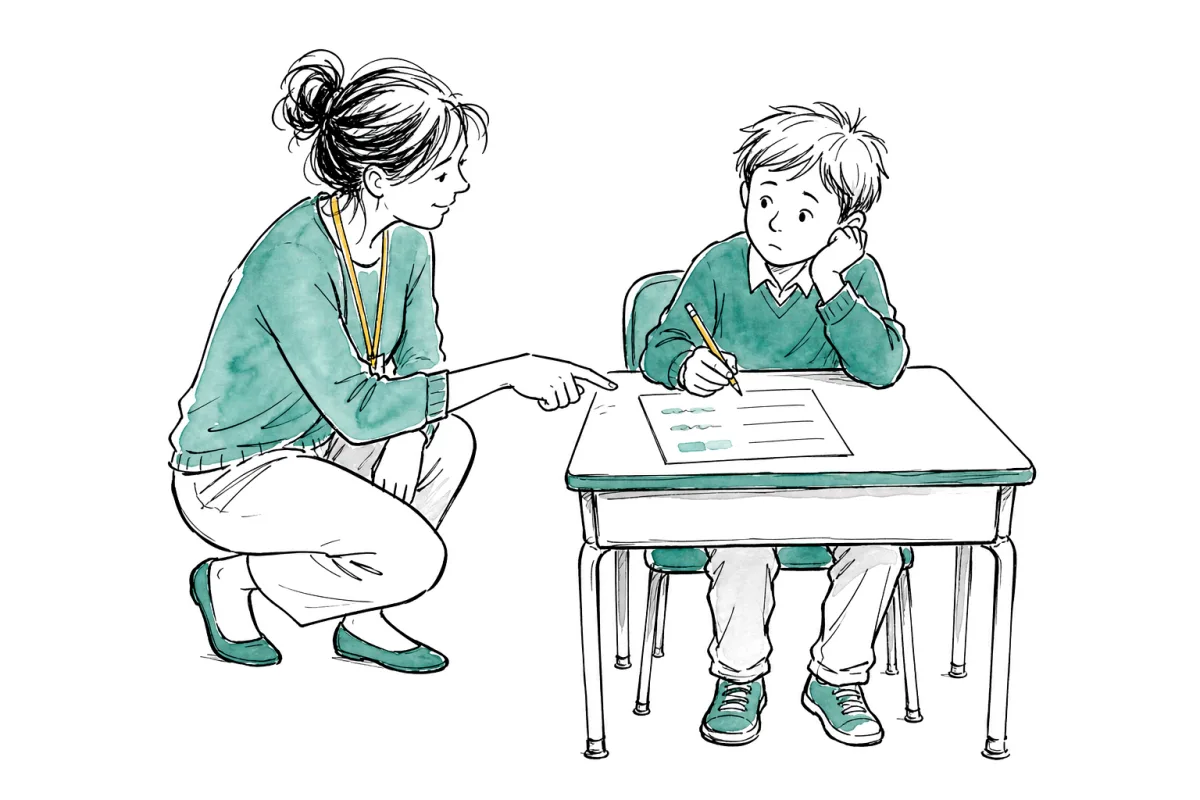
The gist. A two-year study of 524 six- to nine-year-olds found that five everyday classroom behaviours, not the original twenty-item checklist, reliably flagged working memory struggles still linked to weaker reading and maths eighteen months later.
Teachers in Southern Ontario rated 524 six- to nine-year-olds on the Working Memory Rating Scale, a 20-item checklist first built and validated in England. Tested independently, on its own, for the first time, the original 20-item structure did not hold up.
A shorter list of five behaviours did, consistently, for both boys and girls, across two separate school years. Those five ratings, taken at the start of Year 1, were still linked to weaker reading and maths fluency scores six and eighteen months later.
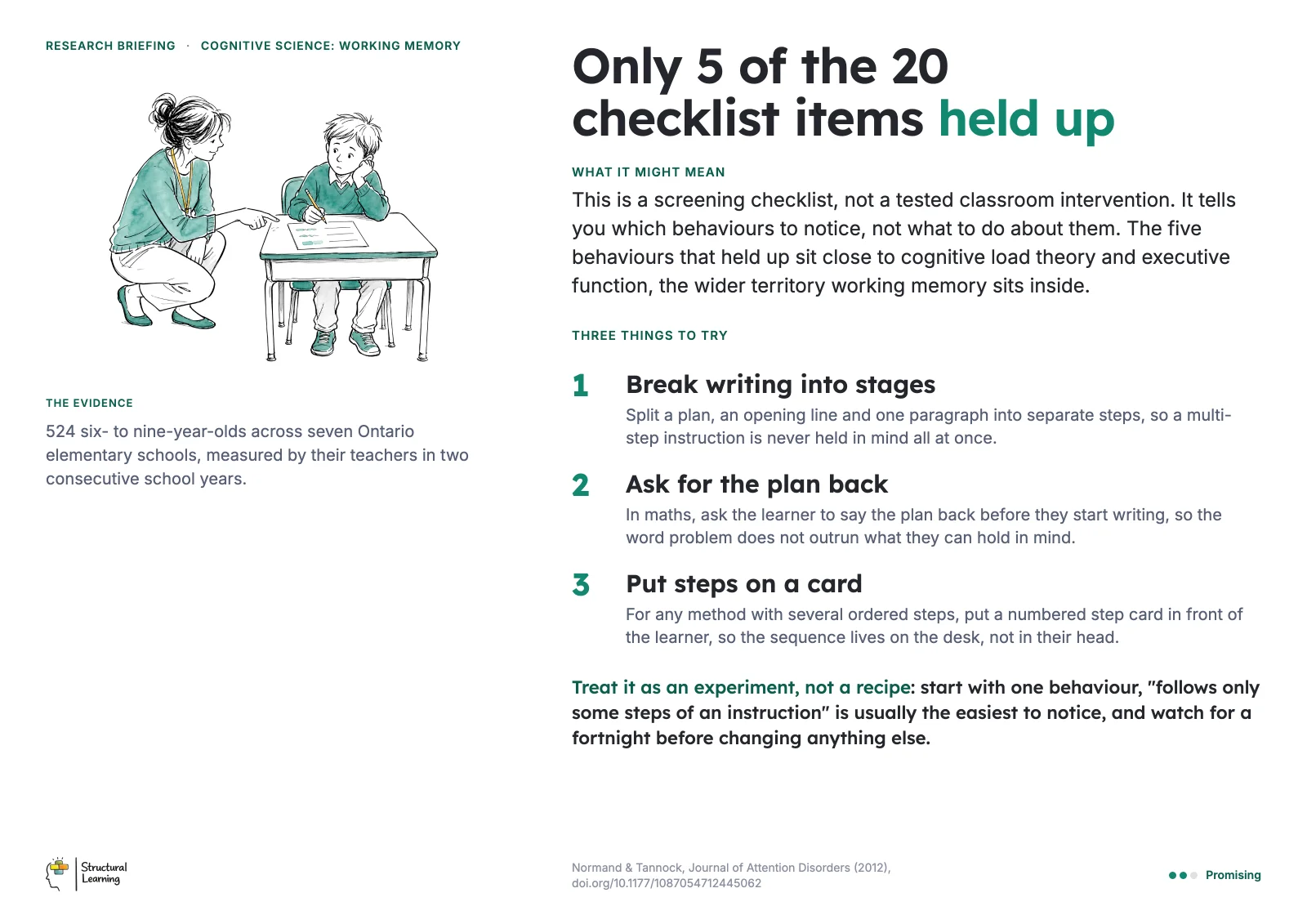
This is a screening checklist, not a tested classroom intervention. It tells you which behaviours to notice, not what to do about them. The five behaviours that held up sit close to cognitive load theory and executive function, the wider territory working memory sits inside.
Treat it as an experiment, not a recipe: start with one behaviour, "follows only some steps of an instruction" is usually the easiest to notice, and watch for a fortnight before changing anything else.
Promising. This rates the evidence's firmness, not our endorsement of the checklist. It is the first independent test of the original 20-item tool on its own, and it found real problems with that version, which is a good sign, though one independent replication is not the last word. The study tracked six- to nine-year-olds for two years in Canadian schools, and did not test whether noticing, or any teaching response, actually helps them. If the pattern worries you for a particular learner, talk to your SENCO rather than relying on a checklist alone.
Normand, S., & Tannock, R. (2012). 'Screening for Working Memory Deficits in the Classroom: The Psychometric Properties of the Working Memory Rating Scale in a Longitudinal School-Based Study.' Journal of Attention Disorders, 18(4), 294-304.
Structural Learning helps teachers turn findings like this into planned, visible thinking in the classroom. Open a free account and try it with your next lesson.
Open a free account →Made by the Structural Learning Evidence Engine. Every claim is traced to the source above and independently verified. See more briefings →