
teacher educators, CPD leads and ITE mentors
Developing
✓ Citations verified
A controlled study of 104 trainee teachers found that being given video models and prompts while they practised classroom "noticing" raised their motivation, but made no reliable difference to how mentally loaded the task felt. Only specific habits, taking notes and using prompts to manage the process, actually eased that load.
Junker, R., Janeczko, J., Lehmkuhl, A., Zucker, V., Holodynski, M., & Meschede, N. (2025). Modeling and prompting professional vision in a virtual learning environment: effects on pre-service teachers' cognitive load and motivation. Education and Information Technologies, 30(14), 19985-20010.
Free to download and share. No sign-up needed.

The gist. A controlled study of 104 trainee teachers tested whether giving them video models and prompts, while they practised classroom noticing, changed how the task felt. The scaffolds raised motivation but made no reliable difference to the cognitive load teachers reported; only specific habits, taking notes and using prompts to manage the process, eased that load. Treat this as a developing signal from a single study of trainee teachers, not a settled result.
Researchers worked with 104 pre-service (trainee) teachers on a German Master's programme for prospective elementary science teachers, 89.58% of them female. Over a one-semester virtual learning environment course, everyone completed the same video-analysis tasks to build their professional vision, the ability to notice and interpret the classroom events that matter for learning. One group of 53 was given two scaffolds, expert video models and written prompts, while the other 51 worked without them.
Being in the scaffolded group was linked to higher motivation: each one-unit rise in motivation raised the relative odds of belonging to that group by 3.636 times (p = .015). The scaffolds had no direct effect on intrinsic, extraneous or germane cognitive load, and the overall model comparing the two groups was not significant (chi-square(4) = 8.078, p = .089). The most classroom-useful signals came from how trainees used the scaffolds: taking notes during the video models significantly predicted lower extraneous load, process-related prompt use significantly reduced extraneous load and raised germane load, and content-related prompt use was positively linked to motivation. These usage patterns explained only a modest share of the variation, with R-squared values running from 0.030 to 0.208.
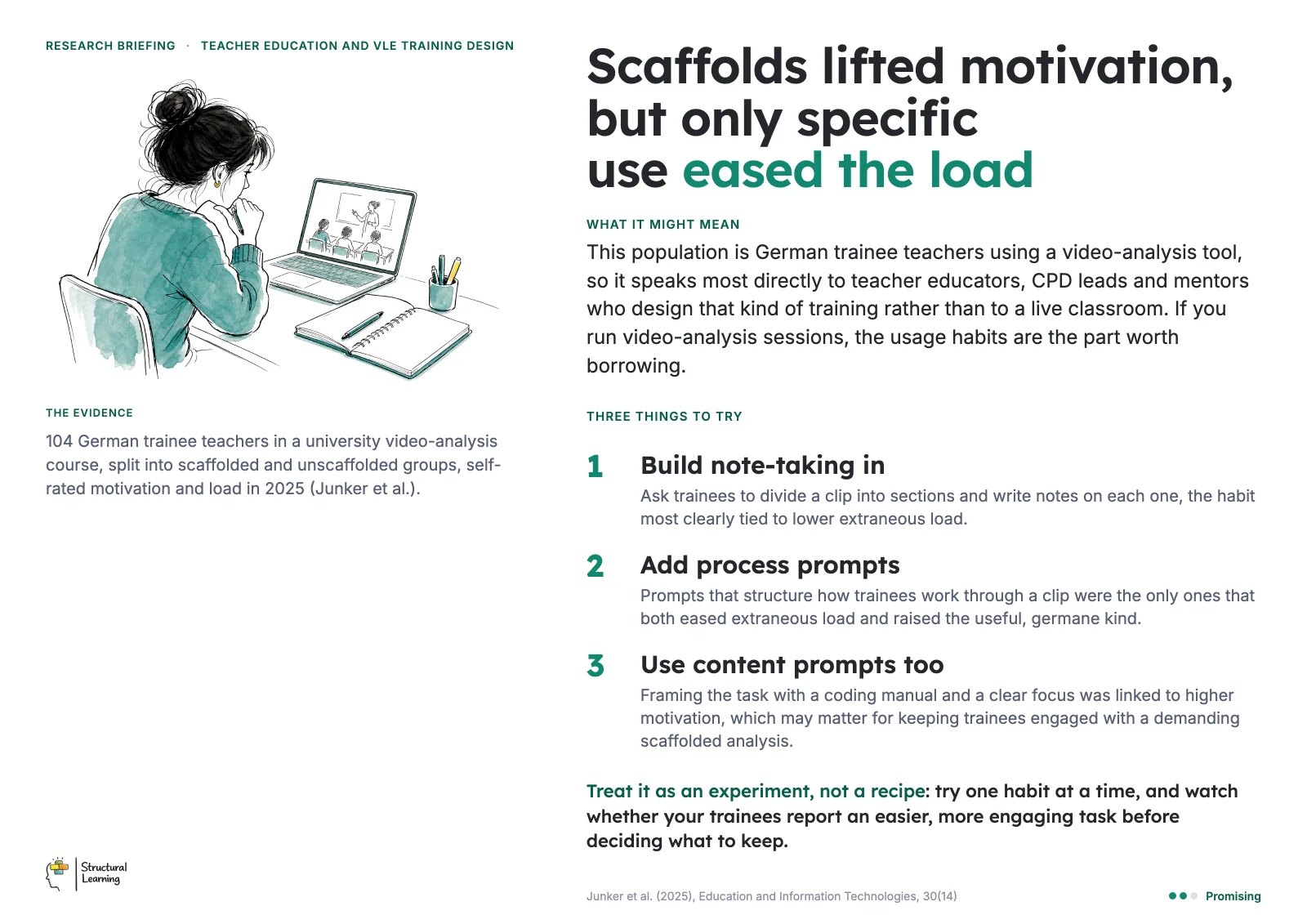
This population is German trainee teachers using a video-analysis tool, so it speaks most directly to teacher educators, CPD leads and mentors who design that kind of training rather than to a live classroom. If you run video-analysis sessions, the usage habits are the part worth borrowing.
Treat it as an experiment, not a recipe: the study measured self-reported motivation and cognitive load, so try one habit, watch whether your trainees report an easier and more engaging task, and keep what works.
Promising. In its favour, this was a genuine experiment with an up-front power calculation (104 teachers against a required minimum of 57), established cognitive-load measures, and an honestly reported null result alongside the motivation finding. Against it: the method never states that teachers were randomly assigned, so this is a controlled comparison rather than a confirmed randomised trial; it is a single study of one narrow group (104 German trainee elementary-science teachers, 89.58% female) with no replication; the two scaffolds were bundled together, so their separate effects cannot be told apart; the note-taking and prompt findings come from trainees' voluntary written responses within the scaffolded group only, which the authors flag as a response-bias risk; and the study measured self-reported motivation and cognitive load, not whether teachers actually got better at noticing. A larger, randomised study with a direct measure of noticing skill would raise the grade.
Junker, R., Janeczko, J., Lehmkuhl, A., Zucker, V., Holodynski, M., & Meschede, N. (2025). Modeling and prompting professional vision in a virtual learning environment: effects on pre-service teachers' cognitive load and motivation. Education and Information Technologies, 30(14), 19985-20010. Open access under a CC BY 4.0 licence.
Structural Learning helps teachers turn findings like this into planned, visible thinking in the classroom. Open a free account and try it with your next lesson.
Open a free account →Made by the Structural Learning Evidence Engine. Every claim is traced to the source above and independently verified. See more briefings →