
primary and secondary teachers
Early signal
✓ Citations verified
Three 11-year-olds in a US special education classroom, each identified with speech, language, learning or emotional and behavioral needs, wore a small buzzer that vibrated every few minutes; each time it buzzed, they simply asked themselves whether they were paying attention and marked it down, and their time spent on task rose from a mean of 55% to more than 90% of the intervals observed.
Amato-Zech, N. A., Hoff, K. E., & Doepke, K. J. (2006). 'Increasing On-Task Behavior in the Classroom: Extension of Self-Monitoring Strategies.' Psychology in the Schools, 43(2), 211-221.
Free to download and share. No sign-up needed.
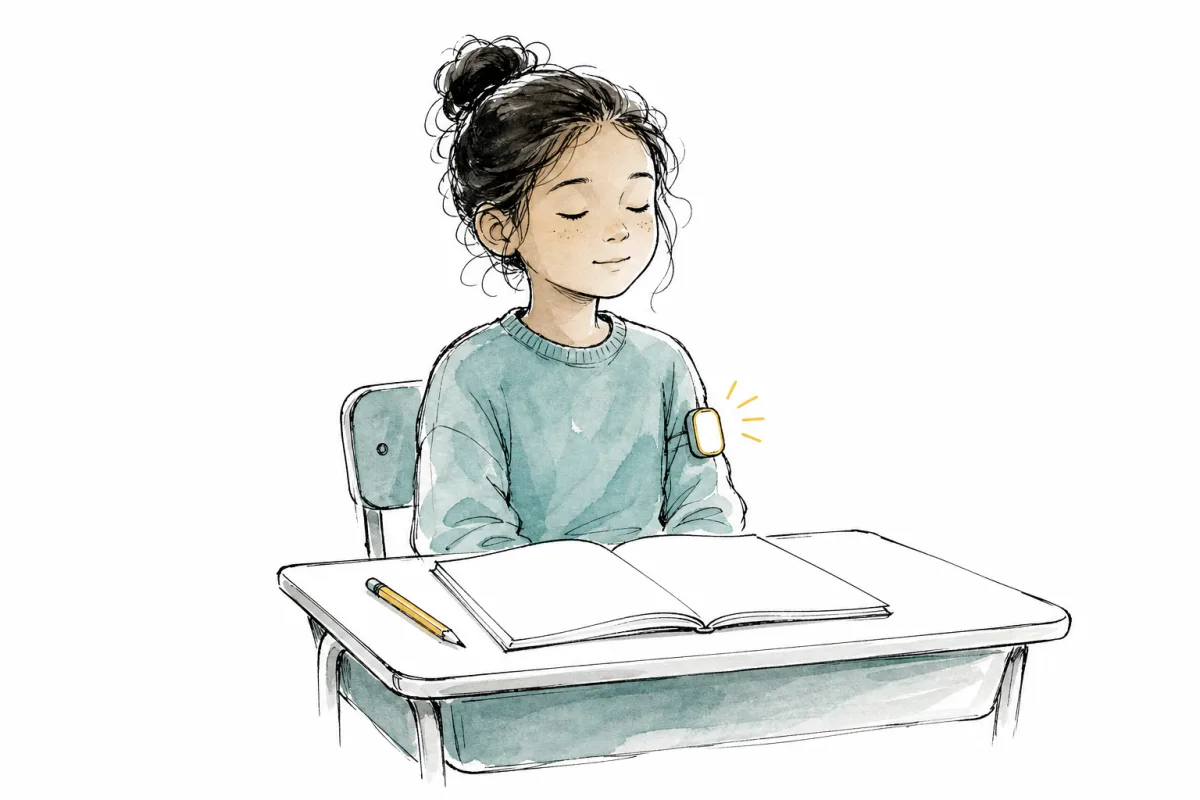
The gist. Three 11-year-olds in a US special education classroom, each already identified with speech, language, learning or emotional and behavioural needs, wore a small buzzer that vibrated every few minutes. Each time it buzzed, they simply asked themselves whether they were paying attention and marked it down. Their time on task rose from a mean of 55% to more than 90% of the intervals observed.
Researchers Amato-Zech, Hoff and Doepke worked with three fifth graders, all 11 years old, in one self-contained US special education classroom. Jack and David had diagnoses of speech and language impairment and specific learning disabilities; Allison had diagnoses of emotional disturbance and speech and language impairment. Each learner wore a small vibrating device called the MotivAider, clipped to a waistband and set to buzz every few minutes during a 45-minute lesson. When it buzzed, they asked themselves whether they were paying attention right then, then marked yes or no on a form. Trained outside observers, using a structured 15-second interval coding system, separately recorded whether each learner was on or off task, so this was not simply learners reporting on themselves.
Before self-monitoring began, on-task behaviour averaged 55% of intervals observed across the three learners. Once the buzzer routine started, this rose to more than 90% of intervals observed. Using a reversal design, the researchers withdrew the intervention partway through and on-task behaviour fell again, though not fully back to its starting level, before rising once more when the buzzer routine was reinstated for each learner. The researchers describe this as the first published test of this specific tactile device for this purpose, and note that independent replication with larger, mainstream UK samples would test how far the effect holds beyond three US special education learners.
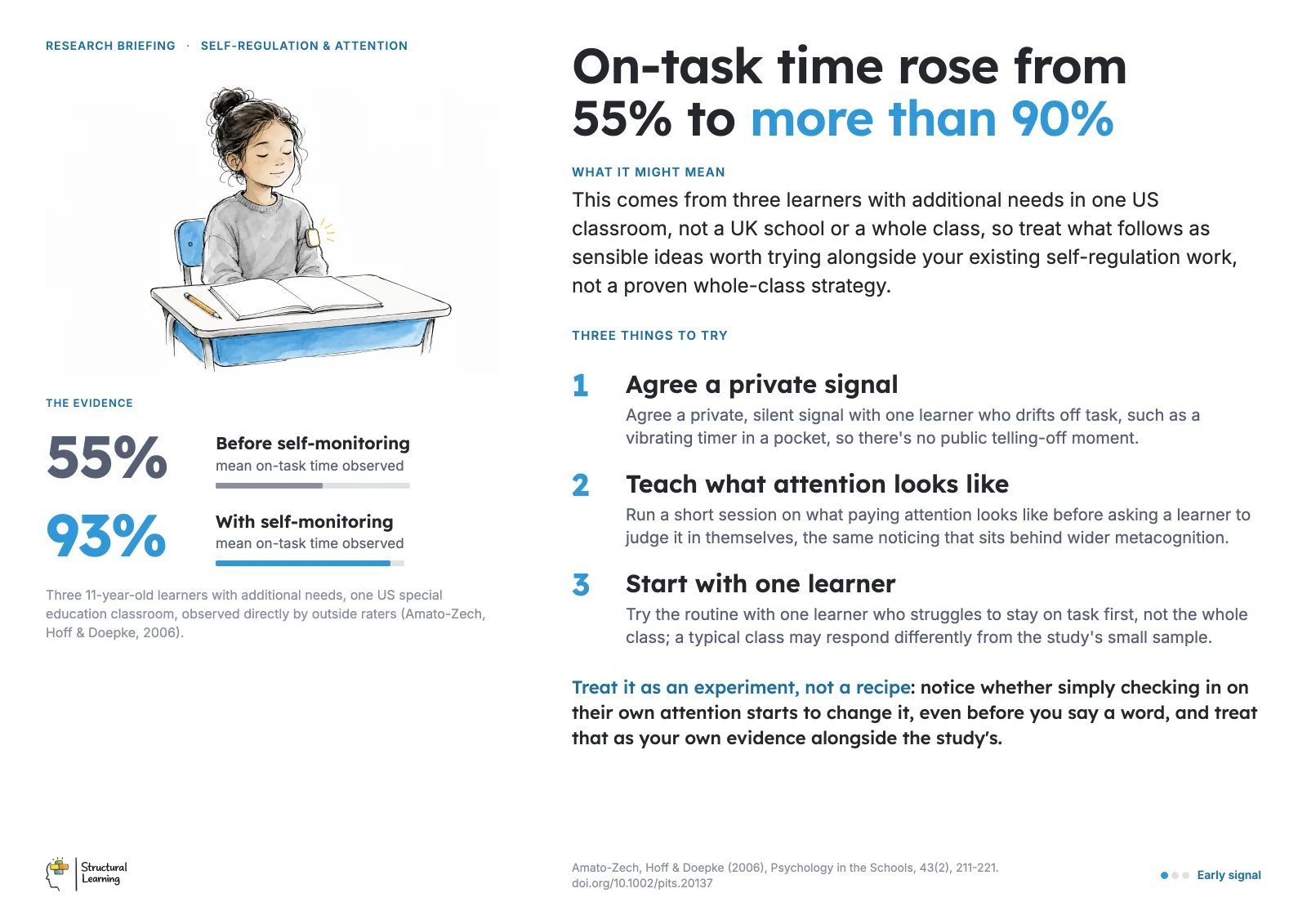
This comes from three learners with additional needs in one US classroom, not a UK school or a whole class, so treat what follows as sensible ideas worth trying alongside your existing self-regulation work, not a proven whole-class strategy.
Treat it as an experiment, not a recipe: notice whether simply checking in on their own attention starts to change it, even before you say a word, and treat that as your own evidence alongside the study's.
This is an early signal, not a settled finding. It comes from a real, repeated within-learner pattern across three learners, each compared with their own earlier behaviour rather than with a separate group of learners who did not self-monitor. All three learners had already been identified with speech, language, learning or emotional and behavioural needs in one US classroom, so it is not clear how this plays out with a typical mixed-ability UK class; see our broader look at attention and learning for related evidence. This is also the first published test of this specific device, with no independent replication yet. Take it as a promising, low-cost idea worth trying with a learner who struggles to stay on task, not a proven whole-class strategy.
Amato-Zech, N. A., Hoff, K. E., & Doepke, K. J. (2006). 'Increasing On-Task Behavior in the Classroom: Extension of Self-Monitoring Strategies.' Psychology in the Schools, 43(2), 211-221.
Structural Learning helps teachers turn findings like this into planned, visible thinking in the classroom. Open a free account and try it with your next lesson.
Open a free account →Made by the Structural Learning Evidence Engine. Every claim is traced to the source above and independently verified. See more briefings →