The platform does the heavy lifting (research, curriculum alignment and materials) so a teacher's time goes into the thinking. With honest curriculum coverage that never fabricates a match, and knowledge organisers built on the depth of the Thinking Framework and designed to be shared with parents.
The richest moments in a lesson are thinking moments: a sharp question, ideas being organised on the table, a child explaining their reasoning out loud. But reaching them takes hours of invisible work first. Researching the topic, cross-referencing the curriculum, and finding or making the materials that carry the learning. Too often the evening runs out before the thinking begins.
That is the work the platform is built to take off your plate, so the time you save goes straight back into the part only a teacher can do.
One topic in, and the parts of a lesson that usually take an afternoon, assembled in minutes.
One topic in, a whole lesson out
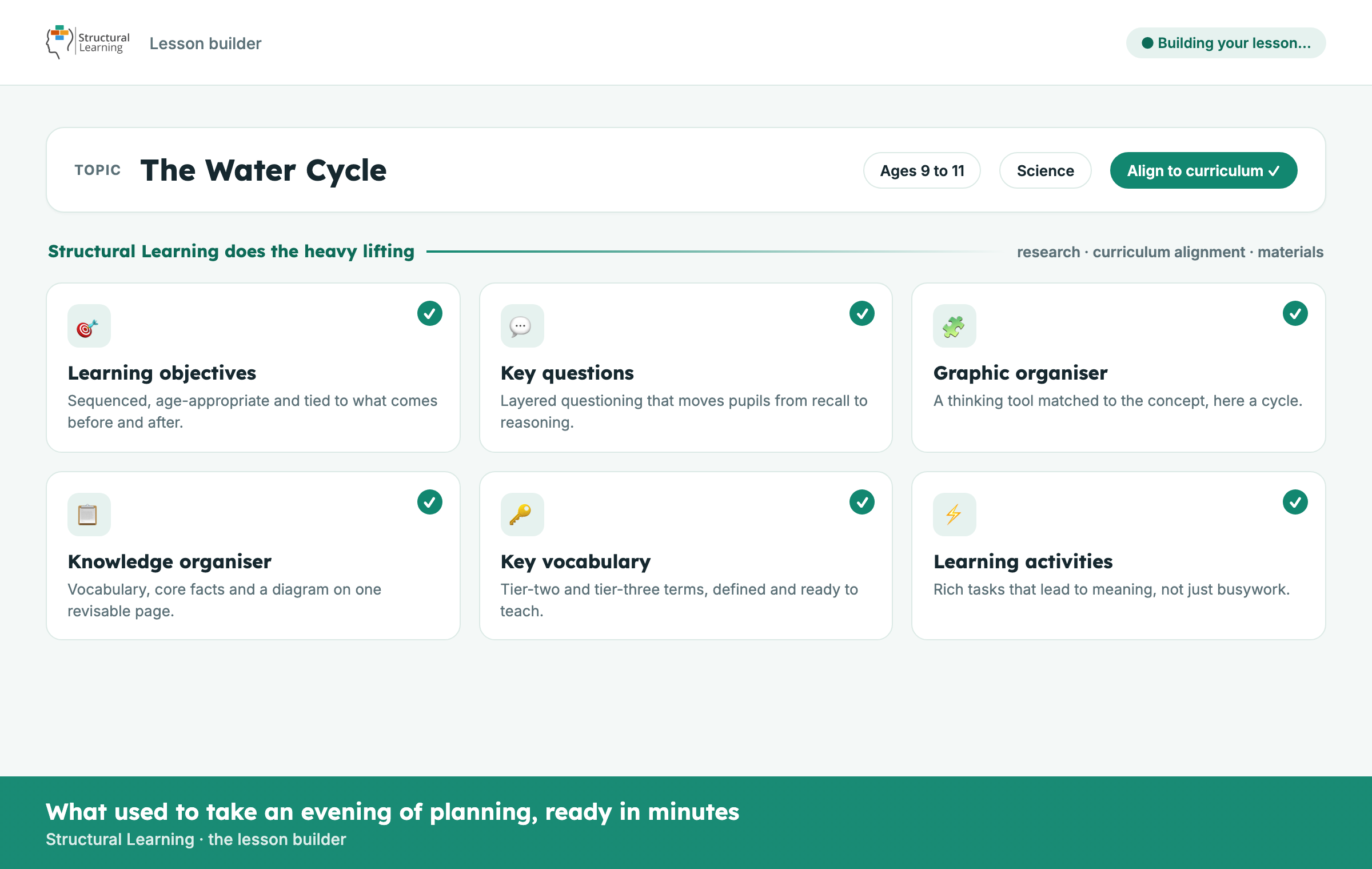
Type in a topic, say the water cycle, choose an age phase, and the platform does the heavy lifting. It researches the subject, aligns it to your curriculum, and assembles the parts of a lesson that usually take an afternoon to pull together: sequenced learning objectives, layered key questions, a graphic organiser matched to the concept, a knowledge organiser, key vocabulary and rich activities that lead to meaning. The same depth you would build by hand, without the hours of groundwork.
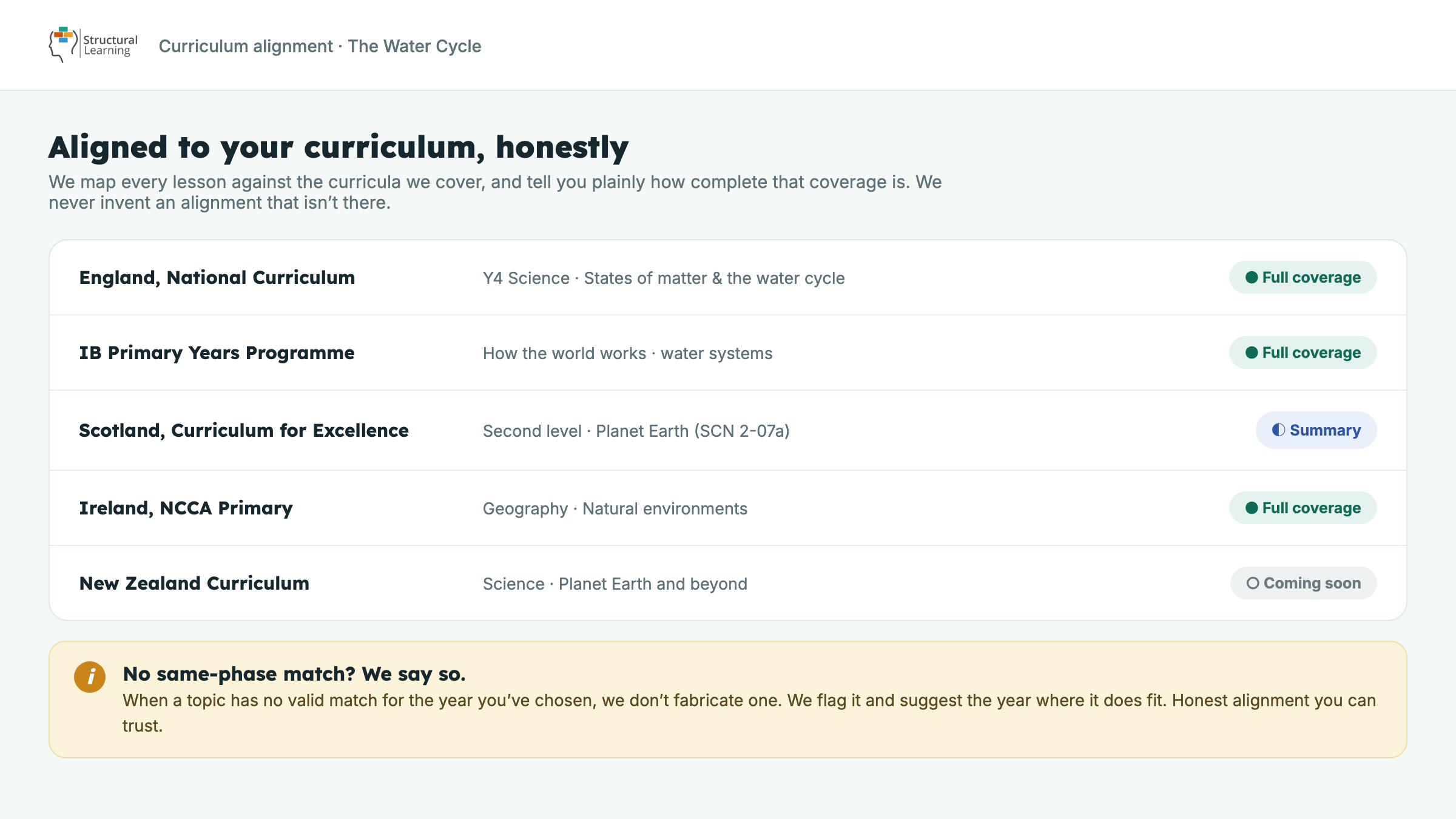
Honest coverage: full, a summary, or marked coming soon, and never an alignment that isn't really there.
Aligned to your curriculum, honestly
Every lesson is mapped against the curricula we cover, from the National Curriculum for England to the International Baccalaureate, Scotland's Curriculum for Excellence and Ireland's NCCA, and we tell you plainly how complete that coverage is: full, a summary, or honestly marked as coming soon.
And when there is no valid match for the year you have chosen, the platform will not invent one. It says so, and points you to the phase where the topic actually fits. It is a small thing with a big implication: a planning tool that models the very habit we want learners to build, knowing what you know, and being honest about what you don't.
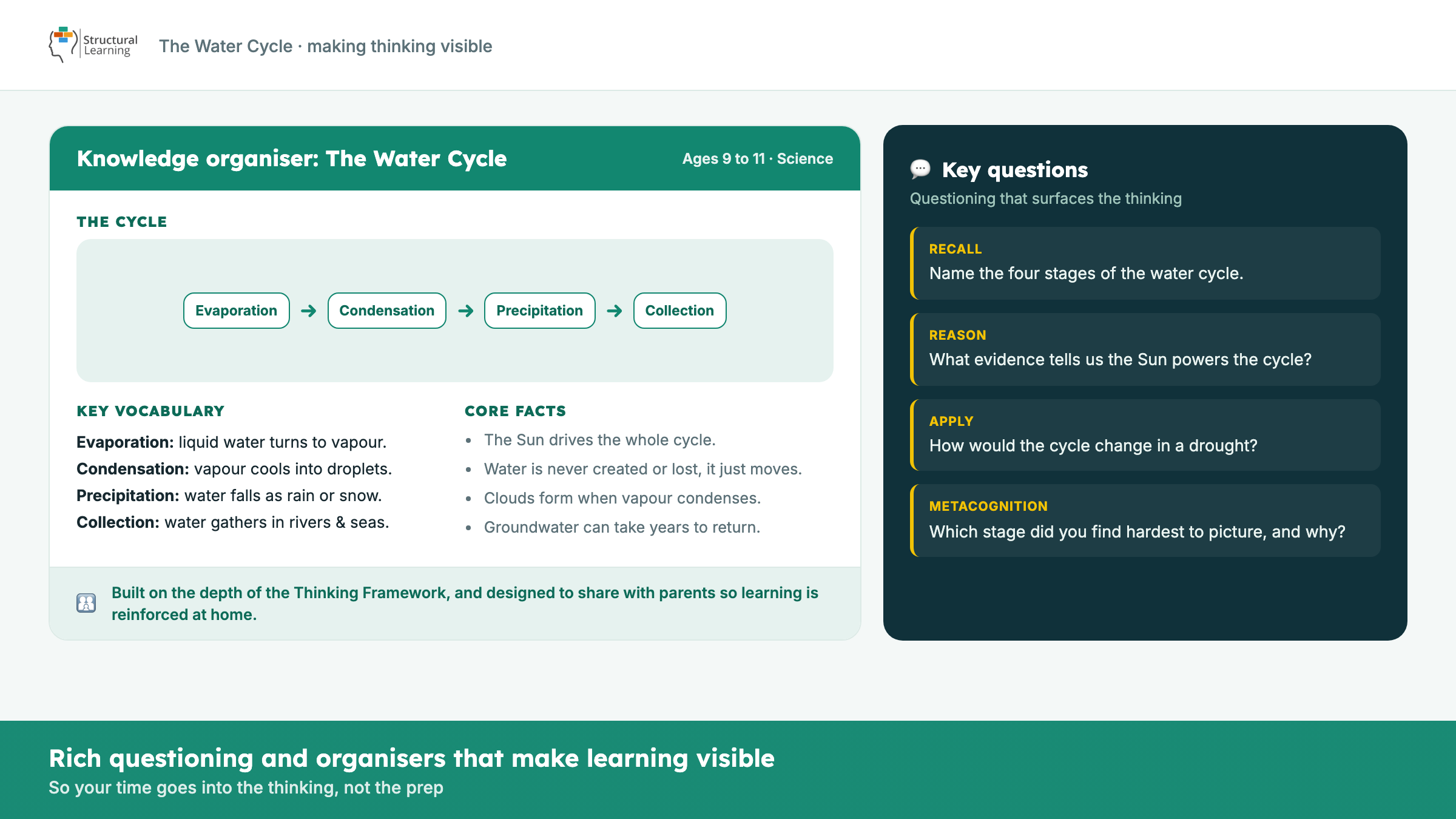
A knowledge organiser built for depth, and designed to leave the classroom and go home.
Knowledge organisers built for depth, and for home
For every lesson, the platform generates a knowledge organiser: the key vocabulary, the core facts and a diagram of the concept on a single, revisable page. What makes ours different is what sits behind it. Each one is structured around the depth of knowledge the Structural Learning Thinking Framework is designed to develop, so it works as a tool for thinking rather than a flat fact sheet.
We also built it to leave the classroom. The organiser is designed to be shared with parents, so families can see exactly what is being learned and have something concrete to work on at home, turning revision into a conversation rather than a guess.
You become the facilitator
When the research, the alignment and the materials are already done, your time moves to where it matters most: asking the next question, running the discussion, noticing the moment a child's understanding shifts. The platform handles the preparation; you do the teaching.
The metacognitive umbrella
Underneath all of it, the platform is really about one thing: making the learning process visible. Every objective, organiser and activity it produces explains how the learning works, not just what to do next, for you, for your learners, and for their families. That is metacognition, built into the planning itself.
See your next topic come to life
Build a lesson and watch the platform do the research, align it to your curriculum and make the thinking visible, so you can get on with teaching. It's free to try, and we read every piece of feedback.