Updated on
March 27, 2026
Learning Tools and Graphic Organisers: The Complete Guide
|
March 27, 2026
Graphic organisers, thinking maps, concept maps, and structured learning tools for every classroom. Updated for 2026.

Updated on
March 27, 2026
|
March 27, 2026
Graphic organisers, thinking maps, concept maps, and structured learning tools for every classroom. Updated for 2026.
Visual learning tools, graphic organisers, thinking maps, and frameworks that make thinking visible. Evidence-based resources for every classroom. Updated for 2026.
Visual learning tools are structured frameworks that make thinking visible on the page. They are not decorations or time-fillers: they are cognitive prosthetics. Ausubel (1968) showed that learners need to connect new knowledge to existing schemas; graphic organisers provide the external structure that makes that connection explicit. Novak and Gowin (1984) developed concept mapping specifically to externalise hierarchical knowledge, and decades of research confirm their value. Hyerle (1996) extended this into a family of eight Thinking Maps, each designed for a specific cognitive operation such as comparing, classifying, or sequencing.
The Thinking Framework takes a different approach: rather than mapping content, it maps the eight cognitive operations that underpin all disciplinary thinking. When pupils use a Circle Map to define, they are not just filling in a template; they are practising the operation of contextualising. When they use a Double Bubble Map to compare, they are building the analytical habit that underpins essay writing, scientific reasoning, and mathematical problem-solving. The research on worked examples (Sweller, 1988) tells us that explicit modelling of thinking reduces cognitive load; visual frameworks are, in effect, worked-example templates for cognition itself.
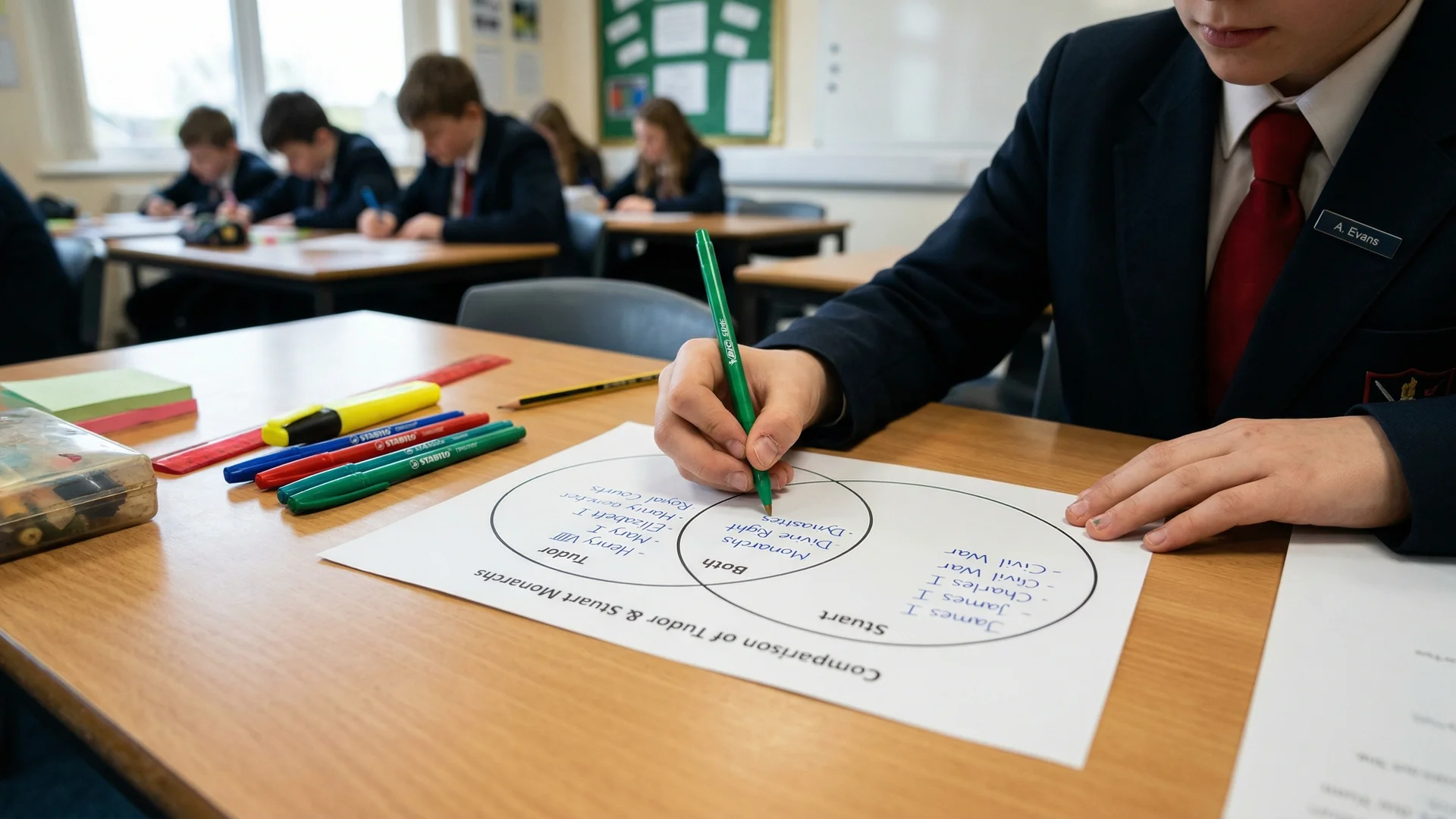
Start with Graphic Organiser Templates for a practical overview, then follow the pathway below.
| Tool Family | Primary Function | Best For | Key Limitation |
|---|---|---|---|
| Graphic Organisers | Visually organise information using boxes, arrows, and spatial arrangement to show relationships. | Note-taking, summarising, and scaffolding writing tasks across all subjects. | Templates can become mechanical if pupils fill them in without thinking about why each section exists. |
| Concept Maps | Show propositional relationships between concepts using labelled linking phrases on connecting lines. | Assessing prior knowledge, revealing misconceptions, and showing hierarchical knowledge structure. | Require explicit teaching before pupils can use them independently; initial construction is cognitively demanding. |
| Mind Maps | Radiate ideas outward from a central topic using branches, sub-branches, and images. | Brainstorming, exploring a topic broadly, and revision of familiar material. | Hierarchical radial structure does not suit all topics; the format can obscure complex non-hierarchical relationships. |
| Thinking Maps | Eight specific map types, each matched to a distinct cognitive process (defining, comparing, classifying, etc.). | Teaching thinking explicitly across the curriculum; building metacognitive awareness of cognitive operations. | The full system requires sustained whole-school commitment to pay dividends; isolated classroom use limits impact. |
| Writing Frames | Sentence starters and structural templates that scaffold extended writing in specific genres. | Supporting novice writers and EAL learners; modelling the genre conventions of academic writing. | Must be faded over time; prolonged use can prevent pupils developing independent structural awareness. |
The practical starting point. Download and use ready-made templates for KWL charts, Venn diagrams, story maps, and more.
Move from generic templates to tools designed for specific cognitive operations. Concept maps reveal what pupils actually understand.
Build a shared language for thinking across the whole school. Use SOLO to design tasks at the right level of complexity.
The Structural Learning platform has CPD courses, interactive lesson planning tools, and a growing library of resources built on the research above. Open a free account to browse.
No credit card required.
About this hub. Articles are written by practising educators and reviewed against peer-reviewed research. Citations follow author-date format. New content added regularly. Get in touch if you cannot find what you need.
Visual learning tools, graphic organisers, thinking maps, and frameworks that make thinking visible. Evidence-based resources for every classroom. Updated for 2026.
Visual learning tools are structured frameworks that make thinking visible on the page. They are not decorations or time-fillers: they are cognitive prosthetics. Ausubel (1968) showed that learners need to connect new knowledge to existing schemas; graphic organisers provide the external structure that makes that connection explicit. Novak and Gowin (1984) developed concept mapping specifically to externalise hierarchical knowledge, and decades of research confirm their value. Hyerle (1996) extended this into a family of eight Thinking Maps, each designed for a specific cognitive operation such as comparing, classifying, or sequencing.
The Thinking Framework takes a different approach: rather than mapping content, it maps the eight cognitive operations that underpin all disciplinary thinking. When pupils use a Circle Map to define, they are not just filling in a template; they are practising the operation of contextualising. When they use a Double Bubble Map to compare, they are building the analytical habit that underpins essay writing, scientific reasoning, and mathematical problem-solving. The research on worked examples (Sweller, 1988) tells us that explicit modelling of thinking reduces cognitive load; visual frameworks are, in effect, worked-example templates for cognition itself.
Start with Graphic Organiser Templates for a practical overview, then follow the pathway below.
| Tool Family | Primary Function | Best For | Key Limitation |
|---|---|---|---|
| Graphic Organisers | Visually organise information using boxes, arrows, and spatial arrangement to show relationships. | Note-taking, summarising, and scaffolding writing tasks across all subjects. | Templates can become mechanical if pupils fill them in without thinking about why each section exists. |
| Concept Maps | Show propositional relationships between concepts using labelled linking phrases on connecting lines. | Assessing prior knowledge, revealing misconceptions, and showing hierarchical knowledge structure. | Require explicit teaching before pupils can use them independently; initial construction is cognitively demanding. |
| Mind Maps | Radiate ideas outward from a central topic using branches, sub-branches, and images. | Brainstorming, exploring a topic broadly, and revision of familiar material. | Hierarchical radial structure does not suit all topics; the format can obscure complex non-hierarchical relationships. |
| Thinking Maps | Eight specific map types, each matched to a distinct cognitive process (defining, comparing, classifying, etc.). | Teaching thinking explicitly across the curriculum; building metacognitive awareness of cognitive operations. | The full system requires sustained whole-school commitment to pay dividends; isolated classroom use limits impact. |
| Writing Frames | Sentence starters and structural templates that scaffold extended writing in specific genres. | Supporting novice writers and EAL learners; modelling the genre conventions of academic writing. | Must be faded over time; prolonged use can prevent pupils developing independent structural awareness. |
The practical starting point. Download and use ready-made templates for KWL charts, Venn diagrams, story maps, and more.
Move from generic templates to tools designed for specific cognitive operations. Concept maps reveal what pupils actually understand.
Build a shared language for thinking across the whole school. Use SOLO to design tasks at the right level of complexity.
The Structural Learning platform has CPD courses, interactive lesson planning tools, and a growing library of resources built on the research above. Open a free account to browse.
No credit card required.
About this hub. Articles are written by practising educators and reviewed against peer-reviewed research. Citations follow author-date format. New content added regularly. Get in touch if you cannot find what you need.