Say It · Oracy

Oracy strategies for every classroom.

Talk routines aligned to your curriculum. Plan a lesson in any subject and it builds the talk in: the roles, the question and the sentence stems every learner needs.

Ages 3 to 16. Download the free research summary (PDF)
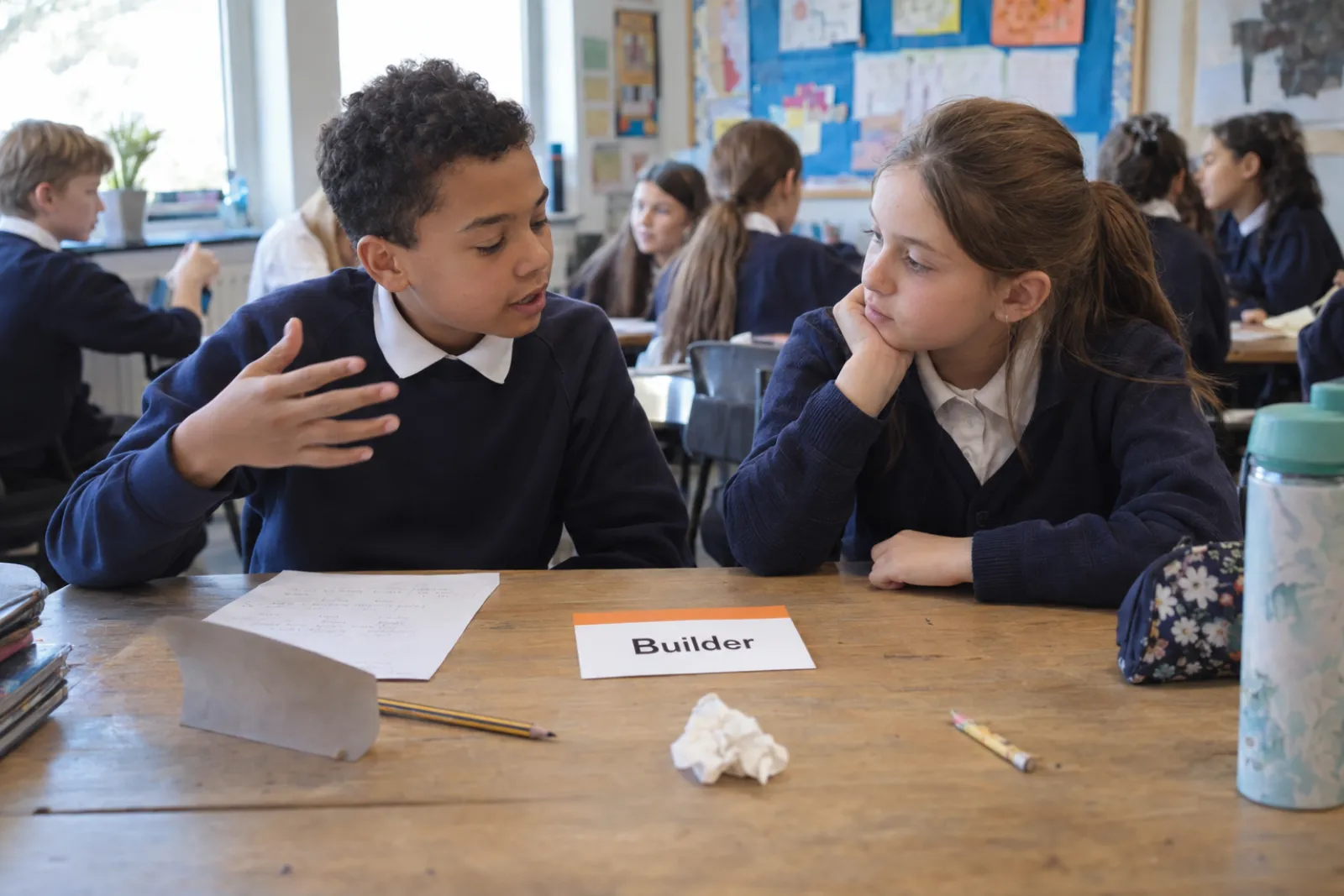
Two learners at a shared desk mid-discussion: one explains with an open hand, the other listens closely, a role card reading Builder on the desk between them
One explains, one listens, a role card between them.
Say It · Guided Conversation Exploratory talk · Ages 7 to 8

The topic

Healthy eating: which foods belong together, and which give us most protein?

Talk rule

In the app, the question comes from your own lesson.

Who it is for

Bring the power of talk into every classroom.

Clear explanation, careful listening, and ideas that grow when learners share them.
  • An oracy leadOne shared set of routines and talk rules, from ages 3 to 16, so talk grows year on year.
  • A class teacherA talk task for tomorrow on your own topic, so learners explain it clearly before they write it.
  • A whole school that believes in talkTalk that feeds reading, writing and every subject. A learner who can say it clearly can write it clearly.
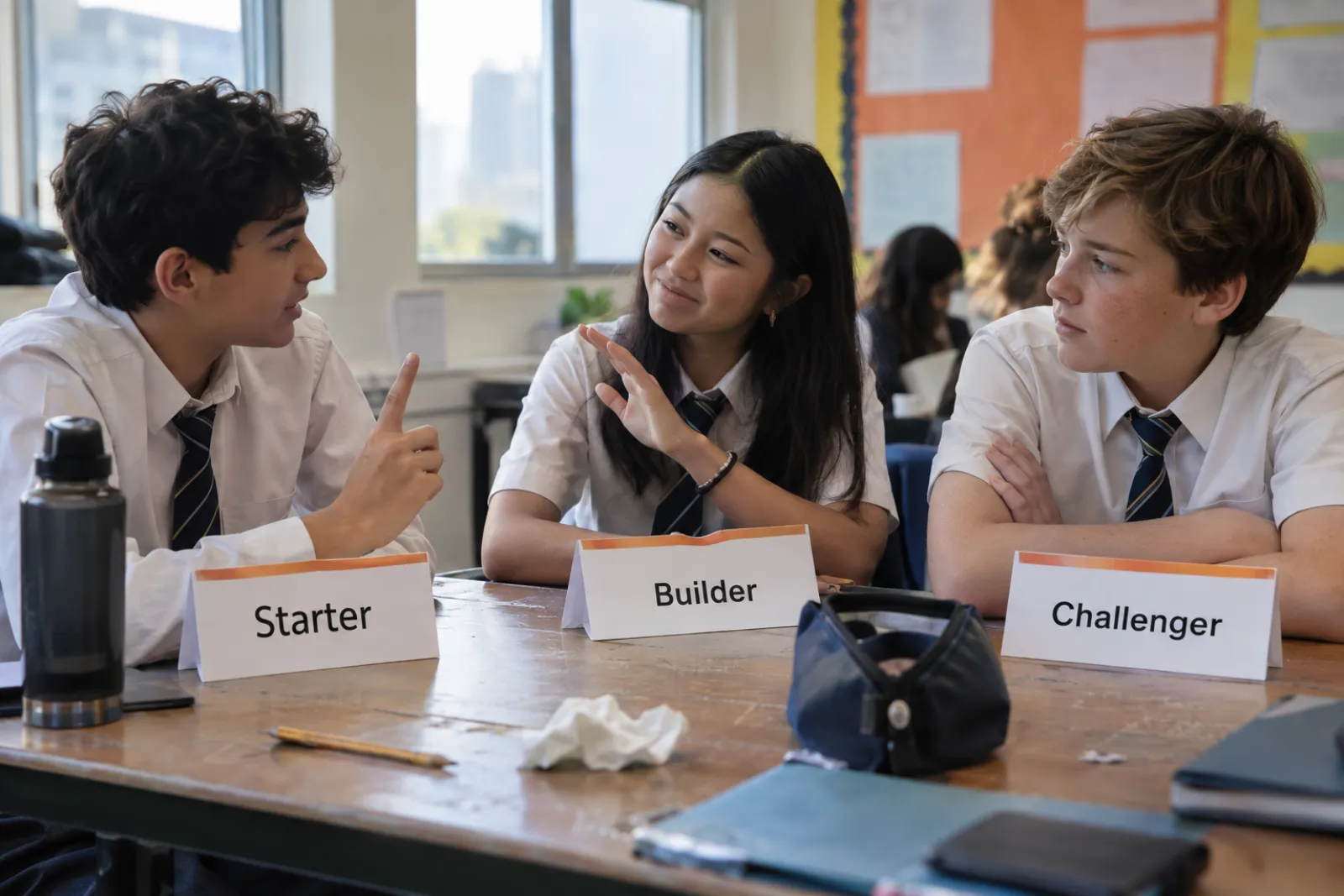
Three older learners round a table with role cards reading Starter, Builder and Challenger, one making a counterpoint while another shakes her head and smiles
Three roles, one polite disagreement.
Young learners sitting in a circle on the classroom carpet, one speaking while holding an object, the others listening
Age 7: one voice at a time.

Where talk sits in a lesson

Talk first. Then the writing.

  1. Talk to exploreBefore they know the answer.
  2. ClarifySay what you think, and check it.
  3. Explain, then writeSay it clearly out loud first.
  4. Argue and challengeChallenge the idea, not the person.

Then it is writtenBeans belong with the protein foods, because they help the body grow and repair.
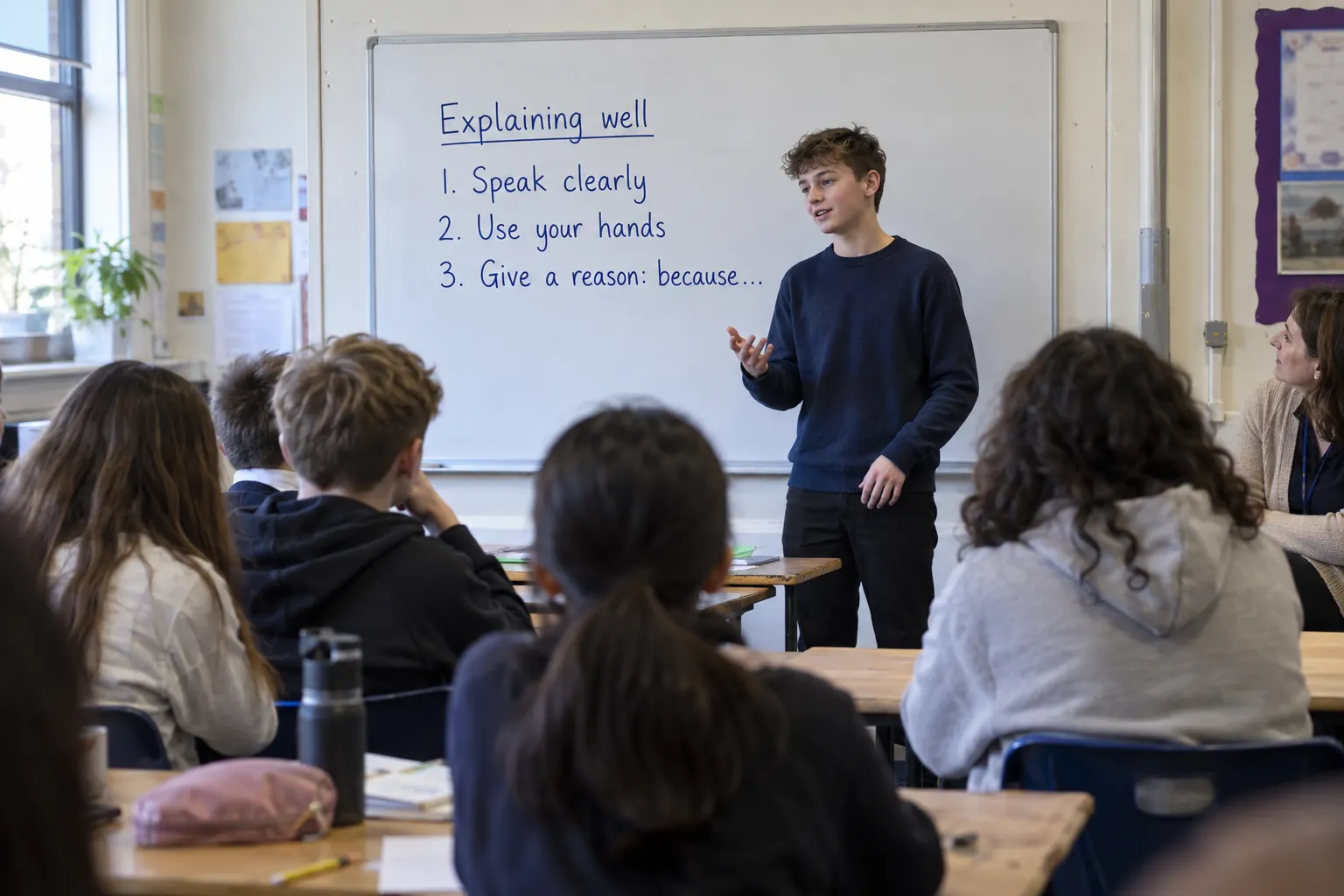

A learner stands at the front and explains to the class with an open hand. The whiteboard behind him reads: Explaining well. 1. Speak clearly. 2. Use your hands. 3. Give a reason: because...
Three talk rules on the board, and a reason out loud.
Two older learners at a desk, one writing in an exercise book while the other points to a line on the page
The talk becomes the first line.

Eight routines, two kinds of talk

Talk is where the thinking happens.

Some talk works something out. Some makes it clear. Say It has routines for both.

Learner AI think beans go with the protein foods…

Learner B…because, like meat, they help your body grow and repair.

Beans go with the protein foods because, like meat, they help your body grow and repair.

Neither had the whole sentence. Between them, they did.

Exploratory talk

When they do not know the answer yet.

  • Talk TacticsThree roles argue a motion, swap, then vote again.Use it when a question has two sides.
  • Think-Pair-ShareA silent minute, a partner, then the class.Use it when every learner should have an answer ready.
  • Philosophy for ChildrenThe class votes for one open question and explores it.Use it for a big question with no single answer.
  • Mantle of the ExpertA team of experts answers a client’s commission.Use it once the knowledge is secure.
  • Guided ConversationThree thinking cards, answered in turn.Use it to talk a topic through one step at a time.

Explanatory talk

When they are making their thinking clear.

  • QuestioningA claim, probed one kind of question at a time.Use it to test an idea before anyone accepts it.
  • Structured ExplanationA finished organiser, talked through with a partner.Use it to rehearse an explanation before the writing.
  • Reflection PromptsA quiet minute to look back, then one reflection shared.Use it at the end, to hear what changed.

Any routine runs in pairs, threes, fours or as a whole class.

Run any routine on the board ↑

How it looks in a lesson

Twenty minutes of talk with a shape to it.

Talk Tactics, ages 7 to 8. The motion: “Protein is the most important food group.”

  1. 1
    Take a role3 min

    Threes, one role card each. Count who agrees.

  2. 2
    Talk in role8 min

    Starter opens, Builder adds, Challenger tests.

  3. 3
    Swap roles5 min

    Pass the card left and go again.

  4. 4
    Decide2 min

    Which reason was hardest to argue against?

  5. 5
    Vote2 min

    Hands up again. Say what changed your mind.

Your side. Write the first count up, listen in, and ask what tipped it. The gap between the two counts is the lesson.

Then the writing. The learner sheet ends with “I used to think, now I think, this changed because”.

More scaffolding, stretch and challenge

Every learner joins in. Every learner is stretched.

Scaffolding gives a quiet learner the first words. Stretch and challenge gives a confident one a harder job.

Three roles to start

Three more for a group of six

StarterOpens the talkPresent an idea or open up a new line of enquiry.“I would like to start by saying…”
BuilderAdds and extendsDevelop, add to or elaborate on an idea.“I agree and would like to add…”
ChallengerTests the ideaDisagree or present an alternative argument.“I disagree because…”
ClarifierChecks understandingAsk questions to make things clearer.“So are you saying…?”
Tell me moreDigs deeperAsk for evidence or justification of ideas.“Could you provide an example?”
SummariserRecaps the talkIdentify and recap the main ideas.“So far we have talked about…”

More scaffolding

  • Stems on the board, so nobody invents how to begin.
  • A role is a job. The quiet learner speaks as the Builder.
  • A safe pass, then asked again later.

Stretch and challenge

  • Swap roles, so the agreer has to challenge.
  • Six roles for groups that find three easy.
  • Say what moved you, not just how you voted.

Primary and secondary

The same routines, pitched for the age.

The stems, the talk rules and, for the youngest, the routine itself change with age.

In real schools

Thinking you can hear.

Explaining her thinking, out loud. A learner in Quebec talks through the structure she built for a poem. Sixty-one seconds, with sound.
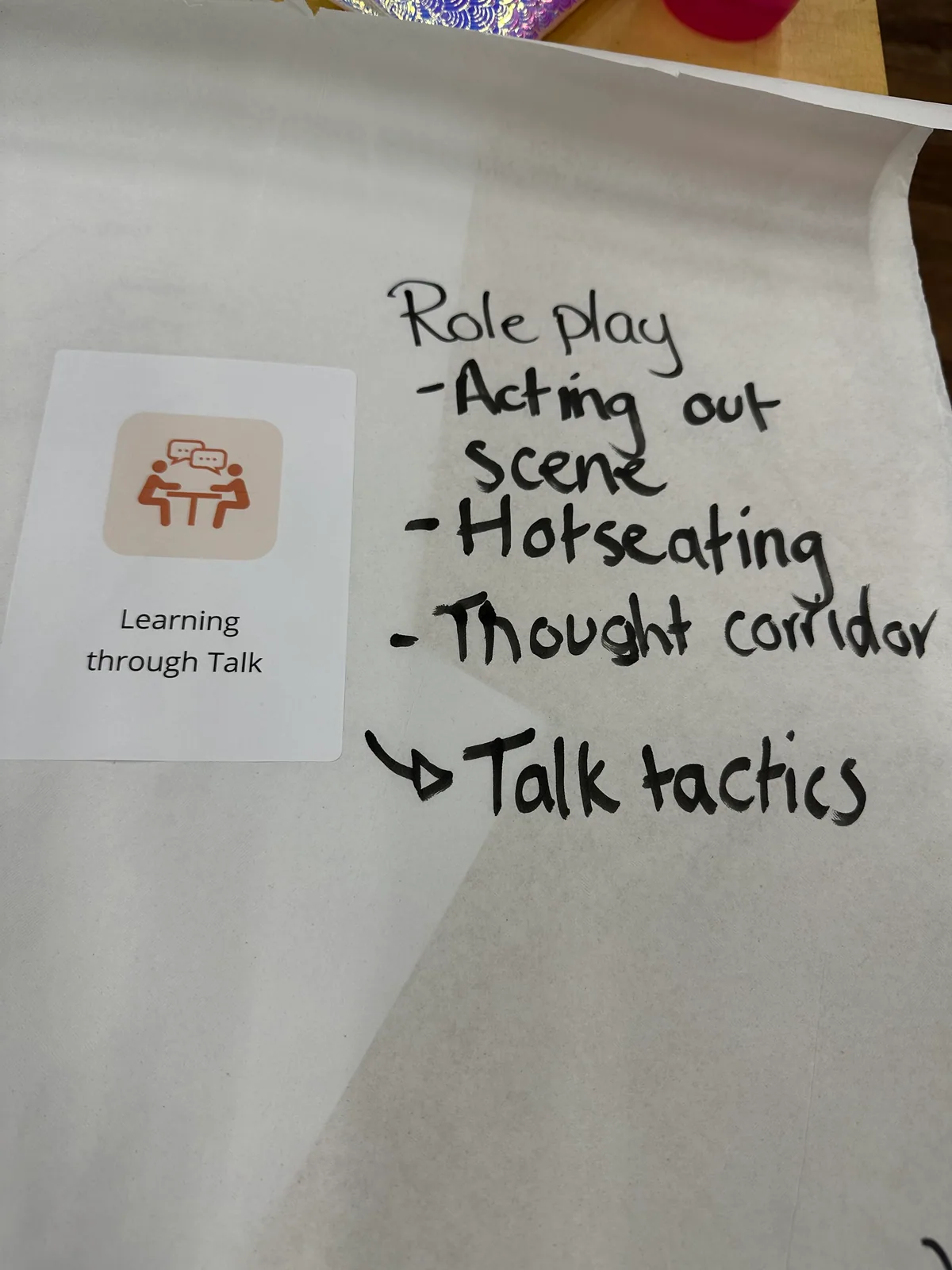
Teachers' notes headed Learning through Talk: role play, acting out a scene, hot seating, thought corridor, talk tactics
Teachers name the talk they already use.
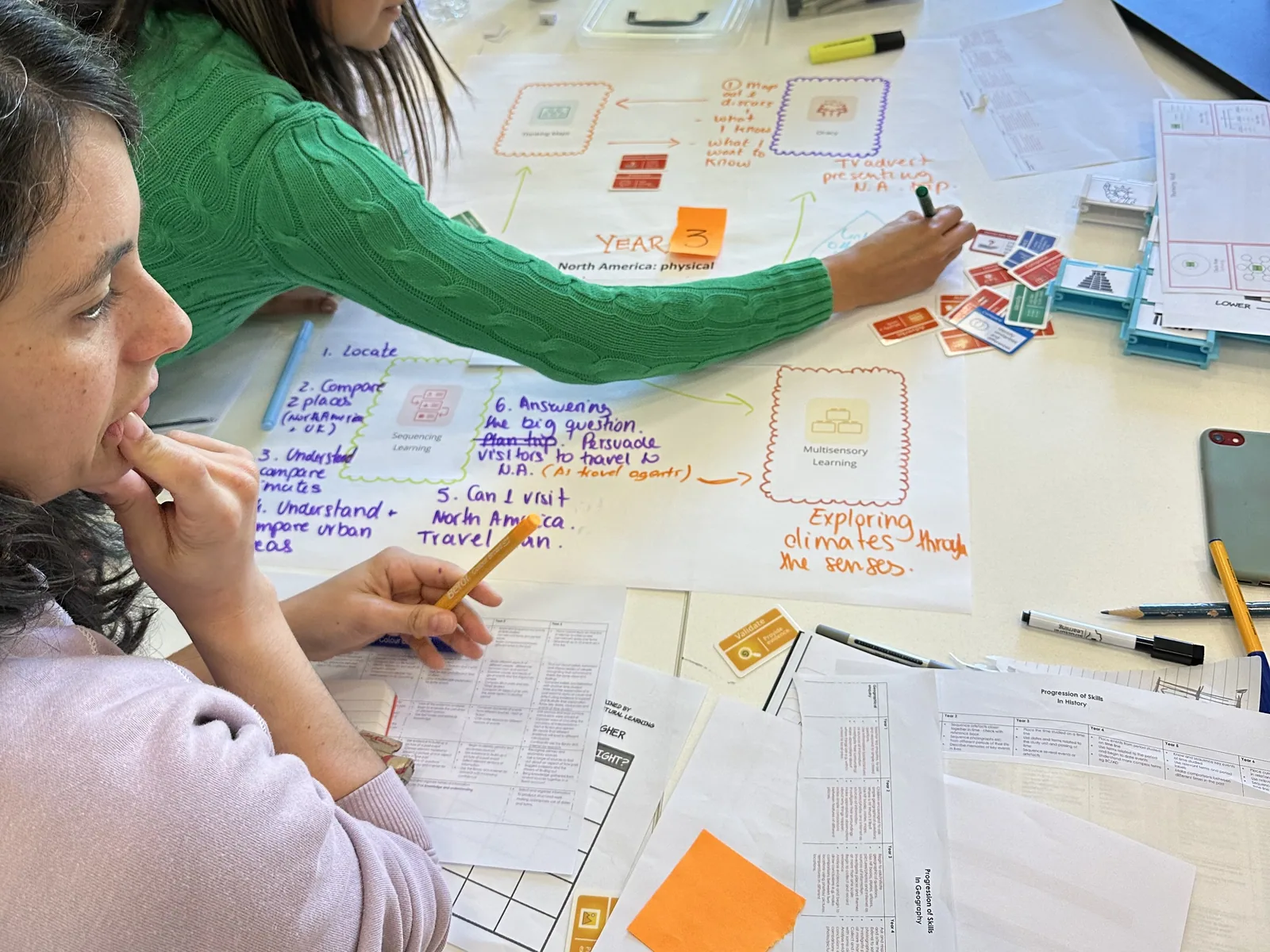
Two teachers at a trust training day lean over one large sheet headed Year 3, North America: physical, a unit drawn as a route between Thinking Framework cards, one teacher placing the next card.
Talking a unit through at a trust training day.

Where it lives

On the board, on paper, in the staff room.

What the board shows, the sheets print.

  • On the board

    The presenter

    One stage at a time, readable from the back. Light or dark.

    Try it free →
  • On paper

    One pack per routine

    Teacher and learner sheets, plus role cards, question slips or expert badges.

    See the roles on the board →
  • In the plan

    Any step of any lesson

    Add talk to any lesson step. It writes the question and stems from your topic.

    Plan a lesson free →
  • In the staff room

    Training

    Staff run the routines on each other, then plan talk into a unit.

    See the training →

The research

Why is oracy so important?

Talk is how learners build, test and share ideas. These are the studies Say It is built on.
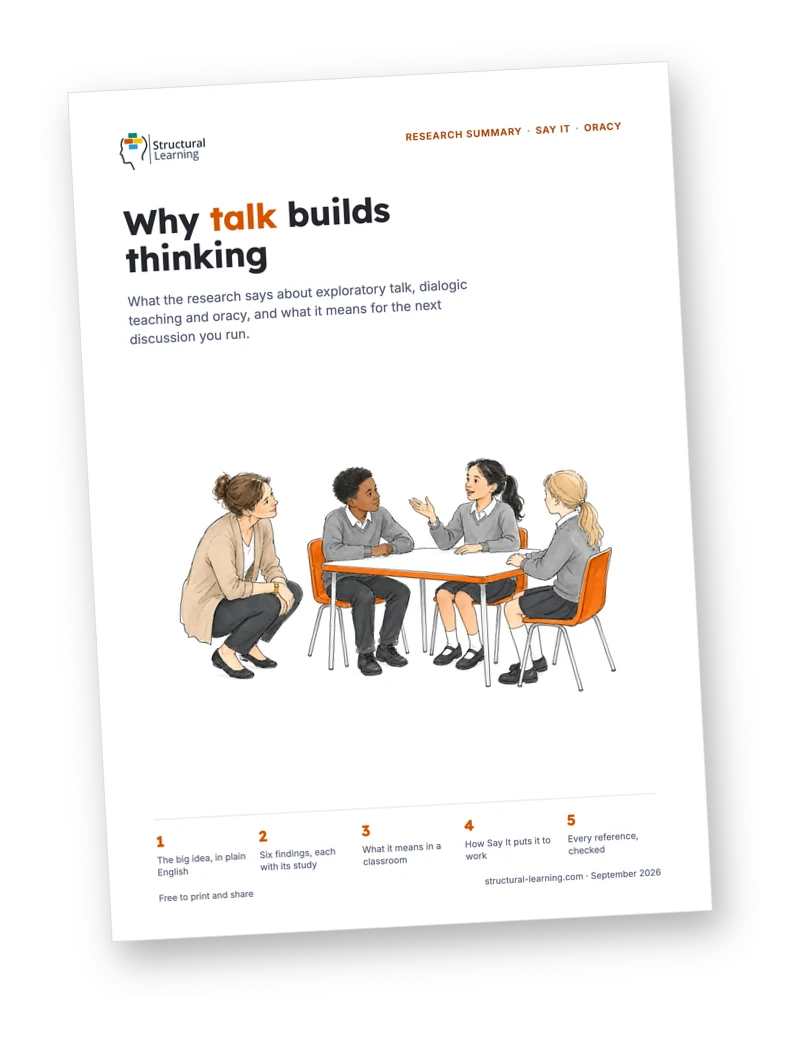
Cover of the research summary Why talk builds thinking

Why talk builds thinking Six findings, each with its study. Free to print and share.
Download the PDF

All evidence briefings →

The Structural Learning platform

It all comes to life on the platform.

Say It is built into the lesson planner: choose a talk routine for any step, and the app writes the motion, the question and the stems from your topic, ready to project or print.

Plan a lesson free

Free to start.

Professional learning

Oracy training your staff can use on Monday.

Staff take the roles themselves, then plan talk into a unit they already teach. A twilight, half day or INSET day.
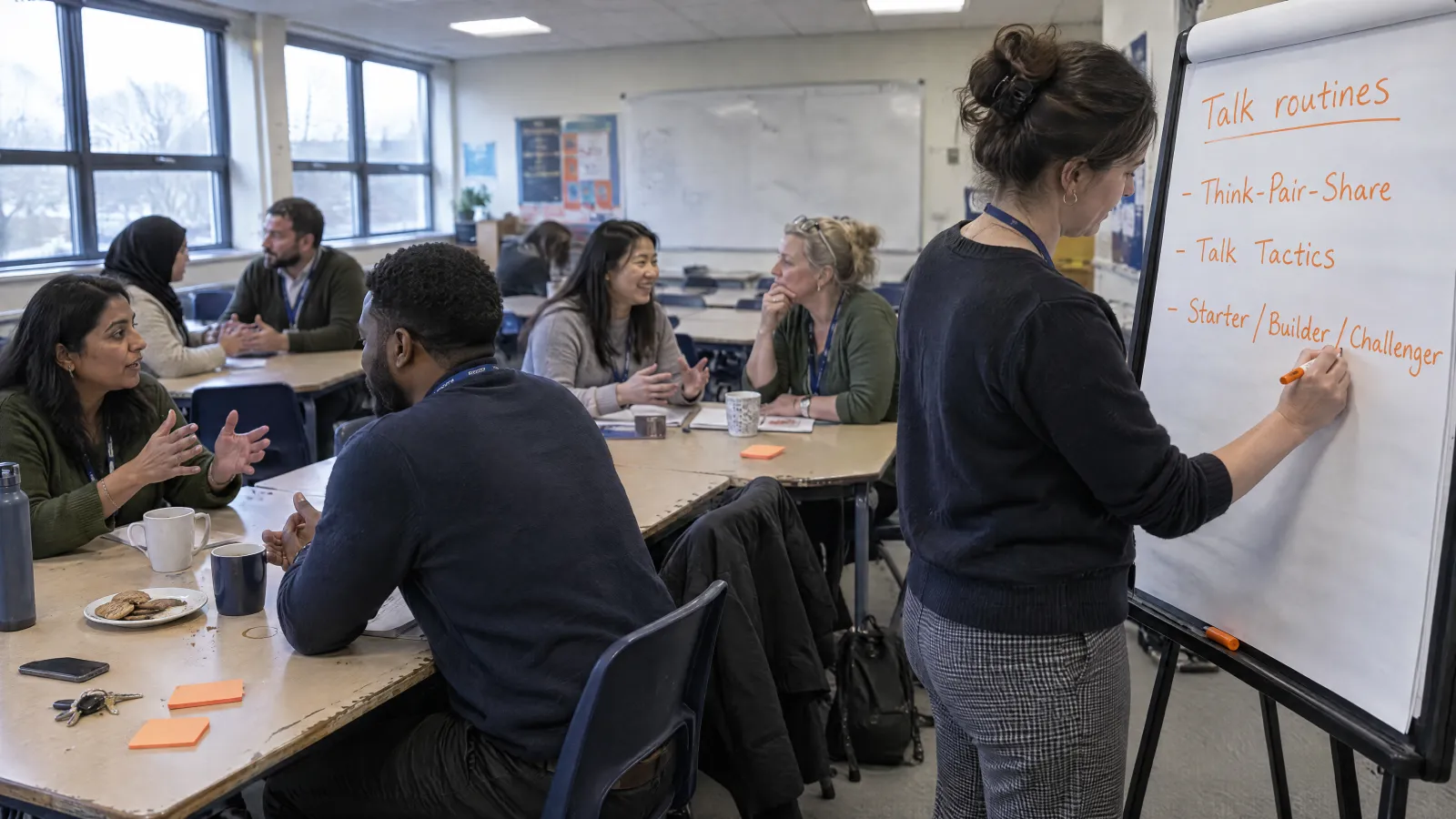
Teachers practise talk roles in pairs at a staff training session while a trainer writes on a flip chart headed Talk routines: Think-Pair-Share, Talk Tactics, Starter / Builder / Challenger
Staff practise the talk roles before planning them into a unit.

A training programme

One focus for the whole staff.

Each focus stands on its own, so a school can start with the one it needs. Together they make a whole-school programme for primary and secondary, so you can add the others when you are ready.

  1. The Thinking FrameworkThe Thinking Framework

    A shared language for thinking, for every teacher in the room.

    This focus

  2. Map ItMap It

    Graphic organisers that make learners' thinking visible on the page.

    This focus

  3. Say ItSay It

    Oracy: talk routines that give every learner a voice.

    This focus

  4. Build ItBuild It

    Learners build sentences and ideas with Writer's Block, then write them.

    This focus

The next step

Talk it through with Paul.

Twenty minutes on Google Meet. Tell me where talk is in your school, and I will say how the routines fit. I reply to every request myself.

Book a 20-minute conversation

Pick a time that suits you. Or send three quick questions first, and I reply by email with a time or a better next step.

Book a 20-minute conversation with Paul Send three questions first
or

Email me directly
paul@structural-learning.com