
primary teachers
Developing
✓ Citations verified
In this large England study, classes where teachers and learners built on and questioned each other's ideas scored higher on maths and grammar tests, so long as most learners were talking too; the pattern was weaker for reading, and there was no link at all to science or reasoning scores.
Howe, C., Hennessy, S., Mercer, N., Vrikki, M., & Wheatley, L. (2019). Teacher-Student Dialogue During Classroom Teaching: Does It Really Impact upon Student Outcomes? Journal of the Learning Sciences, 28(4-5), 462-512.
Free to download and share. No sign-up needed.
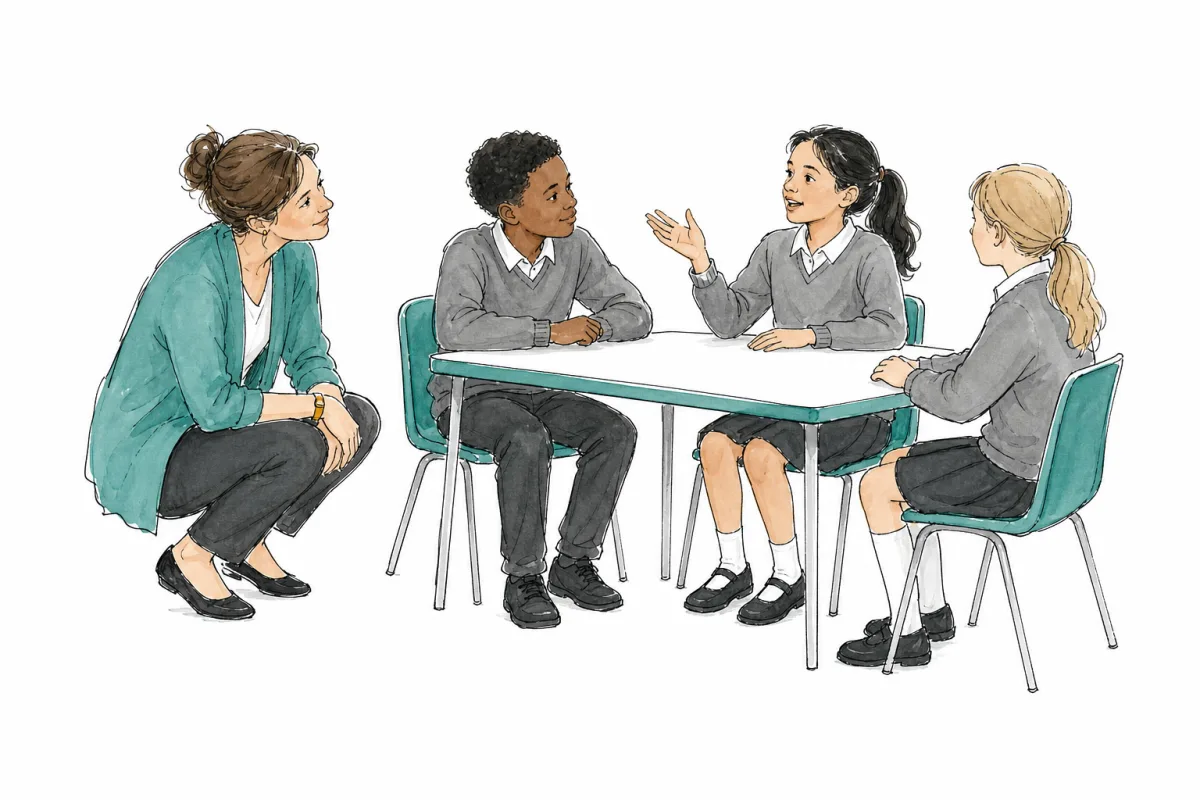
The gist. In a large England study of primary classrooms, maths and grammar scores were higher in classes where teachers and learners built on and questioned each other's ideas, so long as most learners were actually talking too. The pattern was weaker for reading, and there was no link at all to science or reasoning scores.
Researchers at Cambridge video-recorded two lessons each in 72 English primary classrooms across 48 schools, mostly Year 6, covering maths, literacy and science. They coded every turn of teacher-learner classroom talk, then matched the patterns against learners' scores on national tests months later, allowing for prior attainment and other classroom factors.
Across 61 classes, average maths scores were highest, at 107.68, only in classes with both plenty of building-on talk and wide learner participation; every other combination scored lower, from 103.64 to 104.81. The same pattern held for grammar and spelling scores, a weaker version held for reading, and there was no significant link to science or reasoning scores in this study.
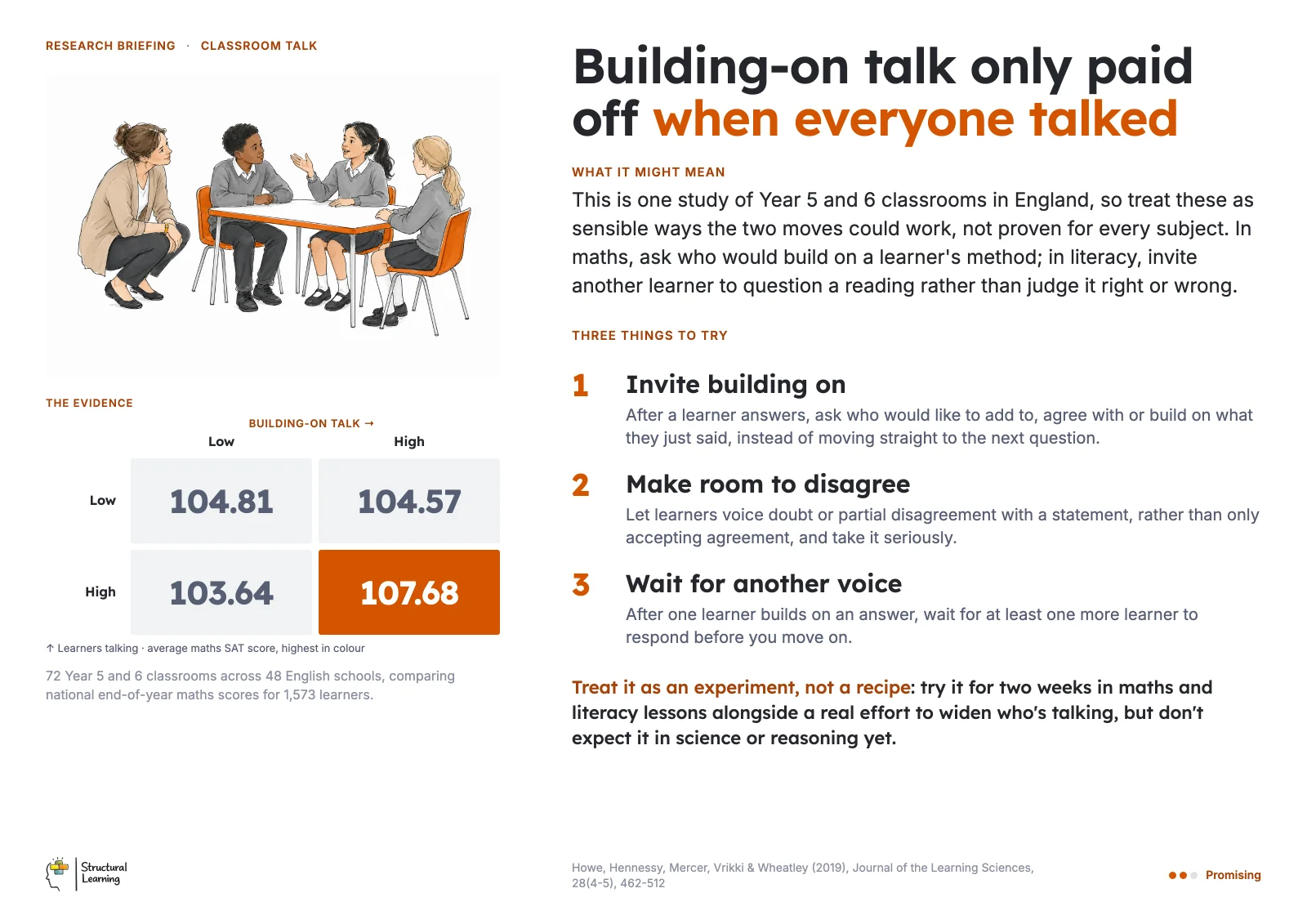
This is one study of Year 5 and 6 classrooms in England, tested in maths, literacy and science lessons, so treat what follows as sensible ways the same two moves could work across your school, not separately proven for your subject or your class. In maths, ask who would like to build on a learner's method or try it a different way before moving to a new example; in literacy, invite another learner to add to or question a reading of a text rather than confirming right or wrong straight away. Both moves sit inside the wider practice of dialogic teaching, where talk builds on itself rather than simply checking answers.
Treat it as an experiment, not a recipe: worth building as a low-cost habit in maths and literacy lessons, alongside a real effort to widen who's talking, but not yet evidence for science or reasoning outcomes specifically.
This comes from one large, well-controlled study of 72 English classrooms, not a stack of independently replicated ones, and it is correlational rather than a randomised trial: teachers were not randomly assigned to talk this way, so the higher scores may partly reflect classes that were already doing well. The pattern showed up clearly for maths and grammar and spelling, more weakly for reading, and not at all for science or reasoning in this particular study, and the benefit only appeared where a wide range of learners were actually talking. Its firmness grade is Promising.
Howe, C., Hennessy, S., Mercer, N., Vrikki, M., & Wheatley, L. (2019). Teacher-Student Dialogue During Classroom Teaching: Does It Really Impact upon Student Outcomes? Journal of the Learning Sciences, 28(4-5), 462-512.
Structural Learning helps teachers turn findings like this into planned, visible thinking in the classroom. Open a free account and try it with your next lesson.
Open a free account →Made by the Structural Learning Evidence Engine. Every claim is traced to the source above and independently verified. See more briefings →