
primary teachers
Developing
✓ Citations verified
Teach learners to always give a reason and expect one back: a ten-week UK primary programme built these habits through seven explicit ground rules, and learners' reasoning-linked talk nearly quadrupled, with a significant gain in individual test scores over a matched class, though the language count rested on very few groups and the class-level test gain fell short of significance.
Mercer, N., Wegerif, R., & Dawes, L. (1999). 'Children's Talk and the Development of Reasoning in the Classroom.' British Educational Research Journal, 25(1), 95-111.
Free to download and share. No sign-up needed.
The gist. Teach learners to always give a reason, and expect one back. In a ten-week UK primary study, seven explicit ground rules for group talk nearly quadrupled learners' use of reasoning language, and their individual test scores improved significantly more than a matched class that carried on as usual.
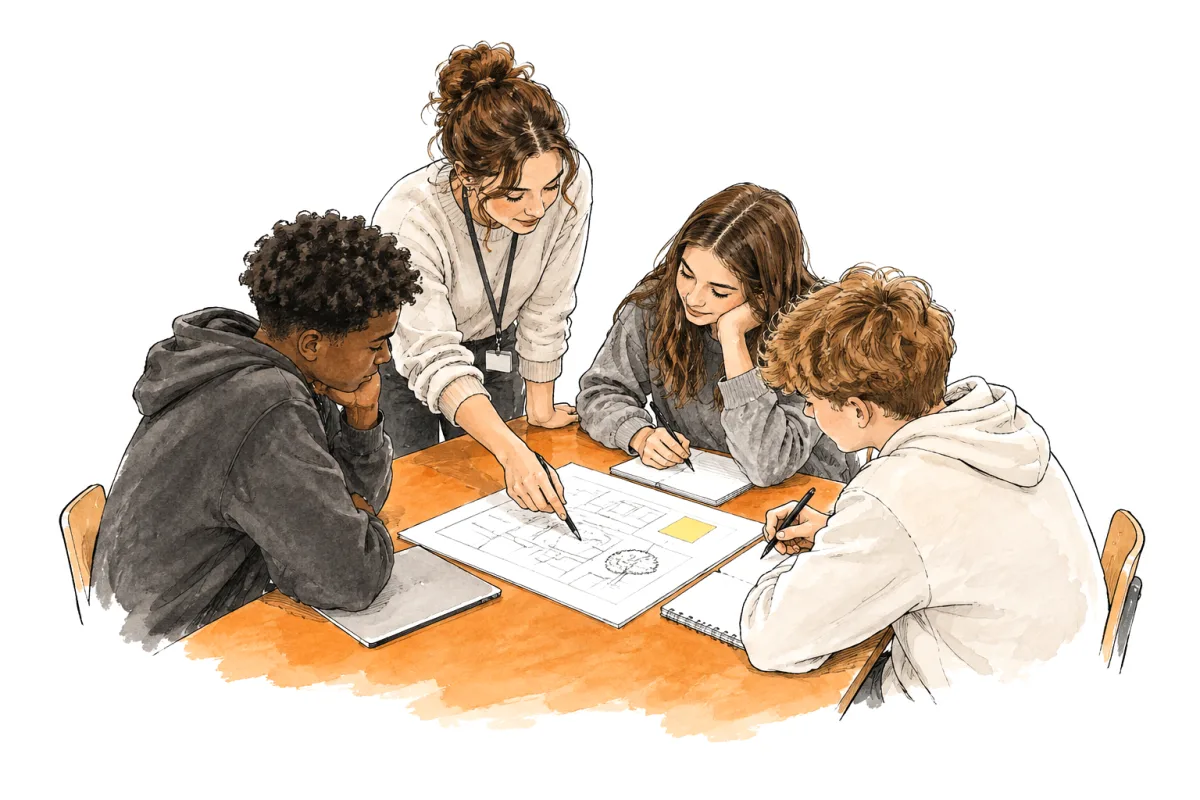
Sixty Year 5 learners, aged 9 to 10, across three Milton Keynes primary schools took nine structured lessons over ten weeks. The lessons built seven ground rules for talking together: share information, expect a reason, welcome challenge, agree before deciding. A matched group of 64 learners in similar schools carried on with their normal lessons, and researchers compared reasoning-linked talk and test scores between the two groups before and after.
Where the taught classes used reasoning words such as "because" and "I think" 110 times before the programme, that count rose to 411 afterwards. Untaught control classes barely moved, from 136 to 139. On an individual reasoning test, the taught group's average score rose from 30.56 to 32.68 out of 36, a significantly bigger gain than the control group's. The group-level test score also rose, from 41.43 to 45.58 out of 60, though that gain did not reach statistical significance.
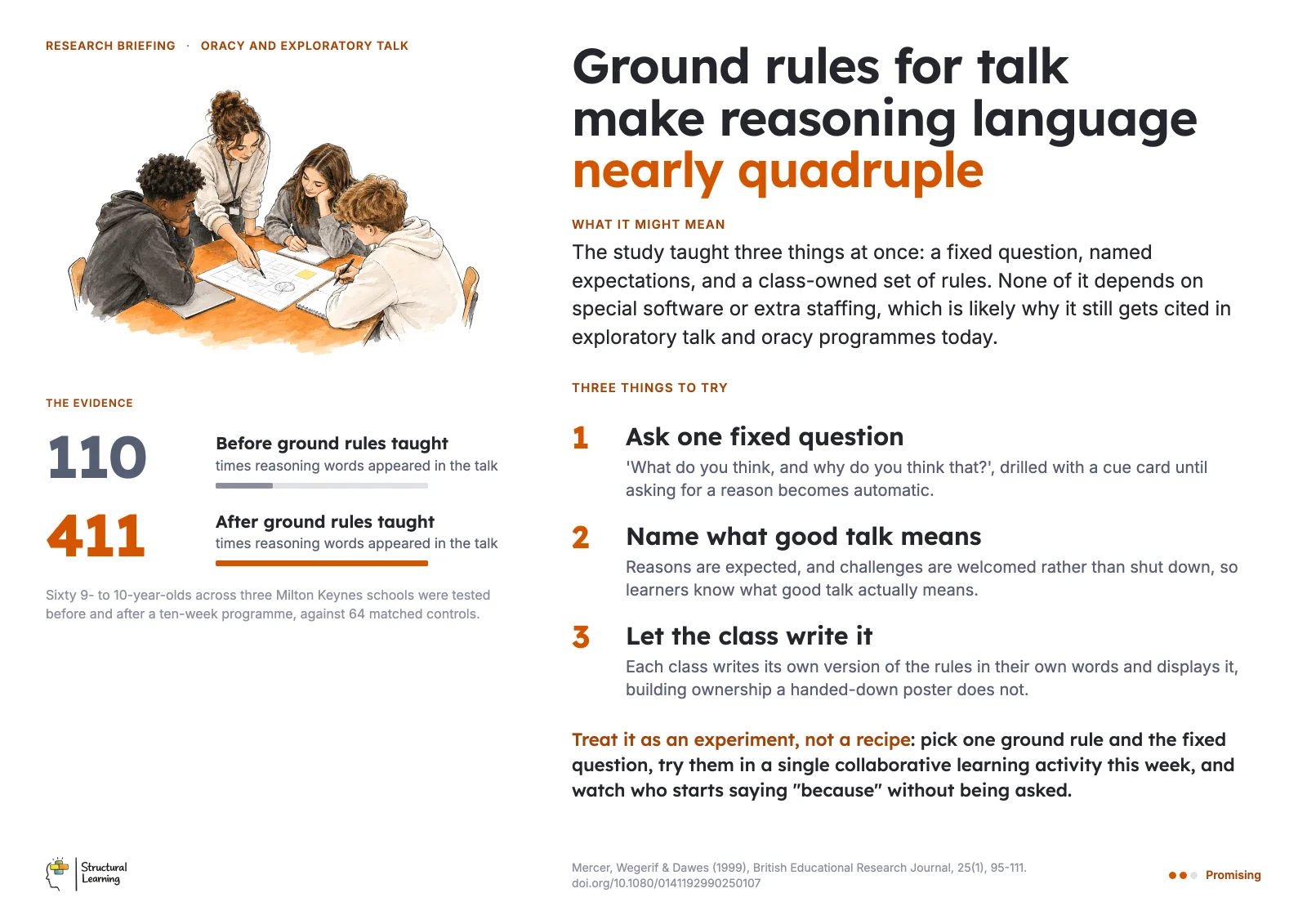
The study taught three things at once: a fixed question, named expectations, and a class-owned set of rules. None of it depends on special software or extra staffing, which is likely why it still gets cited in exploratory talk and oracy programmes today.
Treat it as an experiment, not a recipe: pick one ground rule and the fixed question, try them in a single collaborative learning activity this week, and watch who starts saying "because" without being asked.
This rates Promising. A matched-control study in real classrooms, with qualitative and quantitative findings that point the same way, is solid classroom-research design. It stops short of Secure for three reasons. The standout "nearly quadrupled" figure came from only three of the four matched group pairs; one recording was lost when learners were absent on the day. Every significance test in the study was one-tailed, a less conservative bar than the two-tailed tests now standard in most trials. And the results were mixed: individual reasoning scores improved significantly more in the taught classes, but the group-level score gain did not, an effect the authors themselves had predicted and said "did not materialise." Treat the ground rules as a well-observed starting point for building oracy and classroom talk, not a guaranteed lift to every learner's test score.
Mercer, N., Wegerif, R., & Dawes, L. (1999). ‘Children's Talk and the Development of Reasoning in the Classroom.’ British Educational Research Journal, 25(1), 95-111.
Structural Learning helps teachers turn findings like this into planned, visible thinking in the classroom. Open a free account and try it with your next lesson.
Open a free account →Made by the Structural Learning Evidence Engine. Every claim is traced to the source above and independently verified. See more briefings →