
primary and secondary teachers
Developing
✓ Citations verified
Not a new technique, a pause: when teachers hold silence after a question, and especially after a learner's first answer, for about three seconds rather than one, answers get longer, better reasoned and more widely shared. The pattern has held up for forty years across many classrooms, but the evidence behind it is older and softer than the size of the claim suggests.
Rowe, M. B. (1986). Wait Time: Slowing Down May Be A Way of Speeding Up! Journal of Teacher Education, 37(1), 43-50.
Free to download and share. No sign-up needed.

The gist. When teachers hold their silence for about three seconds after a question, and especially after a learner's first answer, rather than the usual second or less, answers get longer, better reasoned and more widely shared. The pattern has held up across four decades of classrooms, but the evidence behind it is a single author's narrative synthesis, older and softer than the size of the claim suggests, so treat it as developing.
Mary Budd Rowe spent nearly twenty years recording real lessons, mostly in US elementary and secondary science classrooms. Her recordings showed teachers typically waiting a second or less after asking a question before moving on, and a second or less after a learner finished speaking before reacting. In the handful of lessons where teachers held both pauses to three seconds or more, discussion changed shape.
Once average wait time passed roughly 2.7 seconds, Rowe reported pronounced changes: the length of learners' responses rose by between 300% and 700% depending on the study, reasoned and evidenced answers became far more common, 'I don't know' or no-response replies fell, and quieter learners who rarely spoke started answering unprompted. She also found rapid-fire pacing bred restlessness sooner than the longer wait time did.
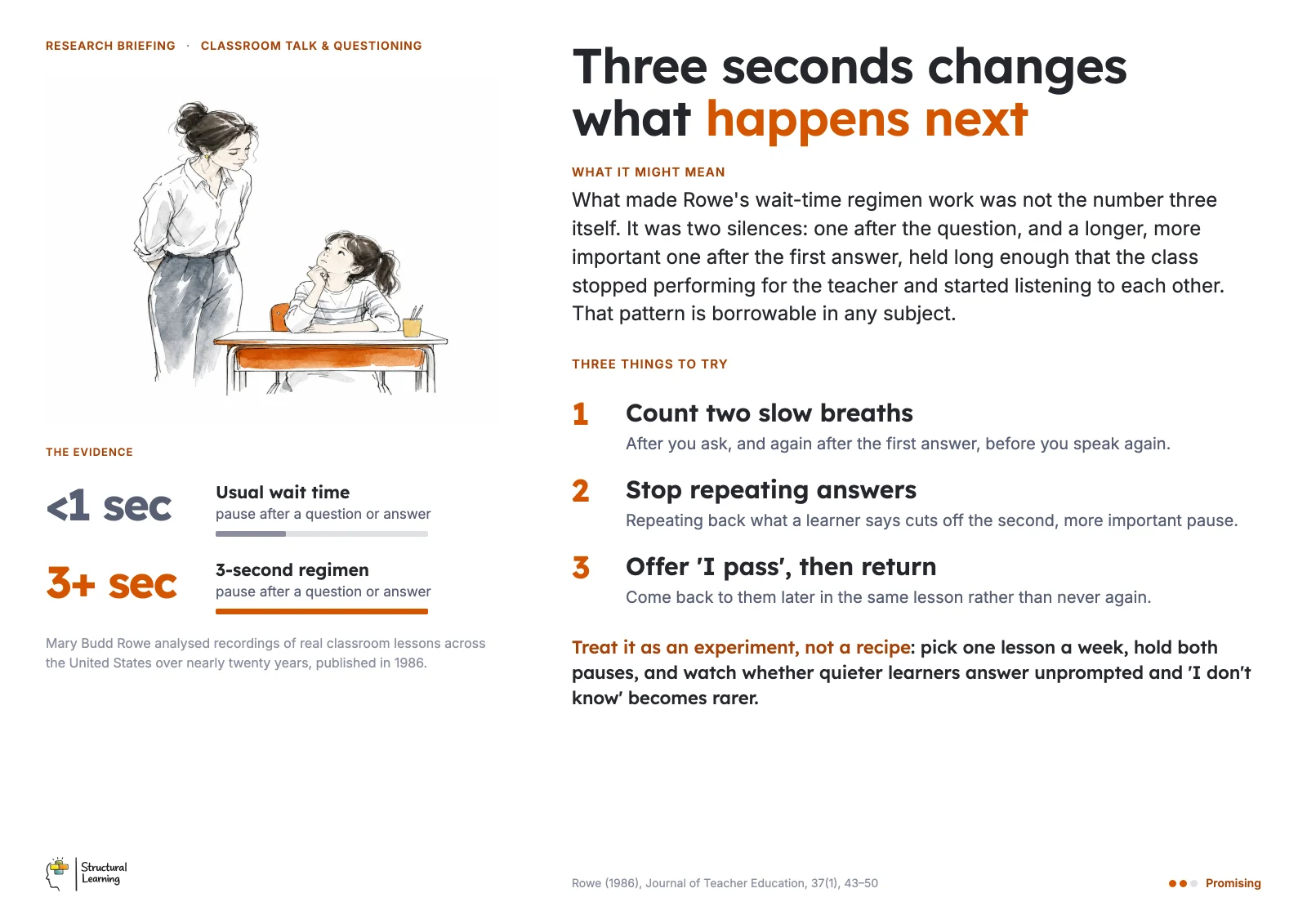
What made Rowe's wait-time regimen work was not the number three itself. It was two specific silences: one after the question, and a longer, more important one after the first answer, held long enough that the class stopped performing for the teacher and started listening to each other. That pattern is borrowable in any subject, and it sits at the heart of both effective questioning in teaching and the wider case for oracy.
Treat it as an experiment, not a recipe: pick one lesson a week, hold both pauses deliberately, and watch whether quieter learners start answering unprompted and whether 'I don't know' becomes rarer. That is your evidence.
We grade this Promising. It has been echoed across decades and countries, which pulls towards firm, but the source itself is one author's narrative synthesis of a roughly twenty-year research programme built substantially on unpublished dissertations, theses and conference papers, using observational and comparison-group designs rather than randomised trials, and reporting effect sizes only as ranges with no confidence intervals anywhere. What would raise the grade: a modern meta-analysis pooling effect sizes, a randomised UK trial, or replication reporting today's standard of confidence intervals.
Rowe, M. B. (1986). Wait Time: Slowing Down May Be A Way of Speeding Up! Journal of Teacher Education, 37(1), 43-50.
Structural Learning helps teachers turn findings like this into planned, visible thinking in the classroom. Open a free account and try it with your next lesson.
Open a free account →Made by the Structural Learning Evidence Engine. Every claim is traced to the source above and independently verified. See more briefings →