
early years practitioners
Developing
✓ Citations verified
In a study of England's most effective early years settings, staff and learners rarely stopped to really think something through together, but excellent settings did it significantly more than good ones, and when it happened, it extended what learners were thinking about.
Siraj-Blatchford, I., Sylva, K., Muttock, S., Gilden, R., & Bell, D. (2002). Researching Effective Pedagogy in the Early Years (REPEY). DfES Research Report 356. Peer-reviewed as Siraj-Blatchford, I., & Sylva, K. (2004). Researching pedagogy in English pre-schools. British Educational Research Journal, 30(5), 713-730.
Free to download and share. No sign-up needed.

The gist. In a study of England's most effective early years settings, staff and learners rarely stopped to properly think something through together, but the most outstanding settings did it significantly more often than the merely good ones, and when it happened, it extended what learners were thinking about.
Researchers spent several months in 2002 observing real teaching in 12 of England's most effective early years settings, drawn from a much larger national study that followed more than 3,000 learners across 141 settings. They coded sustained shared thinking, moments when an adult and a learner work on an idea together and both genuinely add something new, systematically across these settings.
Properly shared thinking turned out to be rare even in this group of strong settings, but it happened significantly more often in the three most outstanding settings than in the seven merely good ones, where staff were more often monitoring learners than thinking alongside them. In almost half of the challenging moments that learners started themselves in the excellent settings, a member of staff stepped in and extended the learner's thinking further, and this kind of shared thinking was most likely to happen when a learner was working one-to-one with an adult or a single peer, not across a whole group.
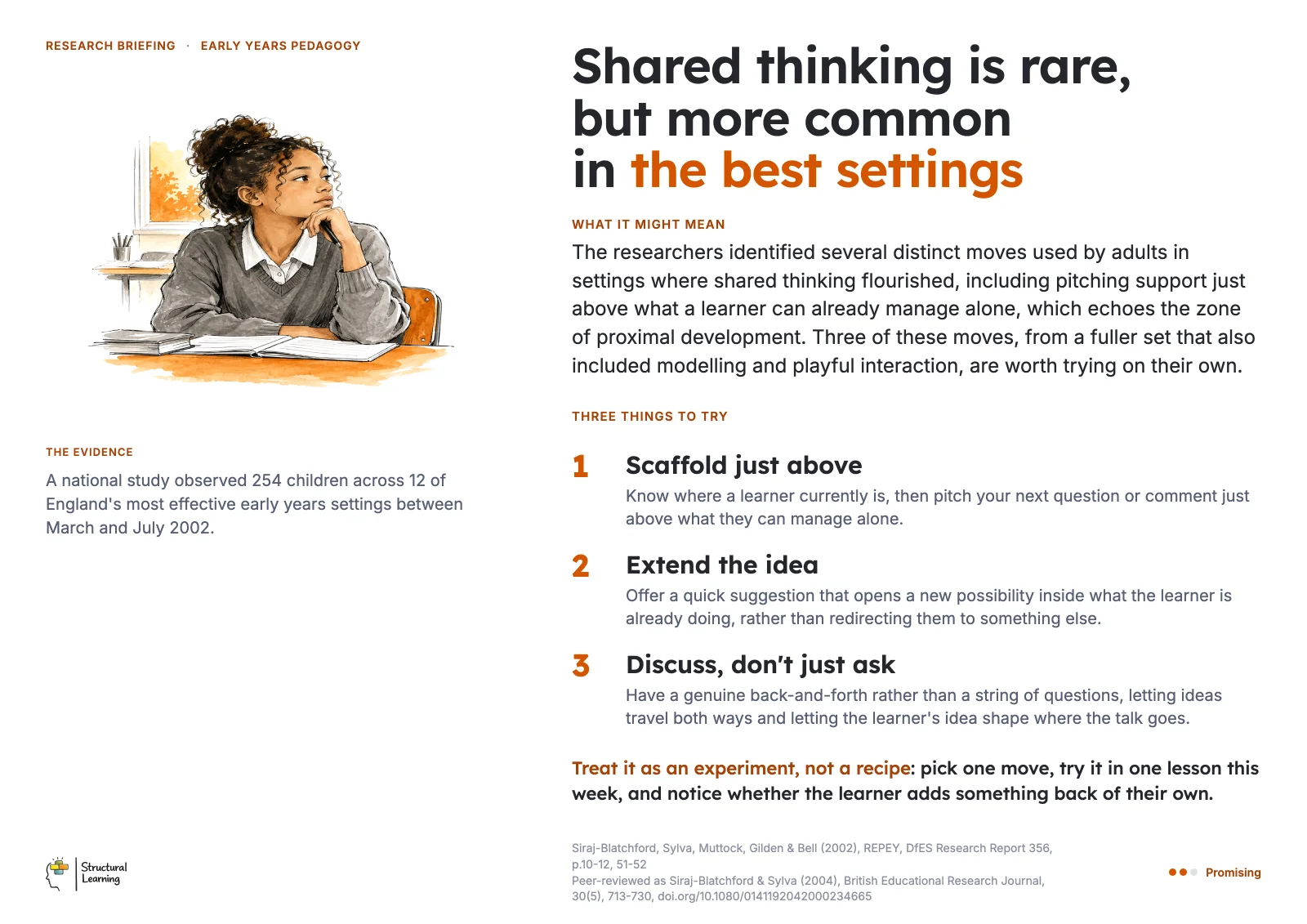
The researchers described several distinct moves used by adults in the settings where shared thinking flourished. Pitching support just above what a learner can already manage alone echoes what education theorists have long called the zone of proximal development, and a genuine back-and-forth, rather than a string of questions, is a form of what our guide to dialogic pedagogy explores in more depth. Three of the moves the study observed, out of a fuller set that also included modelling and playful, humour-led interaction, are worth trying on their own.
Treat it as an experiment, not a recipe: pick one of these moves and try it in a single lesson this week, change nothing else, and notice whether the learner adds something back of their own, a new idea, a new word, a change of direction. That is your own evidence, not the study's.
This rates the firmness of the evidence, not the value of the idea itself, and it comes out as Promising. It is real, carefully coded observation in real English early years settings rather than a randomised trial, drawn from a small number of centres, 12 case-study settings with only 10 fully observed, inside a much larger 3,000-learner national study, so it cannot prove these moves alone caused the outcomes seen. The fieldwork is also now over two decades old, from 2002, and the report itself says full statistical detail was left for further technical publications that are not included here. Properly shared thinking was rare even in the best settings, and most likely in one-to-one or paired moments that do not come round often in a busy room. Treat the pattern itself, that shared thinking is rare, valuable, and more likely one-to-one, as well evidenced, and treat any single figure quoted from the study as an illustration of scale rather than a target to hit.
Siraj-Blatchford, I., Sylva, K., Muttock, S., Gilden, R., & Bell, D. (2002). Researching Effective Pedagogy in the Early Years (REPEY). DfES Research Report 356. Peer-reviewed as Siraj-Blatchford, I., & Sylva, K. (2004). Researching pedagogy in English pre-schools. British Educational Research Journal, 30(5), 713-730.
Structural Learning helps teachers turn findings like this into planned, visible thinking in the classroom. Open a free account and try it with your next lesson.
Open a free account →Made by the Structural Learning Evidence Engine. Every claim is traced to the source above and independently verified. See more briefings →