
early years and reception teachers
Early signal
✓ Citations verified
In the study that coined the word "scaffolding", one tutor working one-to-one with 30 three- to five-year-olds gave direct, hands-on help twice as often to three-year-olds as to four-year-olds, and four times as often as to five-year-olds. Her help fell away as each child's own skill grew, but the study itself only describes this pattern; it does not prove that fading the help is what caused the skill to grow.
Wood, D., Bruner, J. S., & Ross, G. (1976). 'The Role of Tutoring in Problem Solving.' Journal of Child Psychology and Psychiatry, 17(2), 89-100.
Free to download and share. No sign-up needed.
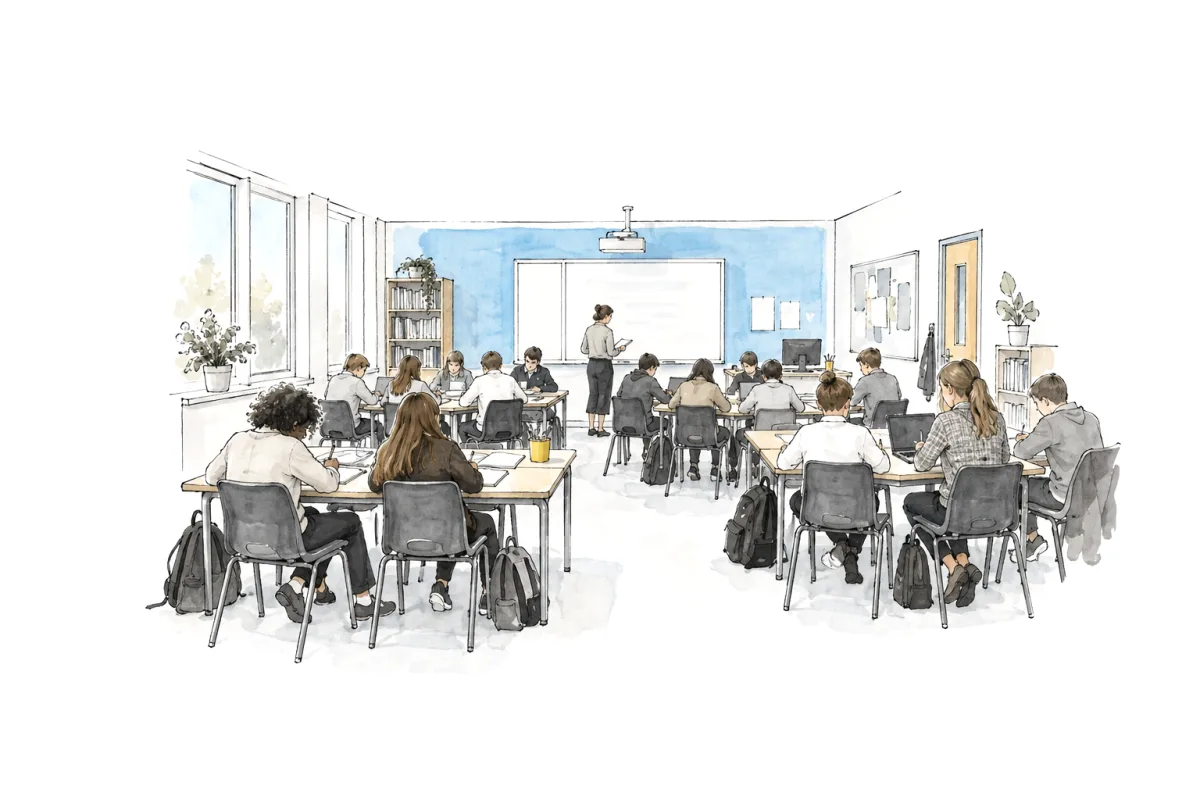
The gist. One tutor working one-to-one with 30 three- to five-year-olds gave direct, hands-on help twice as often to three-year-olds as to four-year-olds, and four times as often as to five-year-olds. Her help fell away as each child's own skill grew, but the study only describes this pattern; it does not prove that fading the help is what caused the skill to grow.
A single tutor sat one-to-one with 30 children, aged three, four and five, and helped each of them build a wooden block pyramid. She followed one rule throughout: always try telling before showing, and only step in more directly when a verbal instruction failed. She had no fixed script; each child's own success or failure decided her next move.
As the children got older, her direct, hands-on help fell sharply: a median of 12 instances per child at age three, halving to 6 at age four, and halving again to 3 at age five. The share of constructions each child completed with no help at all rose alongside it, from 64.5% at age three to 79.3% at age four and 87.5% at age five.
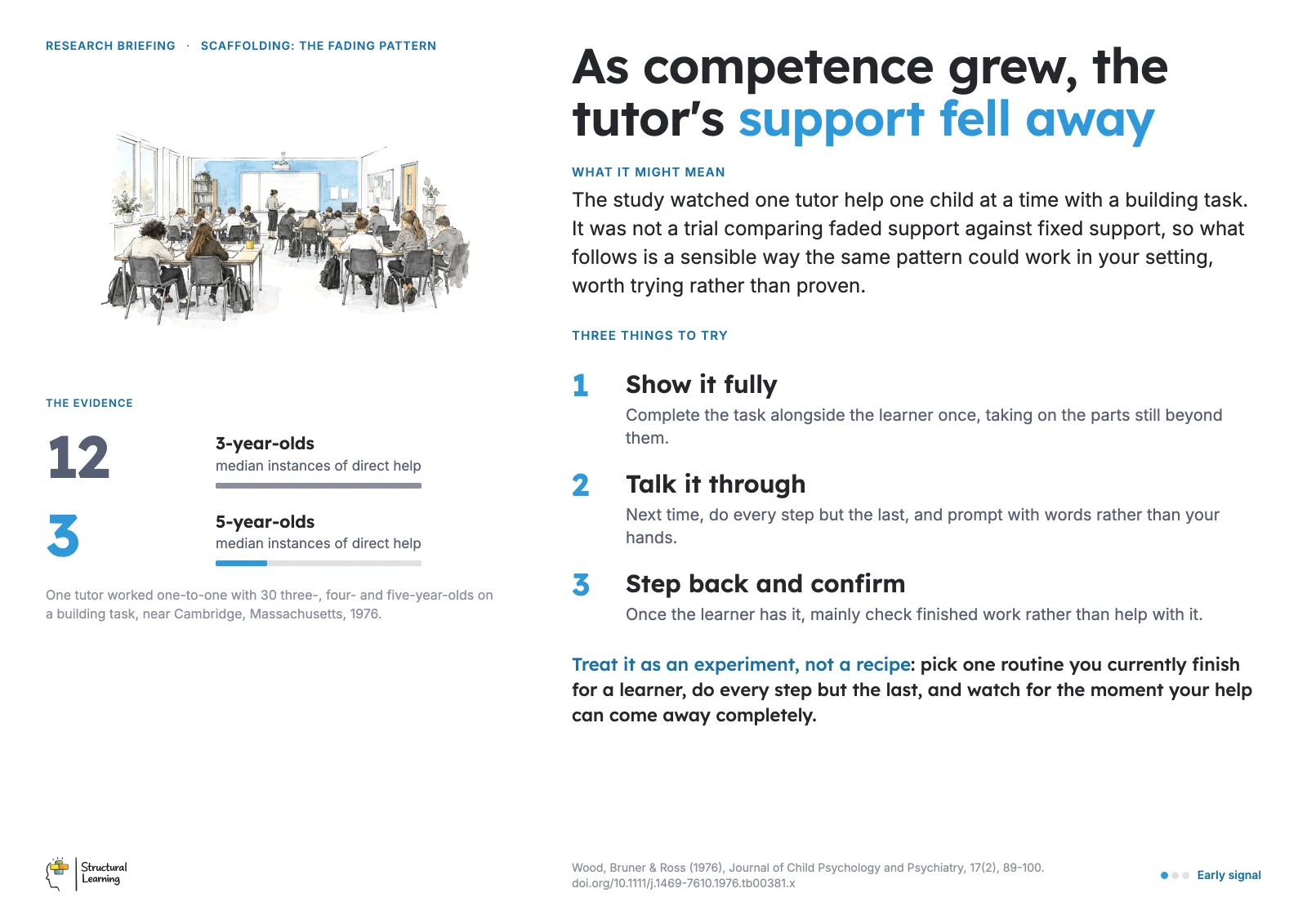
The study watched one tutor help one child at a time with a building task. It was not a trial comparing faded support against fixed support, so what follows is a sensible way the same pattern could work in your setting, worth trying rather than proven. It sits close to the sequence in our guide to scaffolding in education, and alongside ideas like the zone of proximal development.
Treat it as an experiment, not a recipe: pick one routine you currently finish for a learner, do every step but the last, and watch for the moment your help can come away completely.
This is an early signal, not a settled finding. The falling-support pattern is clear and consistent across several measures within the study, but there was no comparison group: every child received the same fading style of help, and the authors describe the work as a systematic description rather than a test of a hypothesis. Just one tutor, one of the paper's own authors, worked with all 30 children, split into only 10 per age band, in a US research playroom in 1976, not a UK classroom. The design also cannot separate fading support from growing competence, since age, practice and skill are all tangled together in this kind of study. A controlled UK classroom study using multiple tutors, and separating fading support from growing competence, would test the pattern properly.
Wood, D., Bruner, J. S., & Ross, G. (1976). 'The Role of Tutoring in Problem Solving.' Journal of Child Psychology and Psychiatry, 17(2), 89-100.
Structural Learning helps teachers turn findings like this into planned, visible thinking in the classroom. Open a free account and try it with your next lesson.
Open a free account →Made by the Structural Learning Evidence Engine. Every claim is traced to the source above and independently verified. See more briefings →