
secondary teachers
Developing
✓ Citations verified
A signal about visibility, not willpower: in two university experiments, a phone visible on the desk quietly narrowed people's working memory and reasoning even when nobody touched it or thought about it, but only "in another room" clearly beat "on the desk" (a phone in a pocket or bag landed in between and wasn't clearly different from either), and the effect hasn't shown up reliably in every later replication.
Ward, A. F., Duke, K., Gneezy, A., & Bos, M. W. (2017). Brain Drain: The Mere Presence of One's Own Smartphone Reduces Available Cognitive Capacity. Journal of the Association for Consumer Research, 2(2), 140-154.
Free to download and share. No sign-up needed.

The gist. In two carefully designed experiments with 795 university learners, having a phone visible on the desk, even switched off and untouched, was linked to lower working memory and reasoning scores than having it in another room; a phone tucked in a pocket or bag landed in between and wasn't clearly different from either end.
Researchers at the University of Texas and UC San Diego randomly assigned participants to keep their phone on the desk (face down or face up), in their pocket or bag, or in a separate room, then sat two standard cognitive tests: a working memory task and ten reasoning puzzles from Raven's Matrices. Across two separate experiments, 520 learners then 275 more, those with their phone in another room scored higher on both tests than those with a phone on the desk, and the size of that gap held up almost exactly the second time round.
Silencing the phone or switching it off completely made no measurable difference, which rules out incoming notifications as the explanation. Almost all participants said afterwards that their phone's location had "not at all" affected their performance, so this wasn't something anyone noticed happening in the moment.
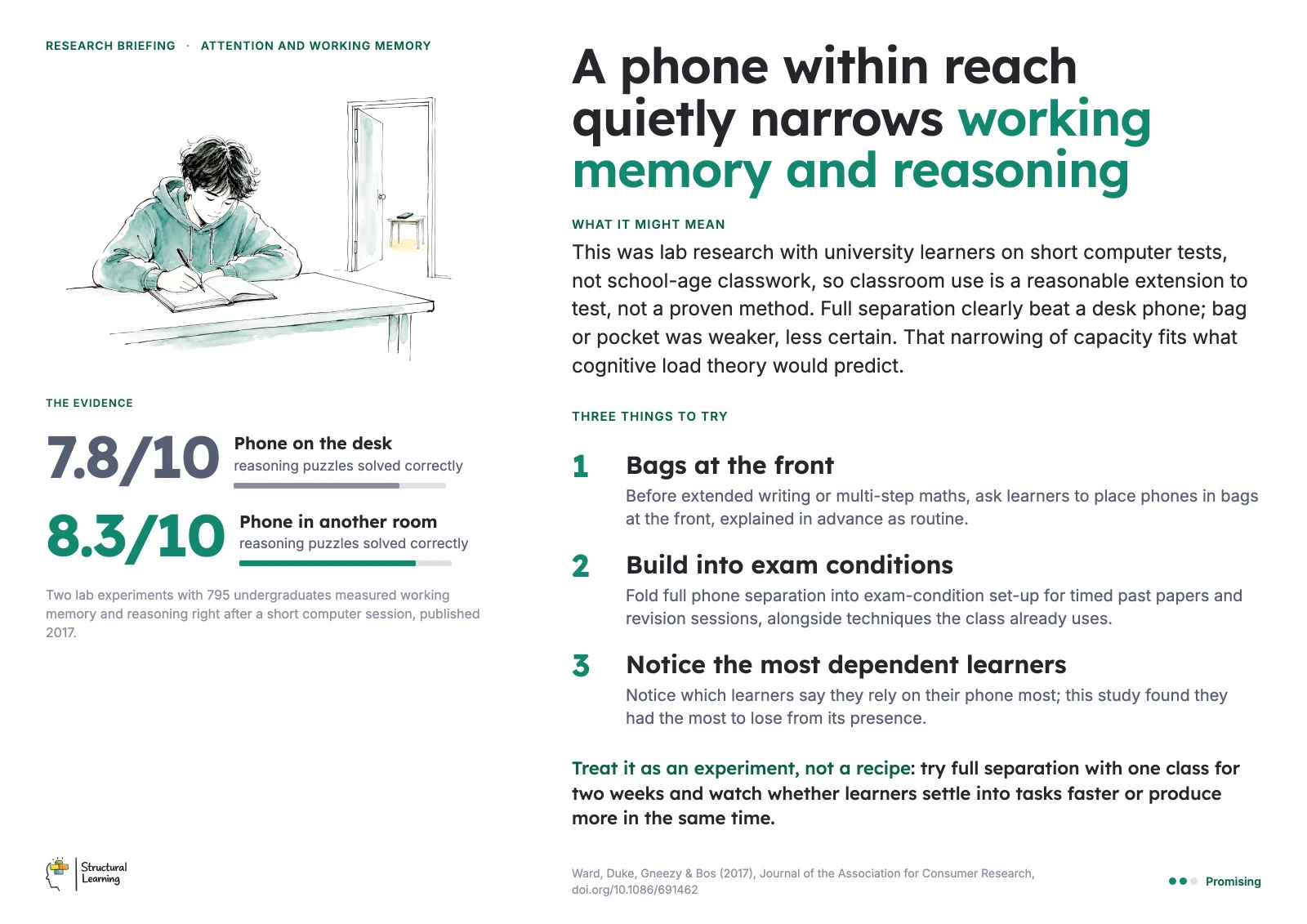
This was lab research with university learners doing short, computer-based tests, not school-age learners doing real classwork, so any classroom use is a reasonable extension worth testing rather than a proven method. The clearest, safest reading is that full separation beats a phone on the desk; a phone tucked in a bag or pocket is a weaker, less certain middle step. That narrowing of available working memory capacity is exactly the kind of thing cognitive load theory would predict from anything competing for attention during a demanding task.
Treat it as an experiment, not a recipe: try full separation with one class for two weeks and watch whether learners seem to settle into tasks faster or produce more in the same time, rather than assuming it will work the same way for every subject or every learner.
Rated Promising. Two well-powered, properly randomised experiments show a consistent pattern, and the effect survived checks meant to rule out simpler explanations like distraction from notifications. But the clean, statistically solid result is specifically "another room beats the desk": a phone in a pocket or bag was never clearly different from either end in either experiment. Both experiments tested university learners in a single lab sitting, not school-age learners across a lesson or a revision period, and a later pooled analysis of 22 studies found the effect was real but small and inconsistent across settings. Treat this as a promising, small-scale nudge worth trying before working-memory-heavy tasks, not a guaranteed fix.
Ward, A. F., Duke, K., Gneezy, A., & Bos, M. W. (2017). Brain Drain: The Mere Presence of One's Own Smartphone Reduces Available Cognitive Capacity. Journal of the Association for Consumer Research, 2(2), 140-154.
Structural Learning helps teachers turn findings like this into planned, visible thinking in the classroom. Open a free account and try it with your next lesson.
Open a free account →Made by the Structural Learning Evidence Engine. Every claim is traced to the source above and independently verified. See more briefings →