
classroom teachers
Developing
✓ Citations verified
A widely used classroom-talk guide distils decades of research into nine practical prompts for deepening discussion. Four of the simplest to start with: pause longer, ask for reasoning, invite a learner to add on, and check you've understood by restating it back.
Michaels, S., & O'Connor, C. (2012). Talk Science Primer. Cambridge, MA: TERC.
Free to download and share. No sign-up needed.
The gist. A widely used classroom-talk guide distils decades of research into nine practical prompts for deepening discussion. Four of the simplest to start with: pause longer, ask for reasoning, invite a learner to add on, and check you've understood by restating it back.
Sarah Michaels and Cathy O'Connor's Talk Science Primer distils twenty years of classroom discourse research into nine practical "talk moves", sorted under four goals: helping learners share their thinking, listen to each other, deepen their reasoning, and build on each other's ideas.
The most researched of the four highlighted moves, Wait Time, comes with the primer's one hard number. Across many classrooms and subjects, pausing three seconds or more after a question changed several things at once: learners' answers grew 300% to 700% longer, they explained their thinking with more evidence, they asked more questions themselves, and they talked to each other more, not just to the teacher (Michaels and O'Connor, 2012, citing Rowe, 1986). No confidence interval is given for this range in the primer.
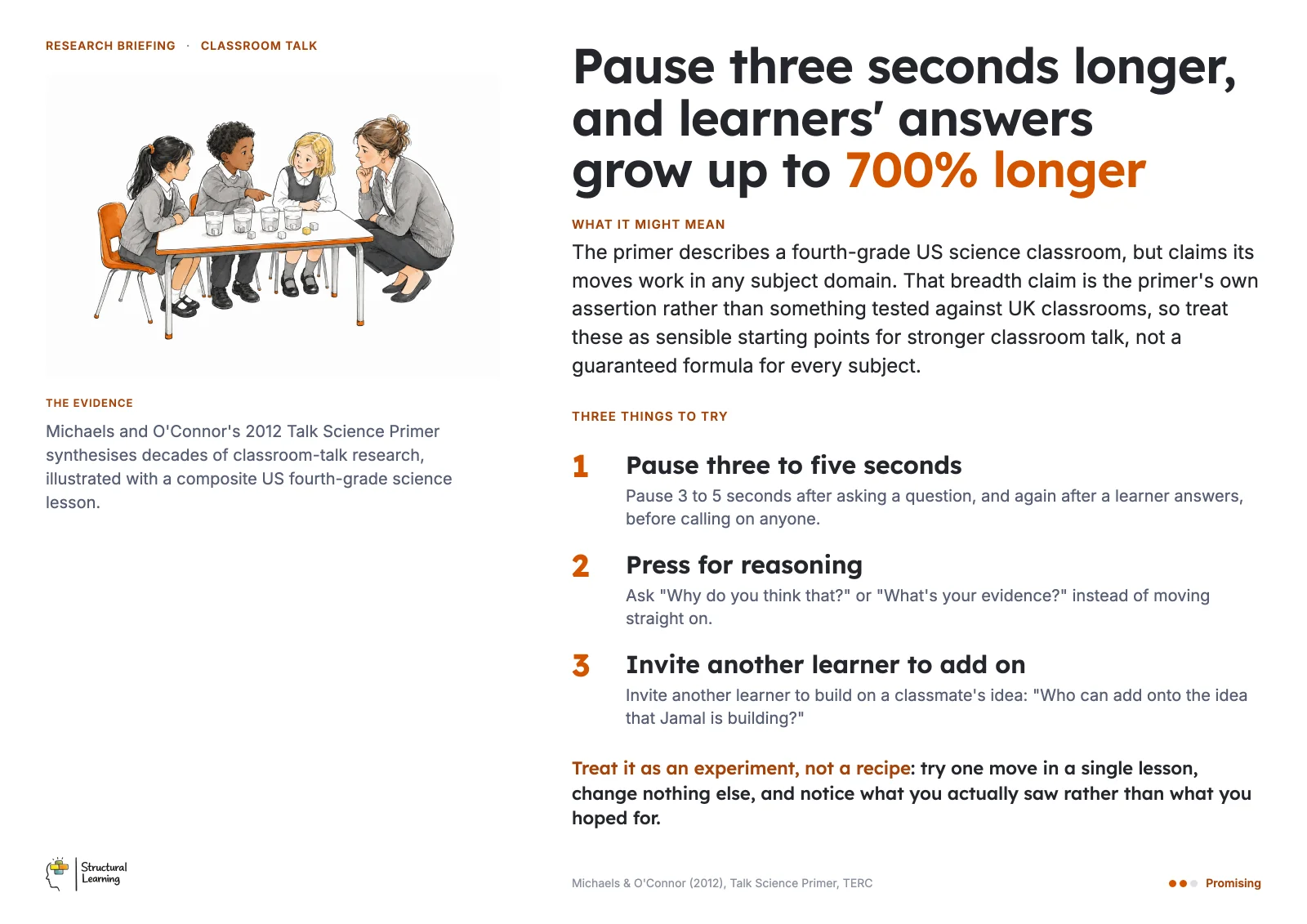
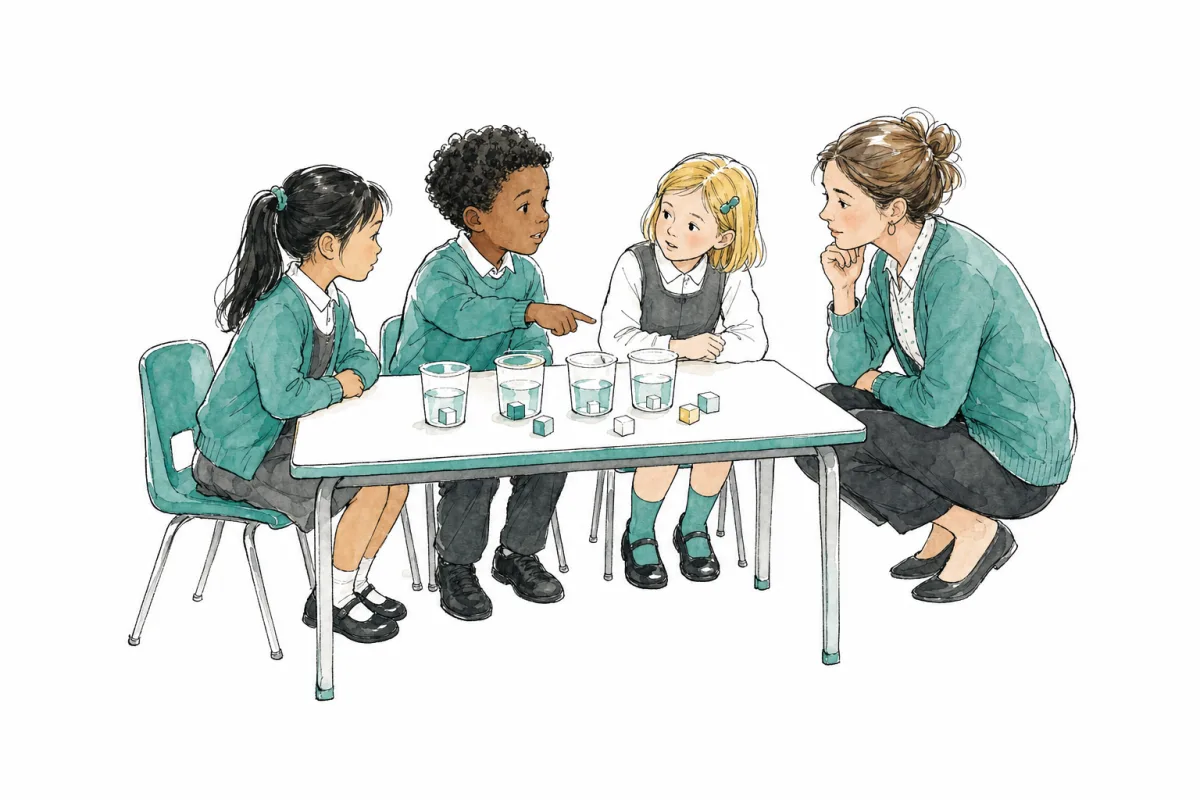
The primer describes a fourth-grade US science classroom, but it claims the moves work "in any subject domain". That breadth claim is the primer's own assertion rather than something tested against UK classrooms here, so treat these as sensible starting points for building stronger classroom talk, not a guaranteed formula for every subject. A fourth move from the same primer, checking you've understood by restating a learner's point back and asking them to confirm it, works alongside the three below.
Treat it as an experiment, not a recipe: try one move in a single lesson, change nothing else, and notice what you actually saw rather than what you hoped for. This kind of structured noticing sits well alongside a wider metacognition practice, where learners reflect on their own thinking as well as share it.
We rate this evidence Promising: a widely used synthesis of decades of classroom-talk research, not a new study with its own sample or control group, carrying one precisely quantified finding and three moves offered as well-established practice. Only Wait Time comes with a specific number attached, and that figure, answers growing 300% to 700% longer, is credited to Mary Budd Rowe's 1986 research as cited by the primer, with no confidence interval or sample size given here. It's a US guide written for science lessons; the primer itself says the moves work in any subject, but that breadth claim isn't tested against UK classrooms in this document. Worth building as a low-cost habit, especially Wait Time, which needs no new phrasing, just a longer pause. Treat the other moves as sensible, well-established prompts to try rather than a guaranteed formula, alongside a broader dialogic teaching approach to classroom talk.
Michaels, S., & O'Connor, C. (2012). Talk Science Primer. Cambridge, MA: TERC.
Structural Learning helps teachers turn findings like this into planned, visible thinking in the classroom. Open a free account and try it with your next lesson.
Open a free account →Made by the Structural Learning Evidence Engine. Every claim is traced to the source above and independently verified. See more briefings →