
school leaders and cpd leads
Developing
✓ Citations verified
Across 104 randomised trials, CPD that built insight, set a goal, taught a technique AND helped teachers embed it in practice showed three times the average effect of CPD missing one of those four, though that headline gap comes from just nine studies and is not yet statistically secure.
Sims, S., Fletcher-Wood, H., O'Mara-Eves, A., Cottingham, S., Stansfield, C., Goodrich, J., Van Herwegen, J., & Anders, J. (2025). 'Effective Teacher Professional Development: New Theory and a Meta-Analytic Test.' Review of Educational Research, 95(2), 213-254. https://doi.org/10.3102/00346543231217480
Free to download and share. No sign-up needed.

The gist. A meta-analysis of 104 randomised trials found that teacher CPD landed harder when it built insight, set a goal, taught the technique and helped teachers embed it in practice, though the headline gap comes from just nine studies and is not yet statistically secure.
Researchers combined a systematic review and meta-analysis of 104 randomised controlled trials of teacher CPD, searching English-language studies from OECD countries published since 2002. Across the whole sample, the average effect on learners' standardised test scores was small (d = 0.05), matching what earlier reviews have found.
Programmes that built in more of 14 specific, evidence-based design features, such as goal-setting, modelling, feedback and rehearsal, tended to show bigger gains. CPD covering all four purposes, Insight, Goals, Techniques and Practice, averaged an effect of 0.15 across nine trials, compared with 0.05 across ninety-five trials that missed at least one purpose. With so few balanced-design trials, that gap is not statistically significant at conventional levels (p = .22).
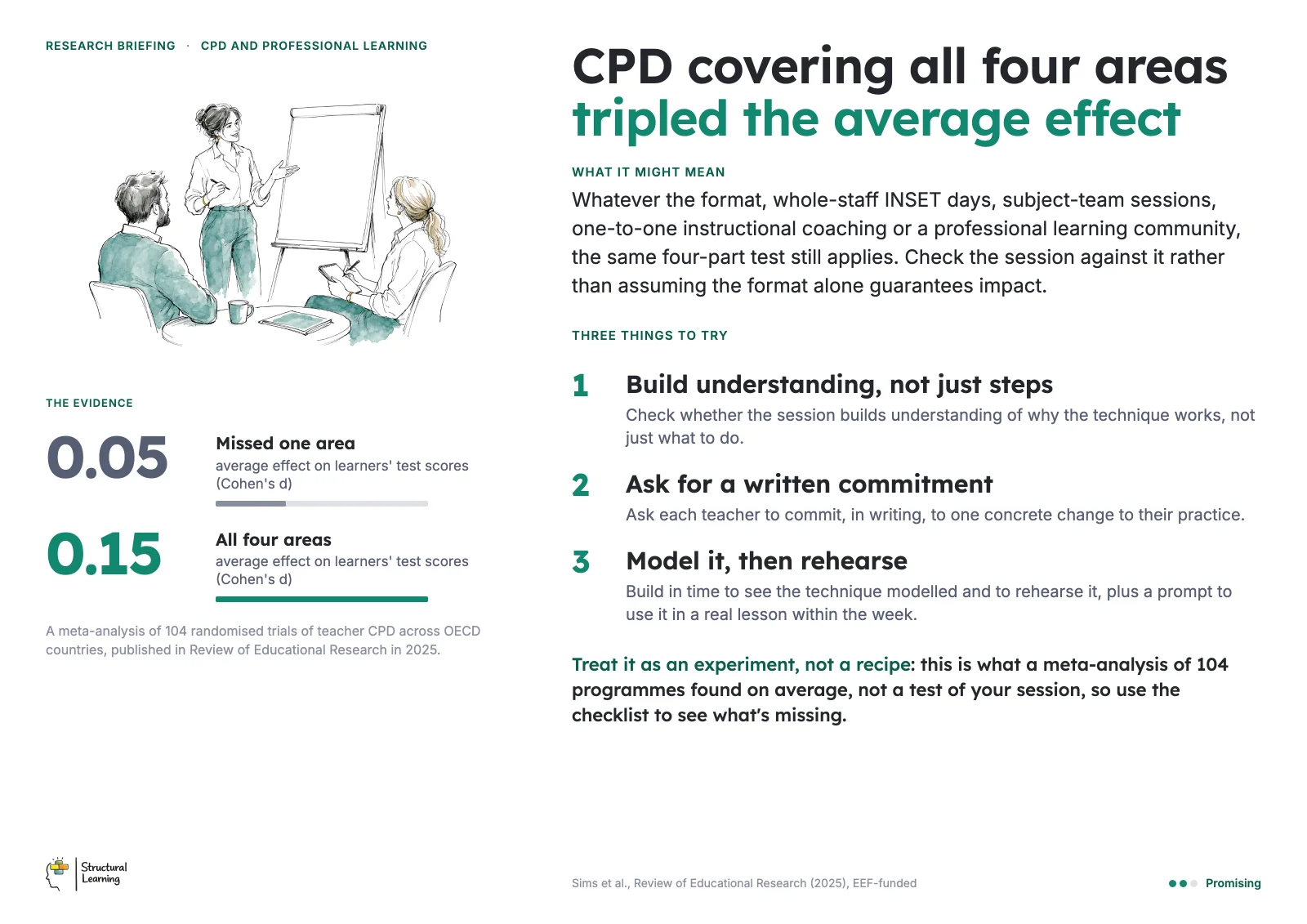
Whatever the format, whole-staff INSET days, subject-team sessions, one-to-one instructional coaching or a professional learning community, check it against the same four-part test rather than assuming the format alone guarantees impact.
Treat it as an experiment, not a recipe: this is what a meta-analysis of 104 programmes found on average, not a test of your specific session, so use the checklist to see what's missing rather than as a guaranteed formula. If you want to go further, our guide to designing CPD programmes covers how to structure the whole cycle.
This rates Promising. A pre-registered systematic review and meta-analysis of 104 randomised trials is about as rigorous as classroom CPD research gets, but the headline finding needs more evidence. The balanced-CPD comparison rests on only nine trials against ninety-five imbalanced ones, and the gap is not statistically significant at conventional levels (p = .22). The link between more design features and bigger effects also weakens when the analysis is limited to studies that pre-registered their design in advance (p = .32), and two authors agreed on only 82% of mechanism judgements when double-coding a sample of the papers. Treat covering all four purposes as a sensible checklist backed by a rigorous review, not a guaranteed formula.
Sims, S., Fletcher-Wood, H., O'Mara-Eves, A., Cottingham, S., Stansfield, C., Goodrich, J., Van Herwegen, J., & Anders, J. (2025). 'Effective Teacher Professional Development: New Theory and a Meta-Analytic Test.' Review of Educational Research, 95(2), 213-254.
Structural Learning helps teachers turn findings like this into planned, visible thinking in the classroom. Open a free account and try it with your next lesson.
Open a free account →Made by the Structural Learning Evidence Engine. Every claim is traced to the source above and independently verified. See more briefings →