
primary, secondary and post-16 teachers
Developing
✓ Citations verified
Asking learners to explain why a fact is true carries a real, moderate boost to learning (d = 0.56 across 254 comparisons and 2,138 learners), but the boost depends on how it's done: it's bigger when the explanation is precise, self-generated and builds on more prior knowledge, and it helps surface recall more reliably than deep understanding.
Donoghue, G. M., & Hattie, J. A. C. (2021). A Meta-Analysis of Ten Learning Techniques. Frontiers in Education, 6, Article 581216. https://doi.org/10.3389/feduc.2021.581216
Free to download and share. No sign-up needed.

The gist. Asking learners to explain why a fact is true carries a real, moderate boost to learning: d = 0.56 across 254 comparisons and 2,138 learners. How much it helps depends on how the question is asked, and it works more reliably for surface recall than for deep understanding.
Elaborative interrogation, prompting learners to explain why a stated fact or idea is true, was first identified as one of ten popular questioning techniques by Dunlosky et al. (2013). A later synthesis by Donoghue and Hattie (2021) quantified it directly: across 254 separate comparisons and 2,138 learners, the technique produced a moderate positive effect on learning (d = 0.56), landing inside the researchers' own “Moderate” band of 0.54 to 0.69. The purpose of the “why” question is to help learners connect new information to what they already know, the same link at the heart of cognitive load theory.
The effect varies by phase: d = 0.38 at primary level, d = 0.71 at secondary, and d = 0.58 at university, based on 28 primary, 84 secondary and 110 university-level comparisons (Donoghue & Hattie, 2021, Table 3). Primary-level evidence for this technique specifically is thinner than secondary or university.
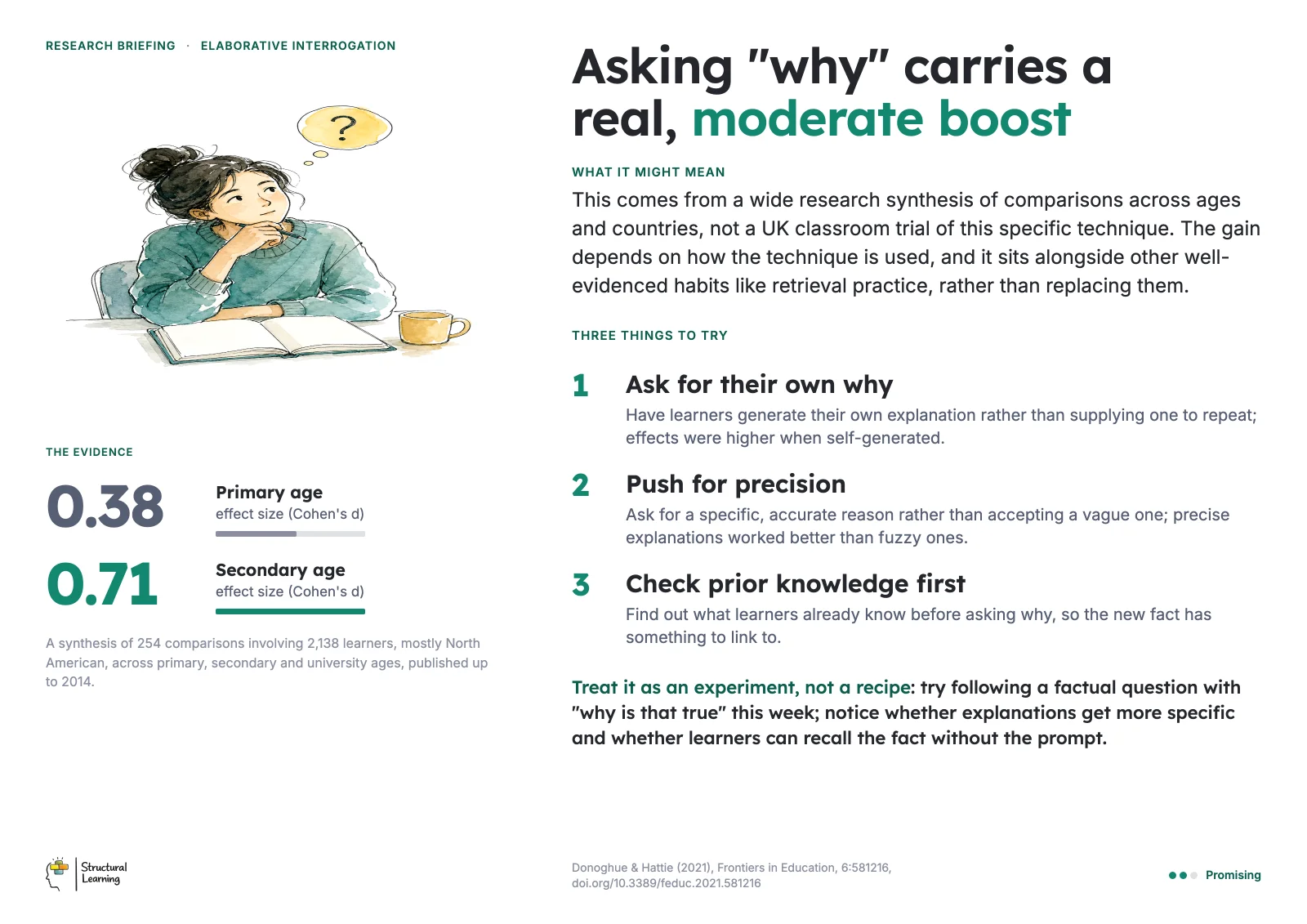
This comes from a wide research synthesis of comparisons across ages and countries, not a UK classroom trial of this specific technique. The three moves below follow from what raised the effect in the underlying studies, and sit alongside other well-evidenced habits like retrieval practice.
Treat it as an experiment, not a recipe: try following a factual question with “why is that true” this week, and don't accept a vague answer. Notice whether learners' explanations get more specific over a few weeks, and whether they can recall the fact later without the prompt. That's your own evidence, not ours, and the underlying research says more about straightforward recall than about deep understanding.
The evidence here is graded Promising: a large, consistent synthesis (d = 0.56, just inside the researchers' own “Moderate” band of 0.54 to 0.69), but the effect depends heavily on how it's implemented. The source doesn't report the effect size for the weakest combination of moderators, so the floor when it's done poorly is unknown, and in the authors' own words the technique “is more applicable to surface than to deep understanding”. No new data has been added to this evidence base since 2014, and primary-level evidence is much thinner (28 comparisons) than secondary (84) or university (110). Treat “ask why, and insist on a precise, learner-generated answer” as a well-evidenced questioning habit worth using routinely for surface recall, not a guaranteed route to deep understanding on its own.
Donoghue, G. M., & Hattie, J. A. C. (2021). ‘A Meta-Analysis of Ten Learning Techniques.’ Frontiers in Education, 6, Article 581216.
Structural Learning helps teachers turn findings like this into planned, visible thinking in the classroom. Open a free account and try it with your next lesson.
Open a free account →Made by the Structural Learning Evidence Engine. Every claim is traced to the source above and independently verified. See more briefings →