
school leaders
Early signal
✓ Citations verified
A feasibility signal, not evidence of impact: when one US medical school sent 120 new medical learners an eight-week AI-drafted study-skills programme by email, PDF and podcast, two-thirds completed the follow-up survey and those who engaged more also rated it more useful, but engagement and perceived benefit were both self-reported on the same survey, with no comparison group and no measure of any actual change in study habits or grades.
Pishko, C., Weinstein, T. J., Bergen, J., Kowalek, K., Butler, D. C., Situ-LaCasse, E., & Amini, R. (2026). Feasibility and Perceived Impact of an AI-Assisted Pre-Matriculation Study Strategies Curriculum for Incoming Medical Students. Cureus. Published online 2026-07-01.
Free to download and share. No sign-up needed.

The gist. When one US medical school sent 120 new medical learners an eight-week, AI-drafted study-skills programme by email, PDF and podcast, two-thirds completed the follow-up survey and those who engaged more also rated it more useful. The short email was read far more than the podcast. But engagement and perceived benefit were both self-reported on the same survey, with no comparison group and no measure of any actual change in study habits or grades, so this is a feasibility signal, not evidence of impact.
All 120 incoming learners at the University of Arizona College of Medicine-Tucson were sent an eight-week, AI-drafted study-strategies curriculum by weekly email, PDF summary and short podcast, built from peer-reviewed learning-science literature and reviewed by a senior educator before each send. Drafting used ChatGPT and NotebookLM, and the whole build took about four hours a week. Two-thirds of learners, 78 of 120 (65%), completed an anonymous survey at orientation.
Engagement varied sharply by channel: the average learner read 3.58 of the 8 emails, reviewed 2.29 of the 8 PDFs, and listened to just 1.03 of the 8 podcasts. Perceived benefit was real but modest, with helpfulness rated 2.95 of 5, the series rated as somewhat introducing new techniques (2.09 of 3), and moderate scores for influence on approach (2.58 of 5) and likelihood of applying the strategies (3.10 of 5). More engagement went with more perceived benefit: emails read correlated with helpfulness (r=0.503), new techniques (r=0.302), influence on approach (r=0.522) and likelihood of applying (r=0.612), all statistically significant. Perceived benefit did not differ significantly by first-generation status, prior study-strategy instruction, or route into medical school.
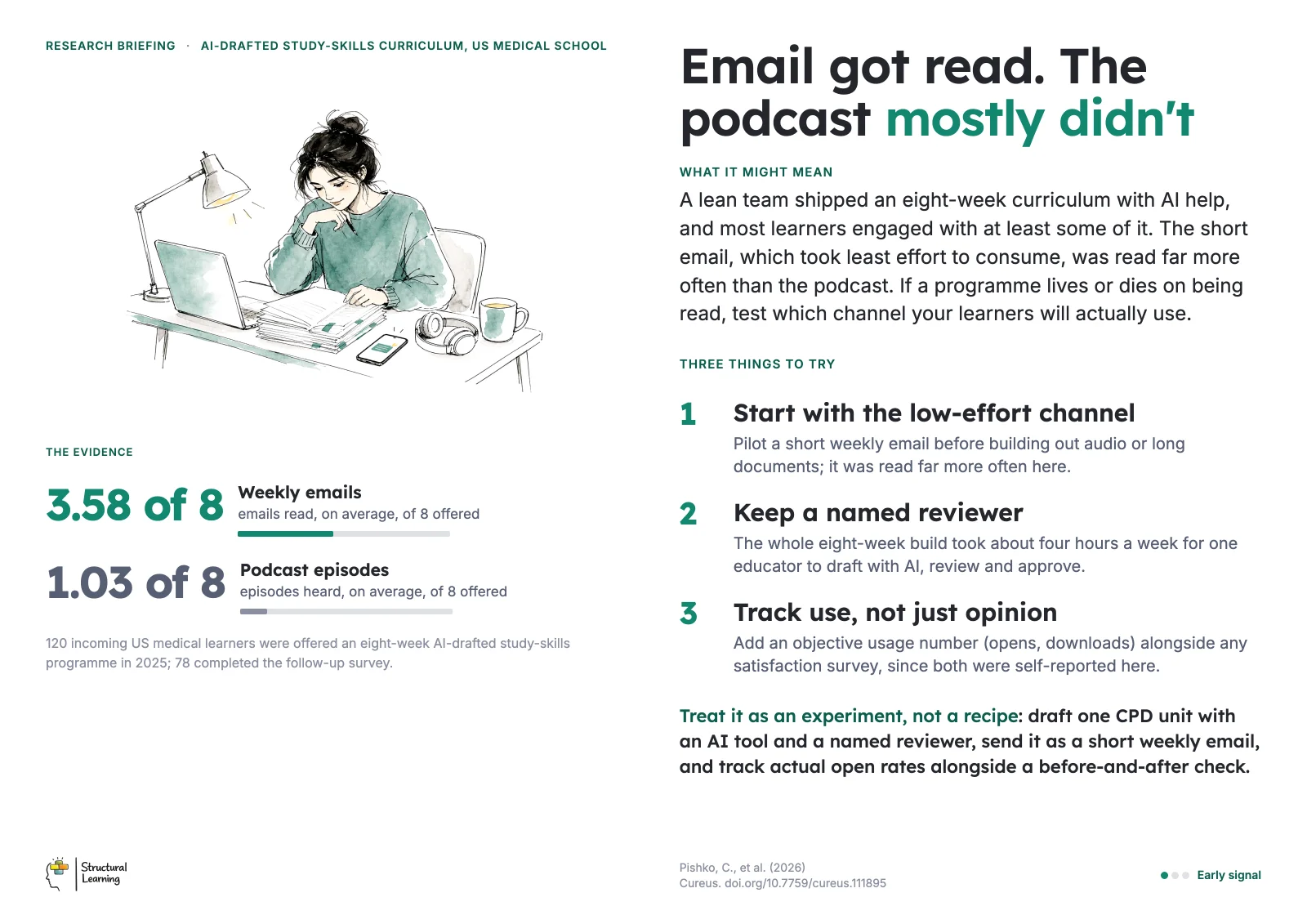
The notable part of this account is not that an AI tool can help draft a study-skills curriculum, it is that a lean team could ship one, most incoming learners engaged with at least some of it, and the channel that took the least effort to consume, a short email, was read far more often than the podcast. If a similar programme lives or dies on being read rather than merely written well, it is worth testing which channel your own staff or learners will actually use before building every format.
Treat it as an experiment, not a recipe: draft one multi-week induction or CPD unit with an AI tool and a single named reviewer, send the core content as a short weekly email, and track actual open or completion rates alongside a simple before-and-after check.
This is an Early signal: one institution's own account of a curriculum it built and evaluated itself, worth testing further, not proof it changes behaviour. It is a single-group, cross-sectional survey at one US medical school, with no control group and no baseline measure of study behaviour or attitudes. Both halves of the headline, how much learners engaged and how helpful they found it, came from the same survey, so more engagement, more benefit could equally mean that more positive learners answered everything more positively. There was no objective usage data, since email open rates, PDF downloads and podcast analytics were not available, and nothing about actual study habits, grades or wellbeing was measured. The authors themselves call their subgroup and correlational analyses exploratory and hypothesis-generating, run without correction for multiple comparisons, and note that the voluntary 65% response rate may have drawn the more motivated learners. A version run across several schools, with an objective usage measure and a comparison group, would raise the grade to Promising.
Pishko, C., Weinstein, T. J., Bergen, J., Kowalek, K., Butler, D. C., Situ-LaCasse, E., & Amini, R. (2026). Feasibility and Perceived Impact of an AI-Assisted Pre-Matriculation Study Strategies Curriculum for Incoming Medical Students. Cureus. Published online 2026-07-01. Published open access under a Creative Commons Attribution (CC BY 4.0) licence.
Structural Learning helps teachers turn findings like this into planned, visible thinking in the classroom. Open a free account and try it with your next lesson.
Open a free account →Made by the Structural Learning Evidence Engine. Every claim is traced to the source above and independently verified. See more briefings →