Updated on
September 11, 2026
Evidence-Informed Practice: Developing Research-Literate
Learn how to develop evidence-informed practitioners in schools. Engage with research, evaluate evidence, and translate findings into classroom practice.


Updated on
September 11, 2026
Learn how to develop evidence-informed practitioners in schools. Engage with research, evaluate evidence, and translate findings into classroom practice.
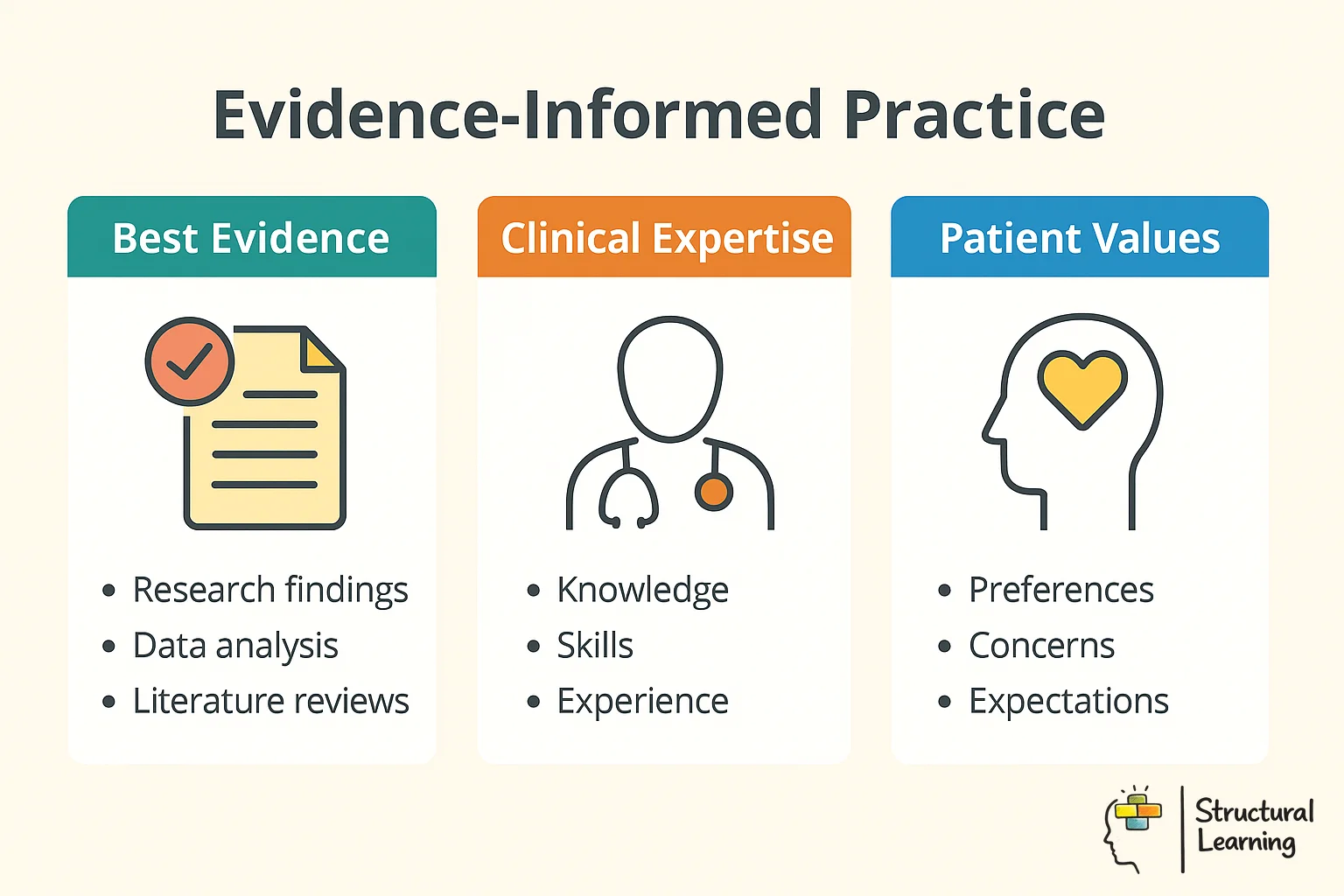
Evidence-Informed Practice: Developing Research-Literate shows how teachers combine the best available research, professional expertise and the lived experience of learners and families (Biesta, 2007). Together, these sources support classroom decisions that are effective, ethical and suited to context. This is not a script for copying research into lessons. It is a careful way to ask whether a strategy has credible evidence, whether it fits this class, and how its impact will be checked.
In a Year 5 reading lesson, this might mean using reciprocal teaching because evidence supports structured dialogue. The teacher would then adapt the prompts for EAL learners and review reading responses after three weeks. The aim is practical research literacy: teachers use studies, local data and classroom judgement together. They also avoid weak claims such as learning styles and one-size-fits-all effect-size rankings.
Teachers use research in class to inform practice (Cochrane, 2005). They blend research with experience and reflection (Schön, 1983). Schools need research access, collaboration time and leadership that values questions (Stoll et al., 2006). Hattie (2009) argued that visible evidence of learning can help teachers adjust classroom decisions.
EIP uses research and learner knowledge (Slavin, 2020). It adapts research for classrooms, going beyond direct evidence use. Rosenshine (2012) set out principles that help teachers plan explicit explanation, guided practice and review within an evidence-informed approach.
Research informs teaching practice when teachers look at evidence, not just instinct (Hattie, 2009). Groups across sectors, such as the Australian Institute of Family Studies (AIFS), HMPPS Insights, Research in Practice and the National Institutes of Health, make a similar distinction between evidence-based practice and evidence-informed judgement. In classrooms, the key question is whether the research fits the subject, the learners and the conditions for implementation (Coe, 2002; Wiliam, 2018).
Biesta (2007) warned that research should inform teachers, not control their decisions. Goldacre (2013) remains an important policy marker, but its medical model of education needs care. This is because classrooms are moral, cultural and relational settings.
Current teacher development policy, including the DfE's Initial Teacher Training and Early Career Framework, places research evidence alongside professional judgement, subject knowledge and context (DfE, 2024). Cochran-Smith and Lytle (1999) and McIntyre (2005) make the same practical point: teacher knowledge and local context are evidence, not noise.
In schools, evidence-based language can be used badly when leaders turn EEF strands, effect sizes or cognitive science principles into a compliance checklist. That is not evidence-informed practice. It removes the professional judgement needed to decide whether a strategy fits the subject, year group, SEND profile and cultural context. A research principle can also suffer a lethal mutation: the label remains, but the teaching loses the mechanism that made the evidence persuasive.
Evidence helps teachers avoid fads and choose strategies that work, according to research. This approach uses research, teacher expertise, and learner understanding to boost results. It saves classroom time by avoiding unproven methods like learning styles (Pashler et al., 2008) or Brain Gym (Hyatt, 2007).
Education has seen unsupported fads and trends. Kirschner et al. (2006) warned that minimal guidance can fail when learners lack the prior knowledge to learn independently. Learning styles and Brain Gym should be named as neuromyths, not harmless preferences, because they lack strong classroom evidence (Pashler et al., 2008; Dekker et al., 2012). Evidence-informed practice helps teachers test such claims before they become routine.
The EEF says evidence can help learners make better progress. Slavin (2020) found that research helps teachers choose better methods. Hattie (2008) showed that evidence helps teachers avoid strategies that do not work.
Teachers who use research gain confidence and job satisfaction (Chartered College of Teaching). Research improves judgement because it gives teachers useful information for learners. It expands teacher choices rather than reduces them.
Research (Slavin, 2020), teacher experience, and learner knowledge inform teaching. Each source plays a part. Teachers use all three to make good choices.
Evidence-informed practice draws on three connected sources. Research evidence matters. Practitioner inquiry, qualitative evidence, learner voice and local data also matter when the question is about meaning, barriers or classroom fit.
Research from education and cognitive science informs this. Strong sources include reviews and trials (EEF Teaching and Learning Toolkit). They give summaries of research on common approaches. (EEF, n.d.; Slavin, 2008; Hattie, 2009).
Teachers gain practical knowledge from experience. They learn what works and how to adapt strategies for learners. Managing classrooms becomes easier with time. This helps teachers use research well, especially with SEND learners (Shulman, 1986; Berliner, 1994; Eraut, 1994).
Know your learners, school, resources, and community to aid context. Use local data like assessment results and attendance (Hargreaves, 1999). Learner feedback offers valuable insights for you (Stoll et al., 2006). Adapt strategies; what works elsewhere may fail locally (Fullan, 2007).
Peer review, sample size, and methodology help teachers judge research quality. Replication studies show how strong findings are. Check for classroom tests with similar results in different settings. Cain (2014) says effect sizes and control groups help spot strong findings.
Teachers must assess research quality. Think critically about what matters (Coe, 2002). Check the study's design (Gorard, 2002) and the sample used (Yates, 2004). Does the research apply to your learners in class (Hattie, 2008)?
Look at the sample size, setting and population. Small studies, or studies in very different places, may not transfer to your class. A university lab study may not suit primary learners in busy classrooms. Evidence drawn mainly from Western, Educated, Industrialised, Rich and Democratic samples can also miss how strategies work for EAL learners, SEND learners and communities with different cultural expectations (Henrich et al., 2010).
Learner gains may be from maturation or repeated tests (Campbell & Stanley, 1963). Check for a suitable comparison group in the research. Judging the real impact is hard without one (Shadish, Cook & Campbell, 2002). Other factors may cause improvements (Campbell & Stanley, 1963).
Think about research sources. Organisations selling services may bias findings, even without meaning to (Bero, 2005). Check who paid for the research (Lexchin et al., 2003). Investigate studies for possible bias (Krimsky & Rothenberg, 2001).
Individual studies can mislead, even when they are well designed. Replicated research gives stronger findings because other studies have tested the same idea. In 2026, teachers also need to check AI-generated lesson plans and CPD summaries, as large language models can invent studies, authors and effect sizes that look plausible. Williamson, Macgilchrist and Potter (2023) argue that AI in education must be examined as part of wider data and automation systems, not treated as a neutral research assistant.
Effect size can help teachers judge practical impact, but it is not a league table. Cohen's d depends on study design, outcome measure, sample and comparison group (Cohen, 1988; Lipsey & Wilson, 2001). Simpson (2017) and Bergeron (2017) warn that averaging unlike studies can hide serious differences, so teachers should ask what was measured, with whom and under what conditions before treating a high number as a priority.
Peer review makes journal research more reliable, but teachers also need to check their own data habits. Confirmation bias can make a familiar strategy look successful because we notice examples that fit what we expect (Nickerson, 1998). Before a trial, agree success measures and compare results with baseline data. Ask a colleague to challenge your reading of the data before changing whole-school practice.
Ebbinghaus (1885) found that spaced repetition helps learners remember more. Vygotsky (1978) explains why teachers should set support just beyond what learners can do alone. Karpicke (2008) shows that retrieval strengthens later learning.
Palincsar and Brown (1984) showed that reciprocal teaching helps learner comprehension. Skinner's (1953) behaviour strategies can guide learners well. Teachers use research and practical experience to boost learning.
Ebbinghaus (1885) showed spaced repetition improves long-term memory. Teachers, revisit key topics with increasing gaps. Cepeda et al (2008) found this works better than cramming for learners.
Palincsar and Brown (1984) found reciprocal teaching helps reading comprehension. In this approach, learners guide talk by summarising texts, asking questions, clearing up points and predicting what comes next. Teachers first model these techniques. This helps learners build stronger reading skills.
Archer and Hughes (2011) show explicit instruction benefits struggling learners. Teachers explain clearly, teach skills directly, and guide practice. This helps learners grasp complex ideas, such as maths procedures.
Frequent assessment and adjustments help teachers tackle learning gaps and raise attainment. Black and Wiliam (1998) showed formative assessment improves learning. Sadler (1989) noted feedback helps learners progress. Hattie and Timperley (2007) found feedback closes achievement gaps.
Cremin et al. (2008) suggest setting aside time for professional development. Stoll et al. (2006) say schools can build research learning communities. Cordingley et al. (2007) advise giving teachers access to research databases, so inquiry is easier. Godfrey (2017) notes that leaders should value evidence use.
Teachers require time for research, reflection and teamwork. This is where many evidence-informed projects fail: leaders buy a programme, cite the EEF, then give staff no protected time to adapt it. The EEF implementation guidance now stresses behaviours, contextual factors and process, including staff workload and competing initiatives (EEF, 2024). Without that structural time, even a strong intervention becomes another task that teachers carry alone.
Teachers can discuss research in learning communities (Cordingley & Bell, 2011). Share ideas and support each other's evidence use (Stoll et al., 2006). Schools provide spaces and resources for these groups (Weston et al., 2017). They also help with facilitation (Avalos, 2011).
These resources can help teachers improve their practice. Use the live EEF Teaching and Learning Toolkit rather than a dated copy, because the EEF updates impact, cost and evidence ratings as new reviews are completed. Teachers can also use the Chartered College of Teaching's Research Database to compare research evidence with learner needs and school priorities.
Questions and experiments help learners investigate ideas. Teachers improve their schools when they share results (Schleicher, 2012). Evidence informs teaching in this classroom.
Evidence informs teaching through research, experience, and learner insights. Teachers adapt findings for classrooms; they don't just follow plans. They use data and reasoning to make choices, not tradition (Biesta, 2007; Hammersley, 2018; Shulman, 1986).
The four practical steps are clear. First, identify the classroom problem. Then find and appraise relevant evidence, adapt the strategy to the learners and context, and review impact against agreed measures. This cycle keeps research tied to classroom decisions, rather than treating it as a one-off CPD activity.
Targeted methods boost learner results and shrink the attainment gap. Schools save time using proven strategies instead of unsupported trends. Research (e.g., Hattie, 2009; Slavin, 2018) links evidence use to better teaching. This also builds teacher confidence.
Teachers using research report higher job satisfaction and better judgement (Chartered College of Teaching). Research offers tools for better choices, although it lacks simple answers. It helps connect research (Gorard, 2004; Levin, 2013; Biesta, 2007) and classroom practice (Hargreaves, 1997; Cain, 2017).
Teachers often treat research as strict rules, ignoring context. Small studies can mislead, so avoid relying on them. Practical wisdom from colleagues matters too. Balance research evidence with learner needs (Slavin, 2020; Hattie, 2008).
Teachers, check studies are peer-reviewed and sample sizes are big enough. Look for replication studies showing similar results across settings. Robust research has a comparison group. This ensures interventions cause improvements (Slavin, 2008).
This tool asks five school context questions. You will get tailored Education Endowment Foundation (EEF) strategy suggestions. The ranking considers impact, cost, and evidence (EEF, n.d.). Use this to help learners succeed.

Assess-Plan-Do-Review helps teachers build effective strategies. The cycle uses evidence to inform planning (Black & Wiliam, 1998). It offers a targeted approach to support each learner's progress (Clarke, 2005).
Evidence-informed practice has limits when it is treated as a shortcut to certainty. Biesta (2007) argues that education is not only a technical question of what works; it also involves aims, values and democratic judgement. A strategy with a positive average effect may still be the wrong choice if it narrows curriculum, excludes learner voice or ignores the purpose of the lesson.
There are also methodological problems. Hattie's synthesis is influential, but Simpson (2017) and Bergeron (2017) warn against comparing effect sizes across unlike studies. This can hide differences in samples, measures and implementation. The same caution applies to retrieval practice, explicit instruction and scaffolding: Karpicke (2008), Kirschner et al. (2006), Rosenshine (2012) and Vygotsky (1978) do not justify fixed routines detached from subject knowledge.
Cultural transfer is another risk. This means a finding from one setting may not work in another. Much education and psychology research comes from Western, Educated, Industrialised, Rich and Democratic settings, so it may not fit EAL learners, SEND learners or communities with different classroom norms (Henrich et al., 2010). This is why qualitative inquiry and local data are needed alongside trials and reviews.
Even with these limits, evidence-informed practice is still useful. It asks teachers to test claims, use professional judgement and adapt research with care. This is better than following fashion or authority.
Hattie, J. (2009). Visible learning.
Karpicke, J. (2008). The critical importance of retrieval for learning.
Kirschner, P. (2006). Why minimal guidance during instruction does not work.
Rosenshine, B. (2012). Principles of instruction.
Vygotsky, L. (1978). Mind in society: The development of higher psychological processes.