
teachers giving feedback and marking work
Developing
✓ Citations verified
Across 12 meta-analyses covering 196 studies, feedback averaged close to double the typical effect of a year's teaching. But the average hides the spread: feedback about the task and how to improve it sat among the strongest, while praise, rewards and punishment sat among the weakest.
Hattie, J., & Timperley, H. (2007). 'The Power of Feedback.' Review of Educational Research, 77(1), 81-112.
Free to download and share. No sign-up needed.

The gist. Feedback can carry close to double the effect of an ordinary year's teaching, but only when it names a clear goal, shows progress toward it, and points to the next step.
Hattie and Timperley pulled together 12 meta-analyses covering 196 studies and almost 7,000 effect sizes on feedback in classrooms. The average effect was 0.79, close to double the typical effect of a year's teaching (0.40), placing feedback among the top 5 to 10 highest-scoring influences on achievement out of more than 100 studied, alongside direct instruction and reciprocal teaching.
That average hides huge variation. A wider synthesis of 74 meta-analyses found feedback on the task and how to do it scoring near the top, while praise and rewards scored near the bottom, ranging from 0.12 for teacher praise up to 1.24 for feedback to learners with special educational needs.
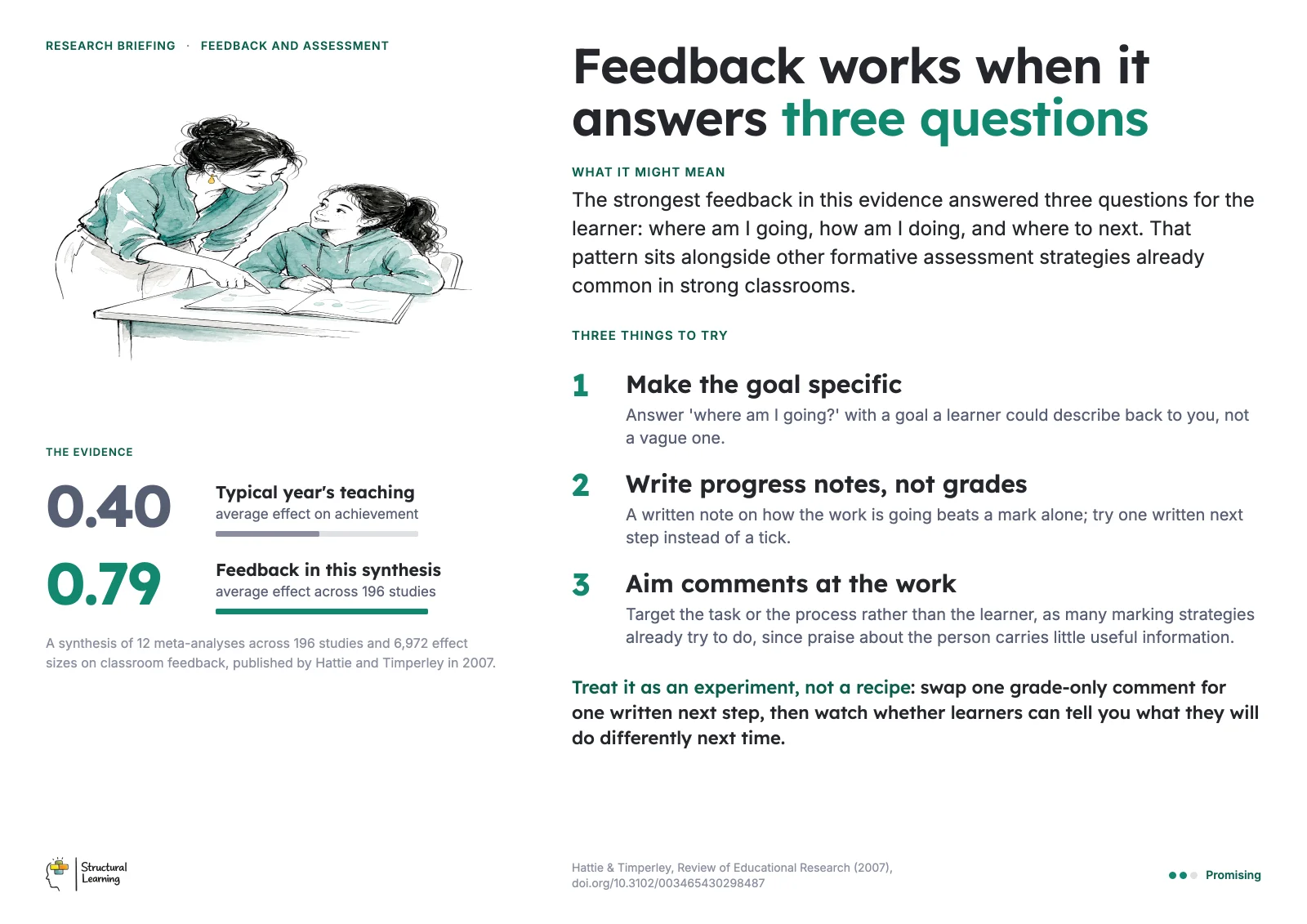
The strongest feedback in this evidence answered three questions for the learner: where am I going, how am I doing, and where to next. That pattern sits alongside other formative assessment strategies already common in strong classrooms.
Treat it as an experiment, not a recipe: this is a synthesis of what dozens of studies found about feedback in general, not a test of any single classroom routine. Swap one grade-only comment for one written next step, then watch whether learners can tell you what they will do differently next time.
Promising. This is a widely convergent synthesis: a dozen independent meta-analyses point the same way, which is about as convergent as education research gets. But it draws together existing meta-analyses rather than running one new, pre-registered systematic review with its own documented search method, the headline averages hide wide variation, from 0.12 for praise to 1.24 for special educational needs, and the underlying studies are international rather than verified as UK-representative. Treat the direction, that feedback on the task and next steps helps more than praise alone, as well established. Treat any single number as an illustration of scale, not a promise for your class.
Hattie, J., & Timperley, H. (2007). 'The Power of Feedback.' Review of Educational Research, 77(1), 81-112.
Structural Learning helps teachers turn findings like this into planned, visible thinking in the classroom. Open a free account and try it with your next lesson.
Open a free account →Made by the Structural Learning Evidence Engine. Every claim is traced to the source above and independently verified. See more briefings →