
teachers who set practice, drill or rehearsal work
Developing
✓ Citations verified
In a study of 17 advanced piano majors, practice time and the number of repetitions didn't predict next-day performance, but pinpointing and repeating the exact hard bit until it was fixed did.
Duke, R. A., Simmons, A. L., & Cash, C. D. (2009). It's Not How Much; It's How: Characteristics of Practice Behavior and Retention of Performance Skills. Journal of Research in Music Education, 56(4), 310-321.
Free to download and share. No sign-up needed.
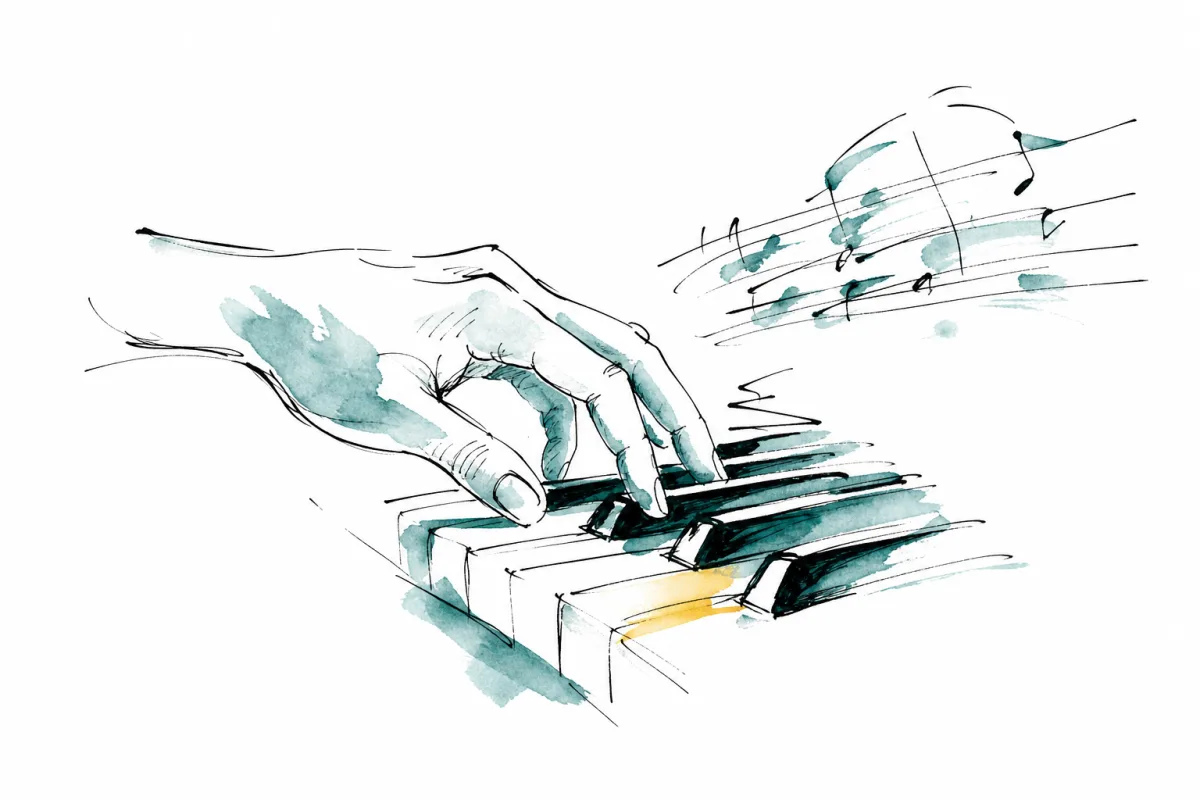
The gist. In a study of 17 advanced piano majors, how long they practised and how many times they repeated a passage did not predict how well they played it back the next day. What did predict it was practising accurately: getting more of each attempt right and making fewer mistakes along the way.
Researchers observed 17 graduate and advanced-undergraduate piano majors learning a difficult three-bar passage from a Shostakovich concerto, then tested them the next day. Total practice time, the number of times they repeated the passage, and the number of complete run-throughs had no significant relationship with how well they played it back.
What did line up with next-day performance: the percentage of attempts played correctly (r = -.51), the percentage of complete run-throughs that were error-free (r = -.71), and the number of mistakes made while practising (r = .48). These are correlations, not proof of cause, but they point the same way: how accurately learners practised tracked with performance the next day, not how much they practised.
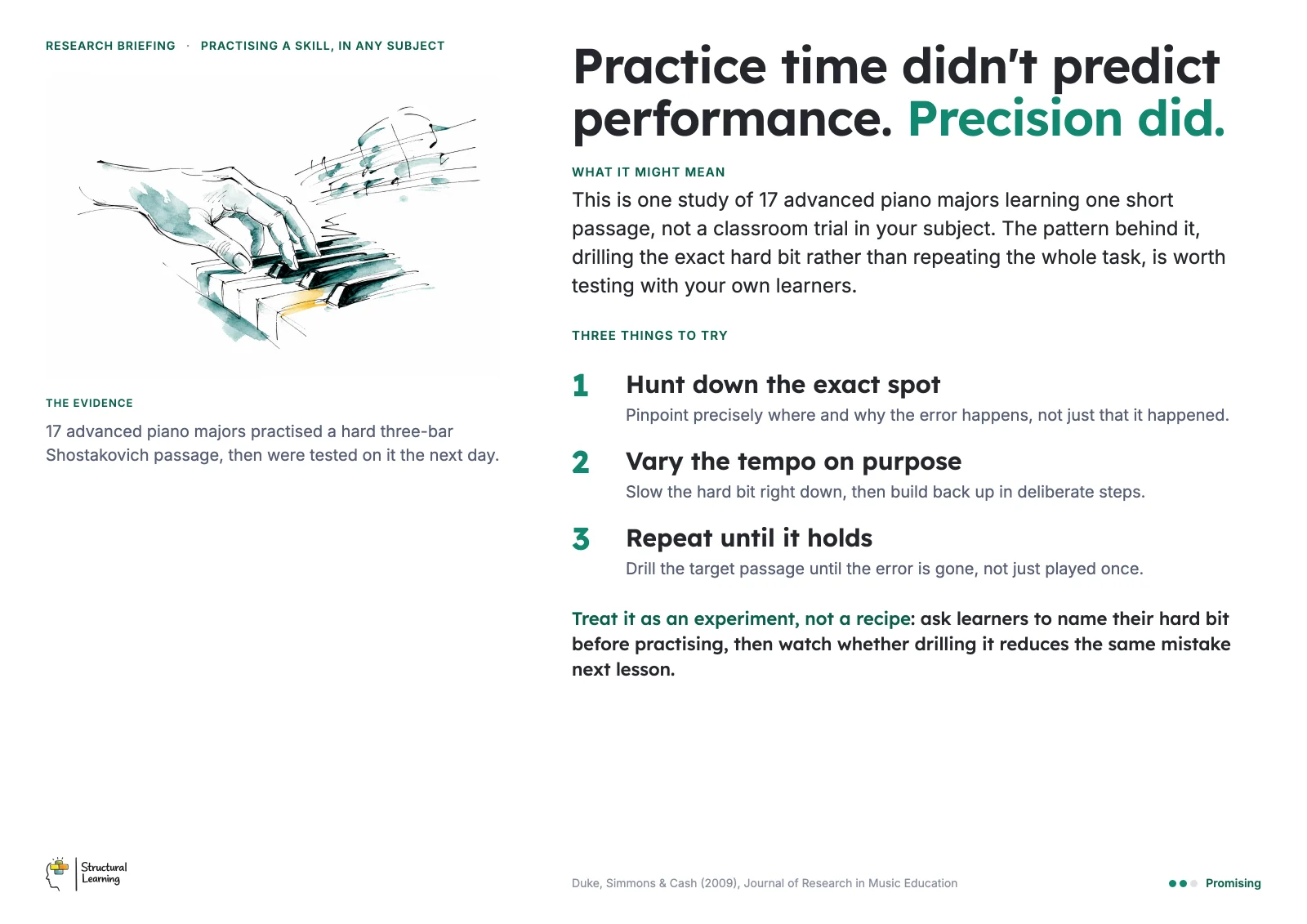
This is one study of 17 advanced piano majors learning one short passage, not a classroom trial in your subject. But the pattern behind it, a form of deliberate practice that hunts down and drills the exact hard bit rather than repeating the whole task, is worth testing with your own learners.
Treat it as an experiment, not a recipe: ask learners to name their own hard bit before they practise, then watch whether drilling that one spot reduces the same mistake next lesson. The study did not test EAL or SEND learners, so treat this as worth trying with your own classes rather than something already proven for them.
Promising. This is a carefully measured, peer-reviewed study with real numbers reported, but it is small and single-domain, not a controlled experiment. Seventeen pianists learned one three-bar passage in a single session, and performance was checked only the next day, so it says nothing about longer-term retention or other subjects. It is correlational, not experimental: no one was randomly assigned to practise well or badly, so the study cannot prove the strategies caused the better performance. If you build this into a wider routine, pair it with retrieval practice for how learners recall the material afterwards, and treat drilling the hard bit as a promising pattern rather than a proven method for every subject or age group.
Duke, Simmons & Cash (2009). It's Not How Much; It's How: Characteristics of Practice Behavior and Retention of Performance Skills. Journal of Research in Music Education, 56(4), 310-321.
Structural Learning helps teachers turn findings like this into planned, visible thinking in the classroom. Open a free account and try it with your next lesson.
Open a free account →Made by the Structural Learning Evidence Engine. Every claim is traced to the source above and independently verified. See more briefings →