
primary teachers and reading leads
Early signal
✓ Citations verified
A signal about digital delivery, not proven superiority: over one term, 22 fourth-graders paired stronger and weaker readers together for 36 lesson hours of online paired-reading practice, and researchers reported improved reading fluency, comprehension and reading self-concept afterwards, but with no comparison class, an ordinary term's progress cannot be ruled out.
Avşaroğlu, B. B. C., & Yıldız, M. (2025). An Example of Digital Transformation in Reading Instruction: The Effect of Online Paired Reading on Fourth Graders' Reading Outcomes. Reading Research Quarterly, 60(4), Article e70063.
Free to download and share. No sign-up needed.
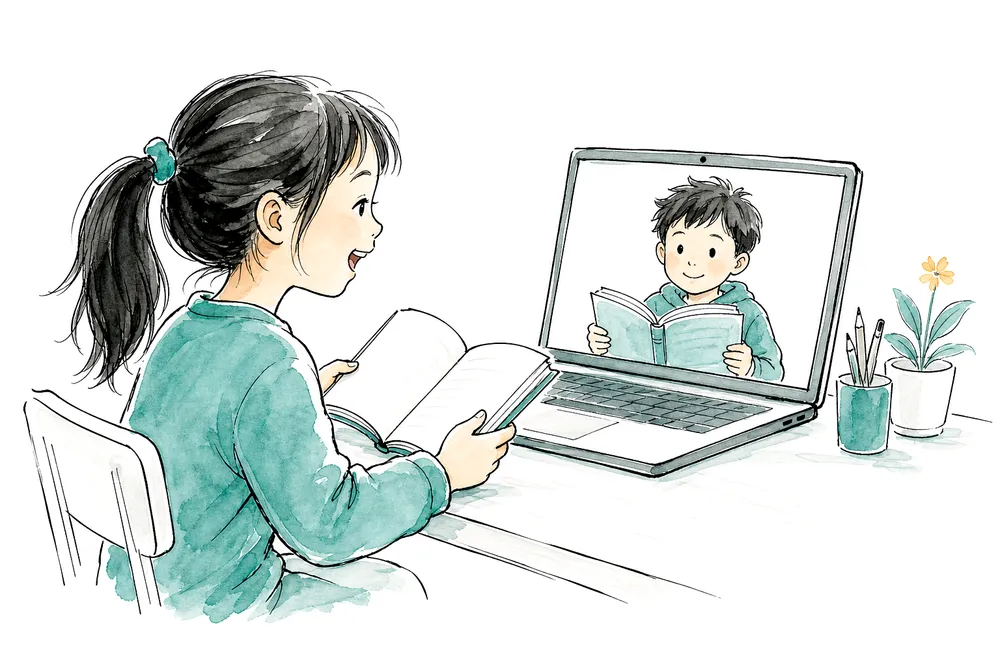
The gist. One class moved a long-established reading strategy, pairing a stronger reader with a weaker one, onto a screen, and reported gains in reading fluency, comprehension and how learners felt about themselves as readers. It is an early signal about digital delivery, not proof: with only 22 learners, one term and no comparison class, an ordinary term's progress cannot be ruled out.
Twenty-two fourth-graders, a mix of stronger and weaker readers, were paired up for online paired-reading sessions across the spring term of the 2023-2024 school year, for 36 lesson hours in total. Every learner sat the same reading checks before the programme and again afterwards. There was no separate class running without the online sessions to compare against.
Reading fluency and reading comprehension were measured with a curriculum-based measurement approach, and reading self-concept with the published Reading Self-Concept Scale (Chapman and Tunmer, 1995). The authors report a significant improvement in fluency and comprehension and a positive improvement in self-concept. The published abstract states these results in words, not numbers: no effect size or statistic is given for any of the three, and the full text sits behind a paywall we could not open.
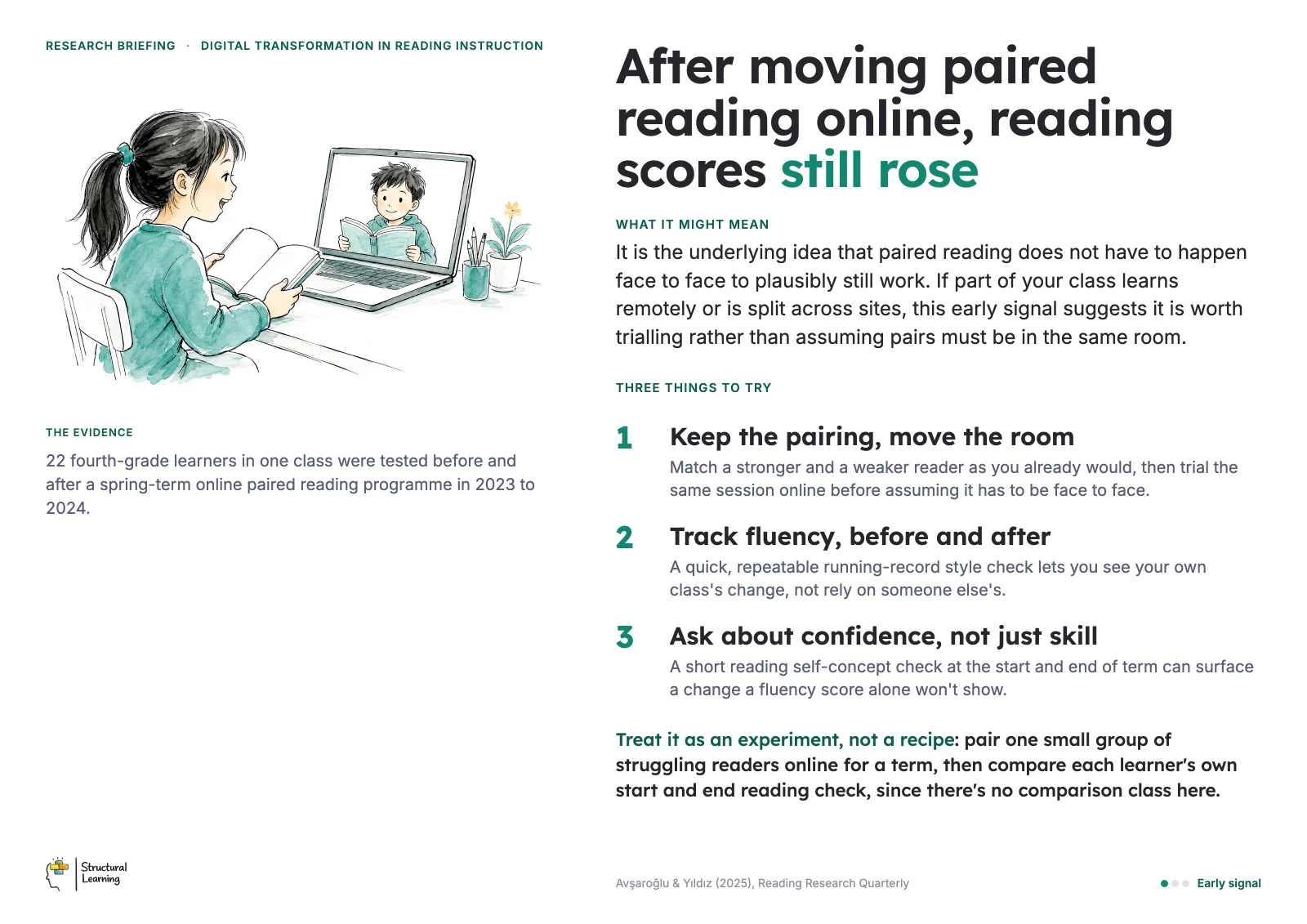
The pattern worth borrowing is not the specific tool this class used; the abstract never says what it was. It is the underlying idea that paired reading does not have to happen face to face to plausibly still work. If part of your class learns remotely or is split across sites, this early signal suggests it is worth trialling rather than assuming pairs must be in the same room. It sits alongside the wider toolkit of reading fluency and reading comprehension strategies you already use.
Treat it as an experiment, not a recipe: pair one small group of struggling readers online for a term and compare each learner's own start-of-term and end-of-term reading check, since this study had no comparison class to tell us what would have happened anyway.
We grade this an early signal. It is a real, peer-reviewed study in a leading literacy journal, which counts in its favour, but the design is a one-group pretest-to-posttest quasi-experiment with no control class, the abstract reports direction only with no effect size or statistic, the sample is a single class of 22 learners, and we could review the abstract alone because the full text is paywalled with no open-access copy. Open full-text access, a matched-comparison design, or independent replication would raise the grade.
Avşaroğlu, B. B. C., and Yıldız, M. (2025). An Example of Digital Transformation in Reading Instruction: The Effect of Online Paired Reading on Fourth Graders' Reading Outcomes. Reading Research Quarterly, 60(4), Article e70063.
Structural Learning helps teachers turn findings like this into planned, visible thinking in the classroom. Open a free account and try it with your next lesson.
Open a free account →Made by the Structural Learning Evidence Engine. Every claim is traced to the source above and independently verified. See more briefings →