
teachers who set exam-style or extended-answer questions
Early signal
✓ Citations verified
In one university class, the same learners scored 80% on exam questions that only asked them to recall facts, 70% on questions asking them to explain ideas in their own words, and just 55% on questions asking them to apply that knowledge, one exam, one class, the mark falling as the thinking climbed the ladder from knowledge to comprehension to application.
Crowe, A., Dirks, C. and Wenderoth, M. P. (2008). 'Biology in Bloom: Implementing Bloom's Taxonomy to Enhance Student Learning in Biology.' CBE-Life Sciences Education, 7(4), 368-381.
Free to download and share. No sign-up needed.

The gist. In one university physiology class, the same 120 learners scored 80% of the available points on exam questions that only asked them to recall facts, 70% on questions asking them to explain ideas in their own words, and just 55% on questions asking them to apply that knowledge, one exam, one class, the mark falling as the questions climbed from knowledge to comprehension to application.
A 120-learner upper-division university physiology class had Bloom's Taxonomy, a well-known way of ranking thinking from simple recall up through explaining, applying, analysing and evaluating, introduced early in term. Learners were regularly asked to name which level of thinking a question needed before attempting to answer it.
On the class's first exam, the instructor broke the marks down by the level of thinking each question demanded. The same learners, sitting the same exam, earned 80% of the available points on knowledge-level questions, 70% on comprehension-level questions, and only 55% on application-level questions, using the knowledge to solve something new. It is one exam, one class, a descriptive snapshot rather than a controlled comparison.
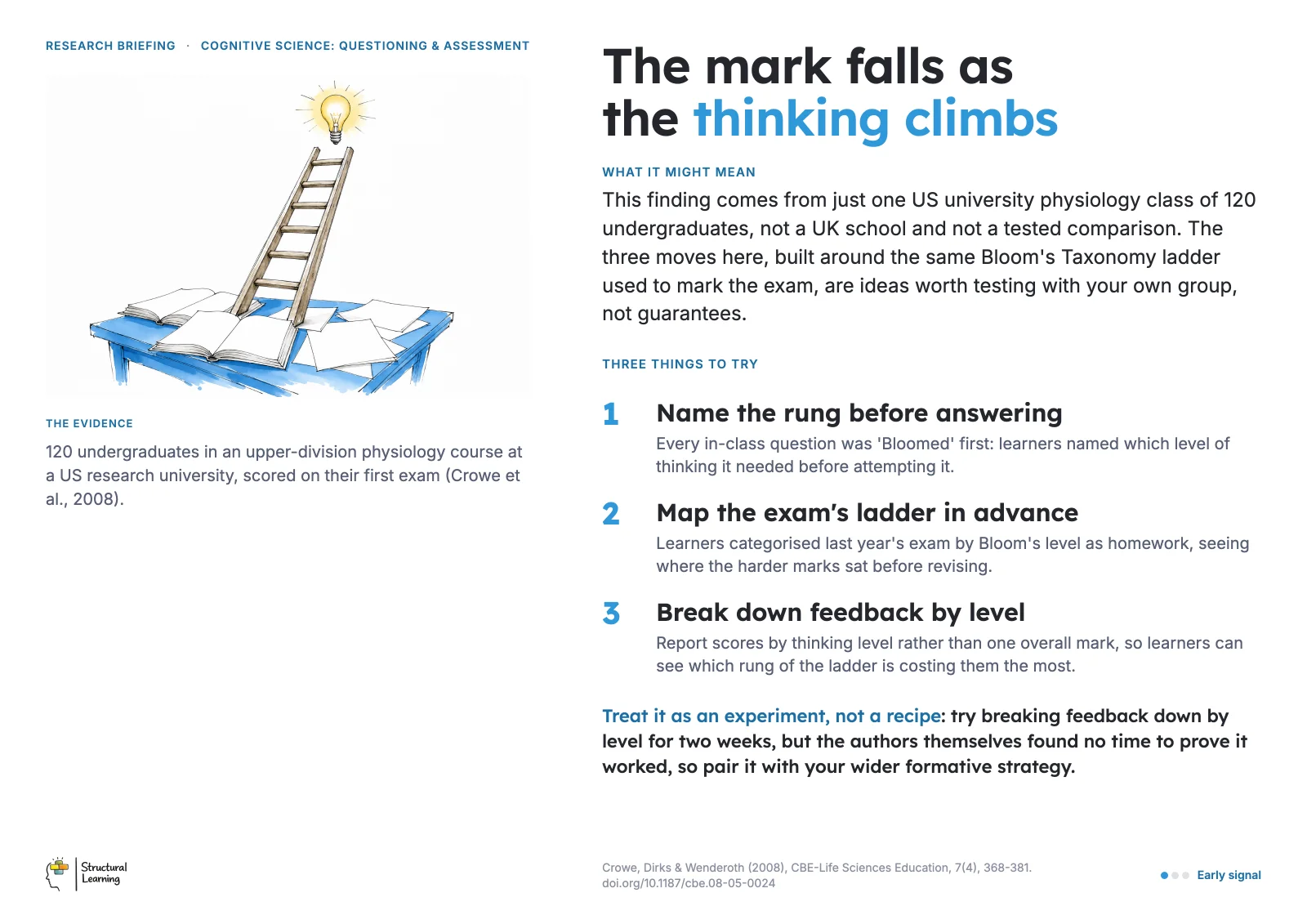
This comes from one US university physiology class, not a UK school and not a tested comparison. The three moves below, built around the same Bloom's Taxonomy ladder, are ideas worth testing with your own group, not guarantees.
Treat it as an experiment, not a recipe: the study's own authors say there was not enough time in their course for the third move, breaking scores down by level, to show a measurable change in learning, so it is an idea tried rather than one proven to work. Pair it with a wider formative assessment strategy rather than relying on it alone.
Early signal. This is a single, plainly reported pattern from one peer-reviewed paper, not a controlled trial: one exam, one class of 120 university physiology learners, with no comparison group and no significance test behind the 80%/70%/55% breakdown. Every case in the source paper is a US undergraduate class, not a UK primary or secondary classroom, and the authors themselves report there was not enough time in the term to show whether the personalised score-by-level feedback changed learning.
Crowe, A., Dirks, C. and Wenderoth, M. P. (2008). "Biology in Bloom: Implementing Bloom's Taxonomy to Enhance Student Learning in Biology." CBE-Life Sciences Education, 7(4), 368-381.
Structural Learning helps teachers turn findings like this into planned, visible thinking in the classroom. Open a free account and try it with your next lesson.
Open a free account →Made by the Structural Learning Evidence Engine. Every claim is traced to the source above and independently verified. See more briefings →