
secondary maths teachers
Firm
✓ Citations verified
A large classroom trial found Grade 7 maths learners who mixed practice problems scored 61% on a test a month later, against 38% for learners who practised one type at a time, though it took more time and the researchers flag real caveats.
Rohrer, D., Dedrick, R. F., Hartwig, M. K., & Cheung, C.-N. (2020). A randomised controlled trial of interleaved mathematics practice. Journal of Educational Psychology, 112(1), 40-52.
Free to download and share. No sign-up needed.
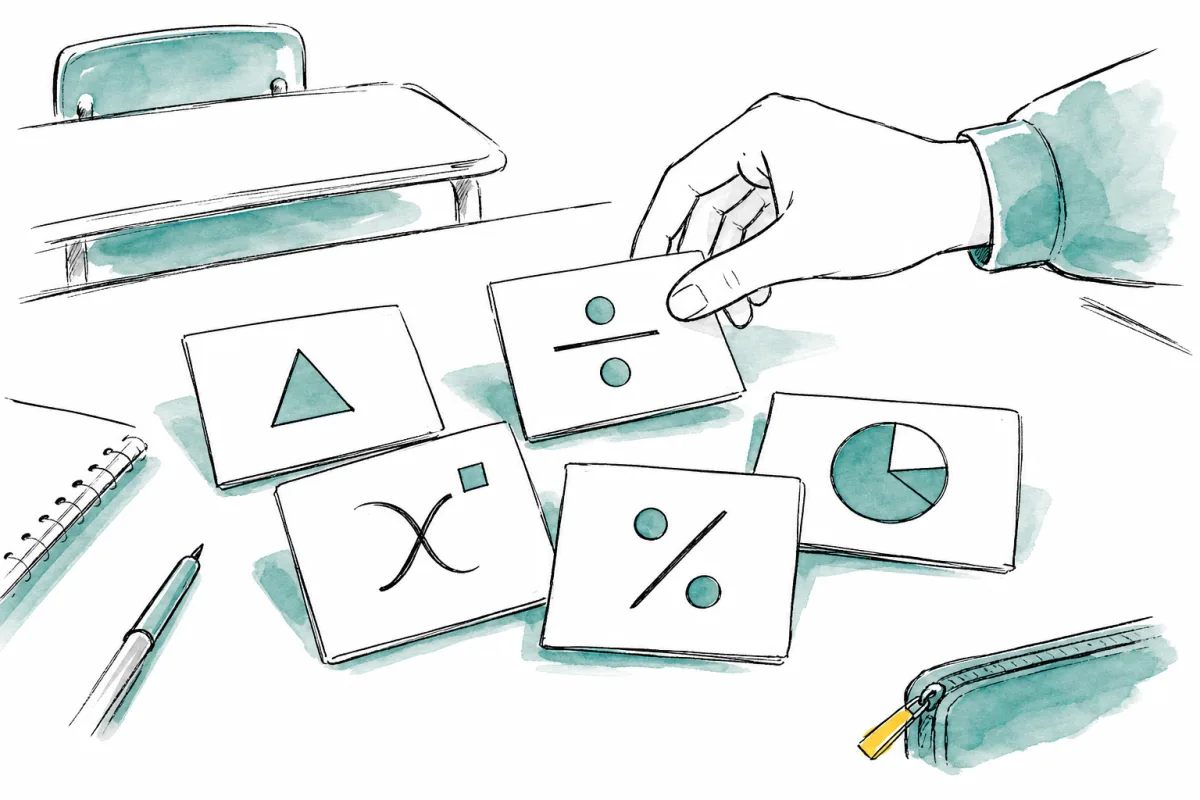
The gist. A large randomised trial of Grade 7 maths classes found that mixing different problem types in practice, instead of grouping worksheets by topic, produced far higher scores on a test given a month later.
Researchers randomly assigned 54 real Grade 7 maths classes, 787 learners and 15 teachers across five Florida schools, to either mixed or one-type-at-a-time practice worksheets over four months. Every method in the mixed worksheets had already been taught on its own first, and learners saw worked solutions and corrected their own mistakes after each worksheet.
Both groups then completed an identical mixed review worksheet, and a month later sat an unannounced test with no warning it was coming. Learners who had done more mixed practice scored 61% correct, against 38% for learners who had mostly practised one type at a time, a large and statistically reliable difference (d = 0.83, 95% CI 0.68 to 0.97) that held for every one of the 15 teachers. The researchers think the size of the effect comes from mixing several memory-boosting effects at once, an idea that sits close to desirable difficulties research.
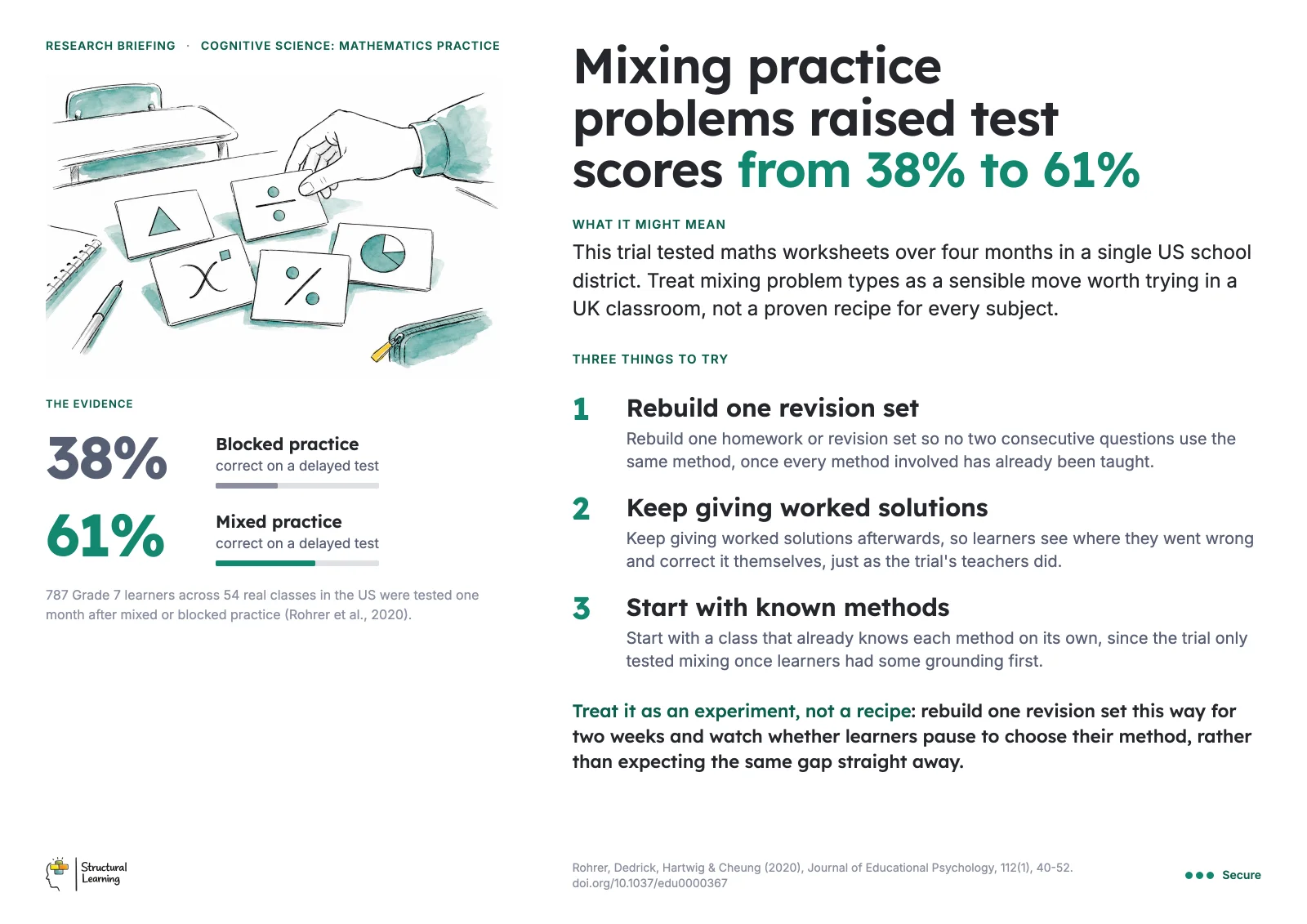
The trial only tested maths worksheets in one US school district, so treat these as sensible moves worth trying in a UK classroom, not proven recipes for every subject. For the fuller picture on how and when to use this, see our teacher's guide to interleaving, which sits alongside other well-evidenced strategies such as retrieval practice.
Treat it as an experiment, not a recipe: rebuild one revision set this way for two weeks and watch whether learners pause to choose their method, rather than expecting the same 61% against 38% gap in your own classroom.
This comes from a preregistered, cluster-randomised controlled trial across 54 real classes, 787 learners and 15 teachers, with a positive effect for every single teacher: Secure evidence, about as solid as classroom research gets. It still has real limits. It covers one country, one age group and one subject (Florida Grade 7 maths, 2017 to 2018), every teacher reported mixed worksheets took longer, and mixing was tested alongside feedback and after learners already had some grounding in each method, so the trial cannot say whether mixing alone would work as well.
Rohrer, D., Dedrick, R. F., Hartwig, M. K., & Cheung, C.-N. (2020). A randomised controlled trial of interleaved mathematics practice. Journal of Educational Psychology, 112(1), 40-52.
Structural Learning helps teachers turn findings like this into planned, visible thinking in the classroom. Open a free account and try it with your next lesson.
Open a free account →Made by the Structural Learning Evidence Engine. Every claim is traced to the source above and independently verified. See more briefings →