
teachers planning revision
Firm
✓ Citations verified
Testing yourself on new material straight after learning it feels harder and produces worse recall minutes later. But in a classic memory study, the self-testers remembered 61% of a passage a week on, against 40% for learners who had just reread it four times, even though they had read it far fewer times.
Roediger, H.L. & Karpicke, J.D. (2006). ‘Test-Enhanced Learning: Taking Memory Tests Improves Long-Term Retention.’ Psychological Science, 17(3), 249-255.
Free to download and share. No sign-up needed.

The gist. Testing yourself on new material straight after learning it feels harder and produces worse recall minutes later. But in a classic memory study, the self-testers remembered 61% of a passage a week on, against 40% for learners who had just reread it four times, even though they had read it far fewer times.
In a study of 180 university learners, one group read a short passage once and then tested themselves on it three times from memory, writing down everything they could recall with no notes and no feedback. A second group reread the same passage four times instead of testing. Five minutes after learning, the rereaders did better: 83% recalled against 71% for the self-testers.
A week later the pattern flipped. The self-testers recalled 61% of the passage, against 40% for the rereaders, even though the self-testers had read the passage far fewer times on average across the study (3.4 times against 14.2). A third group who studied three times then tested once landed in between at both points, recalling 78% after five minutes and 56% a week later.
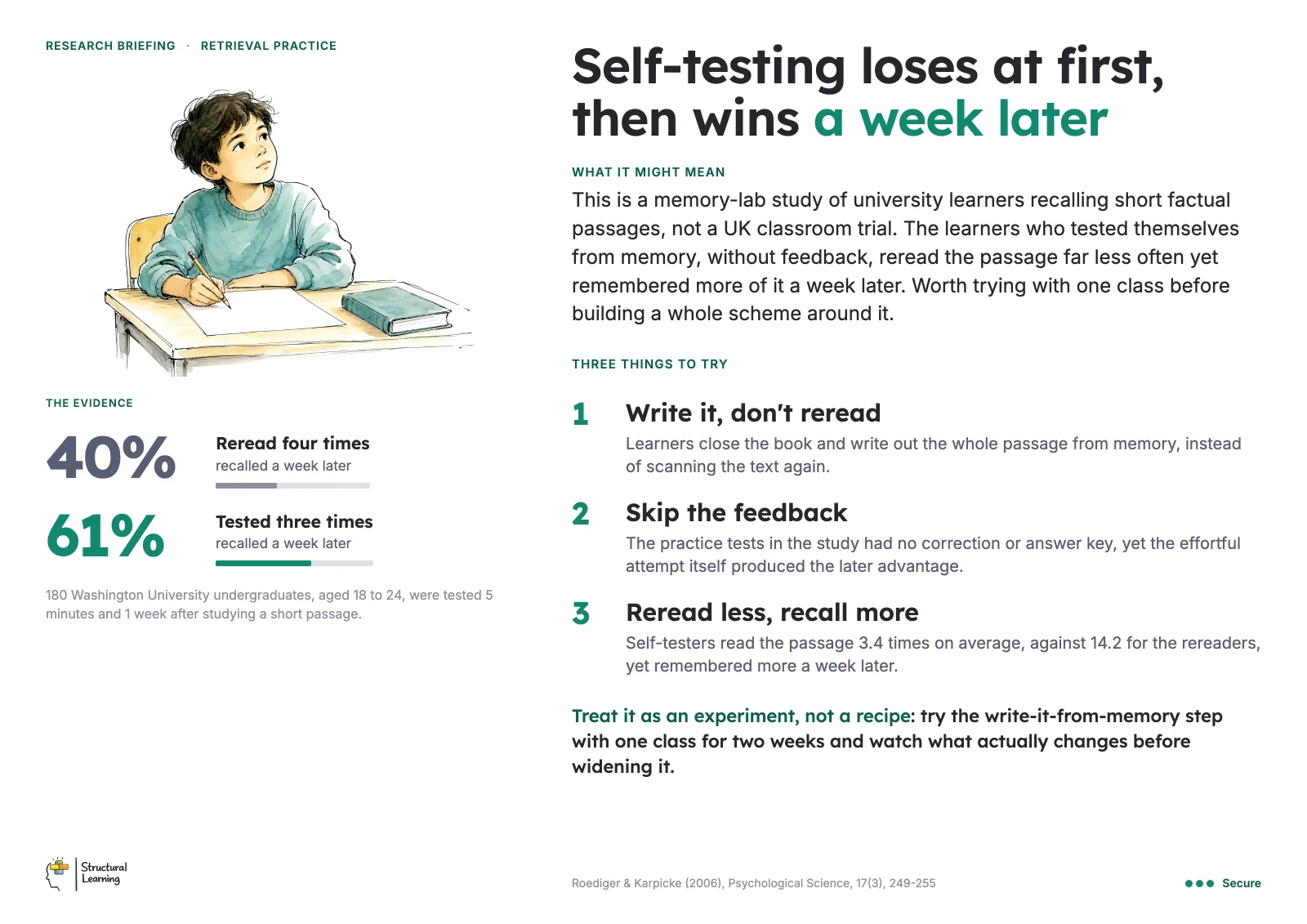
This is a memory-lab study of university learners recalling short factual passages, not a UK classroom trial. The moves below reflect what the self-testers actually did, worth trying with one class before building a whole scheme around it.
Treat it as an experiment, not a recipe: this is university learners recalling short passages under timed lab conditions, not school-age learners doing normal classwork, so try the write-it-from-memory step with one class for two weeks and watch what actually changes before widening it. It sits inside Bjork's desirable difficulties framework, the idea that some of the hardest-feeling study methods produce the strongest long-term learning.
Secure. Two controlled experiments in the same paper show the same reversal, with large, precisely reported effect sizes, and the underlying testing effect is one of the most extensively replicated findings in memory research. Three limits are worth holding onto: the study population was university learners in the US, not UK school-age classes; the comparison is specifically free recall against rereading, not any task that merely feels harder; and retention was measured only out to one week, so this doesn't show whether the advantage lasts a whole term.
Roediger, H.L. & Karpicke, J.D. (2006). ‘Test-Enhanced Learning: Taking Memory Tests Improves Long-Term Retention.’ Psychological Science, 17(3), 249-255.
Structural Learning helps teachers turn findings like this into planned, visible thinking in the classroom. Open a free account and try it with your next lesson.
Open a free account →Made by the Structural Learning Evidence Engine. Every claim is traced to the source above and independently verified. See more briefings →