
science teachers
Developing
✓ Citations verified
In four US university physics experiments, learners who physically felt the forces of a spinning object scored significantly higher on a later quiz than those who only watched, an advantage explained by extra activity in the brain's movement and touch regions when they later reasoned about the same problem.
Kontra, C., Lyons, D. J., Fischer, S. M., & Beilock, S. L. (2015). 'Physical Experience Enhances Science Learning.' Psychological Science, 26(6), 737-749.
Free to download and share. No sign-up needed.
The gist. In four US university physics experiments, learners who physically felt the forces of a spinning object scored significantly higher on a later quiz than those who only watched, an advantage explained by extra activity in the brain's movement and touch regions when they later reasoned about the same problem.
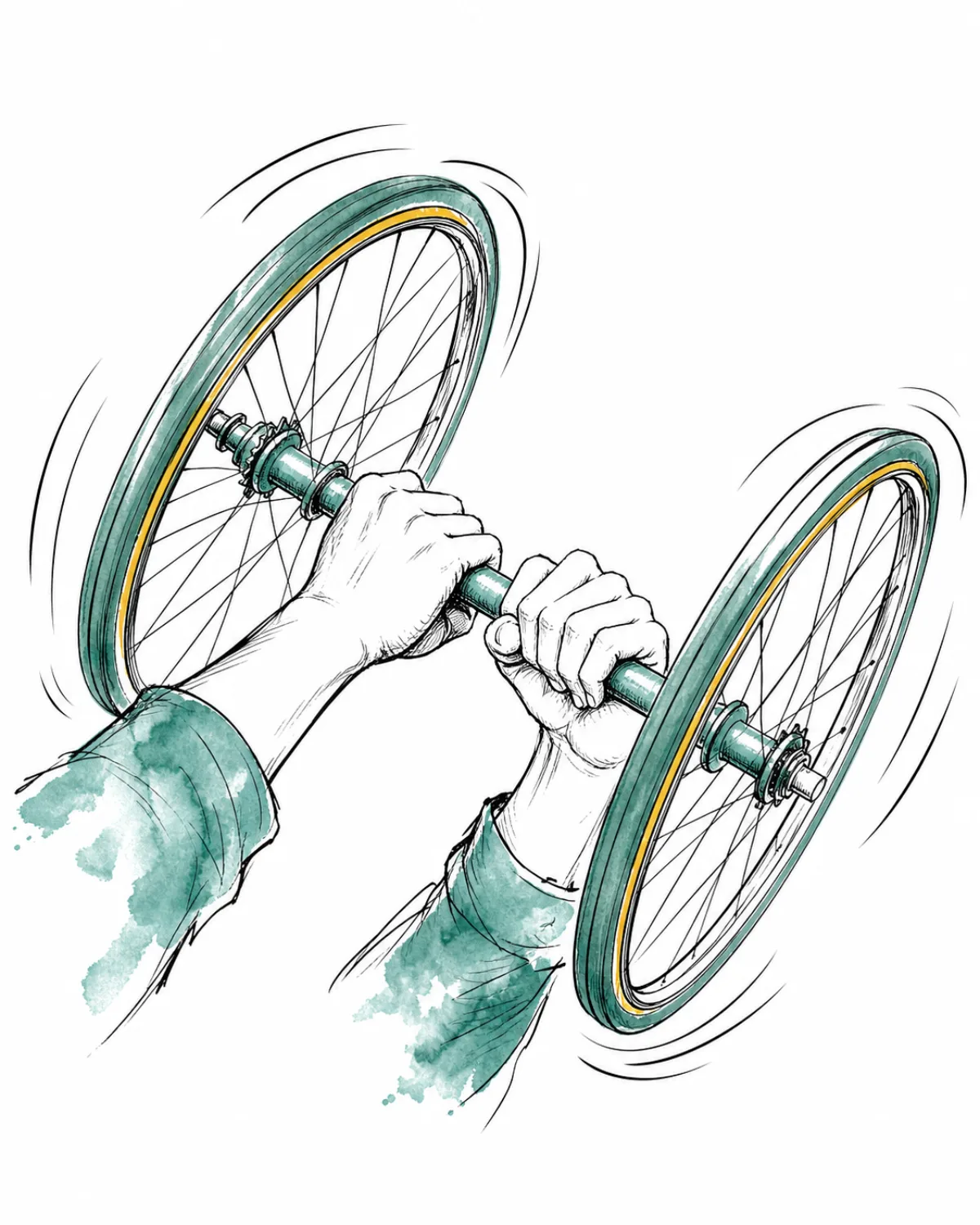
Across three lab studies and one real undergraduate physics class at DePaul University, researchers paired learners up. One learner physically tilted a spinning double-wheel apparatus and felt the resistive force in their hands, an idea drawn from embodied cognition, the theory that thinking activates the same brain systems used to physically interact with the world. Their partner only watched.
In the real classroom, the group who felt the force themselves scored 76% on a later quiz, against 69% for the group who only watched, despite the two groups' grades on other course quizzes being closely matched beforehand. The gap was widest on the hardest questions, the ones asking learners to combine two directions of force at once: 27% correct for the group who had felt it themselves, against 15% for the group who had only watched. Brain scans in a separate lab study showed more activity in the movement and touch regions of learners who had physically handled the apparatus when they later reasoned about the same problem, and that activity statistically explained their better performance.
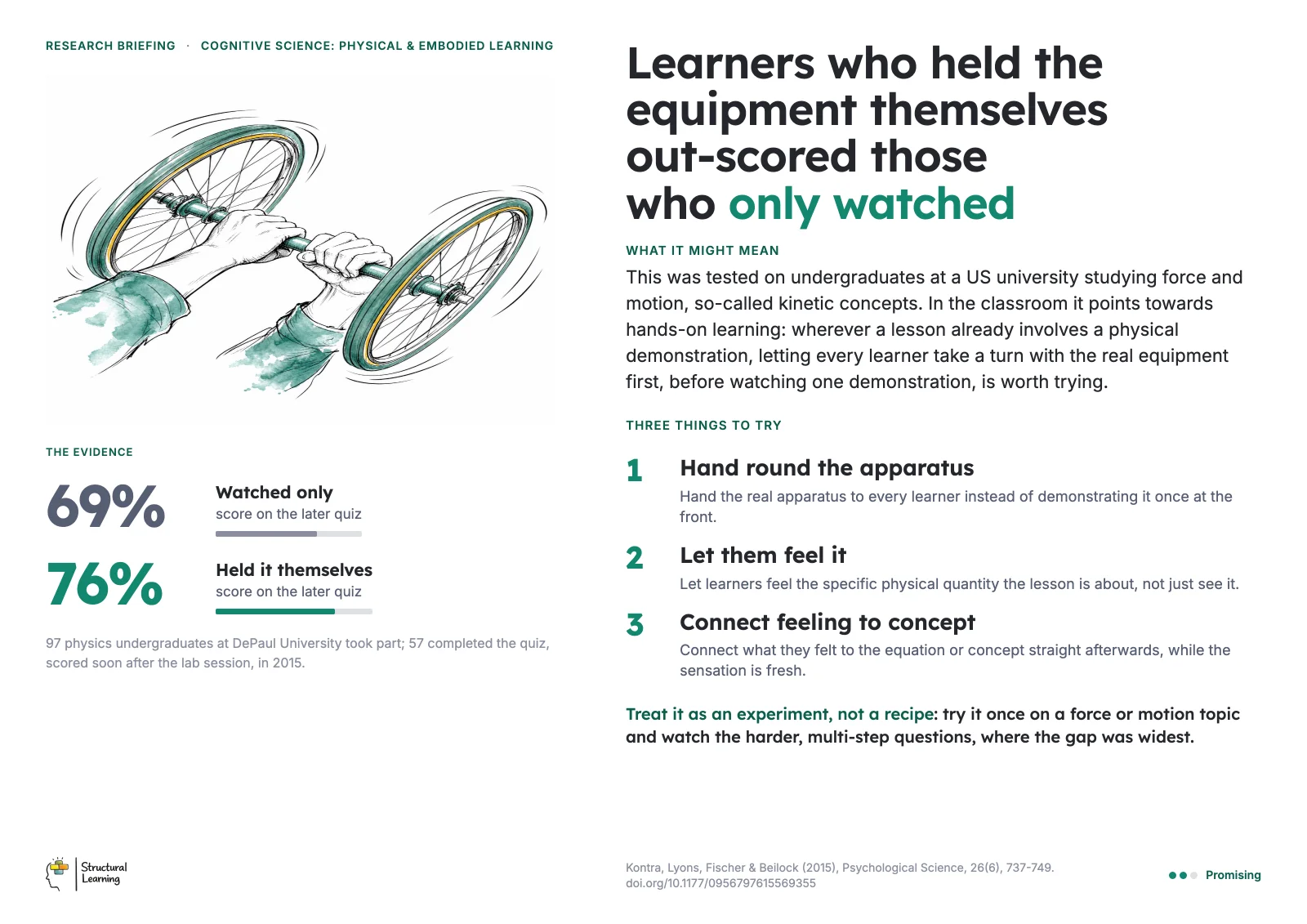
This was tested on undergraduates at a US university studying force and motion, what the researchers call 'kinetic' concepts. In the classroom, it points towards a hands-on learning approach: wherever a lesson already involves a physical demonstration, especially in physics, design and technology, or engineering, letting every learner take a turn with the real equipment first, before watching one demonstration at the front, is worth trying.
Treat it as an experiment, not a recipe: try it once with a class working on a topic that genuinely involves force or motion, and watch who it seems to help, especially on the harder, multi-step questions, since that is where the original study's gap was widest.
Promising. Four converging experiments, including a randomised field trial in a real classroom and a brain-imaging mechanism, come from one strong research team. But every participant in every experiment was an undergraduate at a US university studying physics; no UK sample and no school-age classroom was tested, so this is a translation rather than a school result reported directly. The researchers themselves note the benefit may be strongest for 'kinetic' concepts like force and motion, and the finding has not yet been independently replicated by another research group.
Kontra, C., Lyons, D. J., Fischer, S. M., & Beilock, S. L. (2015). 'Physical Experience Enhances Science Learning.' Psychological Science, 26(6), 737-749.
Structural Learning helps teachers turn findings like this into planned, visible thinking in the classroom. Open a free account and try it with your next lesson.
Open a free account →Made by the Structural Learning Evidence Engine. Every claim is traced to the source above and independently verified. See more briefings →