
years 5-6 teachers
Early signal
✓ Citations verified
A signal about where talk shifts from teacher-led to learner-led, not proof it improves writing: interviewed about a national genre-writing programme, teachers of Years 5 and 6 described talk moving from teacher-led discussion of a shared text towards learner-led paired and group talk while jointly writing a new one, several linking this shift to EAL learners contributing more, but this is 26 teachers' own interview accounts, not classroom observation or a measure of children's writing.
Ehiyazaryan-White, E. (2025). Exploring opportunities for dialogic teaching within the genre pedagogy teaching and learning cycle in primary classrooms. Language and Education, 39(6), 1357-1377.
Free to download and share. No sign-up needed.
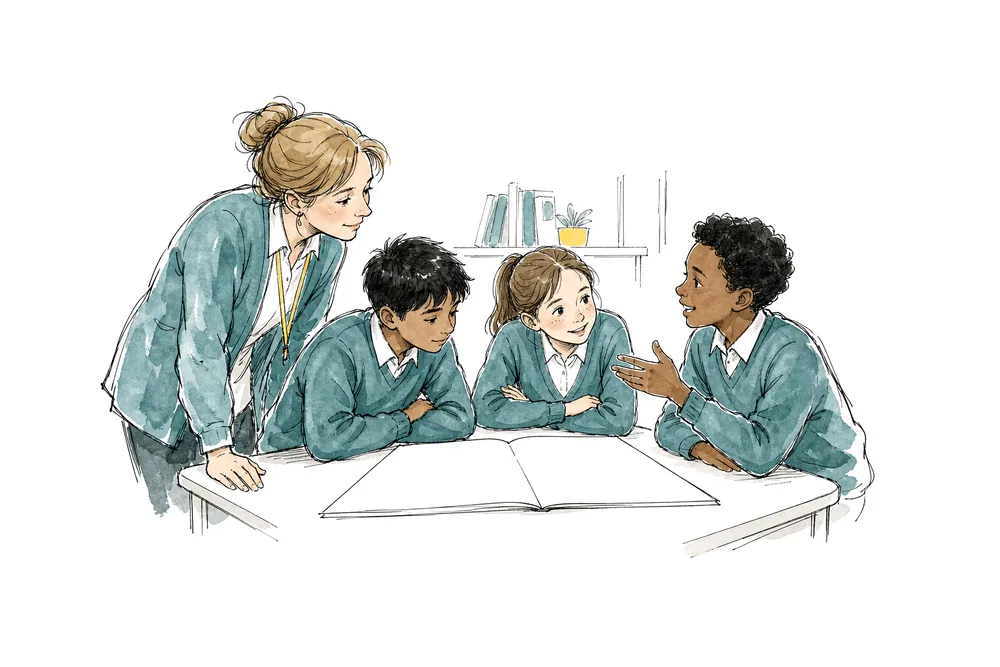
The gist. Interviewed about a national genre-writing programme, teachers of Years 5 and 6 described the talk in their writing lessons shifting from teacher-led discussion of a shared text towards learner-led paired and group talk as classes jointly wrote a new one, with several linking that shift to EAL learners contributing more. It is a signal about where talk changes hands, not proof it improves writing. This is 26 teachers' own interview accounts, gathered midway through the programme, so treat it as an early signal worth testing rather than a measured result.
Teachers were interviewed about a national genre-pedagogy writing programme, LILAC, trialled in 91 schools across England and evaluated for the Education Endowment Foundation. As part of the trial's implementation and process evaluation, researchers interviewed 26 teachers across 14 schools about how they used the programme's three-stage teaching and learning cycle: deconstruction, joint construction and independent construction. Schools were purposively selected for having at least 10 EAL learners in Years 5 and 6; across the wider trial, 53% of learners were EAL and 44% were eligible for free school meals.
In the deconstruction stage, teachers described mostly teacher-led talk, building shared knowledge and vocabulary before learners were asked for their own ideas. In joint construction, several described handing more of the talk to learners through group work and a form of dialogic teaching, discussing ideas and word choices together. One Year 5 teacher linked this word-level, talk-heavy deconstruction directly to EAL access, reporting that even the lower-attaining EAL learners could identify similes and metaphors once the class talked the text apart. Another described a quiet, able EAL learner paired with a more talkative peer, working well together across the planning stage. The paper reports no test scores or writing-quality data, and every theme is illustrated with one or two named teachers rather than counted across the 26 interviews.
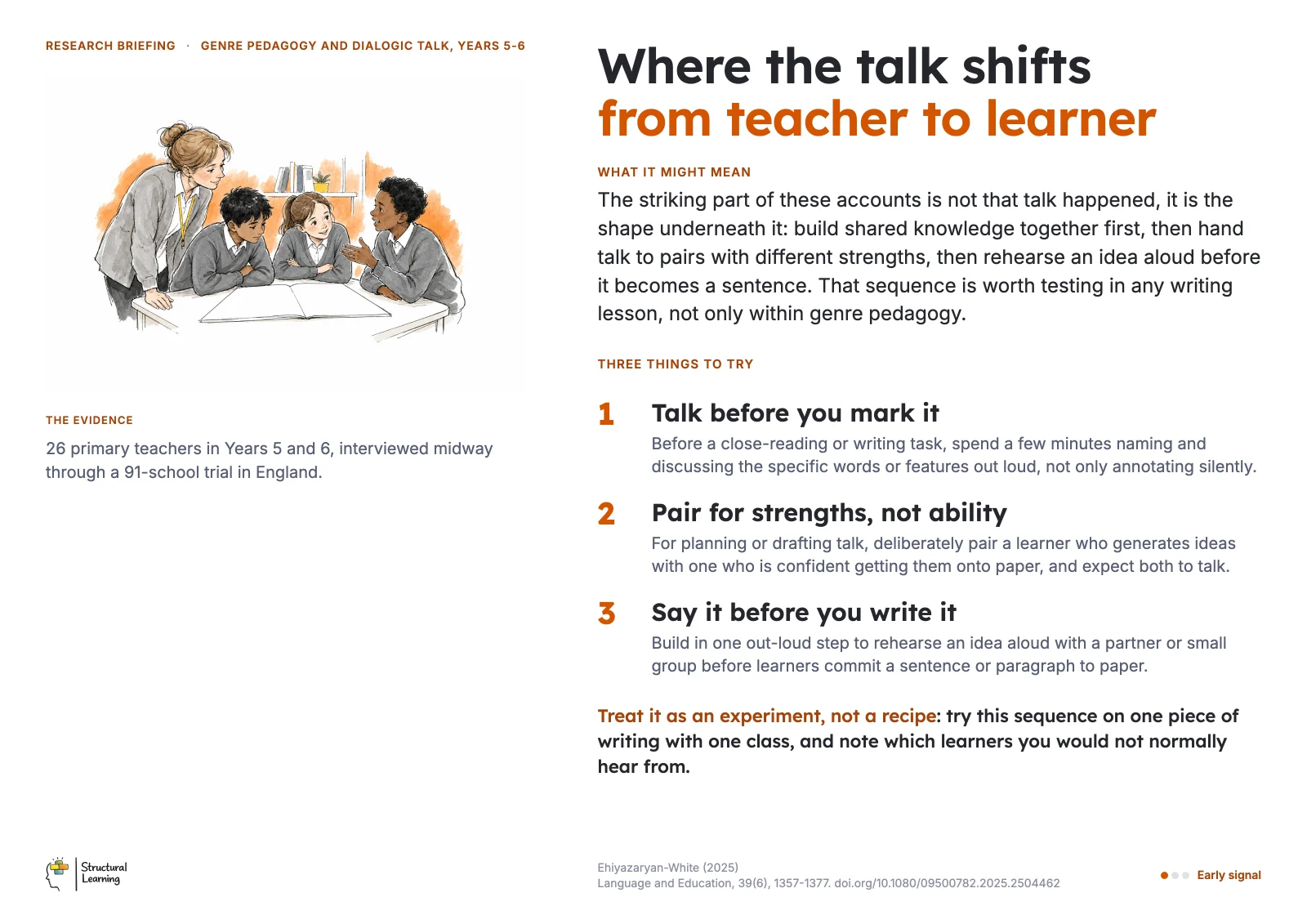
The striking part of these accounts is not that talk happened, it is the shape underneath it: build shared knowledge together first, then hand talk to pairs with different strengths, then rehearse an idea aloud before it becomes a sentence. That sequence is worth testing in any writing lesson, not only within genre pedagogy.
Treat it as an experiment, not a recipe: try this sequence on one piece of writing with one class, and note which learners you would not normally hear from.
This is an Early signal: 26 teachers' own accounts of their perceptions, worth testing further, not a measured study. The data is limited to what teachers said in interviews, not classroom observation, recordings of learner talk, or children's own accounts. The paper reports no writing scores or talk-quality measures, and the trial that measured the programme's impact on writing is a separate publication these results are not drawn from. Interviews took place midway through the programme, so most teachers had not completed a full cycle, and there is no comparison classroom, so nothing rules out that any structured, talk-heavy writing routine would produce a similar reported shift. Classroom observation of the actual talk, alongside a count of how many teachers described each theme, would raise the grade to Promising.
Ehiyazaryan-White, E. (2025). Exploring opportunities for dialogic teaching within the genre pedagogy teaching and learning cycle in primary classrooms. Language and Education, 39(6), 1357-1377.
Structural Learning helps teachers turn findings like this into planned, visible thinking in the classroom. Open a free account and try it with your next lesson.
Open a free account →Made by the Structural Learning Evidence Engine. Every claim is traced to the source above and independently verified. See more briefings →