
teachers who present with slides
Early signal
✓ Citations verified
A single experiment found that revealing a slide's images piece by piece, in time with the narration, helped Japanese university learners learn more and look at the relevant image sooner and longer than learners who saw the whole slide from the start, but it is one small study with adult learners, not yet tested in school classrooms.
Ito, H., & Ichikawa, H. (2026). Cumulative Presentation Enhances Learning Outcomes by Directing Learners' Visual Attention. Journal of Computer Assisted Learning, 42(4).
Free to download and share. No sign-up needed.
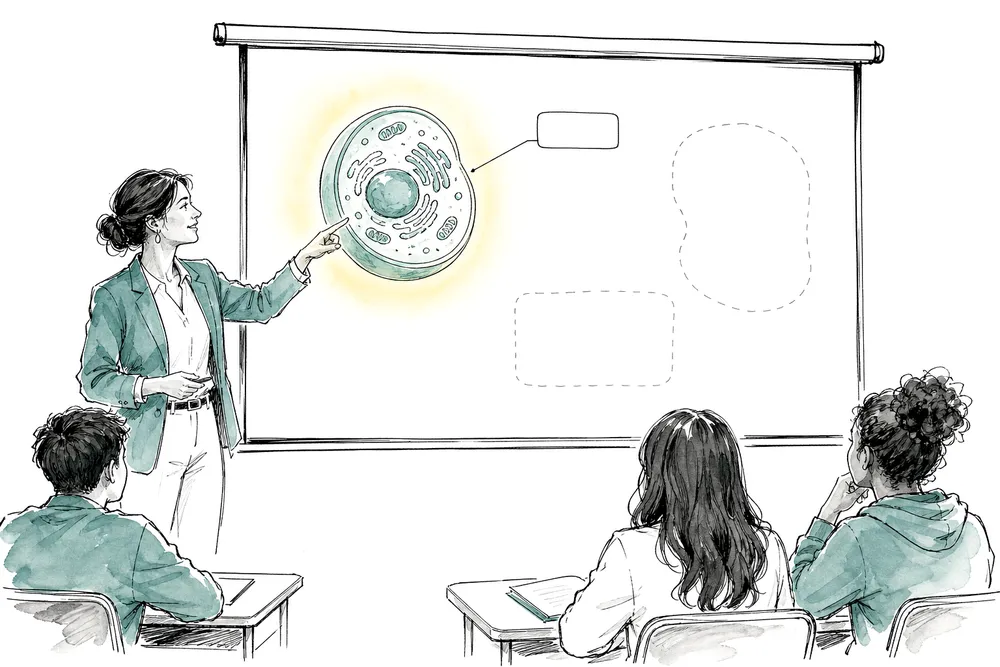
The gist. A single experiment found that revealing a slide's images one at a time, in time with the narration, helped 40 Japanese university learners learn more and look at the relevant image sooner and for longer than learners who saw the whole slide from the start. It is an early signal: one small study with adult learners, not yet tested in school classrooms.
Forty Japanese university learners sat a short pre-test, then watched a biology lesson slideshow narrated by a teacher. On one version of the slide each image appeared one at a time, exactly as the narration reached that point, a format the authors call a cumulative presentation, built within a single PowerPoint slide. On the other version every image was already on the slide before the narration began, a whole-slide presentation. Eye movements were tracked throughout, and everyone sat the same test again straight after the lesson.
Learning outcomes were significantly higher for the built-up slide (Cohen's d = 0.49). Learners in that condition also fixated earlier on the visual element that matched what the narrator was saying (d = 1.76) and looked at it for longer (Cohen's d = 1.15). The authors read this as support for the segmenting principle within the Cognitive Theory of Multimedia Learning.
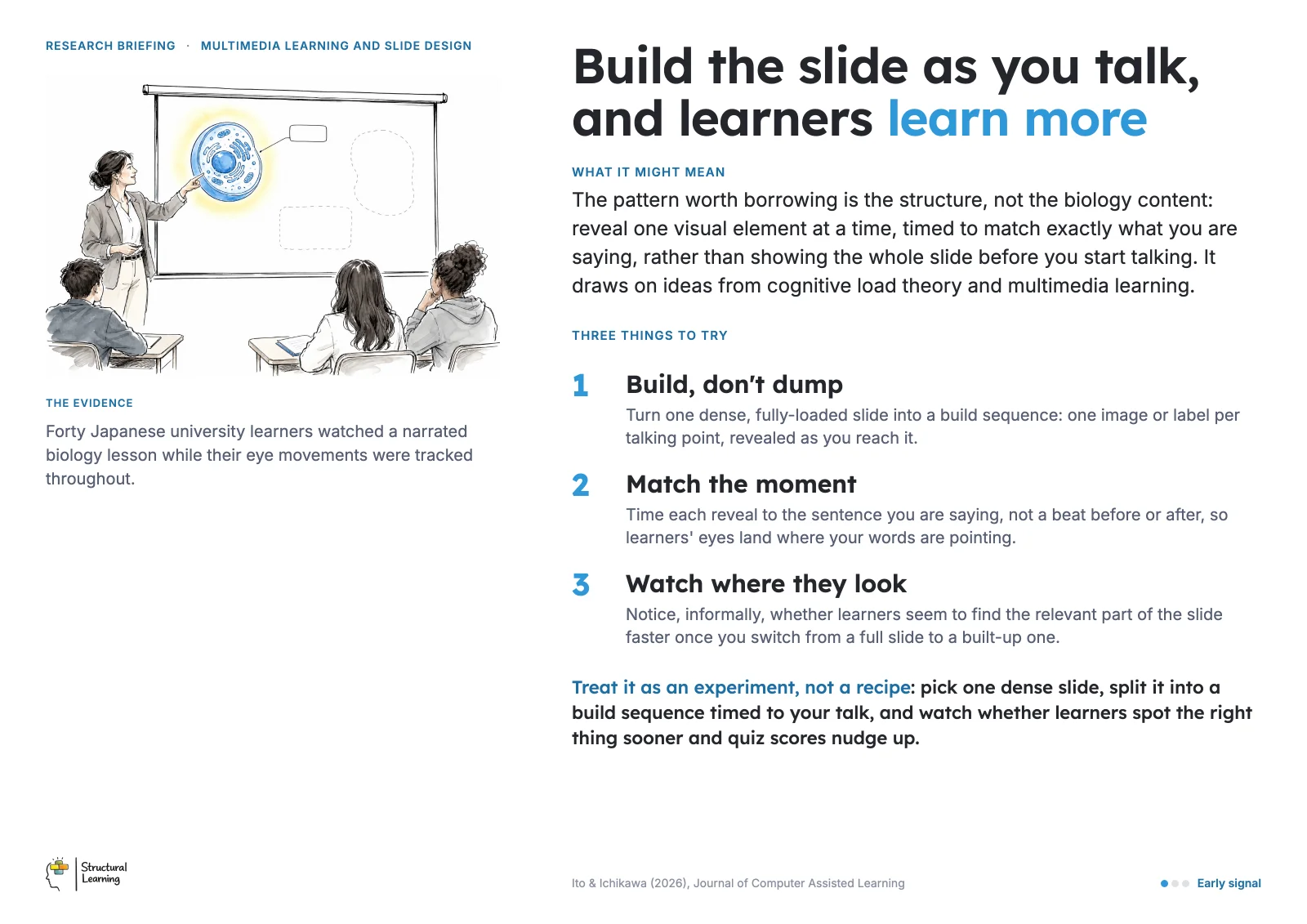
The pattern worth borrowing is not the biology content or the university setting, it is the structure underneath: reveal one visual element at a time, timed to match exactly what you are saying, rather than putting the whole slide up before you start talking. That is a basic click-to-reveal technique already built into PowerPoint, Google Slides and Keynote, and it draws directly on ideas from cognitive load theory and multimedia learning.
Treat it as an experiment, not a recipe: pick one lesson this week with a dense, information-heavy slide, split it into a build sequence timed to your narration, and watch whether learners look at the right thing sooner and whether a quick follow-up quiz nudges up compared with your usual results.
We grade this an early signal. It is a real experiment with a pre-test and post-test design and an objective eye-tracking measure that converges with the test scores, sitting within a well-established theory. But it is a single, brand-new study with no independent replication, the sample is 40 university learners rather than school-age learners in a classroom, we could verify only the abstract because the full text sat behind a bot-challenge, and two of the three effect sizes (d = 1.76 and d = 1.15) are unusually large for a study this size, which often shrinks on replication. Independent replication, full-text verification, and a version run with school-age learners would raise the grade.
Ito, H., and Ichikawa, H. (2026). Cumulative Presentation Enhances Learning Outcomes by Directing Learners' Visual Attention. Journal of Computer Assisted Learning, 42(4). Open access under a CC BY 4.0 licence.
Structural Learning helps teachers turn findings like this into planned, visible thinking in the classroom. Open a free account and try it with your next lesson.
Open a free account →Made by the Structural Learning Evidence Engine. Every claim is traced to the source above and independently verified. See more briefings →