
teachers setting practice questions
Developing
✓ Citations verified
Not just answering questions, but answering them without the notes open, seems to be the useful part: university learners banned from checking their materials during weekly practice questions scored higher a week later (45% against 37%) and on the module exam two months later (61% against 48%) than classmates who could keep the book open, but this is one field experiment of 59 learners in two seminars, the same teacher taught both groups knowing who was who, and the researchers themselves cannot rule out that the closed-book group simply studied harder afterwards.
Rummer, R., Schweppe, J., & Schwede, A. (2019). 'Open-Book Versus Closed-Book Tests in University Classes: A Field Experiment.' Frontiers in Psychology, 10, Article 463.
Free to download and share. No sign-up needed.
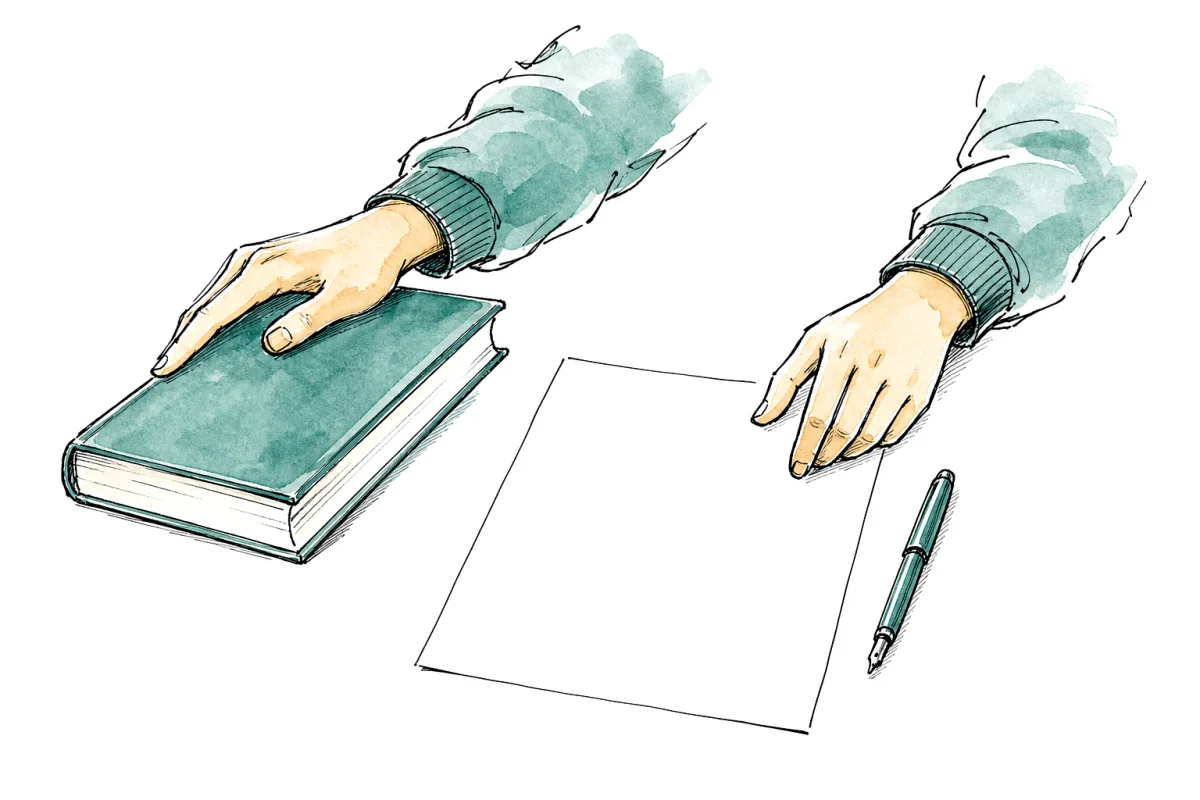
The gist. University learners who answered weekly practice questions without their notes open scored higher a week later, and still led two months after that, than classmates who could keep the book open.
Two parallel university seminars ran the same short practice questions at the end of each lesson for seven weeks. Half the learners could check their notes and slides while answering; the other half could not.
A week later, on a surprise quiz, the closed-book group scored 45% against the open-book group's 37%. Eight weeks after that, on the module exam, the closed-book group still led, 61% against 48%. On exam questions covering content neither group had specifically practised, the two groups scored about the same (63% against 58%), so the gap was not simply one group being stronger overall.
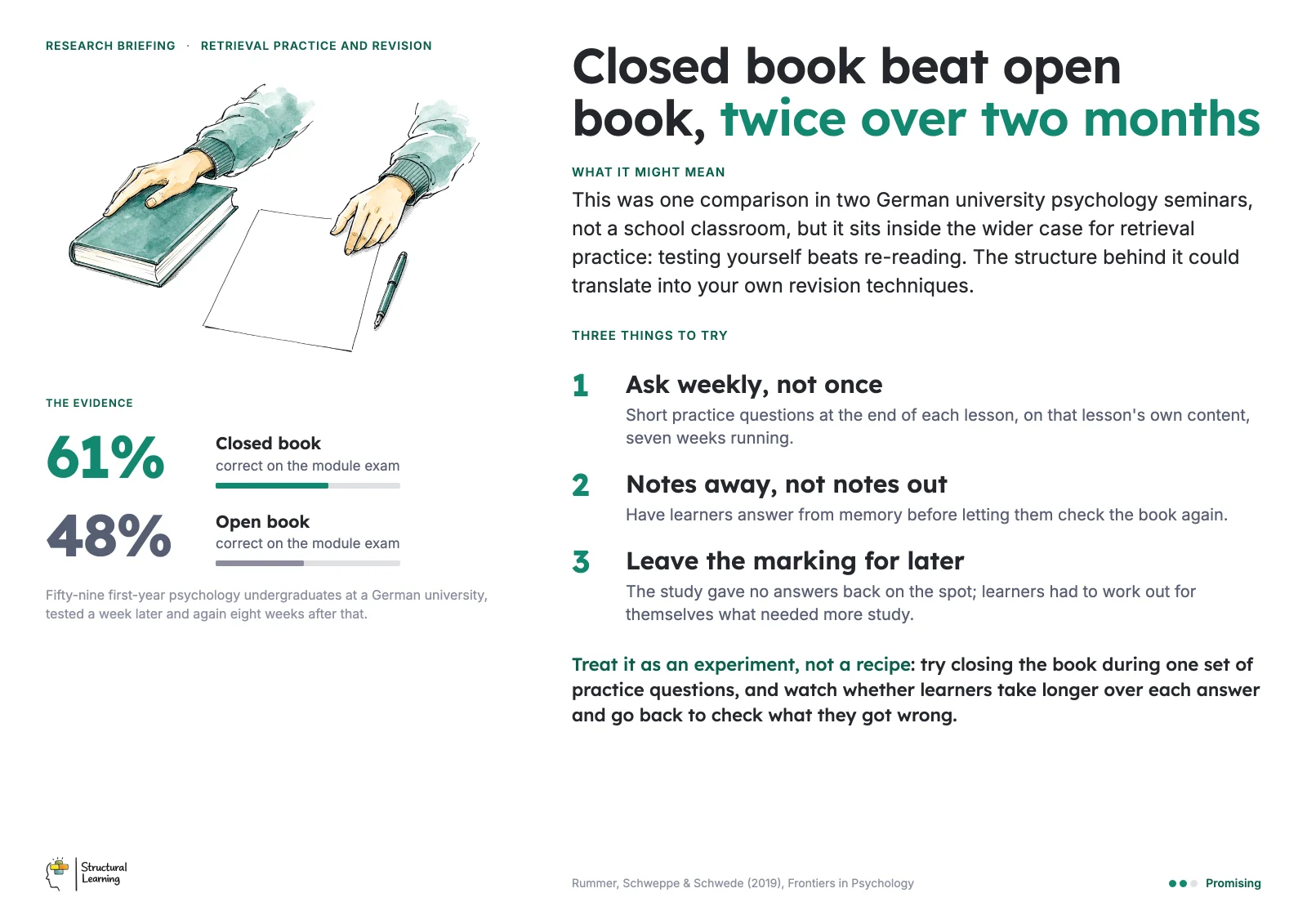
This was one comparison in two German university psychology seminars, not a school classroom, but it sits inside the wider case for retrieval practice: testing yourself beats re-reading. The structure behind it could translate into your own revision techniques.
Treat it as an experiment, not a recipe: try closing the book during one set of practice questions, and watch whether learners take longer over each answer and go back to check what they got wrong. That is your own evidence, not the study's.
This rates the evidence's firmness, not our endorsement of the idea. It is a genuine randomised field experiment with two converging results, but a small, single-site study that has not yet been repeated. Rated Promising. Fifty-nine learners took part, in two German university psychology seminars rather than a UK school classroom, and the same teacher ran both groups while knowing which was which. Fewer closed-book learners turned up to the surprise quiz, and the researchers themselves say they cannot rule out that the closed-book group simply studied harder at home afterwards, rather than closing the book doing the work. Treat closing the book during practice questions as a promising default worth testing in your own room, not a proven fix.
Rummer, R., Schweppe, J., & Schwede, A. (2019). 'Open-Book Versus Closed-Book Tests in University Classes: A Field Experiment.' Frontiers in Psychology, 10, Article 463.
Structural Learning helps teachers turn findings like this into planned, visible thinking in the classroom. Open a free account and try it with your next lesson.
Open a free account →Made by the Structural Learning Evidence Engine. Every claim is traced to the source above and independently verified. See more briefings →