
classroom teachers and department leads
Early signal
✓ Citations verified
A survey of 60 Kazakhstani English teachers found younger teachers reporting far higher use of every formative-assessment practice, including digital and AI tools, than colleagues aged 46 and over; the researchers argue AI could help close that gap, but they never tested whether it actually does.
Yersultanova, G., Orazakynkyzy, F., Zhyltyrova, Zh., & He, Ling. (2026). Integrating AI into formative assessment in English language classrooms of Kazakhstan's schools. Bulletin of Zhetysu University named after I. Zhansugurov, 2(119), 68-80.
Free to download and share. No sign-up needed.
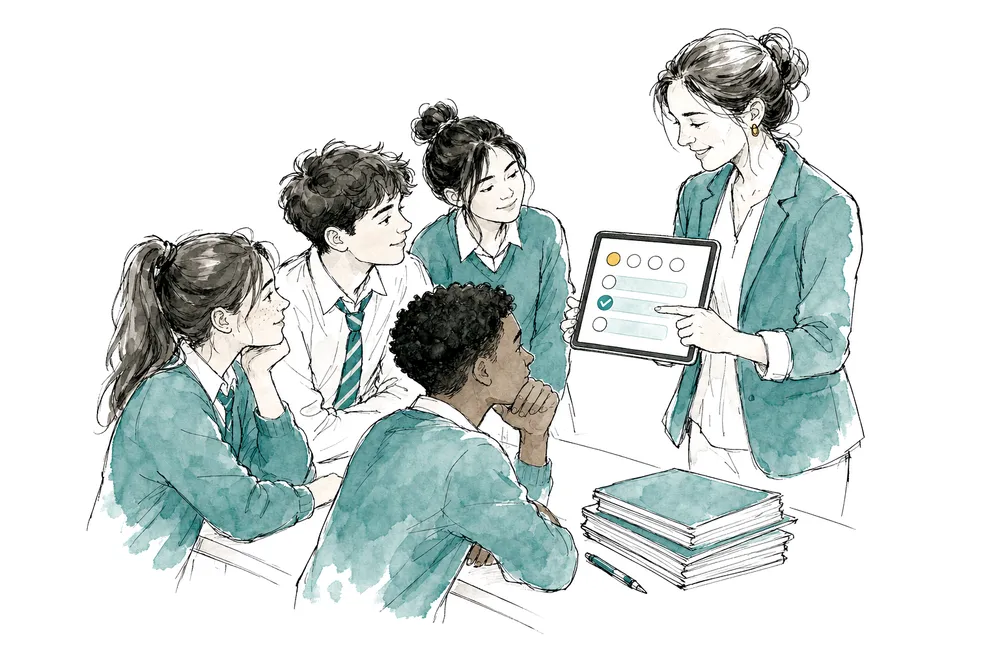
The gist. A survey of 60 English-language teachers in Kazakhstan found that younger teachers reported using every formative-assessment practice, including digital and AI tools, far more than colleagues aged 46 and over. The researchers argue that AI could help close that gap, but their own study never tested whether it does. Read this as an early signal about a generational habit gap, not proof that AI is the fix.
The team surveyed 60 teachers of English across public schools in Almaty city and region, split evenly into three age bands (24-34, 35-45 and 46 and over, with 20 in each) and spanning 2 to 25 years of experience, then interviewed 12 of them in more depth. The study named chi-square tests and ANOVA in its methods but reported no test statistic or p-value for any age comparison, so the differences below are self-reported percentages rather than confirmed statistical effects.
The pattern was consistent: younger teachers reported more of every practice. On using digital or AI tools to support assessment, 40% of the 24-34 group said they did, against 15% of the 46-plus group. For quick in-class checks the split was 90% to 50%, for peer-assessment 55% to 20%, for regular self-assessment 50% to 30%, and for open-ended questioning 75% to 50%. Teachers pointed to time constraints, large classes, limited training and low learner motivation as the main barriers, and the AI examples in the paper, such as a quick poll that revealed a class had misunderstood possessive apostrophes, were single teachers' stories rather than measured results.
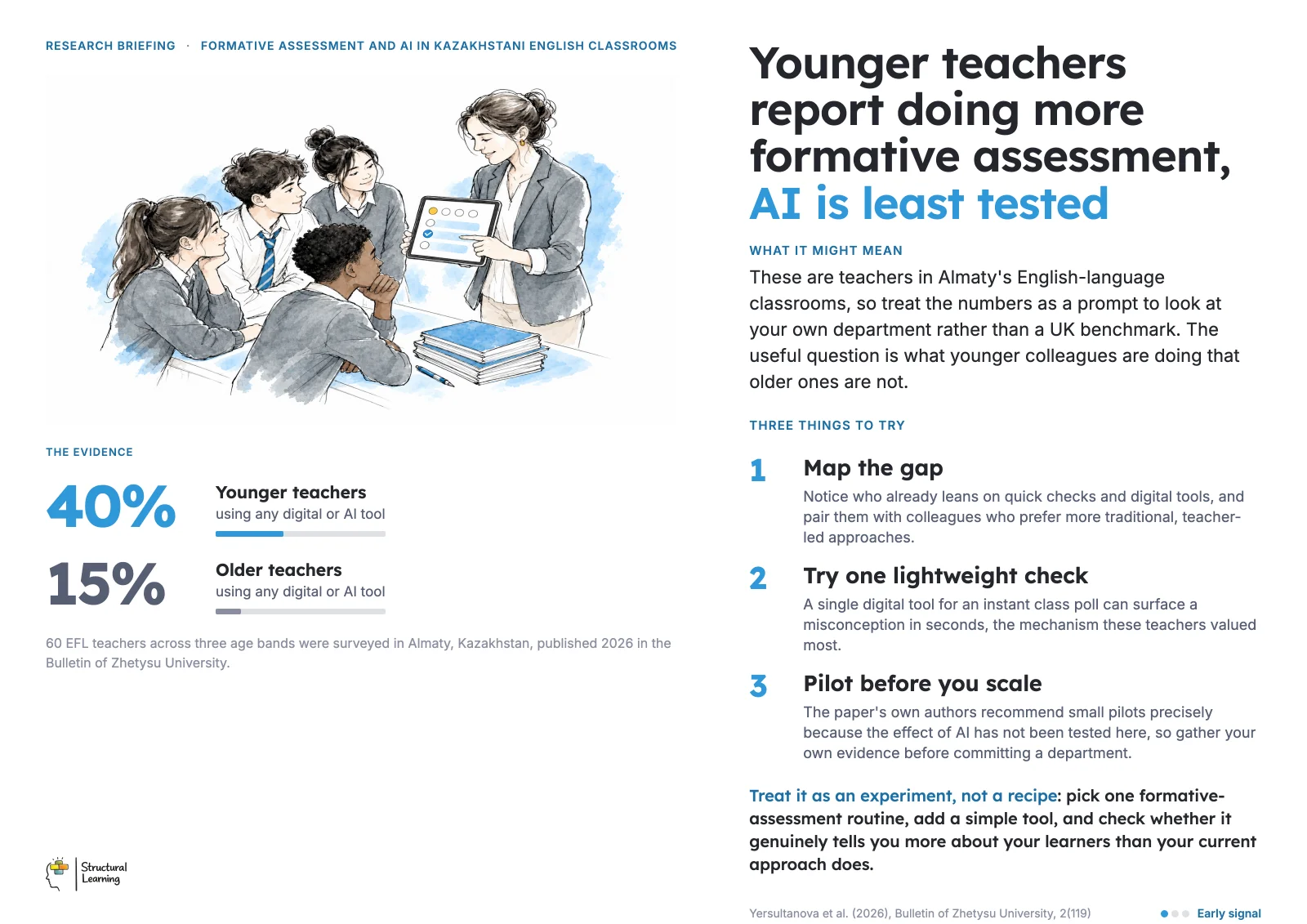
These are teachers in Almaty's English-language classrooms, so treat the numbers as a prompt to look at your own department rather than a UK benchmark. The useful question is what younger colleagues are doing that older ones are not.
Treat it as an experiment, not a recipe: pick one formative-assessment routine, add a simple tool, and check whether it genuinely tells you more about your learners than your current approach does.
Early signal. The age gap is real in the sense that it appears across every practice the survey measured, but two things hold the grade down. First, the study names chi-square and ANOVA yet reports no test statistic or p-value, so the gap is a descriptive difference in what teachers said, not a confirmed significant effect. Second, and more important, the headline idea that AI can close the gap is never tested: the authors state plainly that "without experimental testing of AI's direct impact on learning, the suggested approaches still need further validation", and their AI examples are one-teacher anecdotes rather than data from the 60-teacher sample. The sample is also limited to Almaty and may not represent rural or non-Russian-speaking Kazakhstan, and all of it is self-reported. A controlled trial of an AI tool against a comparison group would raise the grade.
Yersultanova, G., Orazakynkyzy, F., Zhyltyrova, Zh., & He, Ling. (2026). Integrating AI into formative assessment in English language classrooms of Kazakhstan's schools. Bulletin of Zhetysu University named after I. Zhansugurov, 2(119), 68-80.
Structural Learning helps teachers turn findings like this into planned, visible thinking in the classroom. Open a free account and try it with your next lesson.
Open a free account →Made by the Structural Learning Evidence Engine. Every claim is traced to the source above and independently verified. See more briefings →