
secondary maths teachers
Developing
✓ Citations verified
In two 13-week university maths courses, adding a short, unaided recall test at the end of every lesson was followed by the usual link between learners' starting knowledge and their results months later disappearing, while matched classes without the test kept that link firmly in place.
Muzsnay, A., Szabó, C., Zámbó, C., Szabó, G., & Szeibert, J. (2025). Retrieval Practice—A Tool to Narrow the Achievement Gap in Learning Higher Mathematics. International Journal of Science and Mathematics Education, 23(8), 3875-3901.
Free to download and share. No sign-up needed.

The gist. In two 13-week university maths courses, adding a short, unaided recall test at the end of every lesson was followed by the usual link between learners' starting knowledge and their results months later disappearing, while matched classes without the test kept that link firmly in place. In plain terms, the weakest starters caught up, but only in the classes that did the recall test, and only months later. It is a promising matched-comparison result, not yet a randomised trial or a test with secondary-age learners, so treat it as developing evidence.
Two first-year university maths courses for pre-service maths teachers, Number Theory (42 learners) and Algebra (50 learners), each ran for a 13-week term, and everyone sat a diagnostic pre-test of school-level maths at the start. In matched practice groups covering identical lectures and content, one group solved two problems alone, unaided, in a short 5 to 10 minute test at the end of every lesson, a form of retrieval practice; the other group worked through the same two problems as a class, with the teacher's help. Months after each course ended, 3 months for Number Theory and 5 months for Algebra, everyone sat a delayed post-test.
Without the recall test, starting scores kept predicting results: pre-test scores explained about 4 in 10 points of the difference in the delayed post-test in both courses (R-squared of 0.40). With the recall test, that link nearly vanished, with pre-test scores explaining under 1% of the difference (R-squared below 0.01 in both courses). The recall-test classes also scored higher on the post-test itself, a difference that was statistically significant in both courses (Number Theory p=0.0001; Algebra p=0.012), and the gap-closing pattern itself was significant in Number Theory (p=0.0012) and marginally significant in Algebra (p=0.054). It took months to show up: at the first mid-course test, six weeks in, the recall-test classes already scored higher, but the starting-knowledge link had not yet disappeared.
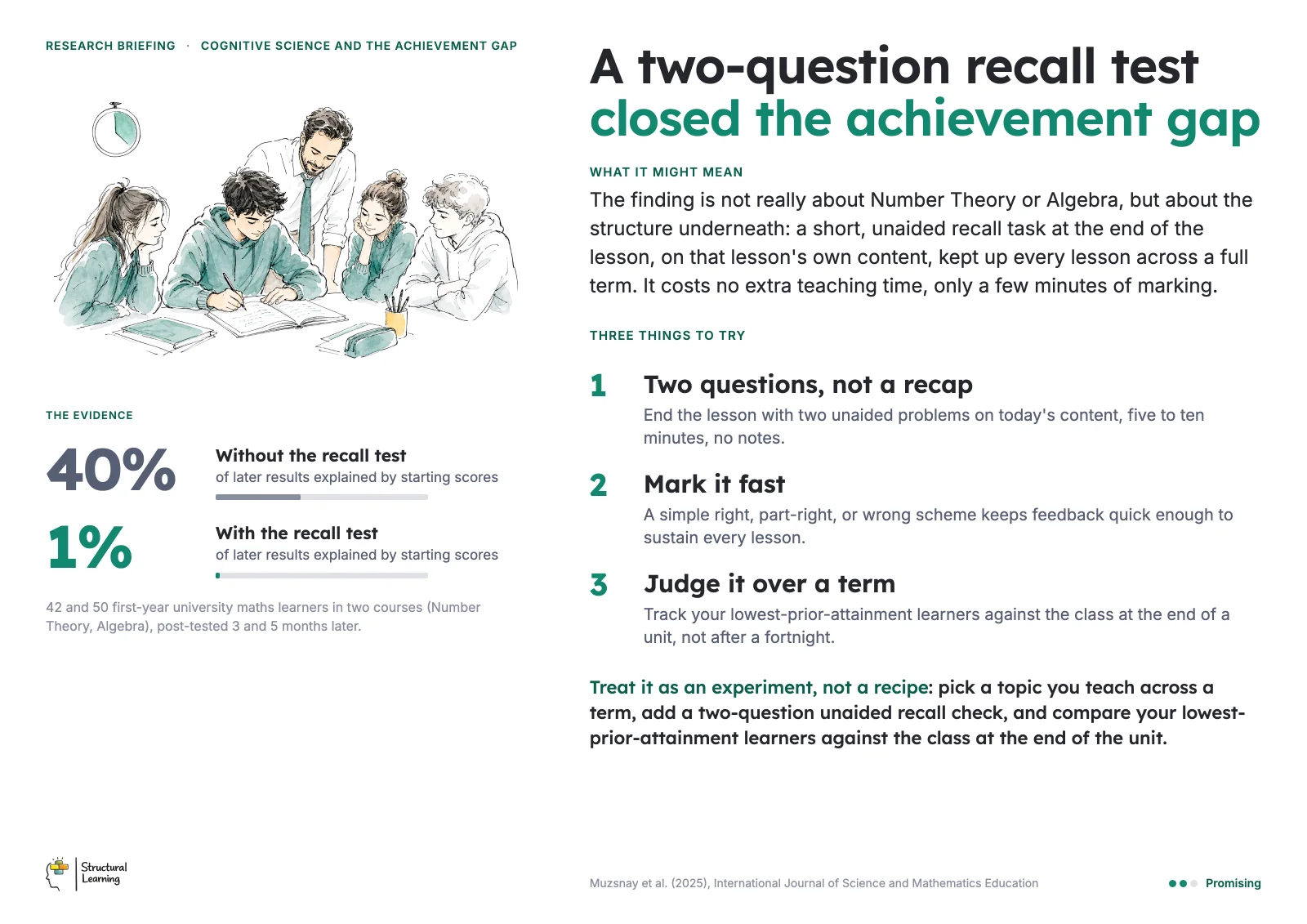
The pattern worth borrowing is not Number Theory or Algebra, it is the structure underneath: a short, low-stakes, unaided recall task at the very end of the lesson, on that lesson's own content, kept up every lesson across a full term. That structure is as easy to build into everyday maths teaching as into a university practice session, and it cost the researchers no extra teaching time, only a few minutes of marking.
Treat it as an experiment, not a recipe: pick a topic you teach across a term, add a two-question unaided recall check at the end of every lesson, and compare your lowest-prior-attainment learners against the rest of the class at the end of the unit, not after the first fortnight.
This is a Promising signal: a real matched-comparison design with statistically significant results converging across two separate courses, but not yet a randomised trial and not yet tested with secondary-age learners. Learners were split into practice groups by course-registration timing rather than deliberately randomised, which the authors say means differing teaching styles could not be eliminated. The participants were 18 to 23 year old university learners training to become maths teachers, not secondary-age learners, so applying this to a school classroom is a translation, not a direct replication. The tightest comparison, Algebra's delayed post-test, rested on only 14 learners in the recall-test group and 20 in the comparison group. The authors also caution the benefit is not solely attributed to the act of retrieval itself. A randomised trial repeating this with secondary-age learners, or independent replication by another team, would raise the grade.
Muzsnay, A., Szabó, C., Zámbó, C., Szabó, G., & Szeibert, J. (2025). Retrieval Practice—A Tool to Narrow the Achievement Gap in Learning Higher Mathematics. International Journal of Science and Mathematics Education, 23(8), 3875-3901.
Structural Learning helps teachers turn findings like this into planned, visible thinking in the classroom. Open a free account and try it with your next lesson.
Open a free account →Made by the Structural Learning Evidence Engine. Every claim is traced to the source above and independently verified. See more briefings →