
primary teachers
Early signal
✓ Citations verified
A signal about local games and struggling readers, not a tested method: after eight weeks of community-game reading lessons run by their own class teacher, all 36 learners in one Philippine Grade 3 class moved from below the pass mark to a class average of 'satisfactory' on a validated reading test, but there was no comparison class, so an ordinary term's progress cannot be ruled out.
Valmores, R. S., & Albacete, V. (2026). Game-Based Learning: A Teaching Intervention Strategy to Improve the Reading Performance of Grade 3 Learners. Psychology and Education: A Multidisciplinary Journal (PEMJ), 57(3), 268-283.
Free to download and share. No sign-up needed.
The gist. After eight weeks of reading lessons built from games the class already played, all 36 learners in one rural Philippine Grade 3 class moved from below the pass mark to a class average of 'satisfactory' on a validated reading test. It is an early signal, not a tested method: there was no comparison class, so an ordinary term's progress cannot be ruled out.
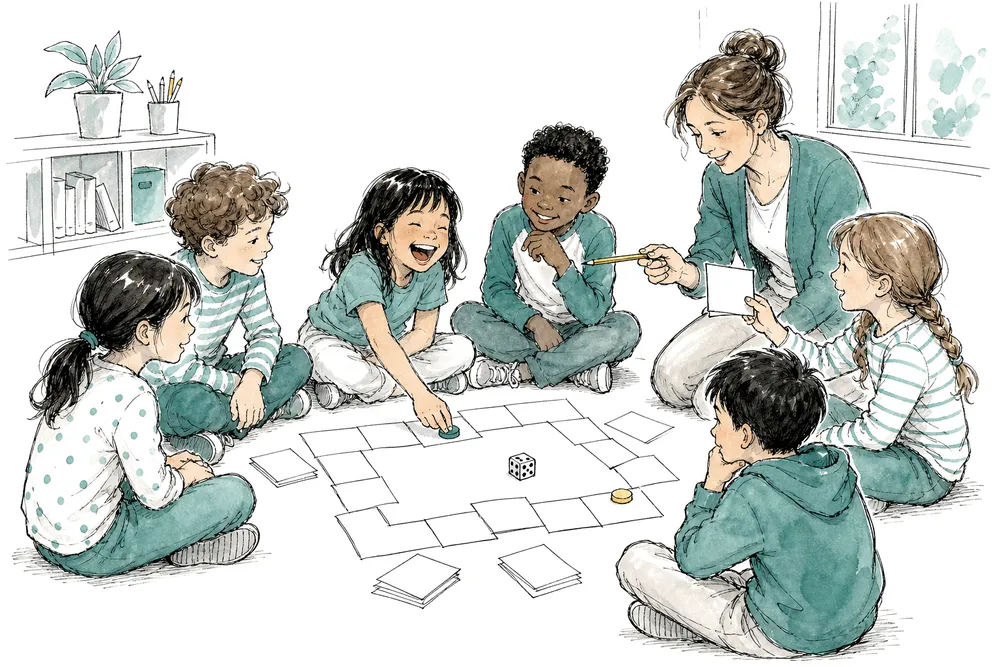
A class teacher at a small, remote elementary school in Malaybalay City Division, Bukidnon, ran eight weeks of game-based reading lessons with her own Grade 3 class of 36 learners, from an Indigenous Peoples and mixed-tribe community. Vocabulary, word decoding and reading comprehension were tested before and after with a validated 45-item reading test, using games built from activities the class already knew rather than a bought resource.
Every learner (all 36, 100%) scored 'did not meet expectations' on the pretest. Afterwards the class average rose from 20 to 37 out of 45, moving from 'did not meet expectations' to 'satisfactory'. Vocabulary and word decoding reached 'very satisfactory' and comprehension reached 'satisfactory', the smallest of the three gains. A paired t-test found the pre/post difference statistically significant (t = -20.40, p = .00001, n = 36); no standardised effect size such as Cohen's d was reported.
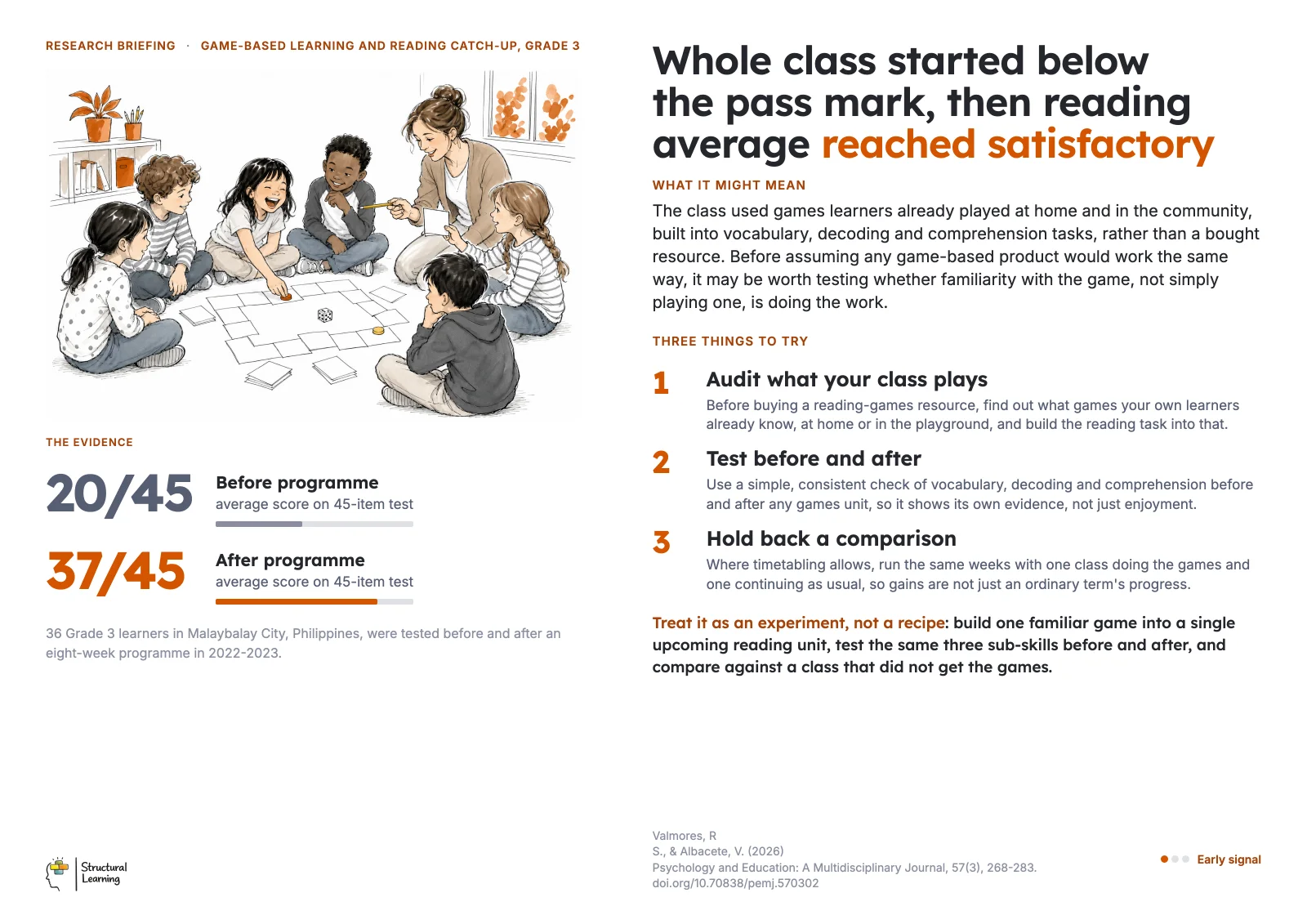
The striking part of this account is not that games can carry a reading lesson, it is that these were games the class already played at home and in the community, folded into vocabulary, decoding and reading comprehension tasks rather than replaced by a new resource. Before assuming any game-based product would produce the same shift, it may be worth testing whether familiarity with the game, rather than the fact of playing one, is doing the work. It is a close cousin of the wider case for play-based learning, and it leans on the same reading comprehension skills you already teach.
Treat it as an experiment, not a recipe: build one familiar game into a single upcoming reading unit, test the same three sub-skills before and after, and compare against a class or group that did not get the games.
We grade this an early signal. The reading test is comparatively well-built and the pre/post difference is highly significant, but there was no comparison group at all, the class's own teacher was also the sole researcher and interviewer, the published tables carry internal numerical inconsistencies we worked around by citing only the self-consistent figures, and it is one class in one under-resourced community using games that are never individually named. A version taught with a matched comparison class, an independent tester, and a named, described set of games would raise this to developing.
Valmores, R. S., and Albacete, V. (2026). Game-Based Learning: A Teaching Intervention Strategy to Improve the Reading Performance of Grade 3 Learners. Psychology and Education: A Multidisciplinary Journal, 57(3), 268-283. Open access under a CC BY-NC-ND 4.0 licence.
Structural Learning helps teachers turn findings like this into planned, visible thinking in the classroom. Open a free account and try it with your next lesson.
Open a free account →Made by the Structural Learning Evidence Engine. Every claim is traced to the source above and independently verified. See more briefings →