
primary teachers
Early signal
✓ Citations verified
A signal about belief and habit, not a tested method: in one Australian survey, 141 primary teachers described formative assessment in positive terms, occurring in both formal and informal, and both planned and unplanned forms, and the study's own authors call for strengthening more deliberate practice.
Bond, E., Markopoulos, C., & Neumann, M. M. (2026). Exploring primary teachers' perceptions and self-reported practices of formative assessment in Australian schools. Studies in Educational Evaluation, 90, 101649.
Free to download and share. No sign-up needed.
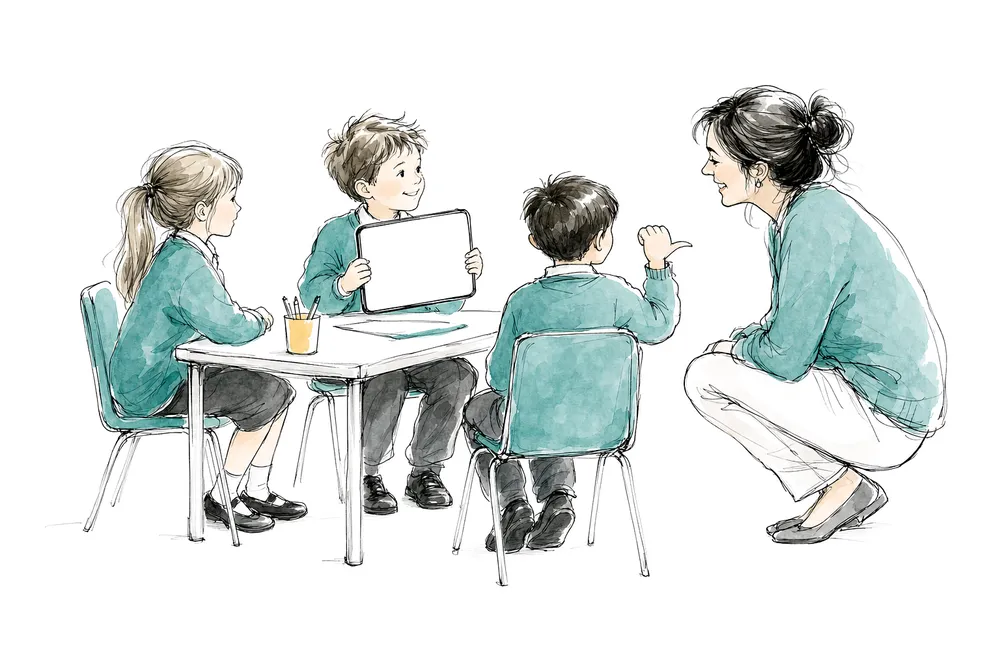
The gist. In one Australian survey, 141 primary teachers described formative assessment in warmly positive terms and said it happens in both formal and informal, and both planned and unplanned, forms. This is a signal about what teachers believe and say they do, not a tested method, and the study's own authors call for strengthening more deliberate practice.
Researchers surveyed 141 teachers across nine suburban Australian primary schools and analysed the responses using exploratory factor analysis and descriptive statistics. Because this is self-report with no classroom observation, it captures how teachers see and describe formative assessment rather than what an observer would record in the room.
Teachers held positive perceptions, describing formative assessment as: an ongoing, integrated part of teaching; a way to find out where learners are in their learning; a valid and reliable way to track progress and inform teaching; useful for improving their own practice; a way to give feedback to learners and teachers; and simply valuable and useful. They saw it as happening before, during and after teaching, in formal and informal and planned and unplanned forms. Teaching experience, year level taught and participation in professional learning did not significantly shape these perceptions; professional learning was, however, associated with more frequent implementation.
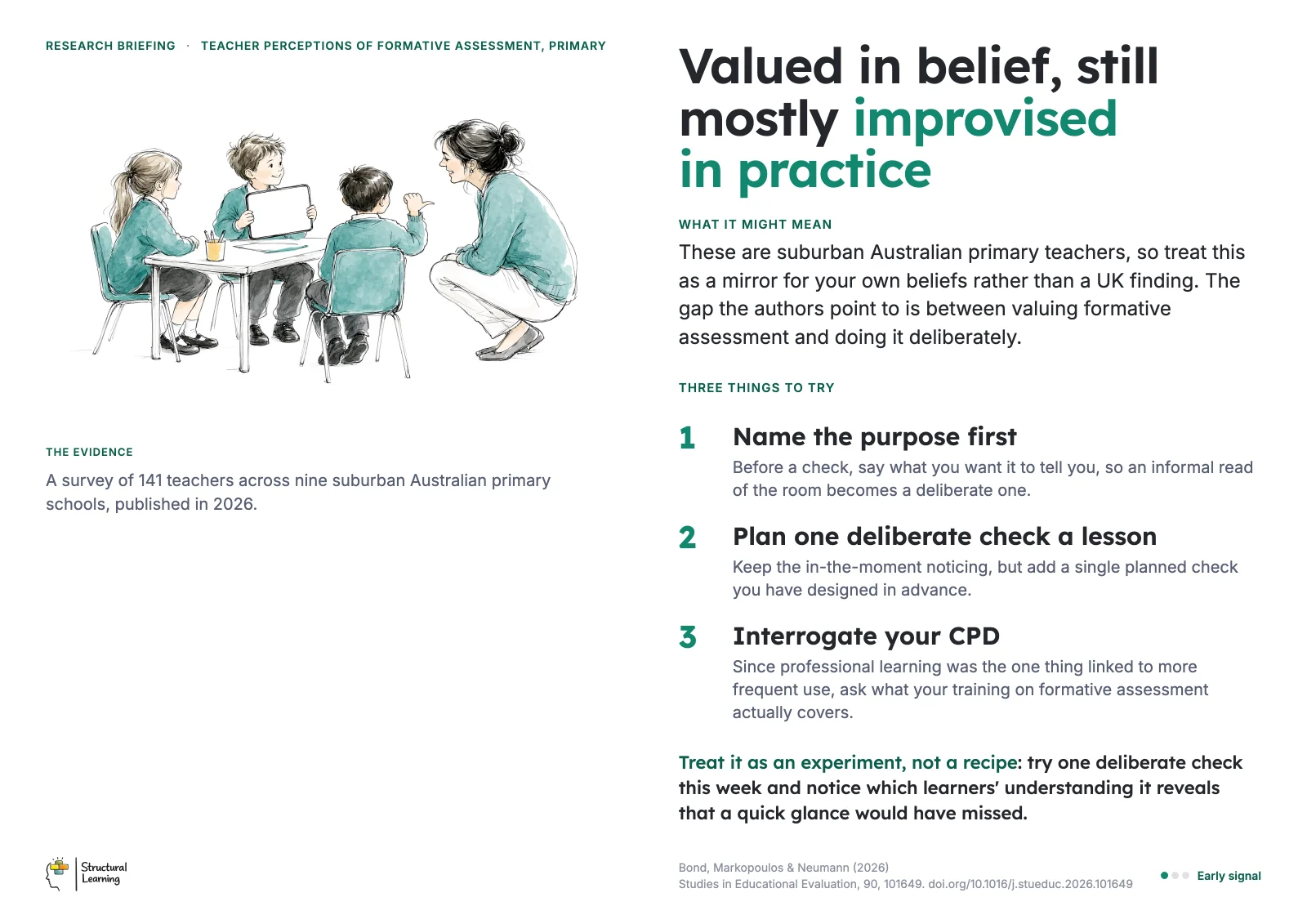
These are suburban Australian primary teachers, so treat this as a mirror for your own beliefs rather than a UK finding. The gap the authors point to is between valuing formative assessment and doing it deliberately, and that is where practical assessment for learning strategies can help. Worth trying, not proven:
Treat it as an experiment, not a recipe: try one deliberate check this week and notice which learners' understanding it reveals to you that a quick glance would have missed.
Early signal. This is a single, cross-sectional, self-report survey of 141 teachers in one Australian region, analysed with an exploratory (hypothesis-generating) method rather than a confirmatory test, and with no classroom observation to check whether stated practice matches what happens. The abstract reports no percentages, factor loadings or test statistics, so none are quoted here, and the one link it does describe, between professional learning and more frequent implementation, is correlational in the source's own words. We could also only access the published abstract, as the full text sat behind a publisher block. A study that observed lessons directly, in more varied schools, would raise the grade.
Bond, E., Markopoulos, C., & Neumann, M. M. (2026). Exploring primary teachers' perceptions and self-reported practices of formative assessment in Australian schools. Studies in Educational Evaluation, 90, 101649. Open access under a CC BY licence.
Structural Learning helps teachers turn findings like this into planned, visible thinking in the classroom. Open a free account and try it with your next lesson.
Open a free account →Made by the Structural Learning Evidence Engine. Every claim is traced to the source above and independently verified. See more briefings →