Ancient Greek PhilosophySixth form students in maroon sweatshirts discussing Ancient Greek Philosophy in a modern study space with large windows.

Updated on  

January 16, 2026

Ancient Greek Philosophy

|

January 26, 2023

Who were the great ancient Greek philosophers and how have they shaped education today?

Course Enquiry
Copy citation

Main, P (2023, January 26). Ancient Greek Philosophy. Retrieved from https://www.structural-learning.com/post/ancient-greek-philosophy

What is Philosophy in Ancient Greece?

Ancient Greek philosophy represents one of the foundational intellectual traditions in human history, shaping how we understand knowledge, morality, politics, and the human soul itself. Emerging in the 4th century BCE and earlier, Greek philosophers pioneered the practice of using reasoned argument to explore the natural world, human nature, and the underlying principles that govern society and the universe.

Key Takeaways

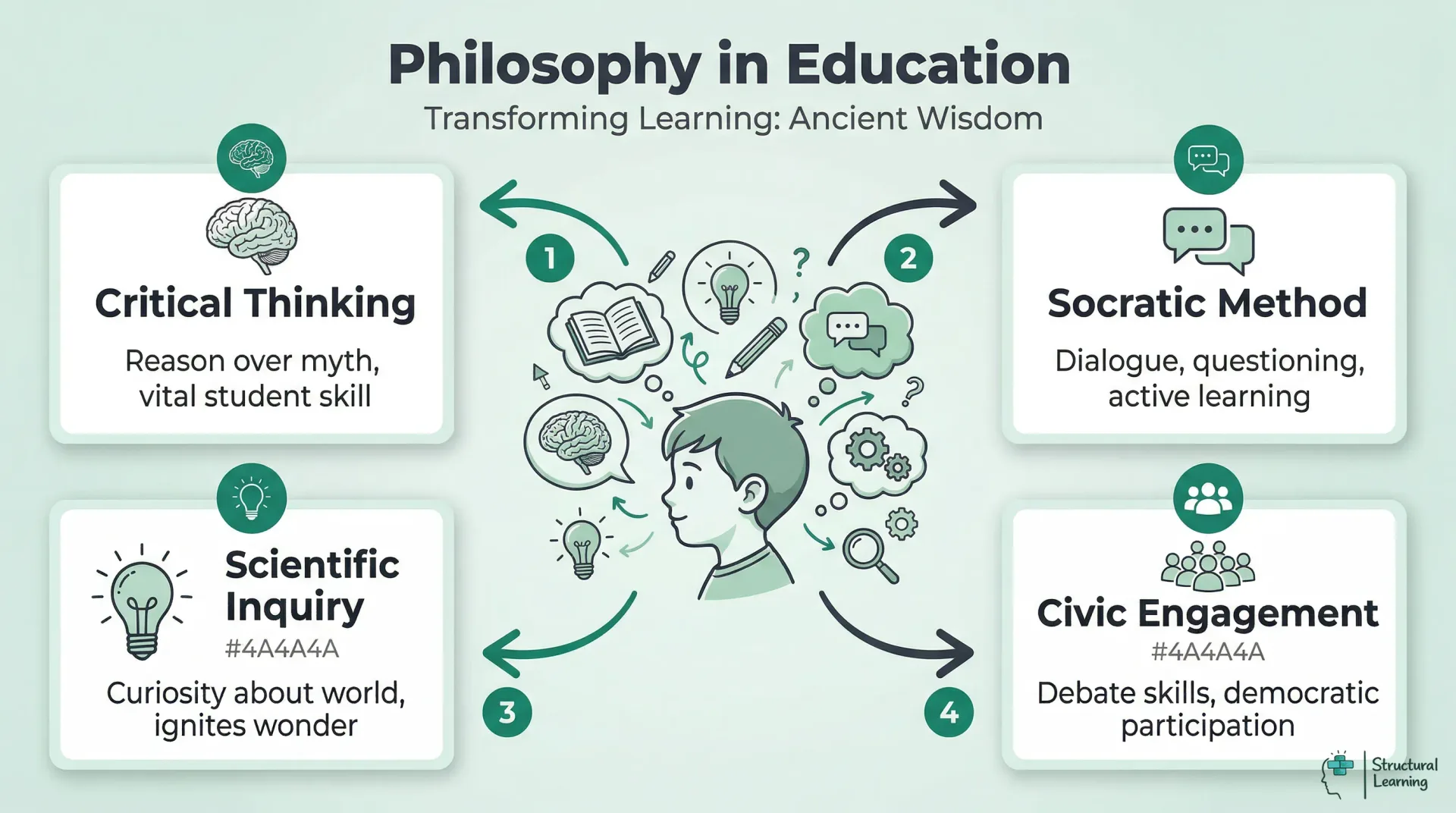
  1. Beyond Myths and Gods: Discover how ancient philosophers' shift from mythology to reasoning mirrors the critical thinking journey your students need to make
  2. The Socratic Classroom Revolution: Transform passive learners into active questioners using the same dialogue techniques that shaped Western education for 2,400 years
  3. Why Philosophy Starts with Wonder: Learn how the Milesians' curiosity about water and air can ignite scientific inquiry in your most reluctant learners
  4. The Hidden Democracy Connection: Uncover why teaching philosophical debate skills directly strengthens students' citizenship capabilities and democratic participation in modern classrooms

The history of philosophy in Ancient Greece spans several centuries and includes a rich diversity of philosophical traditions. While famous names such as Socrates, Plato, and Aristotle often dominate discussions, they were part of a much larger philosophical landscape, one shaped by earlier pre-Socratic thinkers and later Hellenistic schools. Together, these intellectual traditions created a dynamic and evolving dialogue on ethics, politics, science, and metaphysics, a dialogue that continues to influence education, political theory, and philosophical inquiry today.

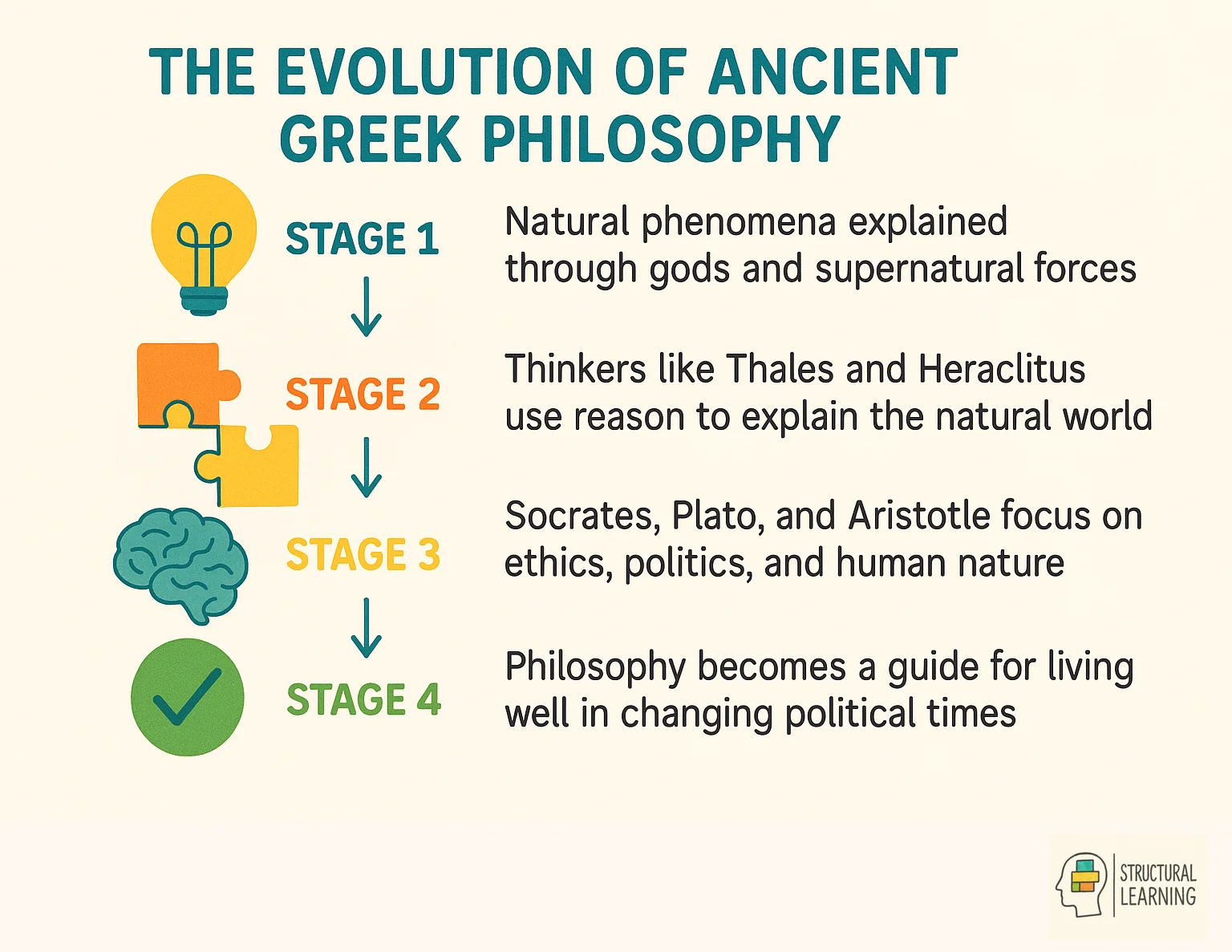
Timeline showing four stages of Ancient Greek philosophy from mythology to Hellenistic schools
The Evolution of Ancient Greek Philosophy

What made Ancient Greek philosophy so unique was its connection to the social and political changes occurring in 4th century Athens and beyond. The development of democracy in Greek city-states provided fertile ground for public debate, where questions of justice, virtue, and citizenship were constantly re-examined. Philosophers did not simply speculate in isolation, they actively engaged with the political and cultural issues of their time, creating a philosophy that was grounded in lived experience.

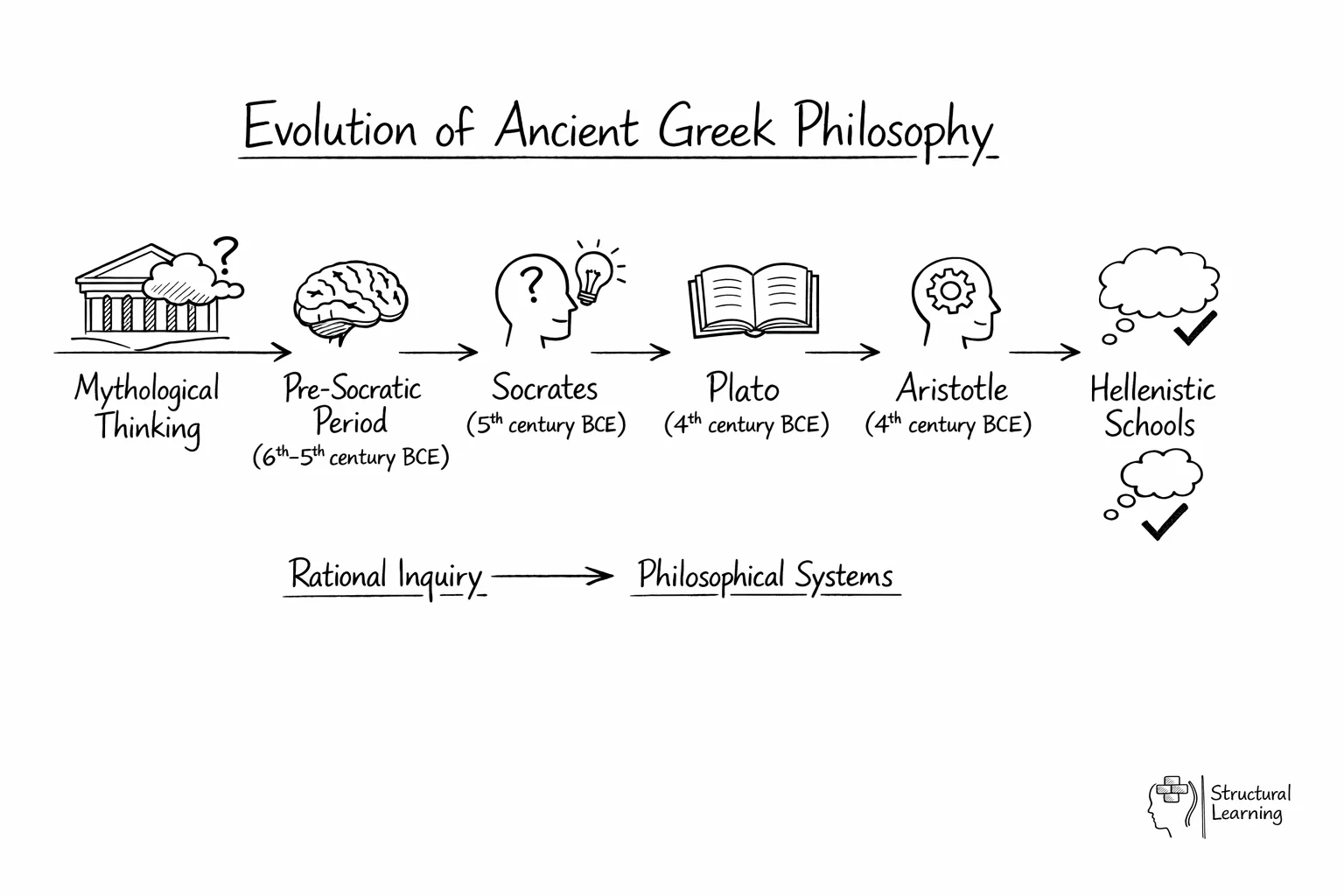
Timeline showing evolution of Ancient Greek philosophy from Pre-Socratics through Classical period
Linear timeline: Evolution of Ancient Greek Philosophy

Central to many Ancient Greek philosophical traditions was the concept of the human soul, its nature, its purpose, and its relationship to knowledge and the good life. From Plato’s theory of the tripartite soul, which explored the balance between reason, spirit, and desire, to Aristotle’s more empirical view of human potential, these reflections on the soul laid the groundwork for future explorations in psychology, ethics, and theology.

The history of philosophy would look very different without the contributions of Ancient Greek thinkers. Their philosophical traditions, shaped by constant questioning, public discourse, and innovative reasoning, gave us enduring tools to think critically about society, morality, and human purpose. In this article, we’ll explore some of the key figures, central themes, and lasting legacies of Ancient Greek philosophy, helping you bring this fascinating period into your classroom conversations, and showing students how these intellectual traditions still shape our understanding of the world today.

Who Were the Pre-Socratic Philosophers and What Did They Teach?

The Pre-Socratic philosophers were early Greek thinkers who focused on explaining the natural world through reason rather than mythology, including Thales, Anaximander, and Heraclitus. They pioneered scientific thinking by asking fundamental questions about the origin of the universe, the nature of matter, and the principles governing change. Their methods of rational inquiry laid the groundwork for all later Western philosophy and science.

The 5th and 4th centuries BCE marked the Golden Age of Ancient Greek philosophy, led by three of the most influential thinkers in the history of philosophy: Socrates, Plato, and Aristotle. Their ideas shaped not only the intellectual traditions of Ancient Greece but also Western thought, education, and political theory for centuries to come.

Socrates, often regarded as the founding figure of Western philosophy, transformed philosophical inquiry by focusing on ethical questions rather than the natural world. He believed that true wisdom came from recognising one’s own ignorance, and his method of dialogue and questioning, later called the Socratic Method, encouraged learners to examine their own beliefs through reasoned debate. Socrates’ relentless questioning of truth, justice, and virtue ultimately led to his trial and execution, but his legacy shaped future philosophical traditions.

Plato, Socrates’ most famous student, expanded these ethical inquiries into a comprehensive philosophical system that explored politics, metaphysics, and the human soul. In his dialogues, Plato introduced the Theory of Forms, the belief that beyond the physical world lies a timeless realm of perfect abstract ideals, such as justice, beauty, and truth, that shape reality. Plato also established The Academy, one of the first institutions dedicated to philosophical and intellectual traditions, ensuring that these ideas were passed to future generations.

Aristotle, Plato’s student, took a different path, grounding philosophy in empirical observation and scientific classification. His writings covered ethics, politics, biology, and logic, emphasising the importance of rational analysis and practical reasoning. Aristotle’s view of the human soul was more functional than mystical, seeing it as the organising principle of living beings.

Together, Socrates, Plato, and Aristotle formed the intellectual core of ancient Greek philosophy, creating foundations that continue to shape modern education, ethics, and critical thinking.

What Was the Milesian School of Philosophy?

The Milesian School, founded in the city of Miletus, included the first philosophers Thales, Anaximander, and Anaximenes who sought natural explanations for the world's origins. They proposed that everything came from a single substance: water (Thales), the infinite (Anaximander), or air (Anaximenes). This marked the revolutionary shift from mythological to rational explanations of nature.

The Milesian School, emerging in the 6th century BCE, represents the earliest known school of philosophy in Ancient Greece. Named after the city of Miletus in Ionia, this group of philosophers pioneered some of the first systematic efforts to understand the nature of the universe through rational inquiry, rather than religious or mythological explanations. Their work laid essential groundwork for later philosophical traditions, particularly in the areas of cosmology, metaphysics, and scientific reasoning.

The Milesian philosophers, Thales, Anaximander, and Anaximenes, were especially concerned with the question of what the world is made of and how change and transformation occur. They each proposed that a single fundamental substance, known as the arche, formed the basis of all matter. This search for a unifying principle marked a significant shift in thinking, as they moved away from seeing the world as governed by the will of gods and instead explored natural processes.

Thales of Miletus, often described as the first philosopher, suggested that water was the essential substance from which all things emerged. His successor, Anaximander, expanded this concept, proposing that the arche was an indefinite, boundless substance, the Apeiron, capable of generating all other forms of matter. Anaximenes, the third major figure, argued that air was the primary element, capable of transformation through processes like condensation and rarefaction.

The Milesians’ ideas about the composition of the world were not isolated theories, but part of a broader effort to understand natural phenomena through observation and reason. This approach not only influenced later Greek thinkers like Pythagoras but also established a critical foundation for the history of philosophy by demonstrating that systematic questioning and logical reasoning could unlock deep insights into the nature of reality.

Greek philosophers
Greek philosophers

Why Was Xenophanes Important to Ancient Greek Philosophy?

Xenophanes challenged traditional Greek religious beliefs by criticizing anthropomorphic gods and arguing that humans create deities in their own image. He promoted monotheism and skepticism about human knowledge, teaching that certain truth might be unattainable. His critical approach to religion and epistemology influenced later philosophical discussions about the nature of divinity and the limits of human understanding.

Xenophanes of Colophon was a poet, philosopher, and religious critic who occupies a unique place in the history of philosophy. While he is often associated with early Greek religious thought, his ideas also contributed to the philosophical traditions that would later define the Eleatic School. Xenophanes was particularly interested in the nature of divine beings and the limits of human knowledge, offering some of the earliest critiques of the anthropomorphic gods found in Greek mythology.

He argued that humans tend to imagine gods in their own image, giving them human-like appearance, personalities, and flaws. For Xenophanes, this reflected human bias rather than any real understanding of the divine. In contrast, he proposed a vision of a single, all-powerful divine entity, a god unlike humans, who governs the world through rational order rather than emotional whim. This focus on unity rather than diversity became a hallmark of Eleatic thought, where reality was seen as a single, unchanging whole, with the diversity of material things regarded as mere appearances.

Xenophanes also questioned the reliability of human knowledge, warning that even the most confident claims to truth are shaped by perspective and limited understanding. This self-reflective stance on certainty and truth influenced later Greek philosophical traditions, particularly in epistemology, the study of how we know what we know. By blending religious inquiry with rational critique, Xenophanes helped shift Greek thought away from mythology and towards systematic reflection on the nature of reality, divinity, and knowledge itself.

What Were the Main Teachings of Pythagoras and His School?

Pythagoras and his followers believed that numbers and mathematical relationships formed the fundamental structure of reality. They combined philosophy with religious practices, including beliefs in the immortality and transmigration of souls, vegetarianism, and communal living. The Pythagorean theorem and their discoveries about musical harmony demonstrated their core belief that mathematics governed the cosmos.

The philosophical traditions associated with Pythagoreanism extend far beyond the mathematical theorem for which Pythagoras is best known today. For the Pythagoreans, mathematics was not merely a practical tool, it was the fundamental structure of reality itself. They believed the universe operated according to fixed mathematical principles, and that understanding these principles could unlock deeper truths about the cosmos, the human soul, and the purpose of existence.

A central doctrine of Pythagoreanism was metempsychosis, the belief in the transmigration of souls, the idea that after death, a person’s soul migrates into a new body, either human or animal. This belief tied into their broader view that harmony and proportion governed all aspects of life, from the movement of the stars to the moral balance of the human soul.

The Pythagoreans also lived by a highly structured ethical and communal lifestyle, which reflected their mathematical worldview. Rules governed everything from diet to speech, with the belief that maintaining internal and external harmony was key to spiritual purification. This emphasis on order, structure, and balance placed the Pythagoreans at the crossroads of philosophy, science, and mysticism, influencing both Greek philosophical traditions and later spiritual movements.

Though much of Pythagoras' own work is lost, his followers' writings preserved his cosmological, ethical, and mathematical theories, leaving a legacy that shaped Ancient Greek philosophy and the intellectual traditions that followed.

What Did Heraclitus Mean by 'Everything Flows'?

Heraclitus taught that constant change is the fundamental nature of the universe, famously stating that you cannot step into the same river twice. He believed that opposing forces create harmony through their tension, and that fire was the primary element driving all transformation. His doctrine of flux influenced later philosophers' understanding of change, permanence, and the unity of opposites.

Known as the philosopher of change, Heraclitus of Ephesus introduced one of the most striking and enduring ideas in the history of philosophy: that change is the fundamental nature of reality. For Heraclitus, the world was not static but in a constant state of flux, where everything flows and nothing stays the same. His famous observation that “you cannot step into the same river twice” illustrates this dynamic view of existence, not only does the river change, but so does the person stepping into it.

At the heart of Heraclitus’ cosmology was the concept of fire as the primary element shaping the universe. Fire, with its constant movement and transformative power, symbolised the ceaseless process of change that governs all things. This idea of perpetual transformation stood in contrast to earlier Pre-Socratic thinkers who sought to identify a single stable substance as the foundation of reality.

Heraclitus also saw conflict and opposition as essential to both the natural world and human society. He believed that tension between opposites, day and night, life and death, war and peace, was not just inevitable but necessary for progress. This view of reality shaped by dynamic contrasts offered an early glimpse of dialectical thinking, a concept later developed by Hegel and other philosophers.

Although much of Heraclitus’ work survives only in fragments, his influence on Ancient Greek philosophy was profound. His insistence that reality is shaped by constant change, rather than static laws or divine intervention, introduced a philosophical tradition that encouraged thinkers to embrace uncertainty, reconsider assumptions, and seek meaning in the ever-changing flow of life.

https://www.structural-learning.com/post/moderate-learning-difficulties
Key Ancient Greek Figures

How Did Parmenides and Zeno Challenge Common Sense About Reality?

Parmenides argued that change and motion are illusions, claiming that true reality is one, unchanging, and eternal. His student Zeno created famous paradoxes, like Achilles and the Tortoise, to prove that motion is logically impossible. Their radical ideas forced philosophers to develop more sophisticated theories about the relationship between appearance and reality.

In ancient Greek philosophy, Parmenides is known as the founder of the School of Elea, which also included Melissus of Samos and Zeno of Elea. About his political life in Elea, it is told that he wrote the city's laws. His most important student was Zeno of Elea. According to Plato, Zeno was 25 years younger eromenos of Parmenides.

Zeno of Elea (465 BCE) was a Greek philosopher of the Eleatic School of ancient Greek philosophy and a student of the elder philosopher Parmenides ( 485 BCE) whose work influenced the philosophy of Socrates.

Why Is Socrates Called the Father of Western Philosophy?

Socrates revolutionized philosophy by turning attention from nature to human ethics and the examined life, famously declaring that 'the unexamined life is not worth living.' He developed the Socratic method of questioning to expose ignorance and lead students to truth through dialogue. His willingness to die for his principles rather than abandon philosophy established him as philosophy's first martyr and moral exemplar.

Aristotle, Plato & Socrates were the most prominent educational philosophers of this era. These three philosophers are the most widely known of all ancient Greek philosophers. Socrates is well-known for his asking thought-provoking questions and teaching strategies.

Rather than using usual ways to teach his learners, he challenged their underlying assumptions by asking them complex questions, which is a technique still preferred by the present-day law schools. Socrates contends that he is willing to master the courtesan skills so he could attract juniors to accompany his life of philosophy.

He thought that learning was the absolute good and that seeking knowledge was essential to leading a virtuous life. Socrates contended that both evil and good are absolute and knowledge is the only way to learn the difference between the two.

Socrates believed that ignorance is absolute evil. Socrates did not write much about his public life; hence, most of the things we know about him have been told by his student Plato.

What Were Plato's Most Important Philosophical Contributions?

Plato developed the Theory of Forms, arguing that the material world is an imperfect reflection of eternal, perfect ideas or forms. He founded the Academy, the first institution of higher learning in the Western world, and wrote philosophical dialogues featuring Socrates. His works on justice, education, and the ideal state in 'The Republic' continue to influence political philosophy and educational theory.

In ancient Greek philosophy Plato is known for researching justice, virtue, ethics, and other concepts about human behaviour. Plato described the ideal city as one based on virtuous life and justice.

His studies on mathematics, politics and philosophy were very persuasive and laid the basis for Euclid's systematic technique of mathematics. Taking Socrates as a model, Plato became an instructor too and founded an academy in Athens and inspired the next extraordinary Greek philosopher, Aristotle's work.

How Did Aristotle's Philosophy Differ from Plato's?

Aristotle rejected Plato's Theory of Forms, arguing that universal properties exist within particular things rather than in a separate realm. He developed systematic approaches to logic, ethics, politics, and natural science, emphasizing empirical observation and practical wisdom. His comprehensive system of knowledge dominated Western and Islamic thought for over a millennium.

Aristotle studied ethics, as well as other subjects such as astronomy, biology, and physics. Aristotle is frequently credited with developing the basis for modern-day zoology and the study of logic.

Aristotle's ideal city is one with happiness, rather than war, and its customs, laws and education correspond to achieving that aim. Aristotle was also anxious about the primary purpose of things and how people can have a good life.

According to Aristotle, when individuals identify their positive traits, they must use them to seek virtue and attain their potential. According to Aristotle, this may give people happiness and allow them to lead a “good” life.

Greek philosophy lesson plan

What Were the Major Post-Socratic Schools of Philosophy?

The major Post-Socratic schools included Stoicism, Epicureanism, Skepticism, and Cynicism, each offering different approaches to achieving happiness and wisdom. Stoics emphasized virtue and acceptance of fate, Epicureans pursued moderate pleasure and friendship, while Skeptics suspended judgment and Cynics rejected social conventions. These schools provided practical philosophies for living that spread throughout the Hellenistic and Roman worlds.

The Post-Socratic ancient Greek philosophers established 4 schools of philosophy:

  • Cynicism,
  • Scepticism,
  • Epicureanism, and
  • Stoicism
  • The Post-Socratic ancient Greek philosophers remained focused on the individual as compared to societal issues like the nature of Greek politics. For instance, in ancient philosophy main purpose of stoicism is to understand and acquire a specific way of a virtuous life.

    Sextus Empiricus was a prominent supporter of an ancient tradition of thinking referred to as scepticism. He was not so extreme sceptic as to reject the possibility of knowledge (which was done by some sceptics).

    Sextus Empiricus believed that each judgement must be cancelled, therefore allowing any information can eventually be declined.

    Nowadays, teachers of Modern philosophy use the patterns of exploration and thinking founded by the ancient philosophers of Greece such as participating in debate to better communicate philosophical concepts.

    Greek philosophers were lovers and seekers of knowledge. They examined their surrounding world through reason and logic. Many people feel that philosophy is close to religion and life, but the great philosophers of the Greek city were scientists too.

    They also studied physics and mathematics. Most of them taught the children of wealthy families. Some of them opened their academies or schools. The basic ideas put forward by the brilliant ancient Greek philosophers such as Aristotle, Socrates, and Plato, still impact people's understanding of their surrounding world.

    These great scholars used logic and reason to unfold the facts of the cosmos. They also examined the delicacies of people's private and public life.

    Ancient philosophy in the classroom
    Ancient philosophy in the classroom

    How Can Teachers Use Ancient Greek Philosophy in Modern Classrooms?

    Teachers can apply Socratic questioning to develop critical thinking skills and encourage students to examine their assumptions about knowledge and values. Philosophy for Children programs adapt ancient dialogue methods to help students discuss ethical dilemmas, logical reasoning, and big questions about life. Resources like philosophy discussion guides and thought experiments based on Greek paradoxes make abstract concepts accessible to learners of all ages.

    These studies provide strong evidence that philosophy in the classroom enhances cognitive development, ethical reasoning, and reflective thinking.

    1. Bowyer, Amos & Stevens (2021), What Does Philosophy Do? Understanding the Work That Philosophy Does
    This review explored the impact of introducing philosophy in the classroom, showing that regular philosophical dialogue significantly enhances students’ cognitive abilities, critical reasoning, and communication skills. The study highlights how philosophical inquiry helps students engage with both basic concepts and key concepts around ethical reflection and deeper thinking, improving overall learning outcomes and fostering a more reflective life of simplicity.

    2. Millett (2018), Why Teach Philosophy in a World Dominated by Science
    Millett’s research emphasizes the importance of teaching philosophy at all grade levels, even in educational environments dominated by STEM subjects. Through structured philosophical discussions, students develop critical thinking and reasoning abilities, and the study highlights how philosophical inquiry, including ideas rooted in Presocratic philosophy and stoic ethics, helps students grapple with moral questions and develop a deeper understanding of themselves and the world around them.

    3. Lipman (1988), Philosophy Goes to School
    As a foundational figure in Philosophy for Children (P4C), Matthew Lipman explored how introducing philosophical dialogue into elementary schools improves reasoning, ethical reflection, and creative thinking. Lipman’s work, which is frequently cited by Cambridge University Press, illustrates how philosophy encourages open-ended questioning and collaborative inquiry, giving students tools to critically assess the world around them while developing strong reasoning and dialogue skills.

    4. Kienstra, Imants & van der Heijden (2015), Doing Philosophy Effectively: Student Learning in Classroom Teaching
    This study examined how structured philosophical discussions, supported by teacher facilitation, improved students’ engagement and learning outcomes across a series of classroom discussions. The research found that students who regularly participated in philosophical dialogue developed higher-level reasoning skills and stronger conceptual understanding, aligning closely with the principles of reflective inquiry seen in Marcus Aurelius’ writings and stoic ethics, which emphasize rational self-reflection and ethical decision-making.

    5. Zappalà & Smyth (2021), Student and Teacher Outcomes from Participating in a Philosophy for Children Program
    This study evaluated a Philosophy for Children program and found positive outcomes for both students and teachers. Students developed greater confidence in expressing themselves, improved their reasoning skills, and became more comfortable exploring ethical dilemmas, many of which mirrored the moral questions addressed in sixth century Presocratic philosophy and the practical wisdom exemplified by Marcus Aurelius. Teachers also reported enhanced confidence in facilitating philosophical inquiry and integrating these approaches into their everyday teaching practice.

    Frequently Asked Questions

    What is Ancient Greek philosophy and why is it considered foundational for education?

    Ancient Greek philosophy represents one of the foundational intellectual traditions in human history, emerging in the 4th century BCE as philosophers used reasoned argument to explore the natural world, human nature, and societal principles. It's foundational for education because it pioneered critical thinking methods like the Socratic Method, transforming passive learners into active questioners through dialogue and reasoned debate. This tradition directly strengthens students' democratic participation capabilities and citizenship skills in modern classrooms.

    How can teachers use the Socratic Method in their classrooms based on Ancient Greek traditions?

    The Socratic Method, developed by Socrates, involves encouraging learners to examine their own beliefs through reasoned debate and questioning rather than providing direct answers. Teachers can transform their classrooms by using dialogue techniques that make students active questioners, helping them recognise their own knowledge gaps whilst developing critical thinking skills. This method has been shaping Western education for 2,400 years and remains highly effective for engaging reluctant learners.

    What were the Pre-Socratic philosophers and how can their approach inspire scientific inquiry in students?

    The Pre-Socratic philosophers, including Thales, Anaximander, and Heraclitus, were early Greek thinkers who explained the natural world through reason rather than mythology, pioneering scientific thinking. The Milesians' curiosity about fundamental substances like water and air demonstrates how wonder about simple natural phenomena can ignite scientific inquiry in students. Teachers can use their approach of asking fundamental questions about the origin and nature of things to encourage observational reasoning and move students away from accepting explanations without investigation.

    How does teaching Ancient Greek philosophy connect to developing democratic citizenship skills?

    Ancient Greek philosophy emerged alongside the development of democracy in Greek city-states, where questions of justice, virtue, and citizenship were constantly re-examined through public debate. Teaching philosophical debate skills directly strengthens students' capabilities for democratic participation because philosophers actively engaged with political and cultural issues of their time. This connection helps students understand that philosophy isn't abstract speculation but grounded engagement with real-world problems affecting society.

    What practical benefits does the philosophical concept of 'wonder' offer for engaging reluctant learners?

    The Milesian philosophers demonstrated that wonder about everyday phenomena like water and air can lead to profound scientific discoveries and rational inquiry. Teachers can use this approach to help reluctant learners see that curiosity about simple, observable things in their environment can lead to deeper understanding. This method transforms learning from passive reception to active investigation, making even the most hesitant students into natural philosophers and critical thinkers.

    How can educators explain the transition from mythology to rational thinking using Ancient Greek examples?

    Ancient Greek philosophers pioneered the shift from explaining the world through mythology to using reasoned argument and observation, particularly evident in how the Milesians moved from seeing the world as governed by gods' will to exploring natural processes. This historical transition mirrors the critical thinking journey students need to make in their own learning. Teachers can use examples like Thales proposing water as a fundamental substance instead of mythological explanations to show students how to question assumptions and seek evidence-based understanding.

    What are the key figures teachers should focus on when introducing Ancient Greek philosophy to students?

    The essential figures are Socrates, Plato, and Aristotle from the Golden Age, plus the Pre-Socratic Milesians including Thales, Anaximander, and Anaximenes. Socrates provides the questioning method, Plato offers the theory of abstract ideals and dialogue format, whilst Aristotle demonstrates empirical observation and practical reasoning. The Pre-Socratics show the foundational shift from mythology to rational inquiry, giving students a complete picture of how philosophical thinking developed and evolved.

Loading audit...

What is Philosophy in Ancient Greece?

Ancient Greek philosophy represents one of the foundational intellectual traditions in human history, shaping how we understand knowledge, morality, politics, and the human soul itself. Emerging in the 4th century BCE and earlier, Greek philosophers pioneered the practice of using reasoned argument to explore the natural world, human nature, and the underlying principles that govern society and the universe.

Key Takeaways

  1. Beyond Myths and Gods: Discover how ancient philosophers' shift from mythology to reasoning mirrors the critical thinking journey your students need to make
  2. The Socratic Classroom Revolution: Transform passive learners into active questioners using the same dialogue techniques that shaped Western education for 2,400 years
  3. Why Philosophy Starts with Wonder: Learn how the Milesians' curiosity about water and air can ignite scientific inquiry in your most reluctant learners
  4. The Hidden Democracy Connection: Uncover why teaching philosophical debate skills directly strengthens students' citizenship capabilities and democratic participation in modern classrooms

The history of philosophy in Ancient Greece spans several centuries and includes a rich diversity of philosophical traditions. While famous names such as Socrates, Plato, and Aristotle often dominate discussions, they were part of a much larger philosophical landscape, one shaped by earlier pre-Socratic thinkers and later Hellenistic schools. Together, these intellectual traditions created a dynamic and evolving dialogue on ethics, politics, science, and metaphysics, a dialogue that continues to influence education, political theory, and philosophical inquiry today.

Timeline showing four stages of Ancient Greek philosophy from mythology to Hellenistic schools
The Evolution of Ancient Greek Philosophy

What made Ancient Greek philosophy so unique was its connection to the social and political changes occurring in 4th century Athens and beyond. The development of democracy in Greek city-states provided fertile ground for public debate, where questions of justice, virtue, and citizenship were constantly re-examined. Philosophers did not simply speculate in isolation, they actively engaged with the political and cultural issues of their time, creating a philosophy that was grounded in lived experience.

Timeline showing evolution of Ancient Greek philosophy from Pre-Socratics through Classical period
Linear timeline: Evolution of Ancient Greek Philosophy

Central to many Ancient Greek philosophical traditions was the concept of the human soul, its nature, its purpose, and its relationship to knowledge and the good life. From Plato’s theory of the tripartite soul, which explored the balance between reason, spirit, and desire, to Aristotle’s more empirical view of human potential, these reflections on the soul laid the groundwork for future explorations in psychology, ethics, and theology.

The history of philosophy would look very different without the contributions of Ancient Greek thinkers. Their philosophical traditions, shaped by constant questioning, public discourse, and innovative reasoning, gave us enduring tools to think critically about society, morality, and human purpose. In this article, we’ll explore some of the key figures, central themes, and lasting legacies of Ancient Greek philosophy, helping you bring this fascinating period into your classroom conversations, and showing students how these intellectual traditions still shape our understanding of the world today.

Who Were the Pre-Socratic Philosophers and What Did They Teach?

The Pre-Socratic philosophers were early Greek thinkers who focused on explaining the natural world through reason rather than mythology, including Thales, Anaximander, and Heraclitus. They pioneered scientific thinking by asking fundamental questions about the origin of the universe, the nature of matter, and the principles governing change. Their methods of rational inquiry laid the groundwork for all later Western philosophy and science.

The 5th and 4th centuries BCE marked the Golden Age of Ancient Greek philosophy, led by three of the most influential thinkers in the history of philosophy: Socrates, Plato, and Aristotle. Their ideas shaped not only the intellectual traditions of Ancient Greece but also Western thought, education, and political theory for centuries to come.

Socrates, often regarded as the founding figure of Western philosophy, transformed philosophical inquiry by focusing on ethical questions rather than the natural world. He believed that true wisdom came from recognising one’s own ignorance, and his method of dialogue and questioning, later called the Socratic Method, encouraged learners to examine their own beliefs through reasoned debate. Socrates’ relentless questioning of truth, justice, and virtue ultimately led to his trial and execution, but his legacy shaped future philosophical traditions.

Plato, Socrates’ most famous student, expanded these ethical inquiries into a comprehensive philosophical system that explored politics, metaphysics, and the human soul. In his dialogues, Plato introduced the Theory of Forms, the belief that beyond the physical world lies a timeless realm of perfect abstract ideals, such as justice, beauty, and truth, that shape reality. Plato also established The Academy, one of the first institutions dedicated to philosophical and intellectual traditions, ensuring that these ideas were passed to future generations.

Aristotle, Plato’s student, took a different path, grounding philosophy in empirical observation and scientific classification. His writings covered ethics, politics, biology, and logic, emphasising the importance of rational analysis and practical reasoning. Aristotle’s view of the human soul was more functional than mystical, seeing it as the organising principle of living beings.

Together, Socrates, Plato, and Aristotle formed the intellectual core of ancient Greek philosophy, creating foundations that continue to shape modern education, ethics, and critical thinking.

What Was the Milesian School of Philosophy?

The Milesian School, founded in the city of Miletus, included the first philosophers Thales, Anaximander, and Anaximenes who sought natural explanations for the world's origins. They proposed that everything came from a single substance: water (Thales), the infinite (Anaximander), or air (Anaximenes). This marked the revolutionary shift from mythological to rational explanations of nature.

The Milesian School, emerging in the 6th century BCE, represents the earliest known school of philosophy in Ancient Greece. Named after the city of Miletus in Ionia, this group of philosophers pioneered some of the first systematic efforts to understand the nature of the universe through rational inquiry, rather than religious or mythological explanations. Their work laid essential groundwork for later philosophical traditions, particularly in the areas of cosmology, metaphysics, and scientific reasoning.

The Milesian philosophers, Thales, Anaximander, and Anaximenes, were especially concerned with the question of what the world is made of and how change and transformation occur. They each proposed that a single fundamental substance, known as the arche, formed the basis of all matter. This search for a unifying principle marked a significant shift in thinking, as they moved away from seeing the world as governed by the will of gods and instead explored natural processes.

Thales of Miletus, often described as the first philosopher, suggested that water was the essential substance from which all things emerged. His successor, Anaximander, expanded this concept, proposing that the arche was an indefinite, boundless substance, the Apeiron, capable of generating all other forms of matter. Anaximenes, the third major figure, argued that air was the primary element, capable of transformation through processes like condensation and rarefaction.

The Milesians’ ideas about the composition of the world were not isolated theories, but part of a broader effort to understand natural phenomena through observation and reason. This approach not only influenced later Greek thinkers like Pythagoras but also established a critical foundation for the history of philosophy by demonstrating that systematic questioning and logical reasoning could unlock deep insights into the nature of reality.

Greek philosophers
Greek philosophers

Why Was Xenophanes Important to Ancient Greek Philosophy?

Xenophanes challenged traditional Greek religious beliefs by criticizing anthropomorphic gods and arguing that humans create deities in their own image. He promoted monotheism and skepticism about human knowledge, teaching that certain truth might be unattainable. His critical approach to religion and epistemology influenced later philosophical discussions about the nature of divinity and the limits of human understanding.

Xenophanes of Colophon was a poet, philosopher, and religious critic who occupies a unique place in the history of philosophy. While he is often associated with early Greek religious thought, his ideas also contributed to the philosophical traditions that would later define the Eleatic School. Xenophanes was particularly interested in the nature of divine beings and the limits of human knowledge, offering some of the earliest critiques of the anthropomorphic gods found in Greek mythology.

He argued that humans tend to imagine gods in their own image, giving them human-like appearance, personalities, and flaws. For Xenophanes, this reflected human bias rather than any real understanding of the divine. In contrast, he proposed a vision of a single, all-powerful divine entity, a god unlike humans, who governs the world through rational order rather than emotional whim. This focus on unity rather than diversity became a hallmark of Eleatic thought, where reality was seen as a single, unchanging whole, with the diversity of material things regarded as mere appearances.

Xenophanes also questioned the reliability of human knowledge, warning that even the most confident claims to truth are shaped by perspective and limited understanding. This self-reflective stance on certainty and truth influenced later Greek philosophical traditions, particularly in epistemology, the study of how we know what we know. By blending religious inquiry with rational critique, Xenophanes helped shift Greek thought away from mythology and towards systematic reflection on the nature of reality, divinity, and knowledge itself.

What Were the Main Teachings of Pythagoras and His School?

Pythagoras and his followers believed that numbers and mathematical relationships formed the fundamental structure of reality. They combined philosophy with religious practices, including beliefs in the immortality and transmigration of souls, vegetarianism, and communal living. The Pythagorean theorem and their discoveries about musical harmony demonstrated their core belief that mathematics governed the cosmos.

The philosophical traditions associated with Pythagoreanism extend far beyond the mathematical theorem for which Pythagoras is best known today. For the Pythagoreans, mathematics was not merely a practical tool, it was the fundamental structure of reality itself. They believed the universe operated according to fixed mathematical principles, and that understanding these principles could unlock deeper truths about the cosmos, the human soul, and the purpose of existence.

A central doctrine of Pythagoreanism was metempsychosis, the belief in the transmigration of souls, the idea that after death, a person’s soul migrates into a new body, either human or animal. This belief tied into their broader view that harmony and proportion governed all aspects of life, from the movement of the stars to the moral balance of the human soul.

The Pythagoreans also lived by a highly structured ethical and communal lifestyle, which reflected their mathematical worldview. Rules governed everything from diet to speech, with the belief that maintaining internal and external harmony was key to spiritual purification. This emphasis on order, structure, and balance placed the Pythagoreans at the crossroads of philosophy, science, and mysticism, influencing both Greek philosophical traditions and later spiritual movements.

Though much of Pythagoras' own work is lost, his followers' writings preserved his cosmological, ethical, and mathematical theories, leaving a legacy that shaped Ancient Greek philosophy and the intellectual traditions that followed.

What Did Heraclitus Mean by 'Everything Flows'?

Heraclitus taught that constant change is the fundamental nature of the universe, famously stating that you cannot step into the same river twice. He believed that opposing forces create harmony through their tension, and that fire was the primary element driving all transformation. His doctrine of flux influenced later philosophers' understanding of change, permanence, and the unity of opposites.

Known as the philosopher of change, Heraclitus of Ephesus introduced one of the most striking and enduring ideas in the history of philosophy: that change is the fundamental nature of reality. For Heraclitus, the world was not static but in a constant state of flux, where everything flows and nothing stays the same. His famous observation that “you cannot step into the same river twice” illustrates this dynamic view of existence, not only does the river change, but so does the person stepping into it.

At the heart of Heraclitus’ cosmology was the concept of fire as the primary element shaping the universe. Fire, with its constant movement and transformative power, symbolised the ceaseless process of change that governs all things. This idea of perpetual transformation stood in contrast to earlier Pre-Socratic thinkers who sought to identify a single stable substance as the foundation of reality.

Heraclitus also saw conflict and opposition as essential to both the natural world and human society. He believed that tension between opposites, day and night, life and death, war and peace, was not just inevitable but necessary for progress. This view of reality shaped by dynamic contrasts offered an early glimpse of dialectical thinking, a concept later developed by Hegel and other philosophers.

Although much of Heraclitus’ work survives only in fragments, his influence on Ancient Greek philosophy was profound. His insistence that reality is shaped by constant change, rather than static laws or divine intervention, introduced a philosophical tradition that encouraged thinkers to embrace uncertainty, reconsider assumptions, and seek meaning in the ever-changing flow of life.

https://www.structural-learning.com/post/moderate-learning-difficulties
Key Ancient Greek Figures

How Did Parmenides and Zeno Challenge Common Sense About Reality?

Parmenides argued that change and motion are illusions, claiming that true reality is one, unchanging, and eternal. His student Zeno created famous paradoxes, like Achilles and the Tortoise, to prove that motion is logically impossible. Their radical ideas forced philosophers to develop more sophisticated theories about the relationship between appearance and reality.

In ancient Greek philosophy, Parmenides is known as the founder of the School of Elea, which also included Melissus of Samos and Zeno of Elea. About his political life in Elea, it is told that he wrote the city's laws. His most important student was Zeno of Elea. According to Plato, Zeno was 25 years younger eromenos of Parmenides.

Zeno of Elea (465 BCE) was a Greek philosopher of the Eleatic School of ancient Greek philosophy and a student of the elder philosopher Parmenides ( 485 BCE) whose work influenced the philosophy of Socrates.

Why Is Socrates Called the Father of Western Philosophy?

Socrates revolutionized philosophy by turning attention from nature to human ethics and the examined life, famously declaring that 'the unexamined life is not worth living.' He developed the Socratic method of questioning to expose ignorance and lead students to truth through dialogue. His willingness to die for his principles rather than abandon philosophy established him as philosophy's first martyr and moral exemplar.

Aristotle, Plato & Socrates were the most prominent educational philosophers of this era. These three philosophers are the most widely known of all ancient Greek philosophers. Socrates is well-known for his asking thought-provoking questions and teaching strategies.

Rather than using usual ways to teach his learners, he challenged their underlying assumptions by asking them complex questions, which is a technique still preferred by the present-day law schools. Socrates contends that he is willing to master the courtesan skills so he could attract juniors to accompany his life of philosophy.

He thought that learning was the absolute good and that seeking knowledge was essential to leading a virtuous life. Socrates contended that both evil and good are absolute and knowledge is the only way to learn the difference between the two.

Socrates believed that ignorance is absolute evil. Socrates did not write much about his public life; hence, most of the things we know about him have been told by his student Plato.

What Were Plato's Most Important Philosophical Contributions?

Plato developed the Theory of Forms, arguing that the material world is an imperfect reflection of eternal, perfect ideas or forms. He founded the Academy, the first institution of higher learning in the Western world, and wrote philosophical dialogues featuring Socrates. His works on justice, education, and the ideal state in 'The Republic' continue to influence political philosophy and educational theory.

In ancient Greek philosophy Plato is known for researching justice, virtue, ethics, and other concepts about human behaviour. Plato described the ideal city as one based on virtuous life and justice.

His studies on mathematics, politics and philosophy were very persuasive and laid the basis for Euclid's systematic technique of mathematics. Taking Socrates as a model, Plato became an instructor too and founded an academy in Athens and inspired the next extraordinary Greek philosopher, Aristotle's work.

How Did Aristotle's Philosophy Differ from Plato's?

Aristotle rejected Plato's Theory of Forms, arguing that universal properties exist within particular things rather than in a separate realm. He developed systematic approaches to logic, ethics, politics, and natural science, emphasizing empirical observation and practical wisdom. His comprehensive system of knowledge dominated Western and Islamic thought for over a millennium.

Aristotle studied ethics, as well as other subjects such as astronomy, biology, and physics. Aristotle is frequently credited with developing the basis for modern-day zoology and the study of logic.

Aristotle's ideal city is one with happiness, rather than war, and its customs, laws and education correspond to achieving that aim. Aristotle was also anxious about the primary purpose of things and how people can have a good life.

According to Aristotle, when individuals identify their positive traits, they must use them to seek virtue and attain their potential. According to Aristotle, this may give people happiness and allow them to lead a “good” life.

Greek philosophy lesson plan

What Were the Major Post-Socratic Schools of Philosophy?

The major Post-Socratic schools included Stoicism, Epicureanism, Skepticism, and Cynicism, each offering different approaches to achieving happiness and wisdom. Stoics emphasized virtue and acceptance of fate, Epicureans pursued moderate pleasure and friendship, while Skeptics suspended judgment and Cynics rejected social conventions. These schools provided practical philosophies for living that spread throughout the Hellenistic and Roman worlds.

The Post-Socratic ancient Greek philosophers established 4 schools of philosophy:

  • Cynicism,
  • Scepticism,
  • Epicureanism, and
  • Stoicism
  • The Post-Socratic ancient Greek philosophers remained focused on the individual as compared to societal issues like the nature of Greek politics. For instance, in ancient philosophy main purpose of stoicism is to understand and acquire a specific way of a virtuous life.

    Sextus Empiricus was a prominent supporter of an ancient tradition of thinking referred to as scepticism. He was not so extreme sceptic as to reject the possibility of knowledge (which was done by some sceptics).

    Sextus Empiricus believed that each judgement must be cancelled, therefore allowing any information can eventually be declined.

    Nowadays, teachers of Modern philosophy use the patterns of exploration and thinking founded by the ancient philosophers of Greece such as participating in debate to better communicate philosophical concepts.

    Greek philosophers were lovers and seekers of knowledge. They examined their surrounding world through reason and logic. Many people feel that philosophy is close to religion and life, but the great philosophers of the Greek city were scientists too.

    They also studied physics and mathematics. Most of them taught the children of wealthy families. Some of them opened their academies or schools. The basic ideas put forward by the brilliant ancient Greek philosophers such as Aristotle, Socrates, and Plato, still impact people's understanding of their surrounding world.

    These great scholars used logic and reason to unfold the facts of the cosmos. They also examined the delicacies of people's private and public life.

    Ancient philosophy in the classroom
    Ancient philosophy in the classroom

    How Can Teachers Use Ancient Greek Philosophy in Modern Classrooms?

    Teachers can apply Socratic questioning to develop critical thinking skills and encourage students to examine their assumptions about knowledge and values. Philosophy for Children programs adapt ancient dialogue methods to help students discuss ethical dilemmas, logical reasoning, and big questions about life. Resources like philosophy discussion guides and thought experiments based on Greek paradoxes make abstract concepts accessible to learners of all ages.

    These studies provide strong evidence that philosophy in the classroom enhances cognitive development, ethical reasoning, and reflective thinking.

    1. Bowyer, Amos & Stevens (2021), What Does Philosophy Do? Understanding the Work That Philosophy Does
    This review explored the impact of introducing philosophy in the classroom, showing that regular philosophical dialogue significantly enhances students’ cognitive abilities, critical reasoning, and communication skills. The study highlights how philosophical inquiry helps students engage with both basic concepts and key concepts around ethical reflection and deeper thinking, improving overall learning outcomes and fostering a more reflective life of simplicity.

    2. Millett (2018), Why Teach Philosophy in a World Dominated by Science
    Millett’s research emphasizes the importance of teaching philosophy at all grade levels, even in educational environments dominated by STEM subjects. Through structured philosophical discussions, students develop critical thinking and reasoning abilities, and the study highlights how philosophical inquiry, including ideas rooted in Presocratic philosophy and stoic ethics, helps students grapple with moral questions and develop a deeper understanding of themselves and the world around them.

    3. Lipman (1988), Philosophy Goes to School
    As a foundational figure in Philosophy for Children (P4C), Matthew Lipman explored how introducing philosophical dialogue into elementary schools improves reasoning, ethical reflection, and creative thinking. Lipman’s work, which is frequently cited by Cambridge University Press, illustrates how philosophy encourages open-ended questioning and collaborative inquiry, giving students tools to critically assess the world around them while developing strong reasoning and dialogue skills.

    4. Kienstra, Imants & van der Heijden (2015), Doing Philosophy Effectively: Student Learning in Classroom Teaching
    This study examined how structured philosophical discussions, supported by teacher facilitation, improved students’ engagement and learning outcomes across a series of classroom discussions. The research found that students who regularly participated in philosophical dialogue developed higher-level reasoning skills and stronger conceptual understanding, aligning closely with the principles of reflective inquiry seen in Marcus Aurelius’ writings and stoic ethics, which emphasize rational self-reflection and ethical decision-making.

    5. Zappalà & Smyth (2021), Student and Teacher Outcomes from Participating in a Philosophy for Children Program
    This study evaluated a Philosophy for Children program and found positive outcomes for both students and teachers. Students developed greater confidence in expressing themselves, improved their reasoning skills, and became more comfortable exploring ethical dilemmas, many of which mirrored the moral questions addressed in sixth century Presocratic philosophy and the practical wisdom exemplified by Marcus Aurelius. Teachers also reported enhanced confidence in facilitating philosophical inquiry and integrating these approaches into their everyday teaching practice.

    Frequently Asked Questions

    What is Ancient Greek philosophy and why is it considered foundational for education?

    Ancient Greek philosophy represents one of the foundational intellectual traditions in human history, emerging in the 4th century BCE as philosophers used reasoned argument to explore the natural world, human nature, and societal principles. It's foundational for education because it pioneered critical thinking methods like the Socratic Method, transforming passive learners into active questioners through dialogue and reasoned debate. This tradition directly strengthens students' democratic participation capabilities and citizenship skills in modern classrooms.

    How can teachers use the Socratic Method in their classrooms based on Ancient Greek traditions?

    The Socratic Method, developed by Socrates, involves encouraging learners to examine their own beliefs through reasoned debate and questioning rather than providing direct answers. Teachers can transform their classrooms by using dialogue techniques that make students active questioners, helping them recognise their own knowledge gaps whilst developing critical thinking skills. This method has been shaping Western education for 2,400 years and remains highly effective for engaging reluctant learners.

    What were the Pre-Socratic philosophers and how can their approach inspire scientific inquiry in students?

    The Pre-Socratic philosophers, including Thales, Anaximander, and Heraclitus, were early Greek thinkers who explained the natural world through reason rather than mythology, pioneering scientific thinking. The Milesians' curiosity about fundamental substances like water and air demonstrates how wonder about simple natural phenomena can ignite scientific inquiry in students. Teachers can use their approach of asking fundamental questions about the origin and nature of things to encourage observational reasoning and move students away from accepting explanations without investigation.

    How does teaching Ancient Greek philosophy connect to developing democratic citizenship skills?

    Ancient Greek philosophy emerged alongside the development of democracy in Greek city-states, where questions of justice, virtue, and citizenship were constantly re-examined through public debate. Teaching philosophical debate skills directly strengthens students' capabilities for democratic participation because philosophers actively engaged with political and cultural issues of their time. This connection helps students understand that philosophy isn't abstract speculation but grounded engagement with real-world problems affecting society.

    What practical benefits does the philosophical concept of 'wonder' offer for engaging reluctant learners?

    The Milesian philosophers demonstrated that wonder about everyday phenomena like water and air can lead to profound scientific discoveries and rational inquiry. Teachers can use this approach to help reluctant learners see that curiosity about simple, observable things in their environment can lead to deeper understanding. This method transforms learning from passive reception to active investigation, making even the most hesitant students into natural philosophers and critical thinkers.

    How can educators explain the transition from mythology to rational thinking using Ancient Greek examples?

    Ancient Greek philosophers pioneered the shift from explaining the world through mythology to using reasoned argument and observation, particularly evident in how the Milesians moved from seeing the world as governed by gods' will to exploring natural processes. This historical transition mirrors the critical thinking journey students need to make in their own learning. Teachers can use examples like Thales proposing water as a fundamental substance instead of mythological explanations to show students how to question assumptions and seek evidence-based understanding.

    What are the key figures teachers should focus on when introducing Ancient Greek philosophy to students?

    The essential figures are Socrates, Plato, and Aristotle from the Golden Age, plus the Pre-Socratic Milesians including Thales, Anaximander, and Anaximenes. Socrates provides the questioning method, Plato offers the theory of abstract ideals and dialogue format, whilst Aristotle demonstrates empirical observation and practical reasoning. The Pre-Socratics show the foundational shift from mythology to rational inquiry, giving students a complete picture of how philosophical thinking developed and evolved.

Big Ideas

Back to Blog