Updated on
August 11, 2026
Edward Thorndike's Theory: The 3 Laws of Learning
Thorndike's theory explains trial-and-error learning, connectionism and three laws: effect, exercise and readiness. See how each works in practice.


Updated on
August 11, 2026
Thorndike's theory explains trial-and-error learning, connectionism and three laws: effect, exercise and readiness. See how each works in practice.
What is Thorndike’s theory of learning?
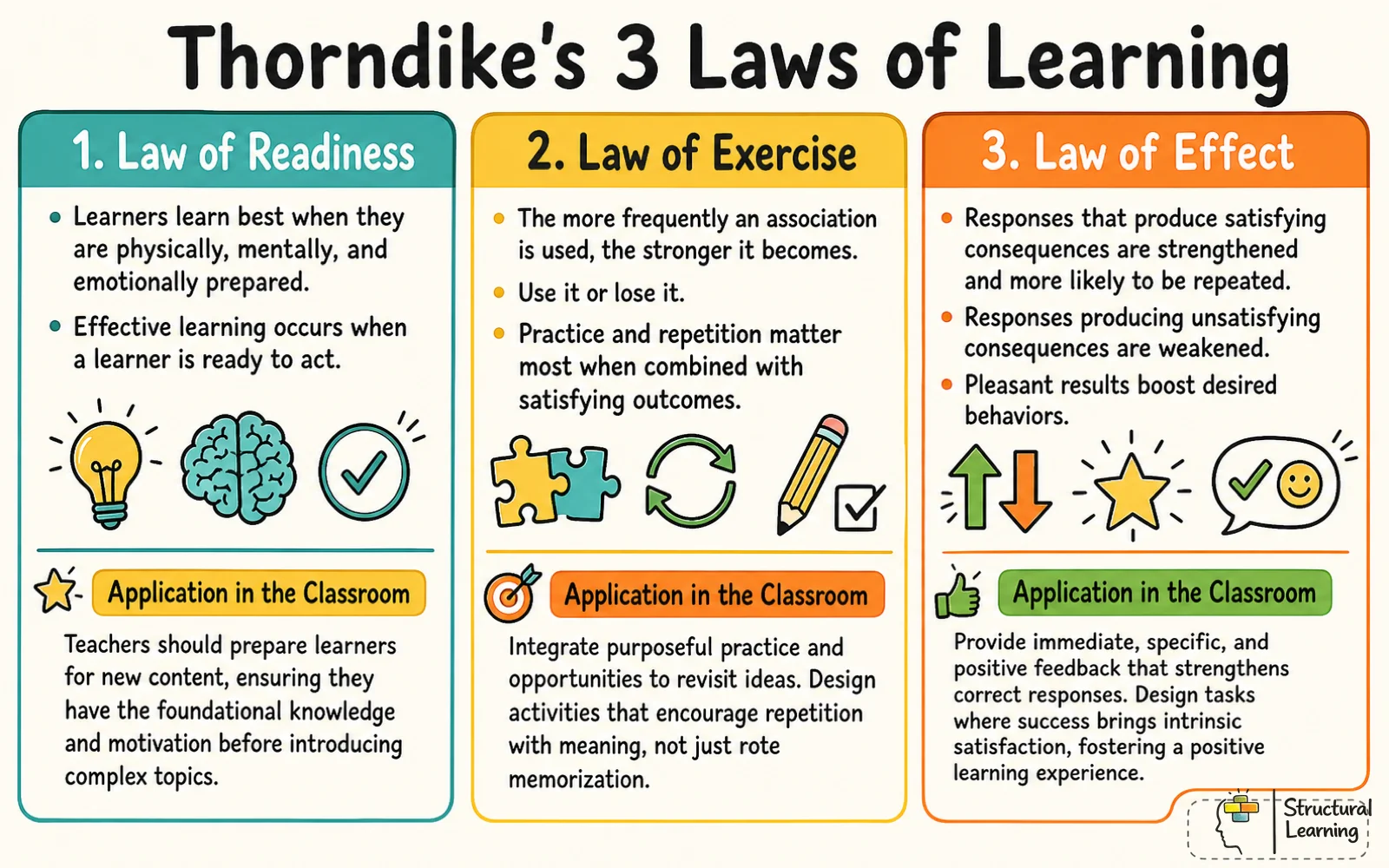
Thorndike's theory explains learning through three laws: Readiness (learners learn best when prepared and motivated), Exercise (skills strengthen with practice and fade without it), and Effect (responses followed by a satisfying result are repeated). Together they shaped early educational psychology and still guide classroom practice such as spaced practice and well-timed feedback.
Thorndike's Theory of Learning explains that learners learn best when they are ready to learn, when they practise and revisit ideas, and when success is followed by a satisfying result. These three principles, known as the Laws of Readiness, Exercise and Effect, helped shape early educational psychology and still offer useful guidance for classroom teaching today. For teachers, they point to practical strategies such as preparing learners for new content, building in purposeful practise, and giving timely feedback that strengthens the right response. Read on to see how each law works and what it looks like in a real classroom.
This connects to the wider context of fundamental theories of learning in modern classroom practice.
Thorndike's (1911) laws help teachers see what makes classroom tasks memorable. His Law of Effect says pleasant results boost behaviours. Unpleasant outcomes weaken them. Reinforcement theories, from Skinner onwards, build on this.
Thorndike (date not given) thought repetition helped learners build strong memories. "Drill and kill" times tables tests still happen in schools. Maths fluency matters, but pressure can scare learners. Boaler (2015) found that timed tests cause maths anxiety.
This anxiety can be especially strong in older learners. One survey found that 40% of 14-year-olds report fear linked to maths. It also damages working memory.
Thorndike knew about neural connections, but separating repetition from meaning distorts his work. Teachers must build fluency without causing learners to fear numbers. We should not drop practise (Thorndike).
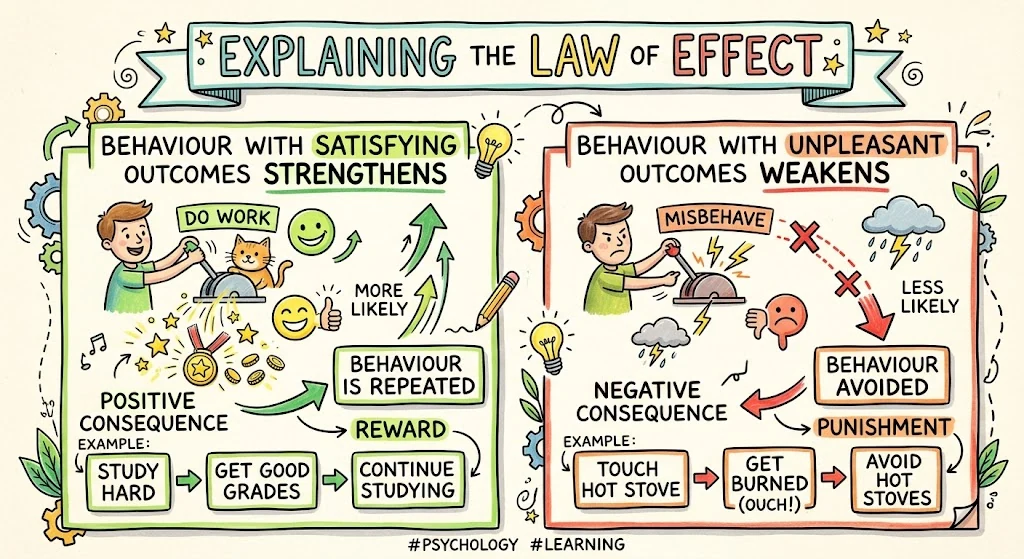
Thorndike's Theory of Learning explains how behaviours become stronger through consequences. His work in the late 1800s challenged the psychological ideas of his time. Thorndike noticed that when a cat escaped a puzzle box and received food, it was more likely to escape faster next time. He called this the Law of Effect: satisfying consequences strengthen behaviour; unsatisfying ones weaken it.
This principle underpins modern reinforcement theory. Skinner built his operant conditioning framework on Thorndike's foundation. Today, reward systems in classrooms, from sticker charts in primary schools to grade-based incentives in secondary education, reflect Thorndike's insight that pleasant outcomes encourage learners to repeat successful actions.
Thorndike's work rested on three core laws: Readiness (learners must be prepared to learn), Exercise (repeated practice strengthens responses), and Effect (satisfying outcomes reinforce behaviour). While the Law of Exercise was later refined (repetition alone is not enough; context and meaning matter), the Laws of Readiness and Effect remain central to teaching practice.
His research was rigorous. In 1898, Thorndike tested cats in puzzle boxes and recorded their learning curves. His 1911 book, Animal Intelligence, systematically presented these findings. By 1932, he had refined his theories based on decades of classroom observation and animal learning experiments.
Understanding Thorndike matters for teachers because his framework explains why some classroom practices work. When you give timely feedback that confirms correct learning, you are applying the Law of Effect. When you prepare learners for a new topic before teaching it, you are respecting the Law of Readiness. When you build in retrieval practice or spacing, you are leveraging Exercise in a modern, evidence-informed way.
This article explores Thorndike's three laws, his famous puzzle box experiments, how his theory compares to Skinner and Pavlov, and practical ways to use his insights in your classroom today. We also look at common misconceptions, such as the overjustification effect (where external rewards can harm intrinsic motivation) and how to avoid unintended reinforcement of unwanted behaviours.
Thorndike's Three Laws offer straightforward steps you can implement this week: Use it as a starting point for professional discussion: identify the learner's current need, record evidence from more than one lesson, and agree the next classroom adjustment with the SENCO or family.
If you use behaviour reward systems (house points, stickers, grades), be intentional. Combine extrinsic rewards with intrinsic motivation by highlighting the real learning gain: "You worked through that tricky algebra problem. Notice how you didn't need a calculator at the end." This anchors the reward to the learner's capability, not just compliance.
Thorndike's three laws describe the conditions under which learning sticks: Use it as a starting point for professional discussion: identify the learner's current need, record evidence from more than one lesson, and agree the next classroom adjustment with the SENCO or family.
These three laws are not independent. Readiness sets the stage. Exercise provides opportunity. Effect makes the learning stick.
In 1898, Thorndike constructed a series of puzzle boxes and placed hungry cats inside. Each box had a latch mechanism that, when operated, would open the door and allow the cat to escape and reach food. Thorndike timed how long it took each cat to escape.
The results were striking. The first time a cat entered the box, it took around 10 minutes to escape. The cat would claw, bite and push various parts of the box seemingly at random. Eventually, it would accidentally trigger the latch and escape.
When placed back in the box, the second attempt took slightly less time. With repeated trials, the cat's escape time decreased. By the 30th trial, the cat could escape in just a few seconds. Crucially, the cat did not suddenly "understand" the mechanism. Instead, it gradually stamped in the correct response through repeated, rewarded practice.
Thorndike plotted learning curves for each cat. These curves showed a steady decline in escape time, with occasional plateaus. This mathematical representation of learning was novel for psychology. It provided empirical evidence that learning is a gradual process of trial-and-error followed by reinforcement, not a sudden insight or understanding.
Imagine a black cat in a wooden cage. It is hungry. Outside the cage, a saucer of fish waits. The cat must press a lever to open the door. The first time, the cat claws and meows randomly. After 10 minutes, by accident, its paw hits the lever. The door flies open. The cat eats.
Next time, the cat remembers vaguely. It takes 8 minutes. Again and again. By the 30th trial, the cat presses the lever in seconds. The cat did not suddenly understand. It did not learn the rule "press lever to escape." Instead, the successful behaviour became automatic through repeated reward.
This is Thorndike's insight: learning is stamping in the right response through consequence. For a classroom learner, the mechanism is the same. A child practising phoneme blending does not initially understand the rule. Through repeated practice and feedback (the satisfying consequence of reading the word correctly), the response becomes automatic. By Year 2, the child blends without conscious effort.
Thorndike's broader theoretical framework was called connectionism. The idea was simple: learning consists of forming connections between stimuli (sensory inputs) and responses (outputs or behaviours). A stimulus is presented (a question, a problem, an image). The learner produces a response (an answer, an action, a thought). If that response is followed by a satisfying consequence, the stimulus-response connection is strengthened.
Connectionism does not require the learner to understand or consciously process information. It works through association and reinforcement. This was revolutionary in the early 1900s because it offered a mechanistic, testable theory of learning that did not rely on intuition or philosophical debate.
Connectionism forms the basis of modern behaviourism. Skinner expanded Thorndike's theory into operant conditioning, which distinguishes between different types of consequences (reinforcement and punishment) and different schedules of reinforcement (variable ratio, fixed interval, etc.). Bandura later added social learning and cognition back into the picture, but the core mechanism, that consequences shape behaviour, remains rooted in Thorndike's work.
Thorndike's connectionist framework rests on five principles: Use it as a starting point for professional discussion: identify the learner's current need, record evidence from more than one lesson, and agree the next classroom adjustment with the SENCO or family.
The Law of Effect is the most powerful of Thorndike's three laws. It states: if a response is followed by a satisfying consequence, that response becomes more probable; if followed by an annoying consequence, the response becomes less probable.
In the puzzle box, the satisfying consequence was food and escape. In the classroom, satisfying consequences might include praise, success on a test, a good grade, or the intrinsic satisfaction of solving a problem. Annoying consequences might include criticism, failure, a poor grade, or public embarrassment.
Thorndike believed the Law of Effect was universal. It applies to cats, pigeons, dogs, and humans. It applies to young children, teenagers, and adults. It applies to academic learning, behaviour change, and habit formation. This universality is both the strength and the limitation of his theory.
The strength: teachers can use the Law of Effect predictably. If you want learners to participate in class, ensure that participation is followed by positive feedback, not criticism. If you want learners to attempt difficult problems, ensure they receive support and recognition for effort, not just correct answers.
The limitation: the Law of Effect does not tell you which consequences are intrinsically satisfying and which are not. It does not explain how human values, prior experience, and personality shape what feels satisfying. A grade is satisfying to a learner who values achievement but may be punishing to one who fears failure. This is where modern cognitive and social learning theories extend Thorndike's work.
Skinner was inspired by Thorndike but went further. Both men believed that behaviour is shaped by consequences. Both used animals in controlled experiments to test learning. But they differed in scope and terminology.
Thorndike studied learning broadly, habit formation, skill acquisition, problem-solving. His framework was connectionism, linking stimulus to response. Skinner focused specifically on how organisms learn to perform actions (operants) in response to environmental cues (discriminative stimuli). Skinner introduced precise definitions: reinforcement (a consequence that increases the probability of a behaviour), punishment (a consequence that decreases it), and schedules of reinforcement (how often or under what conditions rewards are given).
Thorndike spoke of "satisfying" and "annoying" consequences. Skinner measured consequences objectively, did the behaviour increase or decrease? This shift from subjective satisfaction to objective measurement made behaviourism more scientific and testable.
In practice, both theories lead to similar classroom strategies: use positive consequences to encourage desired behaviours, remove consequences to discourage unwanted ones, and space practice over time. But Skinner's framework gives teachers more granular tools, such as variable ratio schedules (unpredictable rewards), which can sustain behaviour even when rewards become less frequent.
Thorndike guessed that learning involved changes in the brain. He did not have the neuroscience tools to prove it, but he was right. Modern neuroscience has revealed that the brain does indeed form neural connections through repeated, rewarded practice. When a stimulus-response pair is reinforced, synaptic connections strengthen. This is called synaptic plasticity or long-term potentiation (LTP).
Brain imaging studies show that when learners practise a skill and receive positive feedback, dopamine is released. Dopamine reinforces the neural pathways associated with that skill. Over time, the skill becomes automated, it requires less conscious effort and less prefrontal cortex activation.
This is why spacing and retrieval practice work. Each time a learner retrieves a memory, they have the opportunity to strengthen it further. Each success, followed by confirmation or reward, releases dopamine. The neural connection is reinforced. Conversely, practising without feedback or reward provides no reinforcement signal, so the connection does not strengthen.
Thorndike's theories translate directly into classroom practice: Use it as a starting point for professional discussion: identify the learner's current need, record evidence from more than one lesson, and agree the next classroom adjustment with the SENCO or family.
Example 1: Primary Phonics A Year 1 teacher introduces a new phoneme each week. On day 1, learners hear the sound and see the letter. They practise saying it (stimulus-response formed). Over the week, they blend the phoneme with others and read simple words (repetition). When they read a word correctly, the teacher smiles and moves on (immediate positive consequence). The stimulus-response connection is stamped in. By week 4, the learner's brain has automated the response; reading no longer requires conscious effort. This is Thorndike in action.
Example 2: Secondary Problem-Solving A Year 9 maths teacher introduces solving quadratic equations. Before starting, she asks learners to solve basic linear equations (checking readiness). She works through one example step-by-step. Learners then solve similar problems in pairs (exercise). For each correct solution, they receive immediate feedback and a model answer to compare (effect). A week later, the teacher includes a quadratic equation in a retrieval practice quiz (spaced exercise). The learner's neural networks have had time to consolidate the connection between "quadratic equation" and "factorising and solving."
Modern adaptive learning platforms apply Thorndike's Law of Effect with real-time precision. Software such as Hegarty Maths, ALEKS, and Mathspace track every attempt a learner makes. When a learner answers correctly, the system immediately provides positive feedback and moves to the next problem. When a learner answers incorrectly, the system provides targeted hints or re-teaches the concept before allowing progression.
This is reinforcement on a minute-by-minute basis. The stimulus (a maths problem) is paired with the response (the learner's attempt) and the consequence (correct feedback or helpful error correction). Because the feedback is immediate, specific, and personalised, the learning is efficient.
However, these platforms work best alongside teacher interaction. A teacher who follows up with a learner to discuss why they struggled, who celebrates growth, and who helps the learner see the relevance of the skill is combining Thorndike's law with social learning and intrinsic motivation. The algorithm handles the repetition and immediate feedback; the teacher provides readiness, context, and encouragement.
Despite its elegance, Thorndike's theory is often misunderstood or misapplied in schools. Here are the most common misconceptions and how to avoid them. Use it as a starting point for professional discussion: identify the learner's current need, record evidence from more than one lesson, and agree the next classroom adjustment with the SENCO or family.
A common misunderstanding is that external rewards always increase motivation. In reality, research shows the opposite is possible: when learners are rewarded for an activity they already find intrinsically motivating, the reward can backfire. This is called the overjustification effect.
Lepper, Greene and Nisbett (1973) conducted a classic study with children who enjoyed drawing. They offered some children an expected reward (a certificate) for drawing, while others received no reward. When the reward was removed, the initially rewarded children drew less often than before. They had reinterpreted their behaviour: instead of "I draw because I enjoy it," they now thought "I draw because I get a reward." When the reward disappeared, the motivation disappeared too.
The lesson for teachers: use external rewards strategically. Reward effort and progress on tasks learners find difficult or boring. On intrinsically motivating activities (creative projects, favourite subjects), be cautious with points and grades. Instead, provide feedback and recognition that highlight growth and capability: "You tried that tricky problem three times before you got it. Your persistence paid off."
Teachers sometimes inadvertently reinforce unwanted behaviour. A learner who is anxious about a difficult maths task acts out, calling out, tapping the desk, making faces. The teacher sends them out of the classroom. From the learner's perspective, the satisfying consequence is escape from the anxiety-inducing task. The unwanted behaviour is reinforced. Next time they feel anxious, they act out again.
Similarly, a learner who struggles to read may clown around to make friends laugh. The laughter is the satisfying consequence. Reading is reinforced as a behaviour to avoid, while clowning is reinforced. EEF (2019) guidance on improving behaviour in schools confirms that negative attention (scolding, sending out, detention) is still attention and can reinforce the very behaviours schools wish to eliminate.
The solution is to reinforce alternative, incompatible behaviours. If a learner acts out when anxious, reinforce calm engagement with easier tasks. Build their confidence first. If a learner clowns around, give attention for appropriate participation, not just for misbehaviour.
Thorndike's Law of Effect works well for building automatic, fluent responses. A child who drills times tables gets faster and faster. A learner who practises spelling rules becomes fluent. This is valuable. Automaticity frees cognitive resources for deeper thinking.
However, Thorndike's framework does not guarantee that learners understand the concept behind the behaviour. A child can become fluent in long division without understanding place value. A learner can pass spelling tests without understanding morphology. They comply with tasks and achieve correct answers because those behaviours are reinforced, but they may not have developed the conceptual understanding that transfers to novel problems.
Modern teaching combines Thorndike's reinforcement with explicit instruction on the reasoning behind procedures. Teachers explain why long division works (place value), not just how to do it. This dual approach, automaticity plus understanding, produces deeper, more transferable learning.
Thorndike's theory is powerful but incomplete. Key limitations include: Use it as a starting point for professional discussion: identify the learner's current need, record evidence from more than one lesson, and agree the next classroom adjustment with the SENCO or family.
Thorndike's principles are especially valuable in neuro-inclusive classrooms where learners have diverse ways of processing and responding. Some learners with ADHD benefit from frequent, immediate feedback and varied rewards (novelty prevents satiation). Some learners on the autism spectrum respond well to clear, explicit teaching and consistent, predictable consequences. Some learners with dyscalculia need multisensory practice and error correction that is matter-of-fact, not emotionally charged.
Thorndike's insistence on readiness, exercise, and effect is even more relevant for neuro-diverse learners. Readiness means: do not assume understanding; check frequently. Exercise means: provide overlearning and practice in many contexts, not just one task format. Effect means: be intentional about consequences; what works for one learner may demotivate another.
The challenge is implementing Thorndike's principles at scale in inclusive classrooms. Adaptive technology can help, personalised practice loops, individualised feedback, progress tracking, but the teacher's role is irreplaceable. A teacher who knows each learner's readiness level, who can spot when a learner is struggling despite correct answers, and who can offer encouragement tailored to that learner's needs is applying Thorndike wisely.
Thorndike died in 1949, but his legacy permeates modern education. Every time a teacher gives feedback, assigns a grade, or designs a reward system, they are working within a framework Thorndike established. Every standardised test reflects his belief that learning can be measured objectively. Every online learning platform that adapts to a learner's responses applies his Law of Effect.
His influence extends beyond the classroom. Industrial and organisational psychology uses reinforcement to shape workplace behaviour. Clinical psychology uses applied behaviour analysis (based on operant conditioning, which extends Thorndike) to treat anxiety and other conditions. Sports psychology uses reinforcement to build athletic skill. Thorndike's insight, that consequences shape behaviour, is one of psychology's most robust and widely applied findings.
Yet Thorndike is not unchallenged. Cognitive scientists argue that his framework is too narrow, that learning involves more than stimulus-response associations. Humanistic educators argue that his focus on external rewards neglects the learner's emotional needs and autonomy. Social learning theorists point out that humans learn through observation and social interaction, not just through direct reinforcement. These critiques are valid; they supplement rather than replace Thorndike's work.
Q: Is Thorndike's law of effect the same as Pavlov's classical conditioning?
A: No. Pavlov studied how a neutral stimulus (a bell) becomes associated with an unconditioned response (salivation) through repeated pairing. The dog does not have to act first; the response is automatic. Thorndike studied operant conditioning: the learner acts (operates on the environment), and the consequence determines whether the behaviour is repeated. When you press a button and the door opens, you are more likely to press it again, operant conditioning. When you hear a bell and feel hungry because the bell has been paired with food, that is classical conditioning. Both are important in education, but they are different mechanisms.
Q: Should teachers always use external rewards?
A: No. External rewards are useful for motivating learners to attempt difficult or boring tasks. But overuse of rewards can reduce intrinsic motivation (the overjustification effect). Best practice is to combine external rewards (grades, praise, points) with feedback that highlights growth and capability, and to reduce extrinsic incentives as learners develop intrinsic motivation and competence.
Q: Does the law of readiness mean learners should never struggle?
A: No. Struggle and productive failure are valuable. The law of readiness means learners need adequate prior knowledge and metacognitive strategies to struggle productively. A learner struggling to solve a problem they cannot yet access will become frustrated and demotivated. A learner struggling within their zone of proximal development, with support available, will learn and grow.
Q: How do I know if a consequence is satisfying to a learner?
A: Observe their behaviour. If they repeat an action after a consequence, the consequence is satisfying to them, regardless of your intentions. A learner who misbehaves to be sent out of class is being reinforced by escape. A learner who works harder when praised is being reinforced by recognition. Tailor consequences to the individual learner, not to a one-size-fits-all assumption.
Bandura, A. (1977). Social learning theory. Prentice Hall.
Boaler, J. (2015). Mathematical mindsets: Unleashing students' potential through creative maths and effective teaching. Jossey-Bass.
Education Endowment Foundation. (2019). Improving behaviour in schools: Guidance report. EEF.
Lepper, M. R., Greene, D., & Nisbett, R. E. (1973). Undermining children's intrinsic interest with extrinsic reward: A test of the "overjustification" hypothesis. Journal of Personality and Social Psychology, 28(1), 129, 137.
Skinner, B. F. (1938). The behavior of organisms: An experimental analysis. Appleton-Century-Crofts.
Skinner, B. F. (1953). Science and human behavior. Macmillan.
Thorndike, E. L. (1898). Animal intelligence: An experimental study of the associative processes in animals. Psychological Review Monographs, 2(4), 1, 109.
Thorndike, E. L. (1911). Animal intelligence: Experimental studies. Macmillan.
Thorndike, E. L. (1932). The fundamentals of learning. Teachers College Press.
These peer-reviewed studies provide the evidence base for the strategies discussed above.
Self-improving reactive agents based on reinforcement learning, planning and teaching
1720 citations
Lin (1992)
This foundational AI paper shows how Thorndike's Law of Effect underpins modern reinforcement learning, demonstrating the enduring power of stimulus-response bonds. For teachers, it highlights the scientific basis for how positive reinforcement shapes learning, offering insights into AI in education.
Research on Junior High School English Reading Class Based on the Principle of Timing and Thorndike's Three Laws of Learning
Ni et al. (2020)
This study applies Thorndike's Laws of Readiness, Exercise, and Effect to junior high English reading. It provides a practical classroom example for teachers on how these laws can structure language acquisition activities, supported by empirical data.
Connectionism Theory in Second Language Learning of Early Childhood
al. (2016)
This research illustrates Thorndike's trial-and-error principle in early childhood second language learning. Teachers can see how focused repetitions and positive reinforcement dramatically improve vocabulary retention in early years foundation stage (EYFS) settings.
Thorndike's Connectionism Theory: Application and Limitations in the Learning of Kiswahili as a Second Language
Kalabai (2024)
A recent discussion on connectionism's role and limits in second language acquisition, offering EAL/MFL teachers a balanced view. It helps educators understand when Thorndike's theory is effective and where other approaches might be needed for language learning.
Connectionism, Edward Thorndike
Brock (2020)
This reappraisal underscores Thorndike's lasting relevance to science education through concepts like learning curves and the importance of research-informed teaching. It reminds teachers of the value of structured learning and a critical stance on discovery learning.